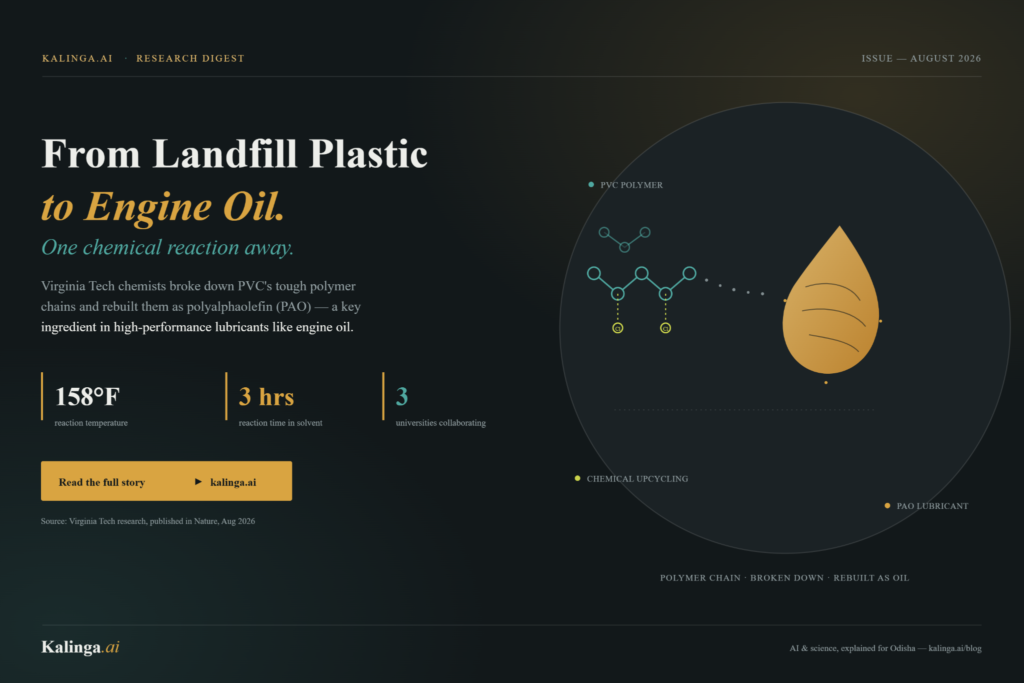
File Name: pvc-plastic-recycling-engine-lubricant.jpg
Title: PVC Plastic Recycling Into Engine Lubricant
Caption: Scientists are turning stubborn PVC waste into a valuable lubricant ingredient,giving discarded plastic a powerful second life.
Description:
The landscape graphic should visually show discarded PVC products such as pipes, plastic cards, and toys transitioning through a chemical transformation into a clean, high-performance lubricant or engine oil. The visual should emphasize the connection between PVC plastic recycling, plastic waste upcycling, and sustainable lubricant production, directly reflecting Virginia Tech’s research featured in the article.
Alt Text: PVC plastic recycling transforms discarded PVC waste into high-performance lubricant for engine oil applications.
Planned Structure
- H2: Why PVC Is One of Recycling’s Toughest Challenges
- H3: What makes PVC difficult to recycle?
- H3: Why lubricant production matters
- H2: How Scientists Turn PVC Waste Into Lubricant
- H3: The chemical process
- H3: From gooey material to useful oil
- H2: What Makes This PVC Plastic Recycling Breakthrough Different?
- H3: From downcycling to upcycling
- H3: Testing the new lubricant
- H2: PVC Plastic Recycling vs. Conventional Recycling Approaches
- H2: Why Turning Plastic Waste Into Lubricant Could Matter
- H3: Environmental potential
- H3: Industrial potential
- H2: What Researchers Still Need to Solve
- H2: Frequently Asked Questions About PVC Plastic Recycling
- H2: The Bigger Picture for Plastic Upcycling
5 Focus Keywords
- Primary keyword: PVC plastic recycling
- PVC waste upcycling
- PVC plastic lubricant
- plastic waste to engine oil
- high-performance lubricants
Can PVC Plastic Recycling Turn Plastic Waste Into High-Performance Engine Oil?
What if the PVC in an old pipe, window component, or discarded plastic product could end up helping lubricate an engine instead of sitting in a landfill?
Researchers at Virginia Tech have demonstrated a way to transform difficult-to-recycle PVC into polyalphaolefin (PAO), an important ingredient in lubricants such as engine oil. The research, published in Nature on August 5, shows how PVC plastic recycling could move beyond simply recovering plastic and instead create a higher-value industrial material.
The idea is surprisingly simple at a high level: instead of trying to preserve PVC as a plastic, the researchers chemically break it down and turn its components into molecules that can form a useful lubricant.
That matters because PVC presents a particularly difficult recycling challenge. At the same time, lubricants are essential to everything from passenger cars and lawn equipment to jet engines. Connecting those two problems could create an entirely different pathway for dealing with plastic waste.
Why Is PVC So Difficult to Recycle?
PVC, or polyvinyl chloride, is one of the most widely used plastics in everyday life. You can find it in products such as plumbing materials, window structures, and credit cards.
But recycling PVC is not as straightforward as simply melting it down and making another product.
What makes PVC difficult to recycle?
PVC is difficult to recycle because it contains chlorine and can contain different additives depending on how it was manufactured.
Those chemical complications can make conventional recycling more challenging. As a result, significant quantities of discarded PVC ultimately end up in landfills rather than being converted into new products.
This is where PVC plastic recycling faces a fundamentally different challenge from simply collecting plastic and mechanically processing it.
PVC’s chemical structure is part of the problem. Researchers therefore increasingly look at chemical recycling and upcycling, approaches that attempt to transform plastic molecules into useful chemicals or materials rather than simply reshaping the original plastic.
Question: Why not just recycle PVC into new PVC products?
The problem is that contaminated, mixed, or additive-rich PVC waste can be difficult to process consistently. Chemical approaches offer another possibility: instead of trying to preserve the original polymer, researchers can break its molecular structure apart and use the resulting material to make something else.
That shift,from recovering the original plastic to creating a new valuable product,is central to the Virginia Tech research.
Definition + Expansion: Chemical upcycling
Chemical upcycling is the process of using chemical reactions to transform discarded materials into new products with useful properties or potentially higher value.
Traditional recycling often aims to recover material for another use. Upcycling can go further by changing the material chemically so it becomes a different resource altogether.
In the Virginia Tech study, researchers did not simply turn PVC waste into another piece of plastic. They converted it into a lubricant-related material, creating a potential route from difficult plastic waste to an industrial product.
That is why this research is significant for the future of PVC plastic recycling.
How Scientists Turn PVC Waste Into Lubricant
The Virginia Tech team’s breakthrough came from rethinking what should happen to PVC’s long polymer chains.
The researchers, led by Virginia Tech chemist and chemical engineer Guoliang “Greg” Liu, developed a process that transforms PVC into polyalphaolefin, or PAO, an important ingredient used in lubricants.
What is the process?
The researchers place PVC in a solvent and add aluminum trichloride and alpha olefins. The mixture is then heated to 158 degrees Fahrenheit for three hours.
After the reaction, researchers extract a relatively thick oil from the solvent. Testing showed that the resulting material functions as a lubricant.
At first glance, this may sound like a straightforward chemical conversion. But the key insight came from an unexpected result during the team’s earlier experiments.
Question: How did researchers realize PVC could become oil?
The team initially tried to chemically transform PVC molecules into other materials by replacing chlorine atoms with different chemical groups.
The early products were not especially impressive. They remained soft and somewhat gooey, which suggested that the researchers had not yet achieved the performance they wanted.
Then Liu reconsidered the problem.
Instead of attempting to convert PVC into another large polymer, he wondered whether the team should continue breaking the polymer chains into smaller segments.
That change in thinking became the turning point.
From a Gooey Material to a High-Performance Lubricant
Polymers are made up of long molecular chains. When those chains are broken down into smaller molecules, the resulting materials can behave very differently from the original plastic.
Liu’s team continued breaking down PVC and evaluating the resulting molecules. Eventually, the researchers recognized that the material they were creating could have properties useful for lubrication.
This is an important lesson in materials research: a failed experiment does not always mean the underlying idea is wrong. Sometimes the unexpected property is the clue that points researchers toward a better application.
Question: What exactly does PVC become in this process?
The Virginia Tech researchers developed a method to convert PVC into polyalphaolefin (PAO), a material used as an important ingredient in lubricants, including engine oil.
Rather than trying to manufacture another PVC product, the process uses discarded PVC as a chemical starting point for a valuable lubricant component.
Why PAO matters
PAO is associated with high-performance lubricants because it can serve as a base material for applications where lubrication and performance are important.
Lubricants may not receive the same attention as electric vehicles, batteries, or renewable energy systems, but they play an essential role in modern machinery.
Engines, industrial equipment, lawn mowers, automobiles, and aircraft all rely on lubrication to help moving components operate effectively.
That creates an interesting opportunity for PVC plastic recycling: a difficult waste stream could potentially become a feedstock for a product that industries already need.
Why Is This Approach Different From Conventional PVC Recycling?
Not all recycling approaches accomplish the same thing. Some focus on recovering the original material, while others chemically transform waste into new products.
The Virginia Tech work belongs to the second category.
PVC plastic recycling vs. other approaches
| Approach | What happens to PVC? | Main goal | Potential value |
| Conventional disposal | PVC is discarded | Waste management | Low material recovery |
| Mechanical recycling | PVC is physically processed | Recover usable plastic | Produces recycled material |
| Chemical recycling | PVC molecules are chemically transformed | Recover chemicals or feedstocks | Can create new materials |
| Chemical upcycling | PVC is transformed into a different useful product | Create higher-value applications | Potentially higher-value output |
| Virginia Tech approach | PVC is converted into PAO lubricant material | Produce lubricant components | Turns waste into an industrial product |
The important distinction is that the Virginia Tech researchers are not simply trying to give PVC another physical form.
They are changing what the material is at the molecular level.
That makes the research especially interesting in the context of PVC plastic recycling, because PVC’s chemical complexity is one of the reasons conventional approaches can struggle.
Question: Is this just another way of recycling plastic?
Not exactly. The research is better understood as plastic upcycling because PVC is chemically transformed into a different, useful material rather than simply being remade into another PVC object.
That distinction matters when evaluating the potential value of the technology.
If a difficult waste stream can become a useful industrial feedstock, recycling no longer has to mean trying to reproduce the same product.
How Researchers Tested the New Lubricant
Creating an oil-like material in a laboratory is only one part of the challenge. Researchers also need to determine whether the material performs well enough to have practical value.
Liu’s team therefore collaborated with researchers from several institutions.
Samples were sent to Ali Erdemir at Texas A&M University, where the resulting materials were tested. The team also worked with William Goddard at Caltech on chemical computations.
At Virginia Tech, researcher Xi Chen contributed an economic and production analysis. The work included modeling how the lubricant could potentially be manufactured at a much larger scale.
These collaborations are important because laboratory chemistry and commercial manufacturing are very different problems.
Question: Did the researchers only prove that PVC can become oil?
No. The team investigated the resulting material’s lubricant performance and also examined the chemistry, economics, and potential scalability of the process.
However, the research does not mean that discarded PVC can immediately be collected and converted into commercial engine oil at industrial scale.
Scaling a laboratory process requires additional work, including economic assessment, process optimization, feedstock handling, and broader validation.
That distinction is crucial when discussing PVC plastic recycling responsibly: a promising laboratory result is not the same thing as a finished commercial recycling system.
Why Turning Plastic Waste Into Lubricant Could Matter
The most interesting aspect of this research is that it connects two separate sustainability challenges.
On one side is difficult-to-recycle plastic waste. On the other is the need for valuable industrial lubricants.
The Virginia Tech approach attempts to connect those challenges through chemistry.
1. It gives difficult PVC waste another possible destination
PVC that might otherwise be discarded could potentially become a chemical feedstock.
That does not mean all PVC waste will suddenly become suitable for the process. But it demonstrates a new pathway worth exploring.
2. It creates a higher-value product
A major advantage of chemical upcycling is the possibility of converting waste into something more valuable than the original discarded material.
In this case, the target is PAO for lubricant applications.
3. It targets an essential industrial material
Lubricants are easy to overlook because they operate behind the scenes.
Yet machinery across transportation, manufacturing, agriculture, construction, and other industries depends on lubrication.
Liu described lubricants as “silent heroes” because they work quietly while enabling machinery to function.
4. It connects waste management with industrial production
A successful circular economy requires more than collecting waste. The recovered material must have a useful destination.
The concept behind this PVC plastic recycling research is compelling because it looks at waste not merely as something to remove, but as a potential raw material.
What Earlier Research Inspired the Breakthrough?
The Virginia Tech project did not appear in isolation.
Liu’s laboratory had previously investigated ways to convert other plastic wastes into useful chemicals. Earlier studies published in Science and Nature Sustainability explored approaches for transforming plastic waste into surfactants used in products such as soaps and detergents.
Those projects helped establish the broader research direction.
The team then asked whether PVC could also be chemically transformed into something valuable.
Question: Why was PVC the next challenge?
PVC is particularly interesting because its chlorine content and additives make it difficult to handle through some conventional recycling pathways.
If researchers could develop a useful chemical transformation for PVC, it could expand the range of plastic waste that might be considered a resource rather than simply a disposal problem.
Doctoral student Eric Munyaneza Nuwayo led the effort, while graduate student Connor S. Thompson and first-year graduate student Abby Civiello also contributed.
Liu referred to the three researchers as the “three musketeers,” reflecting their collaborative role in the project.
What Are the Biggest Challenges Ahead?
A laboratory demonstration is an important milestone, but turning it into a widespread recycling technology is a much bigger task.
The researchers themselves want to improve the sustainability of the production process and make the lubricant more widely available.
Several questions will need to be addressed as the work develops.
Scaling the chemistry
Producing a material in a laboratory and producing it continuously from large quantities of waste are two very different challenges.
Industrial-scale systems need reliable feedstock, efficient chemical processing, consistent product quality, and practical separation and purification methods.
Economics
A recycling technology must make economic sense if it is going to operate at scale.
That is why the production and economic modeling conducted by Xi Chen is relevant. Researchers need to understand not just whether the chemistry works, but whether the overall process could eventually become viable.
Feedstock variability
PVC products can contain different additives depending on how they were manufactured.
A real-world waste stream is also much messier than carefully prepared laboratory material.
Future work will need to determine how different types and qualities of PVC affect the process and the resulting lubricant.
Environmental performance
Calling a technology “green” requires looking beyond the waste material being recycled.
Researchers and manufacturers ultimately need to evaluate the full process, including solvents, energy use, chemicals, emissions, purification, and product manufacturing.
That broader assessment will be important as PVC plastic recycling moves from laboratory research toward potential commercial applications.
Could PVC Plastic Recycling Help Build a Circular Economy?
A circular economy aims to keep materials in productive use for as long as possible instead of following a simple “make, use, throw away” model.
Plastic recycling is an important part of that concept, but the hardest question is often what to do with materials that are difficult to recycle economically.
The Virginia Tech research suggests one answer: change the material into something entirely different.
Instead of asking:
“How can we make this discarded PVC into another PVC product?”
Researchers can ask:
“What valuable chemicals can this PVC become?”
That is a much broader question.
Question: Why is upcycling potentially more powerful than simple recycling?
Upcycling can create new applications for materials that may not have an easy path back into their original product category.
For difficult plastics, that flexibility could be particularly valuable.
In the Virginia Tech research, the destination is a lubricant ingredient rather than another plastic product. This demonstrates how PVC plastic recycling could become part of a broader strategy for converting waste into industrial feedstocks.
What Does This Mean for Students and Young Engineers?
There is a useful lesson here that extends beyond plastics.
The breakthrough did not simply come from following the original experimental plan. The researchers encountered a material that was too soft and gooey for their initial objective.
Instead of treating that result as a dead end, Liu asked whether the unexpected property could point toward another application.
That mindset is relevant to students working in chemistry, chemical engineering, materials science, environmental engineering, and sustainability.
Three lessons from the research
- Unexpected results can contain useful information. A failed target does not necessarily mean a failed experiment.
- Cross-disciplinary collaboration matters. The project brought together chemistry, engineering, computational modeling, materials testing, and economic analysis.
- The best recycling solution may change the material. Sometimes the answer is not to preserve a waste product but to convert it into something more useful.
For India’s growing focus on waste management, advanced materials, and sustainable manufacturing, these ideas are particularly relevant. Technologies that connect waste streams with industrial demand could become increasingly important as researchers look for alternatives to disposal and resource-intensive production.
Is PVC Plastic Recycling Ready to Replace Conventional Engine Oil Production?
No,not based on this research alone.
The Virginia Tech study demonstrates a promising route for producing a lubricant material from PVC waste, but additional research is needed before such a process could become a widespread commercial source of lubricant ingredients.
The distinction between proof of concept and commercial deployment is important.
A laboratory process may work under controlled conditions, while a large-scale industrial process must deal with variable waste, supply chains, operating costs, energy requirements, chemical recovery, safety, regulatory requirements, and consistent product quality.
Still, the research provides something valuable: evidence that PVC waste can be chemically redirected toward a high-value lubricant application.
That makes it an important step in the development of advanced PVC plastic recycling technologies.
The Bigger Picture: From Plastic Waste to Industrial Resource
Plastic waste is often discussed as an environmental problem, but it is also a materials problem.
Every discarded plastic object contains molecules that originally required energy and resources to produce. If those molecules can be recovered and transformed into useful products, researchers can potentially extract more value from materials that would otherwise be wasted.
The Virginia Tech work illustrates that idea particularly well.
A PVC product begins as a durable plastic. Instead of sending it directly to disposal, researchers chemically break its polymer chains down and transform the resulting material into PAO, a component used in high-performance lubricants.
The journey is essentially:
PVC waste → chemical transformation → PAO → lubricant applications
That is a very different vision of PVC plastic recycling from simply shredding and remolding old plastic.
Question: What is the most important takeaway from the Virginia Tech research?
The biggest takeaway is that difficult-to-recycle PVC can potentially be transformed into a valuable lubricant ingredient.
The work does not solve the entire PVC waste problem, but it demonstrates a promising chemical pathway that could give some PVC waste a more valuable second life.
For a material that has long been difficult to recycle, that is a meaningful shift in perspective.
Frequently Asked Questions About PVC Plastic Recycling
What is PVC plastic recycling?
PVC plastic recycling refers to processes that recover or transform discarded polyvinyl chloride so it can be used again. Conventional approaches may recover PVC as a material, while newer chemical approaches can break PVC down and convert it into different useful chemicals or products.
How did Virginia Tech researchers recycle PVC into lubricant?
Virginia Tech researchers developed a chemical process that places PVC in a solvent and combines it with aluminum trichloride and alpha olefins. The mixture is heated to 158 degrees Fahrenheit for three hours, after which researchers extract an oil-like material that functions as a lubricant.
What lubricant material can be produced from PVC waste?
The Virginia Tech research describes converting PVC into polyalphaolefin (PAO), an important ingredient used in lubricants including engine oil.
Why is PVC harder to recycle than some other plastics?
PVC contains chlorine and can contain a variety of additives depending on how it was manufactured. These chemical characteristics can complicate recycling and contribute to PVC waste ending up in landfills.
Does this mean old PVC can immediately become commercial engine oil?
No. The research demonstrates a promising laboratory-based pathway, but further work is needed to determine how sustainably and economically the process can be scaled and applied to real-world PVC waste streams.
Why is this research important for plastic sustainability?
The research demonstrates that difficult-to-recycle PVC could potentially become a valuable industrial feedstock. By transforming plastic waste into lubricant components, the approach connects waste reduction with the production of a useful material.
The Future of PVC Plastic Recycling May Be About Reinvention
The most exciting part of this research is not simply that scientists found a way to make oil from plastic.
It is that they challenged the assumption that recycled plastic has to remain plastic.
Virginia Tech’s work shows how PVC plastic recycling could evolve from material recovery toward chemical transformation, where waste is redesigned at the molecular level for entirely new applications.
The research is still a step toward potential large-scale deployment, not the final solution to PVC waste. But it offers a compelling direction: when a plastic is too difficult to recycle in its original form, perhaps the better question is not how to preserve it,but what else it can become.
For more explainers on emerging technology, sustainable innovation, and the science shaping tomorrow’s industries, explore more stories on Kalinga.ai.
SEO Meta Configuration
Keyword Categorization
Primary Keyword:
- PVC plastic recycling
Secondary Keywords:
- PVC waste upcycling
- PVC plastic lubricant
- plastic waste to engine oil
- high-performance lubricants
LSI/Long-Tail Keywords:
- how PVC plastic recycling works
- how to recycle PVC waste
- turning PVC waste into lubricant
- Virginia Tech PVC recycling breakthrough
Meta Title
PVC Plastic Recycling: Ultimate 2026 Guide to New Oil
SEO Meta Description: PVC plastic recycling could turn hard-to-recycle waste into high-performance lubricant ingredients. Discover Virginia Tech’s breakthrough and its impact.
URL Slug: pvc-plastic-recycling-lubricant