Mycotoxins in Plant-Based Foods: What Did Scientists Find?
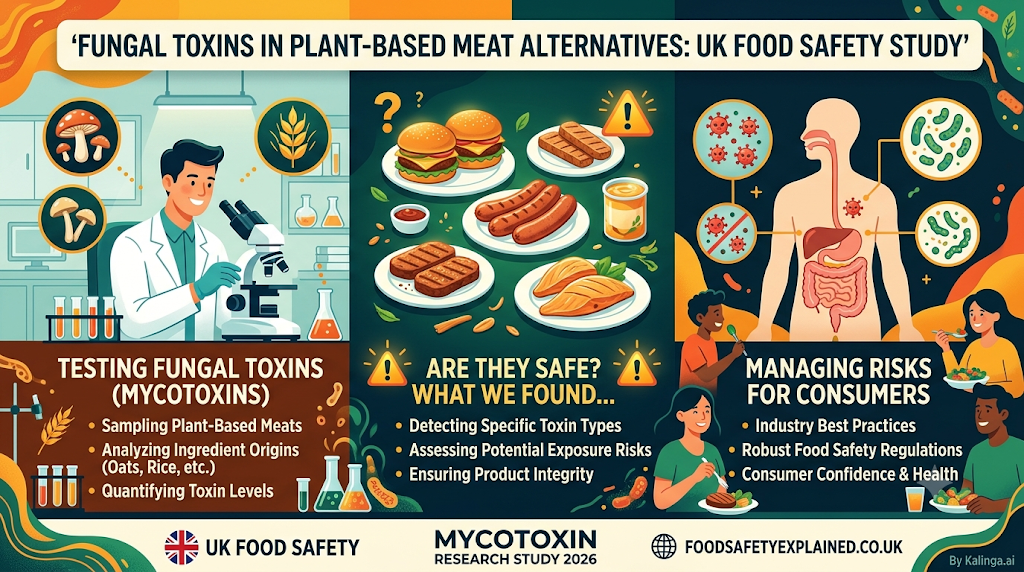
Plant-based burgers, sausages and oat drinks may look like straightforward healthy-food choices, but researchers have discovered an unexpected ingredient hiding in many of them: naturally occurring fungal toxins.
A study of 212 plant-based meat alternatives and plant-based beverages sold in the UK found at least one mycotoxin in every product tested. However, there is an important detail behind that alarming headline: the concentrations detected were below recommended European Union guideline levels.
So, does this mean plant-based meat and dairy alternatives are dangerous?
Not necessarily. The study does not show that eating one vegan burger or drinking oat milk will make you sick. Instead, it raises a more complicated food-safety question: could repeated exposure to small amounts of fungal toxins matter when these products become a major part of someone’s diet?
That distinction is crucial when interpreting the findings on mycotoxins in plant-based foods.
The research was led by the University of Parma in Italy and coauthored by Cranfield University in the UK. Researchers examined a broad selection of products available to consumers, including plant-based burgers, vegetarian chicken pieces, vegan sausages and plant-based beverages made from oats, almonds and soy.
The results provide useful information for food-safety researchers and regulators, but they should not be interpreted as evidence that plant-based diets are inherently unsafe.
What Are Mycotoxins and Why Are They in Food?
Definition + Expansion
Mycotoxins are toxic chemical compounds naturally produced by certain types of fungi that can grow on crops and food ingredients.
These compounds can develop when agricultural products are exposed to mould during cultivation, harvesting, transportation or storage. Grains, legumes and seeds are among the ingredients that can potentially carry fungal contamination before they are processed into foods.
That makes mycotoxins different from an intentionally added food ingredient. They are naturally occurring contaminants that food producers attempt to control through agricultural practices, storage conditions, processing and food-safety monitoring.
Question: Are mycotoxins only found in vegan foods?
No. Mycotoxins are not unique to plant-based products. They can occur in a wide range of foods because fungi can contaminate agricultural commodities used in many different food systems.
The significance of the new research is that plant-based meat alternatives and beverages can contain substantial amounts of plant-derived ingredients such as grains, legumes and seeds. That creates a reason to examine these products specifically rather than assuming that their plant-based status automatically tells us everything about their safety.
The study therefore adds another dimension to the broader discussion around mycotoxins in plant-based foods.
What Did Scientists Find in 212 Plant-Based Products?
The headline finding is striking: researchers tested 212 plant-based meat alternatives and plant-based beverages, and every product contained at least one of 19 different mycotoxins examined in the research.
Some products contained multiple mycotoxins.
The foods represented products that many consumers would recognize from supermarket shelves, including vegan sausages, plant-based burgers and meat-style alternatives. The beverage category included oat, almond and soy-based drinks.
However, the presence of a detectable compound is not the same thing as a demonstrated health hazard.
The researchers reported that the concentrations measured in the tested UK products remained below recommended EU guideline levels. This is one of the most important details to keep in mind when discussing the study.
Question: Does “every product contained a mycotoxin” mean every product was dangerous?
No. The finding means researchers detected at least one mycotoxin in each product they tested; it does not mean that each product contained a harmful dose.
Food-safety risk depends on several factors, including the specific toxin, its concentration, how frequently someone consumes it and how much exposure accumulates over time.
In other words, the study found widespread detection, but detection alone cannot establish that consumers are experiencing harmful effects.
Why Were Mycotoxins Found in Every Product?
The answer starts with the raw materials.
Plant-based foods frequently rely on crops such as grains, legumes and seeds. These ingredients can encounter fungi in agricultural environments or during storage, potentially allowing mycotoxins to develop before the ingredients are transformed into finished products.
Processing can change the concentration of contaminants, but it does not necessarily eliminate every naturally occurring compound.
This becomes particularly relevant for products made from multiple ingredients. A plant-based burger, for example, may contain several plant-derived components rather than one simple raw material.
Question: Why might plant-based meat alternatives contain fungal toxins?
Because many plant-based products are made from agricultural ingredients that can naturally become contaminated with mycotoxins before processing.
The researchers emphasized that mycotoxins are naturally occurring contaminants and cannot be completely avoided. Instead, the food-safety challenge is managing exposure and keeping concentrations within appropriate safety limits.
That is why the researchers argue for stronger monitoring and risk assessment as the plant-based food market evolves.
The Numbers Need Context: Detection vs Risk
Scientific headlines can make food-safety findings sound more dramatic than they are.
Consider the difference between these two statements:
- “A food contains a detectable mycotoxin.”
- “A food contains enough mycotoxin to create a demonstrated health risk.”
They are not equivalent.
The study found the first situation across all 212 products tested. But the reported concentrations remained below recommended EU guideline levels.
This distinction matters because regulatory limits are designed to help manage exposure to contaminants. A measurement below a guideline does not mean that a substance is desirable; it means the measured concentration falls below the relevant benchmark used for food-safety assessment.
Question: Should consumers immediately stop eating plant-based foods?
The study does not justify that conclusion. The researchers themselves noted that consumers should not be frightened or deterred from enjoying a variety of products.
The more reasonable takeaway is that consumers, manufacturers and regulators should pay attention to the quality and safety of ingredients as plant-based foods become increasingly common.
The findings on mycotoxins in plant-based foods are therefore better understood as a food-monitoring issue than as a reason for panic.
The Bigger Concern Could Be Cumulative Exposure
Here is where the research becomes more interesting.
Eating one product containing a low concentration of a mycotoxin is not necessarily the same as consuming several products containing small concentrations every day.
Cumulative exposure refers to the total amount of a substance someone encounters over time, potentially from multiple foods or sources.
Researchers are interested in this because people do not eat foods in isolation. Someone who regularly consumes plant-based burgers, meat alternatives, grain-based foods and plant-based beverages could potentially encounter mycotoxins from several sources.
That does not automatically mean their exposure is dangerous. It means that assessing overall dietary exposure can provide a more complete picture than examining individual products one at a time.
Question: Why does cumulative exposure matter?
Because repeated exposure to small amounts of certain contaminants may contribute to a person’s overall intake over time.
The researchers noted that previous studies have linked severe mycotoxin exposure with serious health effects, including liver and kidney damage, immune-system suppression and cancer. However, the presence of mycotoxins in the products tested does not establish that consumers of those products will experience those outcomes.
The study’s value is therefore partly in helping researchers estimate dietary exposure and identify where additional monitoring may be useful.
Plant-Based Meat Alternatives vs Plant-Based Drinks
The research did not focus exclusively on vegan meat.
Researchers examined both plant-based meat alternatives (PMBAs) and plant-based beverages (PBBs). That distinction matters because these categories can rely on different ingredients and manufacturing processes.
| Product category | Examples from the study | Potential plant-based ingredients | Why monitoring matters |
| Plant-based meat alternatives | Burgers, vegan sausages | Grains, legumes, seeds and other plant ingredients | Multiple ingredients can contribute to overall exposure |
| Plant-based beverages | Oat, almond and soy drinks | Oats, almonds, soy and related ingredients | Raw agricultural materials can be exposed to fungal contamination |
| Conventional plant foods | Grains, legumes and seeds | Agricultural crops | Can also be sources of naturally occurring mycotoxins |
| Mixed-ingredient foods | Processed meat alternatives and drinks | Several plant-derived components | Risk assessment can become more complex |
The researchers’ concern is not that plant-based products are uniquely contaminated. Instead, complex products can make it more difficult to understand total dietary exposure because a finished food may contain ingredients originating from multiple agricultural sources.
That is particularly important when a food category becomes widely consumed.
What Are the Potential Health Concerns From Mycotoxins?
Mycotoxins are not one single substance.
They are a broad group of compounds produced by different fungi, and their effects can vary depending on the particular toxin, concentration and exposure pattern.
Some mycotoxins have been associated with significant health effects at sufficiently high exposure levels. The study materials specifically mention potential links between severe exposure and liver damage, kidney damage, immune-system suppression and cancer.
But those serious outcomes should not be automatically attributed to the products tested in this research.
Question: Did this study show that plant-based foods cause cancer or organ damage?
No. The study detected mycotoxins in the products but did not demonstrate that eating those foods causes cancer, liver damage or kidney damage.
That distinction is especially important for responsible health reporting. Laboratory detection and exposure assessment can identify potential risks, but they do not automatically establish a disease outcome in consumers.
The researchers are essentially asking whether long-term dietary exposure deserves closer examination, not declaring that plant-based foods are causing illness.
Why Food-Safety Monitoring Matters as New Foods Become Popular
Food markets change quickly.
Products that were once niche items can become mainstream, creating new combinations of ingredients, processing methods and consumption patterns. Regulators and researchers therefore need data that reflect what people are actually buying and eating.
Andrea Patriarca, a Senior Lecturer in Mycology at Cranfield University and one of the study’s contributors, emphasized that mycotoxins occur naturally in foods and cannot be completely eliminated.
He also highlighted a regulatory challenge: newer food categories may not always have the same depth of historical monitoring as long-established products.
Question: What should regulators monitor?
Regulators can use studies like this to improve dietary exposure estimates and evaluate whether existing food-safety controls adequately cover newer, complex products.
The researchers specifically argued that the data can support food-safety organizations when they assess risks in multi-ingredient foods.
That does not necessarily mean introducing entirely new rules overnight. It means using evidence to determine where monitoring and risk assessment can be improved.
What Consumers Can Learn From the Study
For someone walking through a supermarket, the research does not provide a simple “good food versus bad food” answer.
Instead, it reinforces a familiar food-safety principle: variety and moderation can matter more than treating one product category as automatically perfect or dangerous.
The researchers themselves said consumers should not be frightened away from eating a variety of foods.
For consumers, the practical lessons are relatively straightforward:
- Don’t panic over detection alone. A detectable mycotoxin is not automatically a harmful dose.
- Look at the broader diet. Total exposure can come from multiple foods rather than one product.
- Choose variety. Eating a diverse range of foods can reduce dependence on any single processed product category.
- Pay attention to food-safety information. Regulatory guidance matters more than sensational headlines.
- Remember the study’s limits. Finding toxins in products does not prove that those products cause disease.
- Avoid drawing conclusions from a single study. Food-safety evidence develops through repeated research and exposure assessment.
These points are particularly relevant when interpreting stories about mycotoxins in plant-based foods online.
What the Study Does,and Does Not,Prove
The strongest way to understand the findings is to separate what researchers observed from what remains unknown.
What the researchers found
The study found that:
- 212 plant-based meat alternatives and beverages were tested.
- Every tested product contained at least one of the 19 mycotoxins examined.
- Some products contained multiple mycotoxins.
- The measured concentrations were below recommended EU guideline levels.
- The products were purchased from stores in the UK.
- The research provides data that can help estimate dietary exposure and improve food-safety risk assessments.
What the study did not establish
The research did not establish that:
- Plant-based foods are inherently unsafe.
- Eating one vegan burger will cause illness.
- Plant-based diets cause cancer.
- The detected levels will cause organ damage in consumers.
- All plant-based foods worldwide contain the same concentrations.
- Long-term health outcomes can be predicted from this study alone.
That last distinction is particularly important.
The study examined products available in the UK, so its findings should not automatically be generalized to every plant-based product sold in India, the United States or elsewhere. Ingredients, agricultural conditions, manufacturing processes and regulatory controls can differ between markets.
Why the Findings Are Relevant to India
Plant-based food is not just a Western supermarket trend.
Indian consumers increasingly encounter plant-based beverages, meat alternatives, protein products and other processed foods made from ingredients such as grains, pulses, nuts and seeds.
That makes food-safety research around naturally occurring contaminants relevant beyond the UK.
However, the UK findings should not be treated as measurements of Indian products. There is no basis in the supplied study to claim that Indian plant-based foods contain the same mycotoxin concentrations.
Instead, the research raises a broader question for food scientists and regulators: as plant-based products become more diverse and widely consumed, how should manufacturers and food-safety authorities monitor naturally occurring contaminants across complex ingredient chains?
For students and young professionals interested in biotechnology, nutrition science, food technology or public health, this is an interesting example of how a seemingly simple food trend can create new scientific questions.
The Food-Safety Lesson Goes Beyond Vegan Food
There is an easy temptation to turn research like this into a debate over whether plant-based or animal-based food is “better.”
But that misses the scientific point.
Food safety rarely works that neatly. Different foods have different nutritional benefits, processing methods, contamination risks and storage requirements.
A better question is: How can food producers identify potential hazards and keep consumer exposure within safe limits?
Mycotoxin monitoring is one part of that larger system.
From the farm to the factory and eventually the supermarket shelf, food safety involves multiple stages. Crop management, harvesting, storage, ingredient testing, manufacturing controls and regulatory oversight can all influence the final product.
The study of mycotoxins in plant-based foods therefore offers a useful reminder that “plant-based” describes the source of ingredients, not a guarantee that a food has zero contaminants.
At the same time, finding naturally occurring contaminants does not make a food automatically unsafe.
What Happens Next?
The research provides useful evidence, but it also leaves important questions open.
One major question is how much mycotoxin exposure consumers receive from their entire diets rather than from individual products. Another is whether repeated consumption of products containing low concentrations could meaningfully change long-term exposure.
Researchers and food-safety organizations can use these measurements to build more detailed dietary exposure assessments.
Manufacturers can also use monitoring programs to identify where contamination may enter their supply chains and determine how best to manage it.
Question: Does this mean plant-based food safety research is finished?
Quite the opposite. The study creates additional data for researchers and regulators to investigate how mycotoxins move through modern food supply chains and how cumulative exposure should be assessed.
As new food products become more sophisticated, understanding their ingredient combinations becomes increasingly important.
FAQ: Mycotoxins in Plant-Based Foods
What are mycotoxins in plant-based foods?
Mycotoxins are naturally occurring toxic compounds produced by certain fungi that can contaminate agricultural ingredients used in plant-based foods. Grains, legumes and seeds can encounter fungal contamination during cultivation or storage, which can allow mycotoxins to develop.
Did scientists find mycotoxins in every plant-based product they tested?
Yes. Researchers reported detecting at least one of 19 mycotoxins in all 212 plant-based meat alternatives and beverages included in their UK survey. Some products contained several mycotoxins.
Does finding mycotoxins mean plant-based meat is unsafe?
No. The researchers reported that the concentrations detected in the tested products remained below recommended EU guideline levels. Detection of a contaminant does not automatically mean that a food contains a harmful dose.
Can mycotoxins cause health problems?
Some mycotoxins can cause serious health effects at sufficiently high exposure levels. The study materials associate severe exposure with potential liver and kidney damage, immune-system suppression and cancer, but the study did not demonstrate that the tested foods cause these outcomes in consumers.
Should people stop eating vegan burgers or plant-based milk?
The study does not recommend avoiding plant-based foods altogether. Researchers emphasized that mycotoxins occur naturally and cannot be completely avoided, while also calling for better monitoring and risk assessment.
Why is cumulative mycotoxin exposure important?
Cumulative exposure refers to the total amount of a contaminant a person encounters repeatedly over time. Because people eat multiple foods every day, researchers may need to consider exposure across the whole diet rather than judging the risk of a single product in isolation.
The Bottom Line
The discovery of mycotoxins in plant-based foods sounds alarming because “fungal toxins” is an understandably unsettling phrase. But the actual research tells a more nuanced story.
Scientists detected at least one mycotoxin in every one of 212 plant-based meat alternatives and beverages they tested in the UK. Yet the concentrations were below recommended EU guideline levels, meaning the finding should not be interpreted as proof that these products are unsafe.
The more interesting issue is what happens over time.
If plant-based foods become a large part of someone’s diet, researchers may need to understand cumulative exposure across multiple products and ingredients. That makes continued monitoring, transparent ingredient information and evidence-based food-safety regulation important.
For consumers, the takeaway is simple: don’t confuse the presence of a contaminant with proof of harm, but don’t ignore food-safety research either. The best response to findings like these is better evidence, better monitoring and a balanced diet,not panic.
For more explainers on science, technology, health research and the evidence behind today’s biggest headlines, keep exploring Home