What Did the Study Find About Vaping During Pregnancy?
Question: Did the study prove that vaping during pregnancy causes embryo damage?
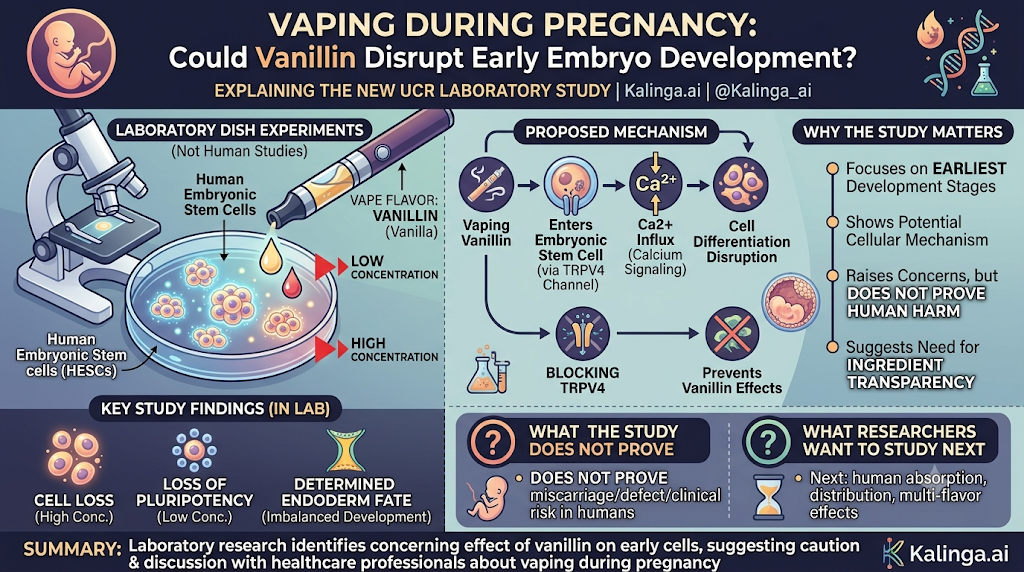
Answer: No. The research found that vanillin affected human embryonic stem cells in laboratory experiments, but it did not demonstrate that the same effects occur in pregnant women or developing human embryos.
The distinction between laboratory evidence and human clinical evidence is essential. Scientists often use cells to investigate whether a substance can trigger a biological response before determining whether that response occurs inside an organism.
In this case, researchers were interested in whether a chemical commonly used to create a vanilla flavor in e-cigarettes could affect cells resembling those present during a very early stage of human development.
The research team, led by UCR professor Prue Talbot, exposed human embryonic stem cells to several concentrations of vanillin. Some were measured in nanomolar concentrations, while others were higher, in the micromolar range.
The results differed depending on concentration.
At higher concentrations, the researchers observed that vanillin tended to kill the cells. At lower concentrations, the cells survived but showed a different and potentially important problem: they lost some of their ability to develop into the wide range of cell types normally produced during early development.
That finding is especially relevant to discussions about vaping during pregnancy because early embryonic development depends on cells responding to precisely controlled biological signals.
The study therefore does not establish a direct cause-and-effect relationship between vaping and pregnancy complications. Instead, it identifies a possible cellular mechanism that warrants further investigation.
What Is Vanillin and Why Is It Used in Vape Products?
Definition: Vanillin is the primary chemical compound responsible for much of the characteristic smell and taste associated with vanilla.
Vanillin occurs naturally in vanilla beans but can also be produced synthetically and used as a flavoring ingredient. In consumer products, it can provide a recognizable vanilla profile without requiring actual vanilla extract.
The UCR researchers focused on vanillin because it is used in some e-cigarette fluids and because previous biological knowledge suggested that embryonic cells contain a protein channel called TRPV4 that could interact with the chemical.
That made vanillin an interesting substance to investigate.
E-cigarette liquids can contain mixtures of nicotine, solvents, flavoring chemicals and other ingredients. The composition varies between products, and consumers may not always know every chemical present in a particular formulation.
This is one reason the researchers argue that ingredient transparency deserves greater attention.
Why Does Flavor Matter?
Flavoring is an important part of the appeal of many vaping products. Vanilla, fruit, mint and other flavors can make inhaled products more attractive to users who may otherwise find aerosol irritating or unpleasant.
But a flavoring’s safety cannot automatically be inferred from its use in food.
The route of exposure matters. A substance consumed in food is processed differently from one inhaled into the lungs, where chemicals can enter the respiratory system and potentially reach the bloodstream.
The new research adds another question: What happens when compounds used in vape flavoring are present during pregnancy?
Scientists still need much more evidence to answer that question conclusively.
How Did Vanillin Affect Embryonic Stem Cells?
The central finding of the research involved pluripotency, a defining property of embryonic stem cells.
Definition: Pluripotency is the ability of a stem cell to develop into many different specialized cell types.
During early development, embryonic stem cells need to retain this flexibility long enough to produce the different tissues required to construct the body. The researchers found that lower concentrations of vanillin caused the cells to lose pluripotency.
In other words, the cells became less capable of developing broadly.
The researchers also observed that vanillin pushed the cells toward forming endoderm, one of the three major embryonic tissue layers, instead of maintaining the normal balance needed to generate ectoderm and mesoderm as well.
These three layers have different developmental roles.
- Ectoderm contributes to structures including the nervous system and skin.
- Mesoderm contributes to tissues such as muscle, bone and blood.
- Endoderm contributes to internal linings including parts of the digestive and respiratory systems.
Normal development requires these pathways to be carefully coordinated.
The researchers therefore described the observed changes as potentially serious because an embryo cannot develop normally if its cells are improperly directed toward one developmental pathway.
However, it is important not to turn this laboratory observation into a prediction about human pregnancy outcomes. A dish containing cultured stem cells is vastly simpler than a developing embryo inside a human body.
There are many biological barriers, metabolic processes and environmental factors that influence what actually happens after a substance enters the body.
Why Are the Earliest Stages of Development So Important?
The earliest stages of embryonic development involve an extraordinary amount of cellular organization.
A relatively small collection of cells must progressively divide, communicate and specialize. Signals determine which cells become part of particular tissues, while other signals tell cells when to grow, move or change their identity.
Question: Why could disruption of pluripotency matter?
Answer: Because embryonic cells need the flexibility to generate multiple tissue types. If that flexibility is disrupted at the wrong time, normal developmental pathways could potentially be affected.
The UCR study does not show that vanillin exposure causes a particular birth defect. Instead, it identifies changes in cellular behavior that scientists consider biologically relevant to early development.
The researchers emphasized that prenatal development can be especially sensitive to environmental chemicals.
That is why laboratory studies involving embryonic cells can be useful even before researchers have enough evidence to establish an effect in humans.
They can reveal mechanisms that would otherwise be difficult to detect.
How Does TRPV4 Fit Into the Findings?
One of the most interesting aspects of the research is that scientists did not simply observe that vanillin changed the cells. They also investigated how the chemical produced those effects.
The researchers focused on a protein channel called TRPV4.
TRPV4 is located on the surface of cells and can participate in signaling involving calcium ions. Calcium is not merely a structural component of cells; it also acts as a signaling molecule that helps control many biological processes.
According to the researchers, vanillin interacts with TRPV4, leading to an influx of calcium into the embryonic cells.
That calcium signal then activates downstream processes associated with the loss of pluripotency and increased differentiation toward endoderm.
The team tested this proposed mechanism by blocking TRPV4.
What Happened When Researchers Blocked TRPV4?
The researchers used a TRPV4 antagonist and an antibody designed to block TRPV4 activity.
When TRPV4 was blocked, the effects associated with vanillin were prevented.
That result strengthened the researchers’ argument that TRPV4 plays an important role in the cellular response to vanillin.
This is significant scientifically because identifying a mechanism is stronger evidence than simply observing that two events happen together.
It provides researchers with a potential biological pathway to investigate in future experiments.
However, identifying a mechanism in cultured cells still does not establish what happens in a pregnant person.
That is an important limitation when interpreting research about vaping during pregnancy.
What Concentrations Did Researchers Test?
The study examined different concentrations of vanillin, including nanomolar and micromolar levels.
At micromolar concentrations, the researchers reported that the chemical tended to kill the cells.
At nanomolar concentrations, the cells generally survived but lost pluripotency and became more likely to differentiate into endoderm.
This difference is important because toxicity is not always simply a matter of whether cells live or die.
A chemical can alter cellular signaling at a concentration that does not immediately kill a cell. Those subtler changes can sometimes affect how cells function or develop.
The researchers said their data predict that nanomolar concentrations of vanillin could reach an embryo in pregnant women who vape. That is a research prediction, not a direct measurement of vanillin concentrations inside human embryos.
Further studies would be needed to determine how much vanillin is actually absorbed during vaping, how it is distributed through the body, whether it crosses biological barriers, and what concentrations could reach reproductive tissues during pregnancy.
Those questions remain unanswered by the current experiment.
Does This Mean All Vape Flavorings Are Dangerous?
Question: Does this study show that every e-cigarette flavoring disrupts embryo development?
Answer: No. The experiment specifically examined vanillin and does not establish that every flavoring chemical has the same biological effect.
Different flavoring compounds have different molecular structures and can interact with different proteins.
That means scientists cannot automatically apply the vanillin findings to every flavor used in e-cigarettes.
At the same time, the study illustrates why looking only at nicotine may provide an incomplete picture of vaping exposure.
Researchers are increasingly interested in the biological effects of individual chemicals present in vape aerosols.
The UCR team has previously investigated menthol and is now examining another synthetic cooling compound called WS-23. The researchers are also studying how menthol and WS-23 may affect embryonic cell differentiation.
This suggests that the broader scientific question is not simply whether vaping is harmful or harmless. It is also about understanding which chemicals are involved, how they act, at what concentrations, and during which stages of development they may matter most.
Vaping During Pregnancy: What Does the Evidence Actually Say?
It is easy for a headline about laboratory research to become an exaggerated claim online.
A careful interpretation looks more like this:
| Evidence | What it tells us | What it cannot establish |
| Human embryonic stem-cell experiments | Vanillin can alter cellular behavior under laboratory conditions | Whether the same changes occur in human pregnancies |
| TRPV4-blocking experiments | TRPV4 appears to be involved in vanillin’s cellular effects | Whether TRPV4 causes pregnancy complications in people exposed to vaping |
| Different vanillin concentrations | Biological effects vary with concentration | The actual concentration reaching a human embryo |
| Previous observational research | Associations between vaping and some reproductive outcomes can be investigated | Whether a specific vape chemical caused those outcomes |
| Future animal or human research | Could provide stronger evidence about exposure and biological effects | Results are not yet available from this study |
This distinction is particularly important for vaping during pregnancy.
The current experiment should be viewed as mechanistic laboratory evidence, not as a clinical trial.
The researchers themselves acknowledged that the study does not estimate the effects of repeated or cumulative vanillin exposure over days, weeks, months or years.
They also did not directly expose human embryos.
What Are the Main Limitations of the Study?
No single laboratory experiment can answer every question about a complex health issue.
The first major limitation is the experimental model. The scientists used human embryonic stem cells grown in laboratory dishes rather than embryos developing inside a uterus.
Those cells are useful because they share important characteristics with cells found during early human development. But they do not reproduce the full biological environment of pregnancy.
A second limitation concerns exposure.
The researchers tested controlled concentrations of vanillin. Real-world vaping involves an inhaled aerosol containing a mixture of chemicals, and exposure can vary depending on the device, liquid, frequency of use and individual behavior.
A third limitation is duration.
The study did not determine what happens after prolonged or repeated exposure. The researchers specifically noted that cumulative exposure remains an unanswered question.
A fourth limitation is outcome measurement.
The experiment measured cellular survival, pluripotency and differentiation. It did not measure miscarriage, infertility, congenital abnormalities or other pregnancy outcomes in humans.
These limitations do not make the findings unimportant. They simply define what can responsibly be concluded from them.
Why the Study Matters for E-Cigarette Regulation
The researchers argue that regulators should consider greater transparency around ingredients used in e-cigarettes.
That proposal is partly motivated by the fact that consumers may not always know which flavoring compounds are present in a product.
For public-health researchers, identifying individual chemicals can make it easier to investigate potential risks.
Instead of treating an e-cigarette as one uniform exposure, scientists can begin asking more specific questions:
- Which chemicals are present?
- At what concentrations?
- How are they transformed during heating?
- How much reaches the bloodstream?
- Can they cross the placenta?
- Which tissues can they affect?
- Are developing cells more sensitive than adult cells?
- Does repeated exposure produce different effects?
- Do combinations of chemicals create additional biological effects?
Those questions could eventually help regulators and health professionals make more evidence-based decisions.
For now, however, the UCR research is best understood as an early warning signal that requires additional investigation rather than definitive proof of a specific pregnancy risk caused by vanillin.
Could Other Vape Chemicals Affect Embryonic Development?
Researchers at UCR are already looking beyond vanillin.
The team is investigating WS-23, a synthetic cooling agent used in some e-cigarette products. Scientists are also examining the effects of menthol and WS-23 on embryonic cell differentiation.
This approach could reveal whether different vape chemicals affect developing cells through similar or completely different pathways.
The idea is important because e-cigarette liquids can contain multiple ingredients. A person’s exposure is therefore not necessarily limited to nicotine or a single flavoring.
Future research could also examine combinations of chemicals rather than individual substances.
That would more closely resemble real-world exposure, although such experiments are more complicated.
Scientists would also need to establish whether laboratory concentrations correspond to biologically relevant exposure levels in humans.
What Should People Take Away From the Findings?
The simplest takeaway is also the most scientifically responsible:
The study raises concerns about vanillin exposure during early development, but it does not prove that vaping vanillin causes developmental problems in human pregnancies.
For someone considering vaping during pregnancy, the research adds another reason to discuss e-cigarette use with a qualified healthcare professional.
The study’s authors specifically recommend caution and say pregnant women should be advised by physicians not to vape, particularly when there are concerns about conception or miscarriage.
Importantly, people should not interpret the study as evidence that a vanilla-flavored vape is uniquely dangerous while other flavors are automatically safe.
The researchers are investigating several chemicals because the biological effects of vaping are likely to depend on the individual substances involved.
The broader message is that “flavoring” does not necessarily mean biologically inactive.
A chemical can be safe for one route of exposure and still require separate evaluation when it is inhaled or encountered during a sensitive developmental period.
Why More Research Is Needed
The next stage of research will need to bridge the gap between cells in a laboratory dish and actual biological exposure.
Scientists could investigate how vanillin behaves after inhalation, how much enters circulation and whether it reaches reproductive tissues.
Animal models could potentially provide information about whole-body exposure and developmental outcomes, although animal results would still need careful interpretation before being applied to humans.
Human observational studies could also investigate whether exposure to specific vaping chemicals correlates with reproductive outcomes.
Each research approach answers a different question.
Laboratory experiments can reveal mechanisms. Animal studies can examine whole-organism effects. Human epidemiological studies can identify patterns in real populations.
Together, these forms of evidence can provide a much stronger basis for determining whether a laboratory finding represents a meaningful human health risk.
That process takes time, especially when the outcome involves pregnancy and embryonic development.
The Bigger Picture: Vaping Is More Than Nicotine
The vanillin study highlights a broader issue in the debate around e-cigarettes.
Much of the public discussion has historically focused on nicotine because nicotine is addictive and has well-established biological effects.
But e-cigarette aerosols can contain other substances, including flavoring chemicals.
The scientific challenge is to understand the effects of those individual compounds and how they behave when heated and inhaled.
This does not mean every chemical in every vape product is dangerous. It means each substance should be evaluated based on evidence rather than assumptions.
For young adults, students and anyone trying to understand health research, this is an important lesson in scientific literacy: a study can identify a genuine biological effect without proving a real-world clinical outcome.
That distinction prevents two common mistakes.
The first is dismissing laboratory evidence simply because it is not a human study. The second is treating laboratory evidence as if it were already definitive proof of harm in humans.
The most accurate position sits between those extremes.
The UCR research provides a plausible biological mechanism that researchers can investigate further. It also highlights the need for better information about the ingredients people inhale, especially during sensitive periods such as pregnancy.
What Does This Mean for Future Research?
The researchers’ next steps could help answer several unresolved questions.
1. How much vanillin reaches the body?
Researchers need better measurements of actual human exposure after vaping.
2. Can vanillin reach developing tissues?
Understanding absorption, distribution and biological barriers will be important for determining whether laboratory concentrations are realistic.
3. What happens after repeated exposure?
The current experiment does not establish the consequences of long-term or cumulative exposure.
4. Do other flavoring compounds behave similarly?
Studies of menthol and WS-23 could reveal whether the findings are specific to vanillin or part of a wider pattern.
5. Are some developmental stages especially sensitive?
The researchers are particularly interested in early embryonic development, when cells are rapidly changing identity and organizing into different tissues.
Answering these questions will require multiple types of evidence.you can explore Home for more .
FAQ: Vaping During Pregnancy and Vanillin
Can vaping during pregnancy affect an embryo?
The current vanillin study does not prove that vaping during pregnancy affects human embryos. It found that vanillin altered human embryonic stem cells in laboratory experiments, providing evidence of a possible biological mechanism that requires further study.
What is vanillin in e-cigarettes?
Vanillin is a chemical associated with the characteristic flavor and aroma of vanilla. It can be used as a flavoring ingredient in some e-cigarette liquids and was the specific compound investigated in the UCR laboratory study.
How did vanillin affect embryonic stem cells?
The researchers reported that higher concentrations of vanillin tended to kill the cells, while lower concentrations caused cells to lose pluripotency and become more likely to differentiate into endoderm. Blocking the TRPV4 channel prevented these effects in the experiments.
What is TRPV4?
TRPV4 is a protein channel found on cell surfaces that can regulate the movement of calcium ions into cells. In the study, researchers found evidence that TRPV4 was involved in the cellular response to vanillin.
Does this study prove that vanillin causes miscarriage or birth defects?
No. The study did not examine pregnant women, human embryos or pregnancy outcomes. It used human embryonic stem cells in laboratory dishes, so it cannot establish that vanillin exposure causes miscarriage, infertility or birth defects in humans.
Should pregnant women avoid vaping?
The researchers recommend that pregnant women should not vape and should discuss vaping with a healthcare professional. The new study adds laboratory evidence concerning vanillin, but decisions about individual health should be based on advice from qualified medical professionals and the broader body of evidence.
The Bottom Line
The new research does not establish that vaping during pregnancy causes developmental problems in humans, but it does raise a scientifically important concern about what happens when specific vape chemicals interact with cells involved in early development.
The finding that vanillin affected embryonic stem-cell pluripotency and differentiation,and that blocking TRPV4 prevented those effects,gives researchers a mechanism to investigate further.
For now, the strongest conclusion is not that a vanilla vape has been proven to harm a developing baby. It is that a common flavoring chemical has shown potentially concerning effects in human embryonic stem cells, and those findings deserve further research before their significance for pregnancy can be fully understood.
For more explainers on emerging science, technology and health research, keep exploring Kalinga.ai and follow the evidence behind the headlines.keep exploringhttps://kalinga.ai/