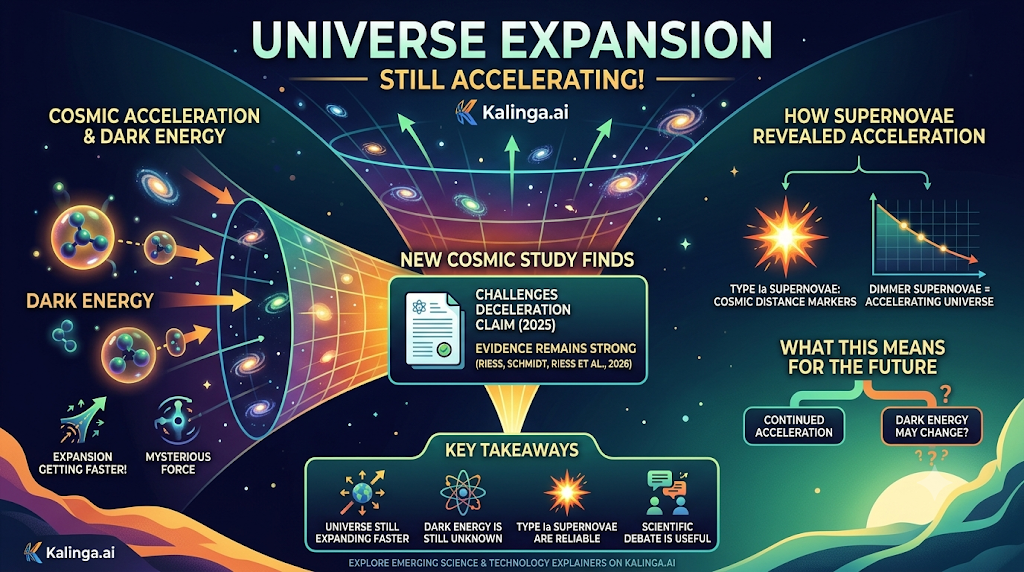
File Name: universe-expansion-dark-energy-2026.jpg
Title: Universe Expansion and Dark Energy Explained
Caption: New research says the universe is still accelerating—bringing dark energy back into the spotlight.
Description: A visually striking cosmic scene showing galaxies spreading across an expanding universe, with subtle representations of dark energy and accelerating cosmic expansion. The image supports the article’s focus on new research challenging claims that the universe’s expansion is slowing and highlights the continuing mystery surrounding dark energy.
Alt Text: Universe expansion continues accelerating as dark energy drives cosmic growth, according to new research
Planned H2/H3 Structure
- Why Is the Universe Still Expanding Faster?
- What the New Cosmic Expansion Study Found
- How Supernovae Revealed Cosmic Acceleration
- Why Scientists Challenged the Earlier Slowdown Claim
- What Is Dark Energy and Why Is It Mysterious?
- Why Type Ia Supernovae Matter in Cosmology
- What This Means for the Future of the Universe
- Why Scientific Disagreement Is Actually Useful
- What We Still Don’t Know About Cosmic Expansion
- FAQ: Universe Expansion and Dark Energy
Focus Keywords
- Primary Keyword: universe expansion
- Secondary Keywords: dark energy, cosmic acceleration, Type Ia supernovae, expanding universe
- LSI/Long-Tail Keywords: why is the universe expanding, is the universe still accelerating, what is dark energy, why is the universe expansion accelerating
Is the Universe Expansion Still Accelerating in 2026?
What if one of the biggest mysteries in cosmology turned out to be even stranger than scientists thought?
The universe expansion is still accelerating, according to a new international analysis that challenges recent claims that cosmic growth may be slowing down. The findings support the long-standing evidence for cosmic acceleration and keep dark energy at the center of the mystery,but scientists still do not know what dark energy actually is.
The study, published in Monthly Notices of the Royal Astronomical Society, revisits a controversial analysis from 2025 that suggested the universe could have entered a period of decelerating expansion. Researchers led by the University of Southampton argue that the earlier conclusion resulted from problems in how supernova data were analyzed.
In other words, the cosmic slowdown may have been a false alarm.
But that does not mean cosmologists have solved the bigger puzzle. If the universe expansion really is accelerating, something appears to be driving it,and that “something” remains one of physics’ deepest unanswered questions.
Why Is the Universe Still Expanding Faster?
The simplest version of the story is surprisingly strange: the universe is not merely getting bigger. Its expansion appears to be speeding up over time.
Imagine marking galaxies across an enormous cosmic map. As space expands, distant galaxies generally move farther apart. Scientists expected gravity to gradually slow that process because matter attracts matter.
Instead, observations showed something unexpected.
The expansion of the universe began accelerating billions of years ago.
Definition + Expansion: Cosmic Acceleration
Cosmic acceleration is the observed phenomenon in which the rate at which the universe expands increases over time.
This does not mean that individual galaxies are necessarily firing through space faster like rockets. On the largest scales, it is space itself that is expanding, increasing the distances between gravitationally unbound galaxies.
The leading explanation involves dark energy, a poorly understood component of the universe that appears to counteract gravity on cosmic scales.
Is the universe expansion actually speeding up?
Yes, according to the latest analysis. Researchers from an international team concluded that the evidence supporting accelerating cosmic expansion remains strong after reassessing the assumptions behind a recent challenge to the standard cosmological picture.
The new research is particularly important because it addresses a direct challenge to one of the foundations of modern cosmology.
The researchers included Nobel Prize-winning scientists Adam Riess and Brian Schmidt, who shared the 2011 Nobel Prize in Physics with Saul Perlmutter for work that established evidence for the accelerating expansion of the universe.
What Did the New Study Find?
The latest research was designed to test whether the evidence behind cosmic acceleration had been interpreted incorrectly.
The controversy began after a South Korean research team published work suggesting that the universe’s expansion could be slowing. That study proposed that dark energy might be weakening with time.
If correct, that would have been a major development.
It could have meant that the standard model of cosmology needed substantial revision. Instead of treating dark energy as a relatively stable driver of accelerated expansion, scientists might have needed a more complicated explanation for how it changes over cosmic history.
The new analysis argues that this dramatic conclusion does not hold up.
Question → Direct Answer: Did scientists discover that the universe is slowing down?
No. The new study argues that the earlier evidence for a slowdown came from problems in the analysis rather than a genuine change in cosmic expansion.
The researchers say established measurements remain reliable when the relevant properties of supernovae and their host galaxies are properly accounted for.
That brings the scientific community back to the original puzzle: why is the universe expansion accelerating at all?
How Did Scientists Discover Cosmic Acceleration?
To understand the debate, it helps to go back to one of astronomy’s most important discoveries.
Scientists needed a way to measure enormous cosmic distances. Ordinary stars are difficult to use because their intrinsic brightness varies. But certain astronomical explosions can act as much more useful reference points.
These explosions are called Type Ia supernovae.
What Are Type Ia Supernovae?
Type Ia supernovae are extremely bright stellar explosions that can be used as distance indicators in cosmology.
They occur when white dwarf stars undergo catastrophic explosions under particular conditions. Because astronomers can estimate their intrinsic brightness, they can compare that with how bright the explosions appear from Earth.
The difference helps researchers estimate how far away the supernova is.
Scientists can then compare distance with the speed at which the host galaxy is receding.
That gives cosmologists a way to reconstruct how the universe has expanded over time.
Why were Type Ia supernovae so important?
Because they allowed scientists to discover that distant galaxies were behaving in a way that could not be explained by a universe whose expansion was simply slowing under gravity.
The observations made by teams including Perlmutter, Riess and Schmidt showed that distant supernovae appeared dimmer than expected in a decelerating universe.
The conclusion was startling: the universe’s expansion was accelerating.
That discovery fundamentally changed cosmology.
Why Did Scientists Challenge the Earlier Slowdown Claim?
The 2025 study that triggered the controversy focused on an important assumption about Type Ia supernovae.
For decades, researchers have treated these explosions as reliable cosmic distance markers after accounting for known differences between them.
But what if their brightness changes systematically with the age or environment of their stars?
That possibility could affect calculations of cosmic expansion.
The South Korean researchers argued that Type Ia supernovae might not be as uniform across cosmic history as previously assumed. If their intrinsic brightness changes in a systematic way, astronomers could potentially misinterpret the observations.
That is why the claim attracted so much attention.
If supernovae evolved in a way that had not been properly accounted for, perhaps the apparent acceleration was partly an observational artifact.
The new research team, however, says there were problems in how the earlier study handled these variables.
The Problem With Stellar Ages
One issue identified by the researchers involves the difference between the age of a galaxy and the age of the particular stellar population associated with a supernova.
Those two things are not necessarily identical.
A galaxy can contain stars born at very different times. Treating the galaxy’s overall age as though it directly represented the age of the exploding star can therefore introduce errors into the analysis.
The researchers argue that this distinction matters when trying to determine whether supernova brightness changes with stellar age.
Host Galaxy Mass Also Matters
The team also highlighted the mass of the galaxy hosting each supernova.
Host-galaxy properties can influence the calibration of Type Ia supernova measurements. Modern cosmological analyses therefore account for environmental differences rather than assuming every explosion exists in an identical setting.
According to the new study, properly accounting for these effects restores the consistency of the evidence for cosmic acceleration.
Professor Adam Riess emphasized the need for especially careful testing when scientific claims challenge an established interpretation.
The result, according to the researchers, was that the evidence for accelerating expansion remained remarkably consistent after recalibration.
How Does Dark Energy Fit Into the Story?
This is where the science gets genuinely weird.
Scientists have strong evidence that the universe expansion is accelerating. But they do not have a complete explanation for the physical nature of the phenomenon responsible.
That unknown component has been given a name: dark energy.
Definition + Expansion: Dark Energy
Dark energy is the name given to the unknown component associated with the accelerated expansion of the universe.
The term does not mean scientists have directly detected a mysterious substance floating through space. Instead, it describes the phenomenon responsible for the observed acceleration within the standard cosmological framework.
One leading possibility is that dark energy is related to the energy of empty space itself. Other theories propose that gravity may behave differently across enormous distances or that our current cosmological model is incomplete.
For now, none of these explanations has definitively solved the mystery.
Does dark energy have a known physical identity?
No. Dark energy is still not understood at a fundamental physical level.
Scientists can measure its apparent effects on cosmic expansion, but knowing that something causes an effect is different from knowing exactly what that thing is.
This distinction is crucial.
Cosmologists are not saying, “We discovered a substance called dark energy and know what it is made of.”
They are saying, in effect, “The universe behaves as though a component with these properties exists.”
That is why the latest research does not eliminate the dark-energy mystery.
It reinforces it.
Universe Expansion vs. Cosmic Slowdown: What Changed?
The scientific disagreement can be summarized simply:
| Question | Earlier slowdown claim | New analysis |
| Is cosmic expansion accelerating? | Questioned | Evidence remains strong |
| Is dark energy weakening? | Possible | Not supported by the revised analysis |
| Are Type Ia supernovae reliable? | Their evolution may affect results | Corrections preserve acceleration evidence |
| Does host-galaxy environment matter? | Potential source of variation | Must be properly accounted for |
| Does the standard cosmological picture survive? | Potentially challenged | Remains robust, according to researchers |
The key point is that the new study does not prove that every aspect of modern cosmology is settled.
Instead, it argues that the specific evidence used to claim a cosmic slowdown does not overturn the existing evidence for acceleration.
Why Does This Matter Beyond Astronomy?
At first glance, this might sound like an argument between scientists about distant galaxies.
It is much more important than that.
Our understanding of cosmic expansion affects how researchers reconstruct the history of the universe and predict its future.
The expansion rate influences models of:
- The age and evolution of the universe
- The growth of large-scale cosmic structures
- The relationship between matter and dark energy
- The formation and evolution of galaxies
- The ultimate fate of the universe
- Fundamental theories of gravity and physics
A change in the expansion history could therefore force scientists to rethink some of the most basic assumptions about the cosmos.
The latest research suggests that dramatic rewrite is not currently necessary.
But the mystery remains.
What Could Dark Energy Actually Be?
There are several broad possibilities scientists investigate.
1. A Cosmological Constant
The simplest explanation is that dark energy could be associated with a constant energy density of empty space, often represented by the cosmological constant.
In this scenario, dark energy does not dramatically change with time.
This idea fits remarkably well with many observations and remains a central part of the standard cosmological model.
2. A Dynamic Field
Another possibility is that dark energy changes over time.
Instead of behaving like a constant property of space, it could be associated with a field whose energy evolves as the universe changes.
This is one reason measurements of distant galaxies and supernovae are so important.
If the behavior of cosmic expansion changes systematically, scientists could potentially identify clues about the underlying physics.
3. Modified Gravity
There is another possibility that is even more fundamental.
Maybe dark energy is not a new component at all.
Perhaps our understanding of gravity is incomplete at cosmological scales.
Under modified-gravity theories, what appears to be accelerated expansion could result from gravity behaving differently across immense distances or cosmic timescales.
Scientists continue to test these possibilities against observations.
Why Type Ia Supernovae Are Still Under the Microscope
One of the most interesting consequences of this debate is that scientists are paying even closer attention to the explosions themselves.
That may sound like a technical detail, but it is actually a major lesson from the controversy.
Cosmology depends on measurements.
Measurements depend on models.
And models depend on assumptions.
If an assumption about a stellar explosion is slightly wrong, that error can propagate into our understanding of the entire universe.
The new researchers therefore argue that the controversy created an opportunity to investigate the astrophysics of supernova explosions more carefully.
That could ultimately make future measurements of dark energy even more precise.
Does scientific disagreement mean the original science failed?
Not necessarily. Scientific disagreement is often how researchers test the strength of an established result.
An unexpected claim forces other scientists to revisit assumptions, reproduce analyses and search for hidden sources of error.
If the original result survives that process, confidence in it can increase.
If it does not, science changes.
Either outcome is useful.
What the Study Means for the Future of Cosmology
The latest findings leave scientists with a familiar but frustrating conclusion.
The universe expansion remains consistent with acceleration, but the mechanism behind that acceleration remains unknown.
That means the next stage of research will not simply be about asking whether the universe is accelerating.
Scientists need to determine how the acceleration behaves over time and whether dark energy has properties that differ from a simple cosmological constant.
Future observations will be especially valuable because increasingly precise measurements can distinguish between competing models.
Researchers will continue studying distant supernovae, galaxies and other cosmological signals to reconstruct the expansion history of the universe.
The goal is not merely to confirm that the universe is accelerating.
It is to discover why.
What We Still Don’t Know About the Universe Expansion
The new analysis answers one question while leaving several others open.
Here are some of the biggest:
- What is dark energy? Scientists know its apparent cosmological effect but not its fundamental identity.
- Is dark energy constant? The latest findings support continued acceleration but do not turn the underlying mystery into a solved problem.
- Could gravity be incomplete? Modified-gravity theories remain an area of active investigation.
- How accurately can supernovae measure cosmic distances? Researchers continue improving calibration and accounting for differences between stellar environments.
- What will happen to the universe eventually? Its ultimate fate depends partly on how cosmic expansion behaves over the extremely long term.
These questions show why cosmology remains one of the most active areas of modern physics.
We can measure the universe with extraordinary precision and still struggle to explain what the measurements mean at the deepest level.
Why the Universe’s Future Depends on Dark Energy
If accelerated expansion continues indefinitely, increasingly distant galaxies will become inaccessible as the space between them grows.
Over enormous timescales, the observable universe could therefore become increasingly isolated from the structures we can see today.
But the precise future depends on the behavior of dark energy.
If it remains approximately constant, one type of cosmic future is expected.
If it changes significantly over time, the outcome could be different.
That is why determining the nature of dark energy is not just an academic exercise. It could tell us how the universe will evolve on timescales far beyond human history.
For now, however, scientists are not predicting a sudden cosmic event.
The important result from this study is much more immediate: the evidence for accelerating expansion remains intact.
FAQ: Universe Expansion and Dark Energy
Is the universe still expanding in 2026?
Yes. Current evidence continues to support an expanding universe, and the new analysis argues that the expansion is still accelerating rather than slowing down.
Why is the universe expansion accelerating?
The leading explanation is dark energy, an unknown component associated with accelerated cosmic expansion. Scientists have strong evidence for its effects but do not yet know its fundamental physical nature.
What evidence shows that the universe is accelerating?
Observations of distant Type Ia supernovae provided a crucial line of evidence. Their measured brightness and distance indicated that the universe was expanding faster than expected in a universe dominated only by matter and gravity.
Did a recent study prove that the universe is slowing down?
No. A 2025 study argued that the expansion might be slowing, but the new international analysis challenged that conclusion. The researchers identified issues involving stellar ages and host-galaxy properties and concluded that the evidence for cosmic acceleration remains strong.
What are Type Ia supernovae?
Type Ia supernovae are exceptionally bright stellar explosions that can be used as distance indicators. Comparing their observed brightness with their expected brightness allows astronomers to estimate enormous cosmic distances and study the history of the universe expansion.
Is dark energy the same thing as dark matter?
No. Dark energy and dark matter are different concepts. Dark matter is associated with additional gravitational effects that help explain the behavior of galaxies and large-scale structures, while dark energy is associated with the accelerated expansion of the universe.
The Bigger Picture
The latest cosmic debate offers an important reminder: sometimes the most exciting scientific discovery is not a dramatic replacement of an old idea.
Sometimes it is finding out that the old idea survived a serious challenge.
The new analysis suggests that the universe expansion is still accelerating, keeping dark energy firmly in the spotlight. But that victory comes with a catch: scientists are still left staring at one of the biggest unanswered questions in physics,what is actually causing the acceleration?
For students and curious minds, that mystery is exactly what makes cosmology so fascinating. The more accurately we measure the universe, the more clearly we see how much we still have to learn.
SEO Meta Configuration
Keyword Categorization
Primary Keyword:
- Universe Expansion
Secondary Keywords:
- Dark energy
- Accelerating universe
- Cosmic acceleration
- Type Ia supernovae
LSI / Long-Tail Keywords:
- Is the universe still expanding?
- Why is the universe accelerating?
- What is dark energy driving cosmic expansion?
- New research on accelerating universe 2026
Meta Title
Universe Expansion: Ultimate Dark Energy Guide 2026
SEO Meta Description:
Universe expansion is still accelerating, new research finds. Learn why dark energy remains a cosmic mystery and what the latest study reveals.
URL Slug:
universe-expansion-dark-energy