File Name: keto-diet-liver-fat-reduction-trial.jpg
Title: Keto Diet Cuts Liver Fat
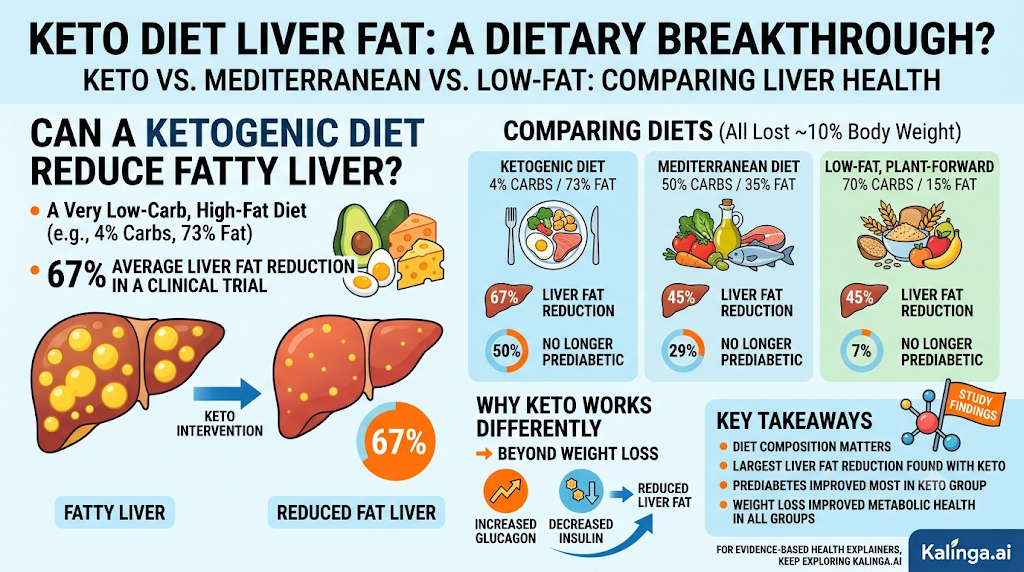
Caption: A clinical trial found the keto diet cut liver fat by 67%,but what makes the metabolic effect so striking?
Description: A medical-style illustration showing a liver alongside visual cues for a ketogenic diet, such as low-carbohydrate and high-fat foods. The image highlights the clinical trial finding that the keto diet reduced liver fat by 67%, making it directly relevant to the article’s findings on metabolic health and prediabetes.
Alt Text: Keto diet reduced liver fat by 67% in a clinical trial involving people with obesity and prediabetes.
Focus Keywords:
- Primary: keto diet liver fat
- Secondary: ketogenic diet, fatty liver disease, keto diet and prediabetes, liver fat reduction
- LSI/Long-Tail: how keto diet reduces liver fat, keto diet for fatty liver disease, keto diet and prediabetes, keto vs Mediterranean diet for liver health
How much can diet change liver health?
What if losing the same amount of weight could produce very different changes inside the body depending on what you eat?
A new clinical trial suggests that keto diet liver fat reduction may be substantially greater than the reduction seen with Mediterranean or low-fat, plant-forward diets, even when participants in all three groups lost about 10% of their body weight. In the study, liver fat fell by 67% in the ketogenic group, compared with 45% in both comparison groups.
The findings, published August 27, 2026, in Cell Metabolism, add an important layer to the discussion around weight loss: it may not only be how much weight someone loses that matters, but also how the body’s metabolism responds to the composition of the diet.
The study involved 42 people with obesity, prediabetes, and fatty liver disease. Researchers supplied participants with their food and worked with them through the intervention, allowing the team to compare three different dietary patterns while targeting similar weight loss.
The results do not mean that everyone with fatty liver disease should start a ketogenic diet. But they do provide researchers with clues about how carbohydrate restriction, hormones, liver fat and blood-sugar regulation may interact.
What did the clinical trial actually test?
The researchers wanted to answer a relatively straightforward question: if people lose roughly the same amount of weight, does the type of diet produce different metabolic outcomes?
Definition: Ketogenic diet
A ketogenic diet is a very low-carbohydrate, high-fat eating pattern that shifts the body’s metabolism toward greater use of fat for energy.
In this trial, the ketogenic diet was particularly restrictive, providing approximately 4% of calories from carbohydrates and 73% from fat. That is considerably different from a conventional balanced diet and should not be confused with simply eating fewer carbohydrates.
The researchers compared this approach with a Mediterranean diet and a low-fat, plant-forward diet. Importantly, the study was designed so that participants in all three groups were expected to lose approximately the same amount of body weight.
Question: Why compare diets if everyone lost the same weight?
Because researchers wanted to separate the effects of weight loss from the effects of diet composition.
Weight loss itself can improve insulin sensitivity, reduce body fat and lower liver fat. If every participant loses approximately 10% of their body weight, researchers can then investigate whether the proportions of carbohydrates and fat produce additional metabolic differences.
That distinction is at the heart of the study’s findings.
The three diets at a glance
| Diet | Carbohydrates | Fat | Main dietary approach |
| Ketogenic | 4% of calories | 73% | Very low-carb, high-fat |
| Mediterranean | 50% | 35% | Vegetables, olive oil, nuts, fish and moderate dairy |
| Plant-forward, low-fat | 70% | 15% | Low-fat, carbohydrate-rich, plant-focused |
All three groups were managed to achieve approximately 10% weight loss.
That makes the liver-fat result particularly interesting because the ketogenic group did not simply lose more weight and therefore automatically have less liver fat. The researchers observed a larger reduction in liver fat despite comparable weight loss.
Keto diet liver fat fell 67% in the study
The headline number from the trial is difficult to miss: liver fat decreased by an average of 67% among participants following the ketogenic diet.
For comparison, liver fat declined by approximately 45% in both the Mediterranean and plant-forward groups.
That difference suggests that the metabolic effects of carbohydrate restriction may extend beyond the simple arithmetic of calories consumed versus calories burned.
Question: Did keto cause more weight loss?
No. The researchers adjusted calorie intake so participants in all three groups would lose approximately 10% of their body weight.
Participants generally reached that target within about four to five months. Each group experienced reductions in body fat and improvements in insulin sensitivity.
The distinctive finding was what happened to liver fat and several metabolic measurements after similar weight loss.
Why is liver fat important?
The liver performs hundreds of jobs, including processing nutrients, storing energy and helping regulate metabolism. But excessive fat accumulation in the liver can be associated with metabolic dysfunction and fatty liver disease.
Liver fat is particularly relevant in people with obesity and prediabetes because the liver is closely connected to the body’s regulation of glucose and fat metabolism.
The trial suggests that changing carbohydrate availability may influence this metabolic system in ways that are not completely explained by weight loss alone.
The researchers observed changes in glucagon and insulin, two hormones involved in controlling energy metabolism.
Why might carbohydrate restriction affect liver fat?
To understand the findings, it helps to look at what happens to the body’s metabolic signals when carbohydrate intake falls dramatically.
When carbohydrate intake is very low, the body has less glucose available from dietary carbohydrates. This changes hormonal signaling and encourages the body to rely more heavily on stored and circulating fat for energy.
The ketogenic group in this trial showed a larger increase in glucagon and a greater reduction in blood insulin levels than participants following the other diets.
Definition: Glucagon
Glucagon is a hormone that helps regulate blood glucose and signals the body to mobilize stored energy.
It works alongside insulin but generally has an opposing role in blood-sugar regulation. In the context of this study, the researchers linked the greater rise in glucagon among ketogenic-diet participants with changes in liver-fat metabolism.
The researchers also observed a larger decline in insulin in the ketogenic group.
Question: Does lower insulin automatically mean less liver fat?
Not necessarily, but the study suggests that changes in insulin and glucagon signaling may help explain why the ketogenic group experienced a larger reduction in liver fat.
The researchers are interested in the possibility that reducing carbohydrate intake produces metabolic effects beyond those generated by weight loss alone.
That is an important distinction. The study demonstrates an association between the dietary intervention and metabolic outcomes, but it does not mean every person will experience the same response.
Keto diet liver fat results were different despite similar weight loss
One of the most useful aspects of the research is the controlled comparison between diets.
Imagine three groups of people who each lose around 10% of their body weight. If all three groups showed almost identical metabolic changes, it would suggest that weight loss itself was doing most of the work.
That is not what happened.
All three groups improved several measures of metabolic health, but the ketogenic group showed the largest reduction in liver fat.
The key results
According to the study:
- All three groups lost approximately 10% of body weight.
- All three groups reduced body fat.
- Insulin sensitivity improved across all three groups.
- Keto reduced liver fat by an average of 67%.
- Mediterranean and plant-forward diets each reduced liver fat by about 45%.
- The ketogenic group showed the largest increase in glucagon.
- The ketogenic group showed the greatest decline in blood insulin.
- About 50% of the keto group no longer met the study’s criteria for prediabetes after the intervention.
These results make the study more nuanced than a simple “keto wins” headline.
The Mediterranean and plant-forward diets also produced meaningful improvements. The ketogenic group simply showed stronger changes in some of the specific metabolic outcomes researchers measured.
What happened to prediabetes?
The liver-fat finding was not the only major result.
The researchers also examined whether participants still met the criteria for prediabetes after the intervention.
Prediabetes refers to blood glucose levels that are higher than the normal range but not high enough to meet the diagnostic threshold for diabetes. It can indicate impaired metabolic regulation and an elevated future risk of developing type 2 diabetes.
Question: Did every diet improve prediabetes?
Yes, but the proportion of participants who no longer met the criteria for prediabetes was highest in the ketogenic group.
After the intervention:
- Approximately 50% of participants in the ketogenic group no longer met the criteria for prediabetes.
- Approximately 29% in the Mediterranean group no longer met the criteria.
- Approximately 7% in the plant-forward group no longer met the criteria.
Again, the findings need to be interpreted in the context of this specific clinical trial and its participants.
The study was relatively small, involving 42 participants, and all participants began with obesity, prediabetes and fatty liver disease. Those characteristics matter when considering how broadly the findings can be applied.
Why does this matter?
The results suggest that diet composition may influence metabolic health independently of the amount of weight lost.
Samuel Klein, the study’s corresponding author at Washington University School of Medicine in St. Louis, said the findings suggest that reducing carbohydrate intake can have important therapeutic effects on metabolism beyond weight loss alone in people with high liver fat and prediabetes.
That does not establish keto as universally superior. Instead, it provides a specific clue about the relationship between carbohydrate intake and metabolic regulation.
Keto vs Mediterranean vs low-fat: What did the study show?
The three diets represent very different nutritional philosophies.
A ketogenic diet dramatically restricts carbohydrates. A Mediterranean diet emphasizes foods such as vegetables, olive oil and nuts, alongside moderate amounts of fish and dairy. The plant-forward diet in this study emphasized low fat and substantially more carbohydrates.
Comparing the approaches
| Measure | Ketogenic | Mediterranean | Plant-forward |
| Weight loss | ~10% | ~10% | ~10% |
| Liver-fat reduction | 67% | 45% | 45% |
| Prediabetes no longer present after intervention | ~50% | 29% | 7% |
| Carbohydrate share | 4% | 50% | 70% |
| Fat share | 73% | 35% | 15% |
| Insulin sensitivity | Improved | Improved | Improved |
The table highlights an important point: there was no single outcome on which one diet simply “won” across the board.
All three produced weight loss and improved insulin sensitivity. The largest differences appeared in liver fat, hormonal responses and the proportion of participants moving out of the prediabetes range.
Why the study does not mean keto is automatically the best diet
A striking result can easily become an exaggerated health claim.
The researchers did not demonstrate that ketogenic diets are universally superior to Mediterranean or low-fat diets. They studied a specific group of people under controlled conditions and measured outcomes over roughly four to five months.
There are also practical considerations that the headline numbers do not capture.
Question: Should everyone with fatty liver disease follow keto?
No. This study alone is not enough to recommend a ketogenic diet for everyone with fatty liver disease or prediabetes.
Dietary needs vary depending on a person’s health status, medications, nutritional requirements and ability to maintain a particular eating pattern. Anyone considering a major dietary change for a metabolic condition should discuss it with an appropriate healthcare professional.
The study’s controlled environment is also worth remembering.
Researchers provided all the food to participants and arranged weekly dietitian meetings to support adherence. That is very different from trying to follow an extremely low-carbohydrate diet independently in everyday life.
The surprising cholesterol finding
There was another result that caught the researchers’ attention.
The ketogenic diet supplied the greatest proportion of calories from fat, yet participants did not experience the increase in blood fat or cholesterol that the researchers expected.
Max Petersen, the study’s first author, described this as the most surprising finding.
That observation is useful because it challenges a simplistic assumption that eating more dietary fat will automatically produce higher blood-fat measurements in every situation.
However, it should not be interpreted as evidence that high-fat diets are universally safe or that cholesterol monitoring is unnecessary.
The response to a diet can depend on many factors, including the types of fat consumed, overall dietary pattern, genetics, baseline health and individual metabolic response.
How the findings connect liver health and metabolism
The study becomes more interesting when viewed as a metabolic puzzle rather than a competition between diet labels.
The researchers were not simply asking whether people could lose weight. They were examining what happens inside the body when similar weight loss occurs under dramatically different nutritional conditions.
The results point toward several interconnected processes:
- Weight loss reduces body fat across dietary patterns.
- Improved insulin sensitivity occurs with weight loss.
- Very low carbohydrate intake changes hormonal signaling.
- Glucagon increased more in the ketogenic group.
- Insulin decreased more strongly in the ketogenic group.
- Liver fat declined more substantially in the ketogenic group.
- More participants in the ketogenic group moved out of the prediabetes range.
This does not prove that every step directly causes the next. Instead, it gives researchers a clearer picture of the metabolic changes associated with the different diets.
What does this mean for fatty liver research?
Fatty liver disease is closely tied to metabolic health, particularly obesity and impaired glucose regulation.
The study therefore raises an important research question: Could changing the composition of a diet provide additional benefits beyond achieving weight loss?
The answer from this trial appears to be yes, at least for some of the measurements studied.
The larger reduction in liver fat among ketogenic-diet participants suggests that researchers should continue investigating the metabolic mechanisms behind carbohydrate restriction.
At the same time, the Mediterranean and plant-forward diets should not be dismissed. They also produced approximately 10% weight loss, reduced liver fat by about 45% and improved insulin sensitivity.
The practical question for future research may therefore be less about identifying one universally “best” diet and more about understanding which dietary pattern works best for particular metabolic profiles.
What makes this clinical trial different?
Nutrition studies can be difficult to interpret because people do not always eat exactly what researchers tell them to eat.
This trial attempted to address that challenge through a more controlled design.
Participants were randomly assigned to their dietary groups, researchers supplied the food, and dietitians met with participants every week.
Question: Why does controlled feeding matter?
It helps researchers determine whether differences in outcomes are more likely to be associated with the assigned diet rather than differences in what participants actually ate.
Real-world dietary studies often rely on participants accurately remembering or reporting their food intake. A controlled feeding approach reduces some of that uncertainty.
However, controlled feeding also makes the study different from everyday life. A diet that works under intensive research supervision may be harder to maintain when people have to shop, cook, travel, work and make their own food choices.
What are the biggest takeaways?
The most important lesson from the research is not simply that “keto is better.”
Instead, the trial suggests that weight loss and diet composition can influence metabolic health in partly different ways.
Here are the key points to remember:
- Keto reduced liver fat by 67% in this clinical trial.
- The Mediterranean and plant-forward groups each saw about 45% reductions in liver fat.
- All three groups lost approximately 10% of body weight.
- All three diets improved insulin sensitivity.
- About half of ketogenic-diet participants no longer met the study’s criteria for prediabetes.
- The corresponding figures were 29% for Mediterranean and 7% for the plant-forward diet.
- The ketogenic diet produced the largest changes in insulin and glucagon.
- The study involved 42 people with obesity, prediabetes and fatty liver disease.
- The intervention lasted approximately four to five months.
- The findings demonstrate potential metabolic advantages but do not establish that keto is appropriate for everyone.
What researchers want us to understand about keto diet liver fat
The most interesting question raised by the study is not whether someone should copy the exact diet used in the experiment.
It is whether the body’s metabolic response to food can be modified independently of weight loss.
Samuel Klein and his colleagues argue that the findings support the idea that reducing carbohydrate intake can produce additional metabolic effects in people with high liver fat and prediabetes.
That possibility matters because modern obesity treatment increasingly involves multiple strategies.
Max Petersen noted that GLP-1-based medications have transformed obesity treatment by providing an effective way to achieve significant weight loss. The study suggests that the composition of a person’s diet may also contribute additional metabolic effects.
In other words, the future of metabolic health may not be about choosing between medication and diet. Researchers may increasingly study how different treatments and dietary patterns interact.
What should readers take away from the research?
If you have heard that weight loss is the only thing that matters, this trial provides a more complicated answer.
Weight loss clearly mattered in the study: all three groups lost approximately 10% of their body weight and improved several measures of metabolic health.
But the differences in liver fat and prediabetes outcomes suggest that what people eat may influence some metabolic outcomes beyond the amount of weight they lose.
At the same time, one clinical trial involving 42 participants cannot settle the broader debate over ketogenic diets.
More research is needed to understand how durable these effects are, how they translate into long-term health outcomes and how different people respond to each dietary pattern.
For now, the strongest conclusion is narrower but still significant: in this controlled clinical trial, a ketogenic diet produced a substantially larger reduction in liver fat than the Mediterranean and plant-forward diets despite similar weight loss.
Frequently Asked Questions
Does a keto diet reduce liver fat?
In this clinical trial, the ketogenic diet reduced liver fat by an average of 67% after participants lost approximately 10% of their body weight. The Mediterranean and plant-forward groups each experienced approximately 45% reductions.
How much weight did participants lose on the keto diet?
Participants following the ketogenic diet lost approximately 10% of their body weight, similar to participants in the Mediterranean and plant-forward groups. Researchers adjusted calorie intake to target comparable weight loss across the three groups.
Can a keto diet improve prediabetes?
The trial found that approximately 50% of participants in the ketogenic group no longer met the study’s criteria for prediabetes after the intervention. The corresponding figures were 29% for the Mediterranean group and 7% for the plant-forward group.
Is keto better than the Mediterranean diet for fatty liver?
This particular trial found a larger reduction in liver fat with the ketogenic diet: 67% versus 45% for the Mediterranean diet. However, the study involved only 42 participants and does not establish that keto is universally better for everyone with fatty liver disease.
Why might keto reduce liver fat more than other diets?
The researchers observed a larger increase in glucagon and a greater decline in insulin in the ketogenic group. These hormonal changes may help explain the larger reduction in liver fat, although the study does not establish a simple single-cause mechanism.
Should people with fatty liver disease start a ketogenic diet?
The study does not provide enough evidence to recommend a ketogenic diet for everyone with fatty liver disease. People with a metabolic condition should consider their individual health circumstances and discuss major dietary changes with a qualified healthcare professional.
The Bottom Line
The latest trial puts a spotlight on a question that goes beyond the usual calorie-counting debate: can changing the composition of a diet change metabolic health even when weight loss is similar?
For the participants in this study, the answer appears to be yes. The 67% reduction in liver fat seen with the ketogenic diet was substantially greater than the reductions recorded in the other two groups, while all three approaches produced meaningful weight loss and improved insulin sensitivity.
The findings are promising, but they are not a prescription. They are another piece of evidence showing how complex the relationship between food, weight, hormones and metabolic health can be.
For more evidence-based explainers on emerging health and science research, keep exploring Kalinga.ai.
SEO Meta Configuration
Keyword Categorization
- Primary Keyword: keto diet
- Secondary Keywords:
- liver fat reduction
- ketogenic diet
- fatty liver disease
- prediabetes
- LSI/Long-Tail Keywords:
- keto diet and liver fat
- how keto diet affects fatty liver
- keto diet for prediabetes
- ketogenic diet liver health
Meta Title
Keto Diet: Ultimate Liver Fat Results in 2026
Meta Description:
Keto diet liver fat fell 67% in a clinical trial, while prediabetes improved in half the keto group. See what the results mean. Read more.
URL Slug:
keto-diet-liver-fat