File Name: eye-drops-for-blindness-vision-restoration.jpg
Title: Eye Drops for Blindness Restore Vision
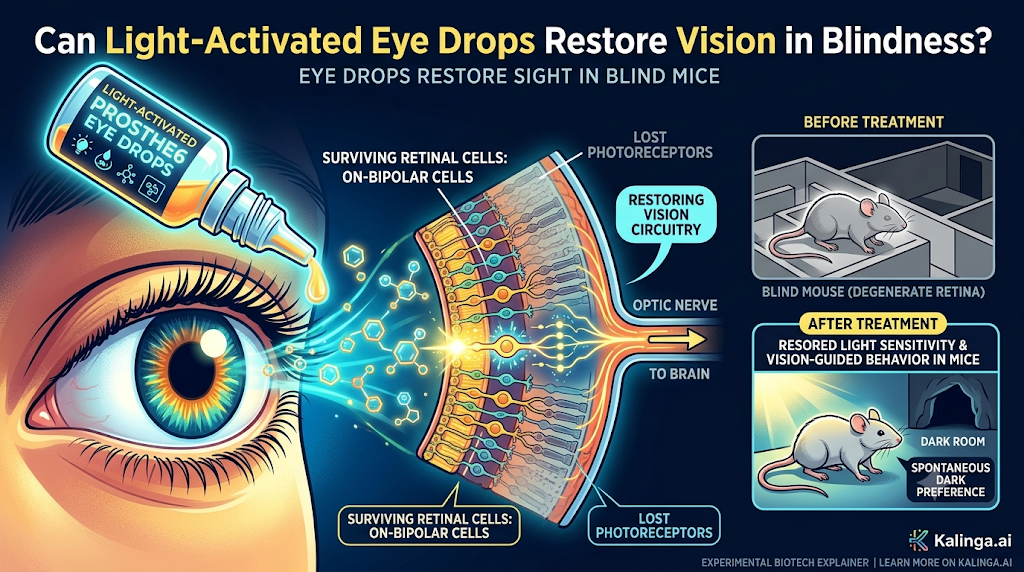
Caption: Could a simple eye drop help restore vision? Scientists have helped blind mice detect light again using light-activated drugs.
Description:
A cinematic landscape illustration showing a close-up human eye with glowing light-activated molecules entering the retina, alongside a subtle scientific visualization of retinal cells responding to light. The image represents experimental eye drops for blindness and the potential of photopharmacology to restore light perception without gene therapy or implanted
Alt Text: Eye drops for blindness shown as light-activated molecules restoring light perception in a blind mouse. devices.
Could a few drops placed in the eye help a blind animal detect light again? New research suggests the answer may be yes,at least in mice and zebrafish. Scientists led by the Institute for Bioengineering of Catalonia (IBEC) developed light-activated drugs that restored key visual behaviors in animal models of retinal degeneration, including compounds that worked when administered as eye drops.
The research, published in the Journal of the American Chemical Society in 2026, does not mean a treatment for blindness is ready for people. Instead, it offers an intriguing experimental route toward vision restoration that could eventually avoid gene therapy, implanted electronics, and specialized lighting.
The central idea is surprisingly simple: rather than replacing damaged photoreceptor cells, researchers are trying to make surviving retinal cells respond to light again.
Why Retinal Degeneration Causes Blindness
To understand why these experimental eye drops matter, it helps to look at what happens inside a degenerating retina.
The retina is the light-sensitive tissue at the back of the eye. It contains photoreceptors, specialized cells called rods and cones that detect light and begin the chain of signals that eventually allows the brain to construct what we see.
In diseases such as age-related macular degeneration (AMD) and retinitis pigmentosa (RP), photoreceptors can gradually deteriorate and die. Once those cells are lost, the visual system can no longer receive normal light signals.
But there is an important detail: photoreceptors are not the entire visual system.
Many of the neurons deeper inside the retina can survive even after photoreceptors have disappeared. Those remaining cells are still connected to parts of the neural circuitry that normally sends visual information toward the brain. The problem is that they have effectively lost their source of light input.
Definition: Photoreceptor degeneration
Photoreceptor degeneration is the progressive loss of retinal cells responsible for detecting light.
It is associated with several serious eye diseases, including AMD and RP. When photoreceptors disappear, other retinal neurons may remain structurally intact but can no longer receive the signals they normally get from light-sensitive cells.
That surviving circuitry is what the new research is trying to exploit.
Why target surviving retinal cells?
Because replacing every lost photoreceptor is extremely difficult, researchers are exploring whether existing retinal neurons can be made light-sensitive instead.
The IBEC-led team took this approach by targeting ON-bipolar cells, which normally receive signals from photoreceptors and help pass information deeper into the retinal network.
If these cells can be switched into a light-responsive state, they could potentially perform part of the job that missing photoreceptors once performed.
That is the basic concept behind the experimental treatment.
How Light-Activated Eye Drops Work
The research relies on a field called photopharmacology.
Photopharmacology uses light to control the activity of a drug. Scientists attach or incorporate a light-sensitive molecular switch into a compound so that its chemical structure,and therefore its biological activity,changes when exposed to light.
In this study, researchers developed a family of compounds called prosthe6.
Rather than acting as a conventional drug that simply remains active after administration, these molecules are designed to respond to light. When light reaches the molecules, they change shape and influence signaling within retinal cells.
The researchers describe this concept as creating a kind of “molecular prosthesis.”
Instead of placing an electronic device inside the eye, the molecules themselves help restore a missing biological function.
What makes prosthe6 different?
The prosthe6 compounds target the surviving retinal circuitry rather than attempting to regenerate the photoreceptors themselves.
The molecules interact with a protein called mGlu6 on ON-bipolar cells. This allows light-triggered molecular changes to influence retinal signaling in a way that resembles part of the normal photoreceptor-to-bipolar-cell pathway.
The approach is therefore fundamentally different from simply attaching a camera or electronic implant to the visual system.
And importantly, researchers found that two compounds,prosthe6-12 and prosthe6-15,could produce visual responses when administered not only through injection into the eye but also through topical eye-drop delivery.
Do these eye drops cure blindness?
No. The researchers explicitly state that the compounds do not cure the underlying degeneration.
Instead, they aim to compensate for the loss of photoreceptor function by making surviving retinal circuitry responsive to light. Whether this can eventually produce useful vision in humans remains an open scientific question.
That distinction is critical. The current findings demonstrate restored visual function in animal models, not a proven treatment for human blindness.
What Happened When Scientists Tested the Treatment?
The researchers tested the prosthe6 compounds across animal models, including blinded zebrafish larvae and mice representing retinal degeneration.
In zebrafish, the compounds restored saccadic eye movements, measured through the optokinetic reflex. This reflex is an involuntary eye movement associated with tracking visual motion and is commonly used as an indicator of visual function.
The mouse experiments provided another striking behavioral result.
Healthy mice naturally tend to prefer darker environments. Blind mice lose this preference because they cannot properly distinguish between light and dark.
After treatment with prosthe6, the blind mice once again showed a spontaneous preference for darker spaces.
Why is the dark-room test important?
The mice did not need to be trained to perform a particular task.
Instead, researchers observed a naturally occurring behavior: treated animals avoided brighter areas and favored darkness. That suggests they had regained enough light perception to use visual information to guide their behavior.
The response also occurred under illumination comparable to ordinary indoor conditions and outdoor light on an overcast day.
That matters because some experimental vision-restoration technologies require unusually intense or specially delivered light. The prosthe6 compounds were designed to respond to more familiar forms of visible or white light.
The results do not establish that the mice regained normal eyesight. They demonstrate that the treatment restored measurable light sensitivity and visually guided behavior.
Why Ordinary Light Matters
Restoring light sensitivity is only useful if the visual system can operate under realistic conditions.
Some experimental approaches to vision restoration use optogenetics, a technique that modifies cells genetically so they become responsive to light. Depending on the system, this can involve specialized lighting equipment or other technologies designed to stimulate the modified cells.
The prosthe6 strategy takes a different route.
The molecules are designed to respond to common visible or white light, including ordinary indoor illumination and daylight. Researchers therefore hope the approach could eventually restore useful visual signaling without requiring patients to carry or operate specialized light-delivery equipment.
Comparison: Different Approaches to Vision Restoration
| Approach | Basic idea | Genetic modification? | Implant required? | Current research challenge |
| Gene therapy | Correct or replace a disease-causing genetic function | Often | No | Suitable for particular genetic conditions |
| Retinal prosthesis | Use electronic hardware to stimulate retinal pathways | No | Yes | Invasive hardware and training requirements |
| Optogenetics | Make retinal cells respond to light using genetic tools | Yes | No | Delivering useful visual information |
| Light-activated drugs | Use photoswitchable molecules to control retinal signaling | No | No | Safety, duration and effectiveness in humans |
| Prosthe6 eye drops | Activate surviving retinal circuitry with photoswitchable molecules | No | No | Human translation and long-term performance |
The comparison highlights why the new approach has attracted attention. A drug that can be delivered topically and work with ordinary light could potentially be simpler than approaches requiring genetic modification or implanted hardware.
But simplicity of delivery does not automatically mean simplicity of treatment. The researchers still need to establish how long the effect lasts, how safe repeated administration would be, how the formulation behaves in the human eye, and whether meaningful vision,not merely light perception,can be restored.
The “Molecular Prosthesis” Idea Explained
The phrase molecular prosthesis sounds futuristic, but the concept can be understood without advanced chemistry.
Imagine a machine whose light sensor has stopped working while most of its wiring remains intact. One possible solution is to install a completely new electronic sensor.
Another is to find a way to make one of the existing components respond to light.
That second strategy is closer to what the researchers are attempting.
What does a molecular prosthesis do?
A molecular prosthesis is a molecule designed to compensate for a missing biological function.
In the prosthe6 approach, the molecule interacts with surviving retinal circuitry and changes its activity in response to light. The objective is not to rebuild the lost photoreceptor but to provide some of the signaling function that the photoreceptor once supplied.
This could be particularly useful in degenerative eye diseases where substantial portions of the retinal network remain available for stimulation.
The researchers’ goal is therefore not to bypass the retina entirely. Instead, they want to reactivate visual processing within the retinal circuit itself.
That is one of the most interesting aspects of the study.
Why Eye-Drop Delivery Could Be a Big Advantage
A treatment’s biological effectiveness is only part of the story. How easily patients can receive it also matters.
Gene therapies can involve sophisticated delivery systems. Electronic retinal prostheses require surgery and implanted hardware. Other experimental approaches can require specialized equipment or carefully controlled stimulation.
By contrast, topical eye drops are familiar, relatively simple to administer, and potentially suitable for repeated dosing if a formulation can be made safe and effective.
The researchers reported that prosthe6-12 and prosthe6-15 produced restored visual behaviors after topical administration as eye drops in the animal experiments.
Does an eye drop mean the treatment is already practical?
Not yet.
Getting a molecule from an eye drop to the right retinal cells at an effective concentration is a major pharmaceutical challenge. Researchers must also determine how long the compound remains active, how frequently it would need to be administered, and whether repeated exposure could cause unwanted effects.
The study establishes that topical delivery is scientifically promising in the tested animal models. It does not establish a safe or effective dosing schedule for people.
That distinction is especially important when discussing experimental medical research online.
What Diseases Could This Approach Eventually Target?
The research focuses on retinal degeneration, particularly models associated with age-related macular degeneration and retinitis pigmentosa.
AMD is one of the major causes of vision loss and primarily affects the central region of vision in its advanced forms. RP refers to a group of inherited retinal disorders that can progressively damage photoreceptors.
Together, these conditions affect a very large global population.
The research team notes that photoreceptor degeneration associated with these disorders affects approximately 200 million people worldwide, while vision loss creates an estimated global economic burden exceeding US$400 billion annually through healthcare costs and lost productivity.
However, the potential breadth of a treatment should not be confused with demonstrated effectiveness.
A major attraction of the prosthe6 concept is that it could potentially work independently of the specific genetic mutation responsible for photoreceptor loss. But that possibility still needs to be demonstrated through additional research and, ultimately, clinical trials.
Why This Research Is Different From Gene Therapy
Gene therapy generally aims to modify genetic material to address a biological problem.
For some inherited retinal diseases, that can mean delivering a functional version of a gene or otherwise altering cellular behavior. But genetic diversity creates a challenge: a therapy designed for one mutation may not work for another.
The prosthe6 strategy approaches the problem from another direction.
Rather than asking, “Which genetic defect caused the photoreceptors to die?” researchers are asking, “Can we make the surviving retinal network respond to light regardless of that original mutation?”
Could this approach work for more patients?
Potentially, but that remains to be proven.
The researchers suggest that a mechanism independent of a specific retinal disorder or genetic mutation could eventually have broader applicability. However, the effectiveness of the approach may depend on how much retinal circuitry remains functional in an individual patient.
This is one reason further animal studies and human research will be essential.
More Than 10 Years of Research Led to This Result
The reported breakthrough did not appear overnight.
The project represents more than a decade of research involving scientists from multiple institutions in Spain, including IBEC, the University of Alcalá, the University of Barcelona, IQAC-CSIC, IRYCIS, the Autonomous University of Barcelona and the Fundació Eduard Soler.
Pau Gorostiza, an ICREA Research Professor at IBEC, led the Nanoprobes and Nanoswitches group involved in the work. Pedro de la Villa at the University of Alcalá also co-led the study.
Rosalba Sortino, a former doctoral researcher at the University of Barcelona and now a postdoctoral researcher in Gorostiza’s group, was a co-first author.
The study illustrates an important lesson about biomedical innovation: major breakthroughs often emerge from years of incremental chemistry, biology, testing and troubleshooting.
The final eye-drop application was built on researchers first understanding how photoswitchable molecules could interact with retinal signaling.
What Happens Next?
The most exciting part of the study may be what researchers need to do next.
The prosthe6 technology is patented, and the team is continuing to investigate its safety and formulation. One goal is to extend the duration of restored visual function.
The researchers are also working with Eyelumina, a spin-off company being formed to help attract investment for translational development and potential future clinical trials.
But moving from successful animal experiments to a human therapy is a long process.
Before a treatment can be tested broadly in people, researchers need evidence addressing questions such as:
- Is the compound safe in the human eye?
- How much of the drug reaches the intended retinal cells?
- How long does a dose remain effective?
- How frequently would patients need treatment?
- Does repeated dosing remain safe?
- Can the treatment restore useful visual information rather than simple light perception?
- Which patients are most likely to benefit?
- Does retinal degeneration have to reach a particular stage for the therapy to work?
- Can the formulation remain stable and practical for clinical use?
These questions are not minor technicalities. They determine whether an exciting laboratory discovery can become a real medical treatment.
From Seeing Light to Seeing the World
There is an important difference between detecting light and seeing a detailed image.
The animal experiments provide evidence that prosthe6 can restore light perception and certain visually guided behaviors. That is an important milestone, but human vision involves much more.
Useful sight requires the visual system to process brightness, contrast, edges, movement, color, spatial relationships and other information. The brain then integrates those signals into meaningful perception.
Therefore, even if a future treatment can make degenerating retinas light-sensitive, researchers will still need to determine what quality of vision is possible.
Could the treatment restore normal eyesight?
There is currently no evidence that it can restore normal human eyesight.
The researchers’ findings demonstrate a promising biological mechanism in animal models. The next challenge is determining whether the same mechanism can provide sufficiently rich visual information in humans.
That is why descriptions such as “blind mice see again” should be interpreted carefully. The animals regained measurable visual responses and behavior, but that does not mean their vision became identical to that of healthy mice.
Why the Study Matters Beyond One Eye-Drop Drug
Even if prosthe6 itself never becomes an approved medicine, the underlying research could influence the broader field of vision restoration.
It demonstrates that surviving retinal neurons may be manipulated chemically to respond to light. That expands the list of possible strategies for treating blindness caused by photoreceptor degeneration.
It also shows the potential of reversible molecular switches in medicine.
Instead of permanently changing cells, researchers can potentially use molecules whose activity changes in response to an external signal,in this case, light.
That creates an intriguing middle ground between traditional drugs and electronic or genetic technologies.
The approach could ultimately become part of a larger toolkit for treating degenerative diseases of the nervous system.
A New Chapter for Photopharmacology
Photopharmacology has been developing for years, but vision restoration provides an especially interesting application because light is already the natural input the eye is designed to detect.
The research team notes that its work comes shortly after the publication of the first clinical trial of a photopharmacological drug for vision restoration, involving a different molecular target.
That milestone suggests the field is beginning to move beyond laboratory concepts and toward clinical investigation.
Still, clinical translation requires caution.
A molecule that works in a mouse retina is not automatically safe or effective in a human retina. Differences in anatomy, metabolism, immune response, disease progression and drug delivery can all affect the outcome.
The path from animal experiment to approved therapy can take years.
The Bigger Lesson: Sometimes You Do Not Need to Rebuild the Whole System
One of the most compelling ideas behind this research is that restoring a lost function does not always require rebuilding the entire biological structure.
In retinal degeneration, photoreceptors may be gone while parts of the downstream network survive.
The scientists are essentially asking whether that surviving network can be given a new input mechanism.
That philosophy appears in many areas of modern biotechnology: rather than replacing every damaged component, researchers look for ways to repurpose what remains.
For people affected by severe retinal degeneration, that could eventually become an important direction for treatment research.
For now, however, the most accurate takeaway is more modest,and still remarkable:
Light-activated molecules delivered as eye drops restored measurable light perception and visually guided behavior in blind animal models, without gene therapy or implanted devices.
The next question is whether that molecular trick can be made safe, durable and powerful enough to help people.
Frequently Asked Questions
Can eye drops restore vision in blind people?
Experimental eye drops have not yet been shown to restore vision in blind humans. The new research demonstrated restored light perception and visually guided behavior in animal models using photoswitchable molecules.
What are light-activated eye drops?
Light-activated eye drops contain molecules whose biological activity can be controlled by exposure to light. In the reported research, prosthe6 compounds were designed to activate signaling in surviving retinal cells that normally receive information from photoreceptors.
How did the eye drops help blind mice?
The prosthe6 compounds targeted ON-bipolar cells in the retina. After treatment, blind mice regained a spontaneous preference for darker environments, suggesting that they could detect light and use that information to guide behavior.
What is photopharmacology?
Photopharmacology is a field that uses light-sensitive drugs whose activity can be reversibly controlled with light. Researchers modify drug molecules with photoswitches so that exposure to light changes their structure and biological activity.
Do these experimental eye drops cure retinitis pigmentosa or macular degeneration?
No. The treatment does not repair the underlying photoreceptor degeneration. Instead, it attempts to replace some of the lost photoreceptor function by making surviving retinal circuitry responsive to light.
When could this treatment be available to patients?
There is currently no established timeline for patient availability. Researchers are still studying safety, formulation and duration of the effect, and future clinical trials would be required before the approach could be considered an approved human treatment.
What This Means for the Future of Vision Restoration
The idea of restoring vision with a simple drop rather than an implant or genetic intervention sounds almost too good to be true. The latest research does not prove that such a treatment is ready for patients, but it demonstrates a clever strategy: use light-sensitive molecules to reactivate retinal circuits that remain after photoreceptors are lost.
If future studies confirm safety and show that the approach can restore richer forms of vision in humans, light-activated eye drops could represent a much simpler category of vision-restoration technology.
For now, the science is promising,but experimental. The journey from blind mice to human treatment still has many steps ahead.
If you enjoy explainers on emerging biotechnology, AI and breakthrough science, explore more research stories and technology guides on Kalinga.ai.
SEO Meta Configuration
Keyword Categorization
Primary Keyword:
- eye drops for blindness
Secondary Keywords:
- light-activated eye drops
- vision restoration
- photopharmacology
- retinal degeneration
LSI/Long-Tail Keywords:
- experimental eye drops for blindness
- eye drops restore sight in blind mice
- light-activated drugs for vision restoration
- can eye drops restore vision without gene therapy
Meta Title
Eye Drops for Blindness: Best 2026 Vision Breakthrough
SEO Meta Description: Light-activated eye drops restored light perception in blind mice. Discover how photopharmacology could transform future vision restoration. Read more.
URL Slug: light-activated-eye-drops-vision-restoration