File Name: roman-space-telescope-wide-field-cosmos.jpg
Title: Roman Space Telescope Maps the Cosmos
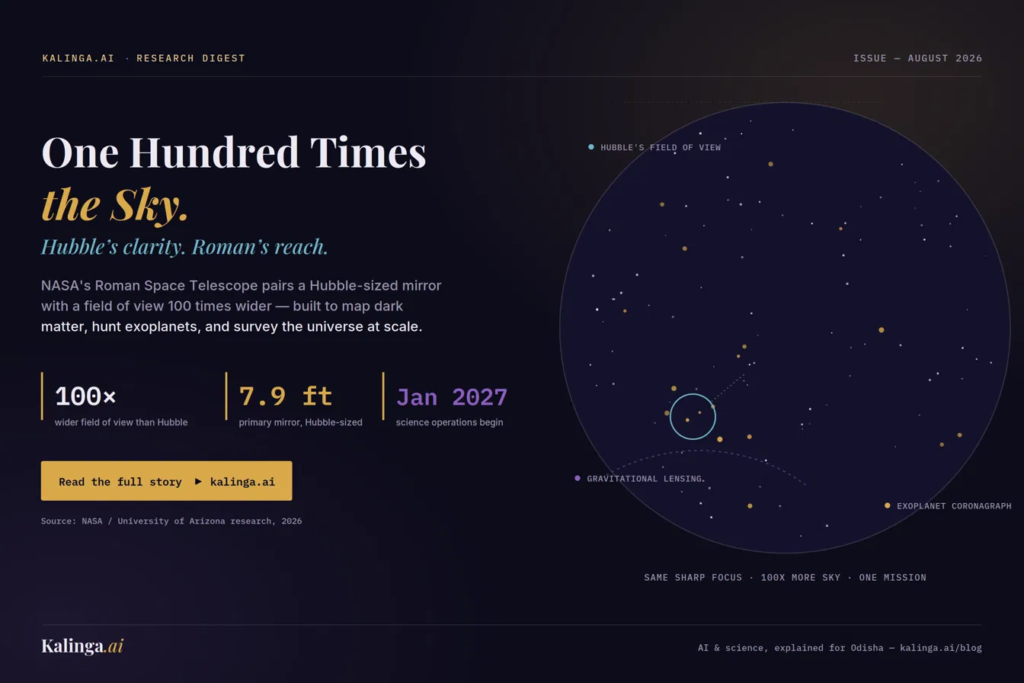
Caption: NASA’s Roman Space Telescope is set to survey the cosmos on a scale 100 times wider than Hubble.
Description:
A cinematic landscape illustration showing NASA’s Roman Space Telescope observing a vast field of galaxies, stars, nebulae, and distant cosmic structures. The composition should emphasize Roman’s 100-times-larger field of view, its infrared astronomy capabilities, and its mission to investigate dark matter, dark energy, and exoplanets.
Alt Text: Roman Space Telescope surveying a vast field of galaxies and distant cosmic objects across the universe.
Planned Structure
- H2: What Makes the Roman Space Telescope Different?
- H3: Hubble-level detail with a wider view
- H3: Roman vs. Hubble vs. Webb
- H2: How Much More Sky Will Roman See?
- H3: The 100-times-larger field of view
- H3: Why wide-field astronomy matters
- H2: How Roman Will Help Solve the Mysteries of Dark Matter and Dark Energy
- H3: Mapping the invisible universe
- H3: Kinematic lensing and cosmology
- H2: How Roman Will Search for Distant Planets
- H3: The Coronagraph Instrument
- H3: Direct imaging explained
- H2: Roman vs. Hubble vs. James Webb: What Is the Difference?
- H2: What Will Roman Discover Across the Universe?
- H3: Galaxies and cosmic structure
- H3: Supermassive black holes and gravitational lenses
- H3: Cosmic dust and reionization
- H2: Why Roman Needs Massive Computing Power
- H2: When Will Roman Begin Science Operations?
- H2: Why the Roman Space Telescope Matters for the Future of Astronomy
- H2: Frequently Asked Questions About the Roman Space Telescope
- H2: The Telescope Designed to See the Universe Differently
5 Focus Keywords
- Primary Keyword: Roman Space Telescope
- NASA Roman Space Telescope
- Roman telescope vs Hubble
- Roman Space Telescope dark matter
- Roman Space Telescope exoplanets
How Will NASA’s Roman Space Telescope Transform Astronomy?
Imagine pointing a telescope at the night sky and suddenly being able to see an area 100 times larger than Hubble’s view without giving up Hubble-like detail.
That is the basic promise of NASA’s Roman Space Telescope, the agency’s next flagship astrophysics mission after the James Webb Space Telescope. Designed to survey enormous portions of the universe while maintaining high-resolution observations, Roman could transform how astronomers study galaxies, exoplanets, dark matter, and dark energy.
The telescope is named after Nancy Grace Roman, NASA’s first chief astronomer and a key figure in establishing the agency’s space-based astronomy program. Its mission is built around a deceptively simple idea: see more of the universe, faster, while still seeing it in extraordinary detail.
Roman will not simply replace Hubble or Webb.
Instead, it is designed to complement them.
Where Webb can examine relatively small regions of space in extraordinary depth, Roman will survey vast areas of the sky. Because Roman and Webb can both observe infrared light, their data can also be combined to give scientists a richer picture of objects and structures across the cosmos.
What Makes the Roman Space Telescope Different?
The most important feature of the Roman Space Telescope is not simply the size of its mirror.
It is the combination of high resolution and an extremely wide field of view.
Roman will have a 7.9-foot primary mirror, approximately the same diameter as Hubble’s mirror. But its Wide Field Instrument is designed to capture an area of sky 100 times larger than Hubble’s cameras while providing comparable sensitivity.
That changes what astronomers can do.
Instead of spending long periods studying one small patch, researchers can survey enormous areas and search those images for rare or unusual objects.
Hubble sees deeply; Roman sees broadly
Hubble has spent more than three decades transforming our understanding of the universe.
But even after all that time, it has observed only around 0.1% of the night sky, according to the source material.
Roman is designed for a dramatically different approach.
Its wide field could allow astronomers to survey enormous portions of the sky at a resolution comparable to Hubble’s, creating enormous catalogs of galaxies, stars, planets, and other cosmic objects.
Question: What is the biggest advantage of the Roman Space Telescope?
Its biggest advantage is its ability to combine high-resolution imaging with an exceptionally wide field of view.
That means astronomers can search much larger regions of space for rare events and objects while still collecting detailed observations.
This matters because the universe is enormous, and many scientifically valuable objects are rare.
Finding one unusual galaxy, distant supernova, gravitational lens, or planetary system can require searching huge areas.
Roman is essentially being designed to make that search much faster.
How Much More Sky Will Roman See?
The phrase “100 times more sky than Hubble” captures one of the mission’s most important capabilities.
The Roman Space Telescope’s Wide Field Instrument is designed to image an area 100 times larger than Hubble’s cameras while maintaining comparable sensitivity.
That does not mean Roman will make every observation 100 times faster or that every scientific measurement will automatically improve by a factor of 100.
It means its camera can capture a much larger region of the sky in a single observation.
Why does field of view matter?
Imagine searching for a rare bird in a forest.
One approach is to inspect a tiny area very carefully. You might see extraordinary detail, but you could spend a long time before finding the bird.
Another approach is to scan a much larger area while retaining enough detail to identify what you are looking for.
Astronomers face a similar problem.
Rare cosmic objects can be scattered across enormous distances. A wider field makes it possible to search more efficiently.
Question: Why can’t Hubble simply do the same thing?
Hubble’s instruments were designed for a different balance between resolution, sensitivity, and field of view.
Roman was specifically designed as a wide-field survey telescope.
Its mission therefore complements Hubble rather than simply duplicating it.
The difference becomes especially important for surveys involving millions or billions of objects.
Instead of asking only, “What is happening in this tiny region?” Roman can help astronomers ask, “What is happening across a huge portion of the universe?”
Roman Space Telescope vs. Hubble and Webb
The three observatories have different strengths.
Hubble revolutionized optical and ultraviolet astronomy from space. Webb was designed primarily for infrared astronomy and can study extremely distant and faint objects in remarkable detail.
Roman adds another capability: large-scale infrared surveys.
| Telescope | Major Strength | Field of View | Key Scientific Role |
| Hubble | High-resolution optical/UV observations | Relatively narrow | Detailed observations of galaxies, stars and other objects |
| James Webb | Deep infrared observations | Smaller survey fields | Early universe, galaxies, stars, planetary systems |
| Roman | Wide-field infrared surveys | 100× Hubble’s camera field | Cosmology, exoplanets, galaxy surveys and large-scale mapping |
Question: Is Roman better than Hubble or Webb?
Not in every situation.
Each telescope is optimized for different scientific goals. Hubble excels at detailed observations across important wavelengths, while Webb can investigate extremely faint and distant infrared sources in depth.
Roman’s strength is scale.
Its ability to survey vast areas means it can identify targets and patterns that might then be studied in greater detail by Hubble, Webb, ground-based observatories, or future missions.
The result could be an astronomical ecosystem in which the telescopes work together rather than compete.
How Roman Will Help Solve the Mysteries of Dark Matter and Dark Energy
Some of the biggest questions in modern physics involve things we cannot directly see.
The universe contains dark matter, which interacts gravitationally but does not emit light in the way ordinary matter does.
It also contains dark energy, a mysterious component associated with the accelerating expansion of the universe.
Together, these poorly understood components account for most of the universe’s overall composition.
Roman is being designed to investigate them through large-scale observations of galaxies and cosmic structure.
Question: How can a telescope study something that does not emit light?
Scientists can study dark matter indirectly by observing its gravitational effects on visible objects.
Mass bends and distorts light. When light from distant galaxies passes through regions containing mass, its apparent shape and position can change.
Astronomers can analyze these distortions to infer where matter is located,even when some of that matter cannot be seen directly.
This phenomenon is known as gravitational lensing.
Definition + Expansion: Gravitational lensing
Gravitational lensing occurs when gravity from matter bends the path of light traveling through space.
A massive galaxy cluster, for example, can distort the light coming from objects behind it. By measuring these distortions across huge numbers of galaxies, astronomers can build maps of how matter is distributed through the universe.
Roman’s wide-field observations could provide an enormous amount of data for this kind of cosmological research.
What Is Kinematic Lensing?
Researchers are also developing specialized techniques to extract more information from Roman’s observations.
One example is kinematic lensing, a cosmological measurement technique being investigated by the University of Arizona’s Arizona Cosmology Lab.
Elisabeth Krause leads the wide-field science team “Kinematic Lensing with the Roman Space Telescope.” The team received $2 million to develop the technique.
The approach combines Roman imaging with spectroscopic measurements.
Spectroscopy is the study of how light is distributed across different wavelengths. Those measurements can reveal information about the motion and properties of astronomical objects.
Question: Why combine imaging with spectroscopy?
Images show where objects are and what they look like, while spectroscopy can provide additional physical information.
Combining those data sets can give researchers a more complete picture of galaxies and their motion.
The goal is to improve measurements used to investigate dark matter and dark energy.
This illustrates an important feature of modern astronomy: the telescope itself is only one part of the scientific system.
The real discoveries emerge when observations are combined with sophisticated models, computing systems, and measurements from other instruments.
How Roman Will Search for Distant Planets
Dark matter is not Roman’s only major science target.
The telescope will also investigate worlds beyond our solar system using its Coronagraph Instrument.
A coronagraph is an instrument designed to block or suppress the overwhelming light from a star so that much fainter objects nearby can potentially be detected.
This is an enormous challenge.
A planet may be billions of times fainter than the star it orbits. Looking for that planet is somewhat like trying to see a tiny candle next to an extremely bright spotlight.
Roman’s coronagraph is designed to demonstrate technologies for suppressing starlight and directly imaging nearby planets and circumstellar disks.
Definition + Expansion: Direct imaging
Direct imaging is a method of detecting an exoplanet by capturing light from the planet itself rather than only observing its effect on its host star.
Most known exoplanets have been discovered indirectly. For example, the transit method detects the tiny decrease in a star’s brightness when a planet passes in front of it.
Direct imaging is different.
Instead of waiting for the planet to block some of its star’s light, astronomers attempt to separate the planet’s faint signal from the star’s much brighter glare.
Question: How powerful will Roman’s coronagraph be?
The instrument is expected to detect planets that are 100 million times fainter than their host stars.
According to the source material, that represents performance roughly 100 to 1,000 times better than existing space-based coronagraphs.
The instrument uses a combination of masks, prisms, detectors, filters, and self-flexing mirrors to suppress starlight.
The technology is also important beyond Roman itself.
Researchers view the coronagraph as a technology pathfinder for a future Habitable Worlds Observatory, a proposed telescope designed to search for signs of life around other stars.
Why Roman’s Exoplanet Work Could Be a Big Deal
Finding an exoplanet is only the beginning.
Astronomers also want to know what these worlds are like.
Are they hot or cold? What chemicals are present in their atmospheres? Do they have clouds? How did their planetary systems form?
Roman’s observations could help answer some of these questions, particularly for young, self-luminous giant planets.
Self-luminous planets
Some young giant planets are hot enough to emit significant amounts of thermal infrared radiation.
Researchers can model their expected atmospheric properties and spectra before observations are made.
Those predictions help scientists determine how much observing time may be required to detect a faint planet.
Question: Why is advance modeling important for Roman?
Roman’s coronagraph will be working with extremely faint, high-contrast targets.
Because telescope time is limited, astronomers need to know which targets are most promising and how long they should observe them.
Atmospheric and climate models can help researchers predict what a planet’s infrared spectrum might look like.
That makes it easier to plan observations efficiently.
University of Arizona researchers including Mark Marley, Ewan S. Douglas, Ramya Anche, and Justin Hom are involved in different aspects of Roman’s coronagraph science and observation planning.
What Else Will the Roman Space Telescope Discover?
Exoplanets and dark matter are only two parts of Roman’s mission.
Its enormous surveys could produce catalogs containing vast numbers of galaxies and other astronomical objects.
Researchers can then analyze those catalogs to investigate how the universe is structured and how it has changed over cosmic time.
Roman’s science program is expected to investigate areas including:
- Galaxy formation and evolution
- Dark matter
- Dark energy
- Gravitational lenses
- Supermassive black holes
- Reionization
- Cosmic dust
- Exoplanets
- Planetary atmospheres
- Large-scale cosmic structure
Mapping the universe
Roman will identify galaxies across a broad range of distances and measure their properties.
Those observations can be assembled into enormous catalogs.
Scientists can then compare the observed distribution of galaxies with theoretical models.
This is how an image of the sky can become something much bigger: a map that helps scientists investigate the history and structure of the universe.
Question: What can a galaxy catalog tell scientists?
A large galaxy catalog can reveal how galaxies are distributed through space and how that distribution changes with distance and cosmic time.
Researchers can use those patterns to test models of the universe and estimate quantities related to dark matter and dark energy.
The larger and more precise the survey, the more powerful these statistical measurements can become.
That is one reason Roman’s wide field is so important.
Why Roman Needs Massive Computing Power
There is a hidden challenge behind all those beautiful space images: data.
A telescope that surveys enormous areas of the sky can produce an extraordinary volume of observations.
Turning those observations into scientific conclusions requires high-performance computing, sophisticated algorithms, physical models, and enormous catalogs.
The University of Arizona’s Tim Eifler is leading a working group responsible for interpreting Roman’s cosmological observations.
His lab received $800,000 for computing resources that will become part of a new university-wide high-performance computing system.
The lab will also receive another $2.4 million over five years for the science.
Question: Why does astronomy need so much computing power?
Modern astronomical surveys produce far more information than researchers can analyze manually.
Computers must process images, identify galaxies, measure their properties, model gravitational effects, compare observations with theories, and extract statistical patterns.
Eifler described the infrastructure as a way to move from catalogs to cosmological interpretation.
That is a useful way to think about modern astronomy.
The telescope collects the raw evidence. Computing turns that evidence into measurements. Scientific models then help turn those measurements into explanations about how the universe works.
Why Roman and Webb Could Work Better Together
It is tempting to think of major telescopes as competing for attention.
But Roman’s design suggests something different.
Webb can observe relatively small areas with extraordinary sensitivity and detail. Roman can survey enormous regions and identify interesting objects or patterns.
Because both observatories can detect infrared light, scientists can compare observations from the two missions.
Question: What happens when Roman and Webb observe the same target?
Astronomers can potentially combine the strengths of both observatories.
Roman may identify a rare galaxy, planetary system, or other object during a wide survey. Webb can then provide a deeper, more detailed investigation of selected targets.
The reverse can also be useful: discoveries from Webb can become targets for broader surveys and statistical analysis with Roman.
This creates a powerful combination of breadth and depth.
When Will the Roman Space Telescope Begin Science Operations?
The source material states that Roman’s science operations are expected to begin in January 2027.
Once science operations begin, its data will become available to researchers across the scientific community.
The University of Arizona is expected to lead nine NASA-approved investigations using Roman data, with more than $2 million in funding described in the source material.
Those projects cover a broad range of astrophysical questions.
Question: Will Roman only benefit scientists working directly on the mission?
No.
A major scientific observatory can become a resource for a much wider research community.
Once data are available, scientists can use them to investigate questions beyond the original observation programs.
That open scientific ecosystem can lead to discoveries that were not necessarily anticipated when the telescope was designed.
What Makes Roman Important for the Future of Astronomy?
The Roman Space Telescope represents a shift in how astronomers can explore the universe.
For much of modern astronomy, detailed observations have often meant focusing on relatively small regions.
Roman changes the balance.
Its mission is built around surveying enormous areas while retaining enough resolution and sensitivity to identify scientifically valuable details.
That could transform several areas simultaneously.
1. Astronomy becomes more survey-driven
Instead of selecting only a handful of targets, scientists can search huge populations of objects.
2. Rare events become easier to find
A wider survey increases the chance of discovering unusual objects and transient events.
3. Cosmology gets enormous datasets
Large galaxy surveys can improve statistical measurements of cosmic structure.
4. Exoplanet research gains a new direct-imaging tool
The coronagraph can demonstrate technologies needed for future missions that may eventually investigate potentially habitable worlds.
5. Multiple observatories can work together
Roman’s surveys can identify targets for deeper observations with Webb, Hubble, and other observatories.
Question: Could Roman change our understanding of the universe?
Yes, it has the potential to significantly improve measurements in several major areas of astronomy, particularly cosmology and exoplanet science.
But the exact discoveries cannot be predicted in advance.
Some of the most important scientific results from a new observatory may come from unexpected objects or phenomena that researchers did not know to look for.
That is one of the most exciting aspects of building a telescope capable of surveying such a large portion of the sky.
Frequently Asked Questions About the Roman Space Telescope
What is the Roman Space Telescope?
The Roman Space Telescope is NASA’s next flagship astrophysics observatory after the James Webb Space Telescope. It is designed primarily for wide-field infrared surveys that can investigate dark matter, dark energy, galaxies, exoplanets, and other major questions in astronomy.
How much more sky will Roman see than Hubble?
Roman’s Wide Field Instrument is designed to image an area 100 times larger than Hubble’s cameras while maintaining comparable sensitivity. This wide field allows Roman to survey much larger regions of the sky efficiently.
Is the Roman Space Telescope replacing Hubble?
No. Roman is designed to complement Hubble rather than replace it. Hubble remains highly valuable for detailed observations, while Roman is optimized for wide-field surveys and large-scale astronomical mapping.
How is Roman different from the James Webb Space Telescope?
Webb is optimized for deep, detailed infrared observations of relatively small regions, while Roman is designed to survey much larger areas of the sky. Their observations can complement one another, especially because both observatories can detect infrared light.
How will Roman study dark matter?
Roman will study dark matter indirectly by measuring its gravitational effects on visible objects. Wide-field observations and gravitational-lensing measurements can help astronomers map the distribution of matter across the universe.
Can Roman directly photograph exoplanets?
Roman’s Coronagraph Instrument is designed to demonstrate technology for directly imaging nearby planets and circumstellar disks by suppressing the bright light of their host stars. It is expected to detect planets that are extremely faint compared with their stars.
The Telescope Designed to See the Universe Differently
The most important thing about the Roman Space Telescope may be summed up in one number: 100.
Not because Roman will simply be “100 times better” than Hubble,it will not. The significance of that number is that Roman’s Wide Field Instrument can see an area of sky 100 times larger than Hubble’s cameras while maintaining comparable sensitivity.
That changes the scale of the questions astronomers can ask.
Instead of studying only individual cosmic objects, scientists can map enormous populations. Instead of searching small regions for rare planets or galaxies, they can survey huge areas. Instead of treating dark matter and dark energy as mysteries constrained by relatively limited datasets, researchers can build increasingly detailed maps of the universe’s structure.
And Roman will not operate alone.
Hubble, Webb, ground-based observatories, computational models, and future missions can all contribute to the scientific picture. Roman’s greatest strength may therefore be not simply what it sees, but how much more efficiently it allows humanity to search the universe for something we have never seen before.
For more explainers on space technology, astronomy, AI, and the discoveries shaping the future, explore more science stories on Kalinga.ai.
SEO Meta Configuration
Keyword Categorization
Primary Keyword:
- Roman Space Telescope
Secondary Keywords:
- NASA Roman Space Telescope
- Roman telescope vs Hubble
- Roman Space Telescope exoplanets
- Roman Space Telescope dark matter
LSI/Long-Tail Keywords:
- how the Roman Space Telescope works
- why Roman Space Telescope is 100 times wider than Hubble
- Roman Space Telescope vs James Webb
- how Roman will study dark matter and exoplanets
Meta Title
Roman Space Telescope: Ultimate 2026 Guide to NASA’s Mission
SEO Meta Description: Discover how NASA’s Roman Space Telescope will survey 100× more sky than Hubble and explore dark matter, exoplanets and cosmic mysteries.
URL Slug: roman-space-telescope