Why Did Claude Code Shrink by 45%?
The size reduction in Claude Code is primarily an engineering optimisation rather than a reduction in the tool’s fundamental capabilities.
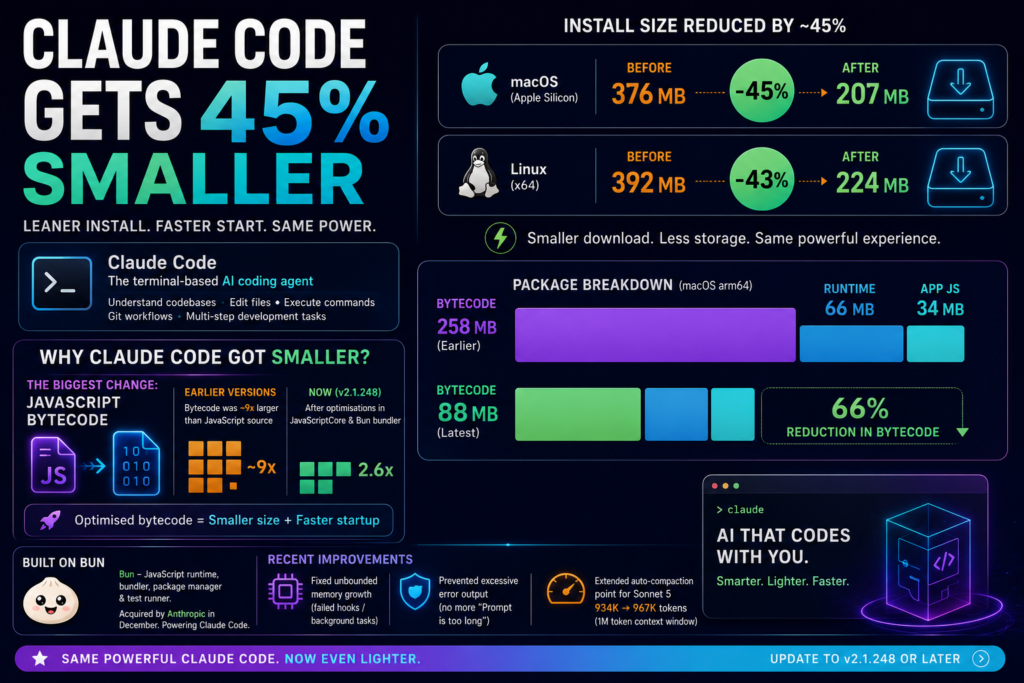
Version 2.1.248, published on August 27, reduced the installation package from hundreds of megabytes to just over 200 MB on the platforms highlighted by Sumner. On Apple Silicon Macs, the package went from 376 MB to 207 MB, while Linux x64 dropped from 392 MB to 224 MB.
Question: What caused the biggest reduction?
The largest change came from the JavaScript bytecode bundled with Claude Code. The application parses source code ahead of time into bytecode to support faster startup, but the generated bytecode had previously occupied considerably more space than the JavaScript source itself.
Sumner said earlier versions produced bytecode that was approximately nine times larger than the JavaScript source code from which it was generated. Following several optimisations to JavaScriptCore’s bytecode serialisation format and Bun’s bundler, that ratio has fallen to approximately 2.6 times.
That difference matters because bytecode is not simply an optional cache sitting somewhere outside the application. In this architecture, it forms part of the software package users install.
The result is a smaller distribution without requiring developers to fundamentally change how they use the coding agent.
What Is JavaScript Bytecode?
JavaScript bytecode is an intermediate representation of JavaScript that a runtime can use when executing a program, allowing some work that would otherwise happen during startup to be performed ahead of time.
In practical terms, the idea is similar to preparing ingredients before cooking. Instead of repeatedly parsing the same source code when an application starts, some of that work can be completed earlier so the program is ready to execute more quickly.
The trade-off is that precomputed data takes storage space. If that representation becomes unnecessarily large, users may end up downloading significantly more data simply to get faster startup behaviour.
The optimisation in Claude Code is therefore interesting because Anthropic and the Bun team have attempted to reduce that storage overhead while retaining the advantages of ahead-of-time processing.
The Biggest Win Came From Bytecode
The package breakdown provides a clearer picture of where the savings came from.
On macOS arm64, the bytecode component fell from 258 MB to 88 MB, representing a reduction of roughly 66%. That is substantially larger than the overall package reduction because other components of the application remain in place.
The latest build contains approximately 66 MB of runtime components and another 34 MB of application JavaScript, according to the breakdown shared alongside the update.
| Component | Earlier macOS arm64 build | Latest build | Change |
| JavaScript bytecode | 258 MB | 88 MB | ~66% smaller |
| Runtime components | , | 66 MB | Part of latest package |
| Application JavaScript | , | 34 MB | Part of latest package |
| Total package | 376 MB | 207 MB | ~45% smaller |
Question: Why does a 66% bytecode reduction produce only a 45% overall package reduction?
Because bytecode is only one component of the installation. The runtime, JavaScript application code and other files still occupy storage, so shrinking one large component does not reduce the entire package by the same percentage.
This distinction is important when interpreting the 45% smaller headline. It does not mean every part of the application has become 45% smaller. Instead, a particularly large component was aggressively optimised, pulling down the total installation footprint.
For developers, that is still a meaningful improvement.
Why Smaller Installation Sizes Matter
A reduction from more than 376 MB to 207 MB may not seem revolutionary if you have a modern laptop with hundreds of gigabytes of storage. But installation size is not only about disk space.
Every software package has a distribution cost. Developers need to download it, install it, update it and sometimes reinstall it across multiple machines or environments.
A smaller package can therefore be useful in situations where developers frequently set up new environments, work across different machines or operate with bandwidth constraints.
Question: Does a smaller package automatically make Claude Code faster?
Not necessarily. The size reduction is directly tied to packaging and bytecode optimisations, while startup performance depends on several factors. The bytecode itself exists partly because source code is parsed ahead of time to help Claude Code start faster.
That means the engineering work has two related goals: avoid excessive storage overhead while preserving the runtime benefits of preprocessed code.
This is a subtle but important distinction. A smaller binary is beneficial on its own, but it does not mean developers should assume that every aspect of the application is now 45% faster.
Claude Code Is More Than a Smaller Binary
The installation reduction arrives while Claude Code continues to evolve as an AI-powered development environment.
Unlike a traditional code editor extension that primarily offers suggestions while a developer types, Claude Code operates from the terminal and can interact with a broader development workflow.
The current tool can:
- Understand existing codebases
- Edit files
- Execute commands
- Work with Git workflows
- Process development tasks from the terminal
- Assist with larger, multi-step coding workflows
This places it in the broader category of AI coding agents.
Definition , AI coding agent: An AI coding agent is a software tool that can interpret a developer’s instructions, inspect project files and perform development actions rather than merely generating isolated snippets of code.
That distinction matters because an agent needs more than a capable language model. It also needs a runtime, file-system access, command execution, tooling and mechanisms for maintaining context while completing tasks.
As these tools become more capable, their underlying software infrastructure becomes increasingly important.
A coding agent that can reason about a repository but takes excessive time to launch, consumes unnecessary resources or becomes difficult to distribute creates friction for developers.
The latest optimisation shows that Anthropic is paying attention to that less glamorous side of AI development: the engineering underneath the model experience.
How Bun Fits Into the Story
One of the most interesting parts of the update is the connection between Claude Code and Bun.
Jarred Sumner, who described the bytecode optimisation, previously founded Bun, a JavaScript runtime and all-in-one development toolkit. Anthropic acquired Bun in December, and the technology has since become important infrastructure for Claude Code.
Bun combines several functions that JavaScript developers typically rely on across different tools, including a runtime, bundler, package manager and test runner.
Question: Why is Bun relevant to the package-size reduction?
Because the optimisation involved both JavaScriptCore’s bytecode serialisation format and Bun’s bundler. In other words, the improvement was not simply a matter of deleting unused files; it involved changes to how JavaScript code is prepared and packaged.
Anthropic said when it acquired Bun that the technology would help make Claude Code faster and more stable. Sumner’s team was also expected to continue developing the open-source project.
The latest reduction provides a concrete example of why control over this layer of the technology stack can matter.
Instead of treating the JavaScript runtime and bundling process as invisible infrastructure, Anthropic can optimise them alongside the application itself.
The Timing Is Important
The smaller package was introduced during a period of rapid release activity.
Version 2.1.248 was published on August 27, followed by version 2.1.250 on August 28.
That pace illustrates another characteristic of modern AI developer tools: they are changing quickly, with improvements often arriving through frequent incremental releases rather than occasional major versions.
The package-size reduction also followed other changes focused on reliability and runtime efficiency.
In version 2.1.247, Anthropic addressed an issue involving unbounded memory growth associated with failed hooks or background-task output. It also addressed excessive error output that could cause sessions to become stuck with “Prompt is too long” errors.
The release additionally reduced unnecessary GitHub status checks.
These changes may sound unrelated to installation size, but they point toward a broader engineering objective: making AI coding agents more reliable while they handle increasingly complex development workflows.
Claude Code’s Context Window Is Also Being Tuned
Another recent change concerns context management.
Anthropic extended the effective auto-compaction point for Sonnet 5’s 1-million-token context window from approximately 934,000 tokens to 967,000 tokens.
For newcomers, a context window is the amount of information an AI model can consider within a particular interaction. A larger context window allows an AI system to work with more code, instructions, conversation history and other information before older content needs to be compressed or removed.
Auto-compaction is the process of condensing accumulated context when a session approaches its usable limit.
Moving the effective compaction point closer to the stated 1-million-token window means the system can retain more context before that process becomes necessary.
Question: Why does context management matter for coding agents?
Because software projects generate large amounts of information. A developer may ask an agent to inspect several files, understand dependencies, modify code, run commands and respond to errors during a single session.
The longer that workflow becomes, the more important efficient context handling becomes.
The package-size optimisation and context-window adjustment solve different problems, but together they demonstrate the same challenge: AI coding agents need to be efficient at both computation and software engineering infrastructure.
What Does This Mean for Developers?
For everyday developers, the most immediate benefit is straightforward: the latest package requires substantially less storage and bandwidth to install.
The reduction is especially noticeable when compared directly:
| Platform | Earlier Size | Latest Size | Approx. Reduction |
| Apple Silicon Mac | 376 MB | 207 MB | 45% |
| Linux x64 | 392 MB | 224 MB | 43% |
The headline reduction is therefore not identical across platforms, even though Anthropic’s update describes the overall change as roughly 45% smaller.
There is also a broader lesson for developers building AI applications.
As AI software becomes more sophisticated, the model itself is only one part of the product. Runtime design, packaging, memory management, context handling and command execution can all influence how useful the application feels.
A developer may never see JavaScriptCore’s bytecode serialisation format directly, but its efficiency can affect the software they download.
The practical benefits
For users, the latest optimisation can translate into several straightforward advantages:
- Smaller downloads: Less data is required to obtain the application.
- Lower storage requirements: The installed package occupies substantially less space.
- Lean deployment: Smaller application packages can simplify repeated installations.
- More efficient infrastructure: Optimised bundling reduces unnecessary packaging overhead.
- Better engineering foundations: Runtime improvements can support a more efficient coding agent.
None of these should be confused with a guarantee that every coding task will run 45% faster. The reported 45% figure refers to installation size, not overall performance.
Claude Code vs Traditional Developer Tools
It is useful to understand where an AI coding agent sits compared with conventional development tools.
| Approach | Primary Role | Typical Strength | Main Limitation |
| Traditional code editor | Write and edit code | Direct developer control | Limited autonomous task execution |
| AI code completion | Suggest code | Fast generation of snippets | Usually works within a narrow interaction |
| AI coding assistant | Help with coding tasks | Combines generation with assistance | May require more developer direction |
| AI coding agent | Execute multi-step workflows | Can inspect, edit and act across a project | Requires careful oversight and permissions |
Question: Is Claude Code replacing traditional programming tools?
No. The latest Claude Code release remains a terminal-based coding agent that works alongside existing development workflows rather than eliminating the need for editors, Git, terminals or human developers.
The more realistic shift is that AI agents are becoming another layer in the software-development stack.
A developer might still use an IDE for visual editing, Git for version control and a terminal for system operations, while an AI agent handles parts of the workflow between them.
That makes efficiency particularly important. If developers begin interacting with AI agents throughout the day, small improvements to startup, memory behaviour, package size and reliability can accumulate into a better overall experience.
The Bigger Lesson: AI Software Needs Systems Engineering
The most interesting part of the Claude Code update may not actually be the 45% number.
It is the fact that improving an AI application increasingly involves optimising everything around the model.
AI products are often discussed through the lens of model size, benchmarks and context windows. But when a model becomes part of a real developer tool, practical engineering questions become equally important.
How quickly does it start? How much storage does it consume? How reliably does it execute commands? How does it manage memory? How does it recover from errors? How efficiently does it package its dependencies?
These questions are easy to overlook because they are less exciting than announcing a new model.
Yet they determine whether developers actually enjoy using the product.
The key takeaway: The latest Claude Code update shows that improving an AI coding agent is not only about making the underlying model more capable. It is also about making the software around that model smaller, faster and more reliable.
What Should Developers Watch Next?
The rapid sequence of recent releases suggests that runtime efficiency will remain an important area for AI coding tools.
Developers should pay attention to several areas as these products mature:
- Installation efficiency: Whether future releases continue reducing package overhead.
- Startup performance: How quickly coding agents become ready for interaction.
- Memory management: Whether long-running sessions remain stable.
- Context handling: How agents manage very large repositories and extended conversations.
- Tool execution: How reliably agents interact with terminals, Git and external development tools.
- Agent reliability: Whether improvements reduce failures during complex, multi-step tasks.
These factors may eventually become just as important as raw model intelligence for developers choosing between AI coding agents.
A model can generate impressive code, but a developer’s experience ultimately depends on the entire system around it.
What the 45% Reduction Really Tells Us
The story behind Claude Code’s 45% smaller installation is ultimately a story about optimisation.
On Apple Silicon, the package dropped from 376 MB to 207 MB, while Linux x64 went from 392 MB to 224 MB. The most dramatic component-level change was JavaScript bytecode on macOS arm64, which fell from 258 MB to 88 MB.
The reduction came as Anthropic continued refining the software infrastructure behind its terminal-based coding agent, including the use of Bun and optimisation of JavaScriptCore bytecode serialisation.
For users, the result is tangible: a considerably smaller package.
For developers and AI engineers, however, the deeper lesson is more interesting. The next phase of AI coding tools will not be defined only by smarter models; it will also depend on how efficiently those models are turned into reliable software.
That means seemingly mundane improvements,smaller binaries, better memory handling, efficient bundling and smarter context management,could become increasingly important as AI agents move from experimental tools into everyday development environments.
Frequently Asked Questions
What is Claude Code?
Claude Code is a terminal-based AI coding agent that can understand codebases, edit files, execute commands and work with Git workflows. It is designed to help developers perform software-development tasks through an agentic interface rather than simply generating isolated code snippets.
Why is Claude Code 45% smaller?
Claude Code became roughly 45% smaller because Anthropic optimised the JavaScript bytecode included in its package. On Apple Silicon Macs, the package dropped from 376 MB to 207 MB, while Linux x64 fell from 392 MB to 224 MB.
What happened to Claude Code’s JavaScript bytecode?
On macOS arm64, Claude Code’s bytecode component fell from 258 MB to 88 MB, a reduction of approximately 66%. The optimisation involved changes to JavaScriptCore’s bytecode serialisation format and Bun’s bundler.
Does a smaller Claude Code package mean it is 45% faster?
No. The 45% figure refers to installation size, not overall application performance. The bytecode is generated partly to support faster startup, but developers should not interpret the package-size reduction as a 45% improvement in every aspect of runtime performance.
What is Bun’s role in Claude Code?
Bun is a JavaScript runtime and development toolkit whose technology has become core infrastructure for Claude Code. Anthropic acquired Bun in December, and the optimisation described in the latest update involved Bun’s bundler alongside JavaScriptCore’s bytecode serialisation.
What other improvements recently came to Claude Code?
Recent releases addressed issues including unbounded memory growth associated with failed hooks or background-task output, excessive error output that could cause “Prompt is too long” errors, and unnecessary GitHub status checks. Anthropic also extended the effective auto-compaction point for Sonnet 5’s 1-million-token context window from about 934,000 to 967,000 tokens.Home
Final Takeaway
The latest Claude Code update is a reminder that the future of AI development tools will be shaped by more than model intelligence. Smaller packages, efficient runtimes, better context management and reliable execution can make the difference between an impressive AI demo and a tool developers actually use every day.
For more explainers on AI coding agents, developer tools and the technology shaping software engineering, keep exploring Kalinga.ai.