Is AI Hiring Making Recruitment Faster Without Replacing Humans?
Imagine applying for a job alongside hundreds of other candidates and knowing that your resume may be evaluated by an AI system before a recruiter ever sees it.
That is increasingly becoming the reality of modern recruitment. AI hiring is changing how companies process applications, shortlist candidates and conduct assessments, but human recruiters and hiring managers still make the critical decisions.
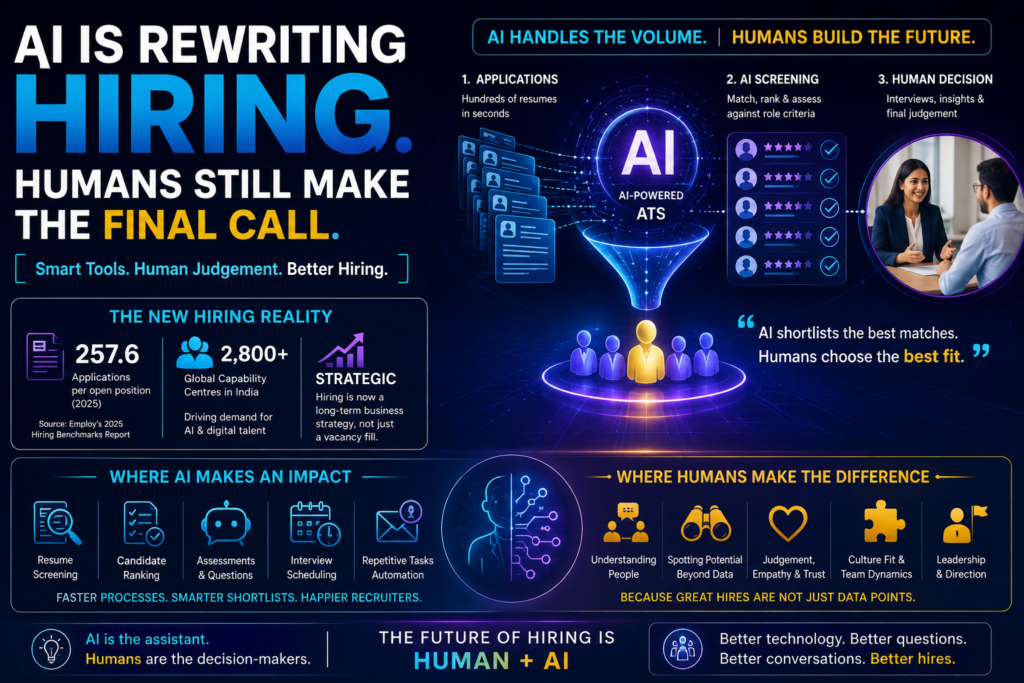
According to Employ’s 2025 Hiring Benchmarks Report, organisations were expected to receive an average of 257.6 applications per open position in 2025. At that volume, manually reviewing every resume with equal attention is difficult, making automation increasingly attractive to recruitment teams.
The important shift is not that machines are taking over hiring.
It is that AI is increasingly handling the volume while humans remain responsible for judgement.
Why Is AI Hiring Growing So Quickly?
Hiring has traditionally involved a lot of repetitive work.
A recruiter may need to review hundreds of resumes, identify candidates with particular skills, send screening questions, coordinate assessments, update applicant records and communicate with hiring managers.
When only a few people apply for a role, that process is manageable.
But technology companies, global capability centres and large enterprises can attract hundreds of applicants for a single position. Recruiters need a way to process that volume without spending their entire day performing administrative tasks.
Question → Direct Answer: Why are companies adopting AI in recruitment?
Companies are adopting AI because it can process large volumes of applications quickly, organise candidates against predefined criteria and automate repetitive recruitment tasks. This allows recruiters to spend more time on interviews, candidate conversations and final evaluation.
The appeal is therefore relatively straightforward.
Instead of asking a recruiter to manually inspect hundreds of applications, an AI-enabled system can perform an initial analysis and present a smaller pool for human review.
That does not necessarily mean the machine knows who the “best” candidate is.
It means the machine can help determine which candidates deserve closer attention first.
Definition: What is AI hiring?
AI hiring refers to the use of artificial intelligence tools to support one or more stages of recruitment, such as resume screening, candidate ranking, assessments, scheduling and recruitment administration.
AI can identify patterns in candidate information and compare applications against criteria established for a particular role. The final recruitment process can still involve human interviews, discussions, reference checks and managerial judgement.
This distinction is important because AI hiring is not a single technology.
It is a collection of tools that can be inserted into different parts of the recruitment workflow.
The First Shortlist Increasingly Belongs to AI
The earliest stage of recruitment is where AI is already having a particularly visible impact.
When hundreds of applications arrive, recruiters have to answer a basic question: Which candidates should be reviewed first?
AI-enabled recruitment systems can help answer that question by processing resumes, comparing qualifications against predefined requirements and supporting assessments.
At Blackbaud India, AI is already embedded across several areas of hiring, according to Hardeep Kaur, Director of HR at the company.
Kaur told AIM that AI is used in hiring for activities including processing, asking questions and assessments, reducing much of the manual work previously handled by HR teams.
The practical benefit is speed.
A recruiter who previously spent hours sorting through resumes can instead start with a system-generated shortlist and devote more time to evaluating those candidates.
Question → Direct Answer: Does AI make the recruiter unnecessary?
No. AI can narrow the candidate pool, but it does not eliminate the need for recruiters and hiring managers to evaluate candidates. Human judgement remains important for assessing qualities that are difficult to infer from resumes or structured data.
For example, a resume might show that a candidate has led a team.
It cannot fully explain how that person handles conflict, communicates under pressure, responds to feedback or motivates colleagues.
Those qualities emerge through conversations and real-world interactions.
That is why the most realistic model of AI hiring is not AI versus recruiter.
It is AI plus recruiter.
What Does an AI-Powered ATS Actually Do?
Applicant Tracking Systems, or ATS platforms, existed long before generative AI became mainstream.
An ATS is essentially recruitment workflow software that helps organisations collect, organise and manage applications.
For years, candidates have worried about their resumes being rejected because they did not contain particular keywords. The growing use of AI has added another layer to this process.
Modern ATS platforms can incorporate AI to organise and rank applicants using customised criteria.
Definition: What is an Applicant Tracking System?
An Applicant Tracking System (ATS) is software that helps employers manage job applications, candidate information and recruitment workflows.
An ATS can store resumes, track candidates through different stages, help recruiters search applications and support communication. AI capabilities can add functions such as candidate matching, ranking, assessment support and automated processing.
The important point is that an ATS does not operate independently of the organisation’s hiring strategy.
Recruiters define the criteria.
The system processes candidates according to those criteria.
This creates a simple but important relationship:
Better criteria → Better screening.
Poor criteria → Poor screening.
Question → Direct Answer: Can an ATS identify the perfect candidate?
No. An ATS can identify candidates who appear to match specified requirements, but matching criteria is not the same as predicting who will become the best employee.
That distinction explains why recruiter expertise matters.
If a company defines an unnecessarily narrow set of requirements, a system may filter out candidates who could actually perform the job well.
If the criteria are too broad, recruiters may still receive an overwhelming number of candidates.
The technology can process the rules efficiently.
It cannot automatically determine whether the rules themselves make sense.
AI Hiring Is Only as Good as the Recruiter Using It
There is a common assumption that buying an advanced AI recruitment platform automatically improves hiring.
That is not necessarily true.
A sophisticated tool in the hands of someone who does not understand how to configure or evaluate it can produce mediocre results.
Kaur highlighted this issue by pointing out that even the best tool remains basic if the person using it does not know how to use it effectively.
This is becoming increasingly relevant as HR professionals gain access to more AI capabilities.
Recruiters need to understand how to define useful criteria, interpret AI-generated rankings and recognise situations where the system’s recommendation deserves additional scrutiny.
Question → Direct Answer: Why does recruiter AI literacy matter?
Recruiter AI literacy matters because humans determine the criteria, prompts and parameters that guide many AI-assisted recruitment systems. Understanding the technology helps recruiters use automation strategically rather than treating it as an unquestionable decision-maker.
This creates a new skill requirement for HR professionals.
Recruitment expertise is no longer limited to interviewing, sourcing and employee relations.
It increasingly includes the ability to work effectively with technology.
Hiring Is Becoming a Strategic Business Function
Another major shift is happening alongside the rise of AI.
Hiring is increasingly being treated as a business strategy rather than simply an HR activity.
Kaur described recruitment as a shared responsibility involving HR, hiring managers and business leaders.
That makes sense when companies are hiring for emerging technologies.
A company recruiting an AI engineer, for example, is not simply filling an empty position.
It may be building a capability that determines what products it can develop several years from now.
The same applies to cybersecurity, cloud computing, data engineering and semiconductor engineering.
Question → Direct Answer: Why has hiring become more strategic?
Hiring has become more strategic because companies increasingly recruit people to build long-term technology and business capabilities, not merely to fill immediate vacancies.
India’s expanding technology ecosystem adds pressure to this process.
The source material notes that nearly 2,800 Global Capability Centres operate across India, increasing competition for AI and digital talent.
In such an environment, recruitment teams need to think beyond job descriptions.
They need to understand what capabilities the organisation will require next year, three years from now and beyond.
AI can help process the candidate pipeline.
But deciding which capabilities the company should build remains a human business decision.
AI Hiring vs Traditional Hiring: What Has Changed?
The fundamental goal of recruitment has not changed.
Companies still want capable people who can perform a role and contribute to the organisation.
What has changed is the amount of automation surrounding the process.
| Recruitment Stage | Traditional Approach | AI-Assisted Approach | Human Role |
| Resume screening | Manual review | Automated processing and ranking | Validate shortlist |
| Candidate search | Keyword/database searches | AI-supported matching | Define requirements |
| Assessments | Manual administration | Automated assessment workflows | Interpret results |
| Scheduling | Email and manual coordination | Automated workflows | Handle exceptions |
| Candidate ranking | Recruiter judgement | AI-supported prioritisation | Make final evaluation |
| Interviews | Fully human | AI may support preparation or screening | Conduct meaningful conversations |
| Final selection | Hiring manager and HR | AI can provide supporting information | Human decision |
This comparison shows why the phrase “AI replaces recruiters” can be misleading.
The technology is most valuable where the work is repetitive, structured and high-volume.
Human involvement becomes more important as the decision becomes more complex.
Where AI Is Strongest in Recruitment
AI is particularly useful when recruiters need to process large quantities of relatively structured information.
For example, hundreds of resumes can contain repeated categories such as education, work experience, technical skills and certifications.
A machine can process those fields much faster than a person.
AI can also help recruiters organise information consistently.
Common applications include:
- Resume processing
- Candidate ranking
- Application filtering
- Screening questions
- Candidate assessments
- Recruitment administration
- Matching candidates to role requirements
- Organising large applicant pools
- Supporting recruiter workflows
These applications can reduce the amount of repetitive work involved in hiring.
The bigger benefit, however, may be what recruiters can do with the time they recover.
Instead of spending hours on administrative screening, recruiters can spend more time speaking with candidates and hiring managers.
Where Humans Still Have the Advantage
Hiring is ultimately a decision about people.
And people are difficult to evaluate purely through structured information.
A candidate may have an unconventional career path but exceptional problem-solving ability.
Another applicant may technically satisfy every requirement but struggle with communication or collaboration.
Someone else may lack one preferred skill but have demonstrated an unusual ability to learn quickly.
These differences can matter enormously.
Question → Direct Answer: What can human recruiters evaluate better than AI?
Humans are better positioned to assess nuanced qualities such as motivation, communication, leadership potential, interpersonal dynamics and organisational fit through conversations and contextual judgement.
That does not mean humans are automatically unbiased or more accurate.
Human hiring decisions can also contain biases.
The goal should therefore not be to romanticise human judgement or blindly trust algorithms.
The better approach is to understand the strengths and weaknesses of both.
The Candidate Side: What AI Hiring Means for Job Seekers
For candidates, the rise of AI-assisted recruitment changes how job applications should be approached.
The old assumption was that a resume was primarily written for a human recruiter.
Today, candidates may need to consider that their application will first pass through software.
That does not mean stuffing a resume with random keywords.
Instead, candidates should make their qualifications clear and relevant to the role.
A strong resume should communicate:
- Relevant skills
- Measurable experience where appropriate
- Projects related to the role
- Technical capabilities
- Industry knowledge
- Clear job responsibilities
- Education and certifications when relevant
The goal is to make the connection between the candidate and the job easy to understand.
AI-assisted screening may identify that connection, but the candidate still needs to impress a human during later stages.
A practical example
Suppose a company is hiring for a data engineer.
A resume that simply says:
“Worked with data.”
provides very little useful information.
A resume that clearly identifies relevant technologies, projects and responsibilities gives both automated systems and human reviewers more useful information.
The lesson is simple:
Write for clarity, relevance and evidence,not just keywords.
AI Does Not Remove the Need for Good Hiring Criteria
One of the biggest risks in AI hiring is confusing automation with objectivity.
A system may produce a ranking that looks precise.
That does not necessarily mean the ranking is correct.
Imagine a recruiter asks an AI-enabled system to prioritise applicants with five years of experience.
That sounds straightforward.
But what if a candidate with three years of experience has built significantly more relevant systems than someone with five years of unrelated experience?
The system can follow the criterion.
The recruiter must decide whether the criterion is actually useful.
This is why hiring teams need to regularly evaluate their requirements.
Before using AI for screening, recruiters should ask:
- Are the criteria genuinely relevant to job performance?
- Are unnecessary requirements excluding potentially strong candidates?
- Can the system explain why candidates are being prioritised?
- Are recruiters reviewing the AI’s recommendations?
- Does the process leave room for unconventional candidates?
- Are human decision-makers involved at appropriate stages?
AI can make a flawed process faster.
That is not the same as making it better.
The New HR Skill: Working With AI
As AI becomes embedded in recruitment, HR professionals will increasingly need a combination of people skills and technical literacy.
They do not necessarily need to become machine learning engineers.
But they should understand enough about AI systems to use them intelligently.
This includes knowing what an AI tool is designed to do, how its criteria work, how to interpret its outputs and when human review is necessary.
The role of the recruiter could therefore evolve.
Instead of being primarily an administrator who moves candidates through a process, the recruiter can become a talent strategist and technology-enabled decision partner.
That is particularly relevant in industries where talent requirements change quickly.
AI skills themselves are evolving rapidly.
A hiring team that understands how AI is being used inside recruitment is better positioned to identify candidates who can contribute to an AI-first business.
Will AI Eventually Make Human Recruiters Obsolete?
This is probably the most obvious question surrounding AI hiring.
Question → Direct Answer: Will AI replace recruiters?
AI is more likely to transform the recruiter’s job than eliminate the role entirely. Automation can reduce repetitive screening and administrative work, while humans remain important for defining hiring needs, evaluating candidates and making contextual decisions.
There may be some recruitment tasks that become heavily automated.
A system may eventually handle much of the scheduling, initial screening and administrative coordination involved in a standard hiring process.
But hiring managers will still need to decide whom they trust with important responsibilities.
Organisations will still need people who understand business requirements.
Candidates will still want meaningful conversations with other people.
And companies will still need someone accountable for hiring decisions.
The likely future is therefore not:
Human recruiter → replaced by AI
It is:
Human recruiter + AI tools → redesigned recruitment workflow
That is a very different proposition.
What the Future of AI Hiring Could Look Like
The next phase of recruitment is likely to involve increasingly integrated AI systems.
Instead of separate tools for resumes, assessments, scheduling and candidate communication, recruitment platforms may connect these processes into a single workflow.
A recruiter could define a role’s requirements, allow the system to process applications, review a ranked candidate pool, analyse assessment results and then focus on interviews and final decisions.
But greater automation also means greater responsibility.
The more influence an AI system has over who gets noticed, the more carefully organisations need to design and monitor the process.
The future of recruitment will therefore depend on finding the right balance.
Automation should reduce unnecessary work.
Human judgement should remain where context matters.
Accountability should remain clear.
That balance could make recruitment faster without making it less human.
The Real Shift Is From Manual Screening to Human-AI Collaboration
The most important change in AI hiring is not that recruiters have disappeared.
They have not.
The bigger change is that the recruiter’s time is being redistributed.
Instead of spending most of the day processing applications, recruiters can potentially spend more time understanding business requirements, engaging with candidates and helping hiring managers make better decisions.
That is where AI can have its greatest value.
At the same time, recruiters need to understand the systems they use.
An AI-powered ATS is not a magic box that automatically discovers the perfect employee.
It is a tool.
And like any tool, its value depends on how well people use it.
For candidates, the message is equally important.
AI may influence whether a resume reaches the next stage, but a strong application still needs to demonstrate real skills, relevant experience and evidence of what the candidate can do.
AI may increasingly control the first filter. Humans still make the final call.
FAQ: AI Hiring and AI Recruitment
What is AI hiring?
AI hiring is the use of artificial intelligence to support recruitment activities such as resume screening, candidate ranking, assessments and administrative tasks. It is generally used to help recruiters process large applicant volumes more efficiently.
How does AI help recruiters screen resumes?
AI can process resumes and compare candidate information against predefined skills, qualifications and other hiring criteria. It can then help organise or rank candidates so recruiters can focus their attention on a smaller group.
Can AI replace human recruiters?
AI can automate parts of recruitment, but it does not eliminate the need for human recruiters and hiring managers. Humans remain important for defining hiring requirements, evaluating nuanced qualities and making final decisions.
What is an AI-powered ATS?
An AI-powered ATS is an Applicant Tracking System that uses artificial intelligence to support activities such as candidate matching, application processing and ranking. Recruiters still determine many of the criteria and parameters used by the system.
How should candidates prepare for AI-assisted recruitment?
Candidates should create clear, relevant resumes that accurately describe their skills, experience and projects. Rather than relying on excessive keyword repetition, applicants should clearly demonstrate how their background matches the requirements of the role.
Why is AI literacy becoming important for HR professionals?
AI literacy helps HR professionals understand how recruitment tools work, configure relevant criteria and critically evaluate AI-generated recommendations. The best technology can still produce poor outcomes when users do not understand how to apply it effectively.
Final Takeaway
AI is rewriting the recruitment workflow, not eliminating the human recruiter. As application volumes rise, AI can handle more of the repetitive work involved in screening and assessment, while humans remain responsible for context, conversations, strategy and final hiring decisions.
For students and young professionals, the lesson is equally clear: AI may become part of the hiring process, but demonstrable skills, relevant experience and the ability to communicate your value will still matter.keep exploringkalinga.ai/