Why Is India’s Space Programme Known for Frugality?
The idea of frugal engineering has become deeply associated with the India space programme because Indian space missions have historically been designed around constraints.
Limited budgets force engineers to make difficult choices. Components have to be carefully selected, systems have to be designed for specific mission requirements, and teams often have to find ways to reuse knowledge and infrastructure across projects.
Frugal engineering is an approach to technology development that aims to deliver the required capability with fewer resources, lower costs and simpler systems.
In the space industry, that does not mean simply buying cheaper components. It can mean designing a mission around available launch capacity, reducing unnecessary complexity, developing indigenous technologies and using existing infrastructure wherever possible.
That distinction matters.
A spacecraft costing less than a comparable Western mission is not necessarily a “cheap” spacecraft. It may represent years of engineering expertise, specialised testing facilities, highly trained personnel and infrastructure that already exists because of decades of investment.
Does frugal mean India spends very little on space?
No. Frugality means India tries to maximise capability from its available resources; it does not mean space missions are inexpensive.
That distinction becomes increasingly important as India expands its ambitions. Launch vehicles, satellites, propulsion systems and human-spaceflight infrastructure remain capital-intensive technologies.
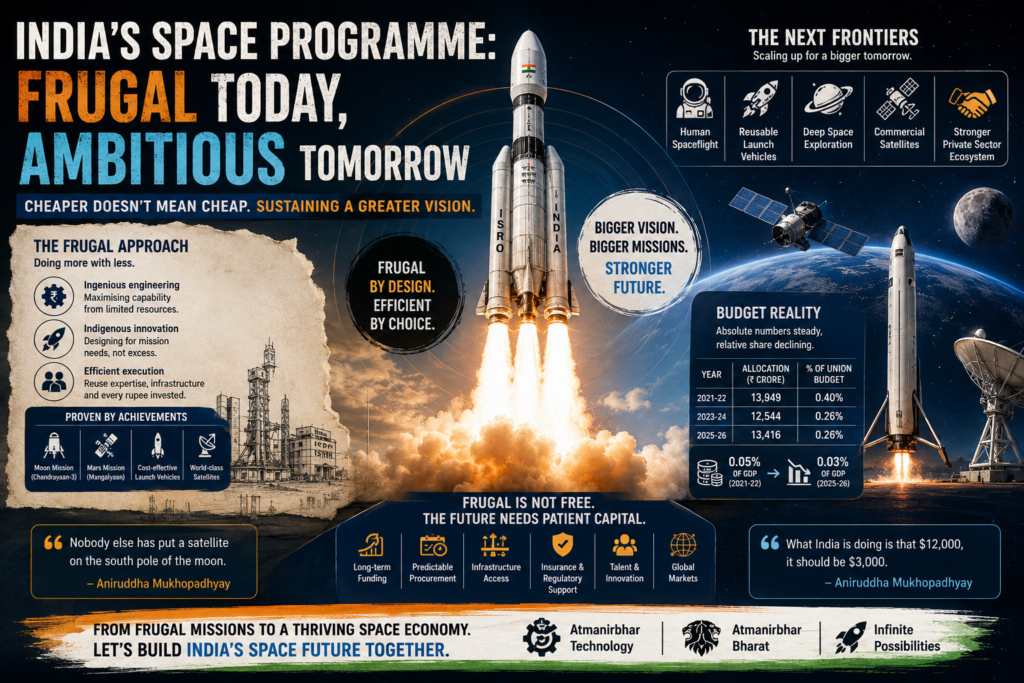
According to the figures in the source material, the Department of Space received ₹13,949 crore in 2021-22, with the allocation falling to ₹12,544 crore in 2023-24 before recovering to ₹13,416 crore in 2025-26.
The more revealing number is the department’s share of overall government spending. Its share of the Union Budget declined from 0.40% in 2021-22 to 0.26% in 2025-26.
Its share of India’s GDP also fell from 0.05% to 0.03% over the same period.
So while India’s absolute space allocation has not collapsed, space spending has become relatively smaller compared with the broader economy and government expenditure.
That creates an interesting tension: India wants a bigger space programme without necessarily increasing its fiscal footprint at the same pace.
What Do India’s Space Budget Numbers Actually Tell Us?
Budget numbers provide an important reality check on the popular image of India’s low-cost space achievements.
A falling share of the Union Budget does not automatically mean India’s space programme is being neglected. Government priorities change, the economy expands and different departments compete for resources.
However, it does highlight a fundamental constraint.
If India wants to move from a successful government-led space programme towards a broader commercial and strategic space ecosystem, the financial requirements will grow.
The country is no longer discussing only communication satellites and launch vehicles. The ambitions increasingly include:
- Human spaceflight
- Reusable launch technology
- Deep-space exploration
- Commercial satellite services
- Earth observation
- Space-based communications
- In-orbit technologies
- Private launch companies
- Space manufacturing
- Advanced propulsion
- Larger international markets
Each of these areas requires long development cycles.
A software startup can potentially build a product, acquire customers and generate revenue within a relatively short period. A space company may spend years developing hardware before its first commercial mission.
That difference makes financing particularly important.
Why does the declining budget share matter?
Because a larger space programme eventually requires more capital, even if engineering efficiency keeps reducing the cost of individual technologies.
Aniruddha Mukhopadhyay, S&A Lead and Chief Technologist at Synopsys, argues that the economics of space should also be viewed through the amount of effort and government support required to make successful missions possible.
He contrasts India’s approach with the funding environment surrounding successful Western space startups, where governments have sometimes absorbed substantial development risk.
This is an important part of the space-cost debate.
Looking only at the final launch price can hide the amount of money spent on failed prototypes, testing, research and development before a technology becomes reliable.
In other words, the cost of success is not always visible in the price of the successful mission.
Why Cheaper Space Missions Are Still Expensive
One of the biggest misconceptions about the India space programme is that low mission costs mean India can build space hardware cheaply.
It cannot.
Space hardware remains one of the most technically demanding forms of engineering. A rocket has to survive extreme vibration, acceleration and temperature conditions. Satellites need to operate in environments that are difficult or impossible to reproduce completely on Earth.
A failure can erase years of development.
Chetan Mehta, Founding Partner at Aum Ventures, points out that development costs in India may be lower than in many other countries, but space hardware still requires significantly more capital than a typical software startup.
That is because the timeline is fundamentally different.
What makes space technology capital-intensive?
Several factors contribute to the high cost of building space technology:
Long development cycles: Launch vehicles and spacecraft can require years of engineering and testing before commercial revenues appear.
Technical risk: A single mission failure can delay commercialisation and force a company to repeat expensive development or testing work.
Specialised infrastructure: Space companies need access to testing facilities, manufacturing capabilities, launch infrastructure and other specialised resources.
Regulatory approvals: Space activities require government oversight and regulatory clearances, adding time to already lengthy development cycles.
Patient capital: Investors may have to wait years before a space company reaches meaningful revenue or profitability.
This is why comparing a space startup with a conventional software startup can be misleading.
The space company may look inefficient if judged by short-term financial metrics. But its underlying intellectual property, engineering expertise and hardware capabilities can become significant long-term assets.
India vs the US: Is India Really Cheaper?
One comparison highlighted in the source material illustrates the complexity of space economics.
A study published in Economics Letters estimated that the average cost of placing a kilogram of payload into low Earth orbit was more than $13,000 in India, compared with about $3,225 in the US.
At first glance, that appears to undermine the idea of India’s low-cost space programme.
But there is an important caveat: these figures represent estimated average costs and should not be interpreted as the price charged for an individual rocket launch.
The distinction is crucial.
A launch price reflects what a customer pays for a particular service. An estimated cost per kilogram can incorporate broader economic factors and assumptions about launch capacity, utilisation and other elements.
| Factor | India’s traditional model | Commercial US model |
| Core strength | Cost-conscious engineering | Commercial scale and reusable systems |
| Government role | Strong institutional support | Major customer and funding partner |
| Private-sector role | Rapidly expanding | More mature commercial ecosystem |
| Development model | Resource optimisation | Larger risk-taking capacity |
| Capital environment | More constrained | Deeper private and public capital |
| Major challenge | Scaling investment | Managing high development costs |
| Opportunity | Efficient indigenous technology | Commercial scale and global markets |
The comparison shows why saying one country’s space programme is simply “cheaper” can be misleading.
India’s advantage has historically been engineering efficiency under constraints. The US advantage increasingly comes from a combination of government demand, private investment, larger markets and companies capable of scaling hardware development.
The Bigger Question: Can Frugality Survive Scale?
This may be the most important question facing the India space programme.
There is a major difference between making one mission highly efficient and creating an entire space industry capable of producing dozens or hundreds of products and services.
At small scale, engineers can sometimes compensate for resource limitations through ingenuity and highly specialised teams.
At large scale, the system itself has to become efficient.
That means reliable supply chains, manufacturing capacity, launch infrastructure, insurance, procurement systems, financing mechanisms and a large talent pool.
What does India need beyond low-cost missions?
India’s next phase of space development needs to focus on:
- Predictable government procurement
- Long-term commercial contracts
- Access to testing and launch infrastructure
- Space insurance frameworks
- Faster regulatory approvals
- Patient venture capital
- Advanced manufacturing
- A larger pool of specialised engineers
- International commercial opportunities
This is where policy becomes just as important as technology.
Mehta argues that India’s space policy has already moved significantly beyond simply opening the sector to private participation. The next challenge is creating demand for the products and services that private companies are developing.
That is a major shift in thinking.
Why Government Demand Could Make or Break Space Startups
Opening a market is not the same as creating a market.
A startup may be legally allowed to build a satellite or launch vehicle, but that does not automatically mean customers will appear.
Space technology requires substantial upfront investment. Investors therefore need confidence that there will be a sufficiently large market at the end of the development process.
This is where government procurement can become powerful.
Can governments help create commercial space companies?
Yes. Governments can act as early customers, reducing market uncertainty and giving startups a path to revenue while their technologies mature.
The US Commercial Crew programme is often cited as an example of this approach. Instead of developing every capability entirely within government institutions, NASA worked with private companies and became an early customer for commercial transportation services.
For India, a similar model could help private space companies move from prototypes to sustainable businesses.
The government does not necessarily have to build every technology itself.
Instead, it can create demand for technologies that support national objectives.
That could include satellite imagery, communications, navigation, climate monitoring, disaster management, secure connectivity and other space-enabled services.
The result could be a more commercially sustainable ecosystem in which government spending acts as a catalyst for private investment.
India’s Private Space Industry Is Changing the Equation
The India space programme is no longer synonymous only with ISRO.
The private sector is becoming increasingly important, with companies working across launch vehicles, satellites, Earth observation, propulsion and other technologies.
Companies such as Skyroot have demonstrated that Indian private companies can develop sophisticated space hardware.
This changes the economics of the sector.
When expertise, infrastructure and intellectual property spread beyond government institutions, India can potentially build a larger industrial base around space.
But private participation also introduces a new challenge: companies need to become commercially sustainable.
A startup cannot depend indefinitely on grants or occasional contracts.
It needs customers.
It needs repeatable revenue.
And eventually, it needs the ability to compete internationally.
Why is scaling harder than building a prototype?
Because proving that a technology works is only the first step; companies must then manufacture it reliably, sell it repeatedly and operate at commercial scale.
That transition is difficult in almost every deep-tech industry.
A successful demonstration mission can attract attention and investment. But building a sustainable business requires supply chains, production capacity, customer relationships and operational reliability.
For India’s space startups, this is likely to be one of the defining challenges of the next decade.
The ISRO-to-Startup Pipeline Is a Hidden Advantage
There is another reason the India space programme has been able to build sophisticated technology with comparatively constrained resources: human capital.
ISRO has spent decades developing scientists and engineers capable of working on complex missions.
That expertise is now increasingly moving into the private sector.
Mehta describes this movement as a strength rather than simply a loss for the public organisation.
Engineers trained inside a national space programme carry valuable experience in systems engineering, mission planning, hardware development and reliability.
When they move into startups, that institutional knowledge can become commercial technology.
Why does the ISRO talent pipeline matter?
It transfers decades of mission experience from a government institution into a growing private ecosystem.
This can reduce one of the biggest disadvantages faced by new deep-tech companies: the absence of experienced technical leadership.
A startup founded by engineers with experience working on complex space missions begins with knowledge that would otherwise take years to develop.
The long-term objective, however, should not be to move all talent from public institutions into private companies.
India needs both.
The public sector can continue working on national missions and technologies with long time horizons, while private companies can commercialise technologies and pursue markets globally.
A healthy ecosystem therefore requires talent to flow in both directions.
What Does India’s Space Programme Need to Fund Next?
The next phase will require a different definition of investment.
The objective should not simply be to increase spending. It should be to ensure that additional money creates capabilities that can support future missions and commercial activity.
Human spaceflight is one obvious area.
Reusable launch vehicles are another.
Deep-space exploration will require increasingly sophisticated spacecraft, propulsion and communication systems.
Meanwhile, commercial space companies will need access to infrastructure and capital.
This creates a broad investment map.
| Investment area | Why it matters |
| Human spaceflight | Builds crewed-mission capability and supporting infrastructure |
| Reusable launch vehicles | Could improve launch economics over time |
| Deep-space missions | Expands scientific and technological capability |
| Satellite manufacturing | Enables larger commercial constellations |
| Launch infrastructure | Supports more frequent missions |
| Space startups | Brings private capital and innovation into the ecosystem |
| Testing facilities | Reduces development bottlenecks |
| Advanced manufacturing | Helps move from prototypes to mass production |
| Talent development | Creates the workforce required for scale |
The important point is that cost efficiency and investment are not opposites.
India can continue looking for ways to reduce waste while simultaneously investing more money in areas where additional capital is essential.
That may ultimately be the more sustainable definition of frugality.
Is India’s Space Strategy Really “Frugal”?
Chetan Mehta offers a useful alternative description: rather than calling India’s space policy frugal, he describes it as evolving.
That distinction captures where the sector stands today.
The earlier model focused heavily on achieving national space capabilities within financial constraints.
The emerging model has broader objectives.
It seeks to create private companies, attract investment, develop commercial markets and establish India as a global space technology player.
The result is less about doing everything cheaply and more about doing the right things efficiently while building the capacity to do more.
What has changed in India’s space strategy?
The transformation can be viewed in three stages:
Stage 1 , Build capability:
Develop indigenous launch vehicles, satellites, scientific missions and technical expertise.
Stage 2 , Open the ecosystem:
Allow private companies to participate and provide access to government infrastructure and regulatory frameworks.
Stage 3 , Create scale:
Develop predictable demand, private investment, manufacturing capacity and global commercial opportunities.
India is increasingly moving into the third stage.
And that is much harder than simply building an efficient spacecraft.
Why “Cheaper” Cannot Be the Only Goal
There is a danger in celebrating low-cost space missions too much.
If cost becomes the primary measure of success, India could end up optimising for smaller missions when its ambitions require larger systems.
A country planning human spaceflight, reusable launch vehicles and increasingly sophisticated deep-space missions cannot judge every investment solely by whether it is cheaper than an equivalent foreign project.
Sometimes the strategic objective matters more than the immediate cost.
Building a domestic capability can create knowledge that cannot easily be purchased later.
Developing an indigenous propulsion system, for example, is not only about the cost of one engine. It can create expertise that supports multiple future missions.
The same applies to launch vehicles, satellite platforms and space manufacturing.
Does India need to abandon its frugal engineering culture?
No. It needs to evolve it.
The strongest version of India’s space strategy would combine the country’s traditional engineering discipline with substantially greater access to capital.
That means asking a different question.
Instead of asking, How can India accomplish this mission with the smallest possible budget?
The question becomes:
How can India build this capability efficiently enough to support the next ten missions?
That is the shift from project efficiency to ecosystem efficiency.
India’s Space Programme Is Entering a Different Economic Phase
The early success of India’s space programme came from doing difficult things with limited resources.
Its next success may depend on knowing where not to be overly frugal.
A launch vehicle can be made more efficient. A satellite can be designed with fewer unnecessary components. Manufacturing processes can be streamlined.
But engineers cannot eliminate the need for testing.
Startups cannot eliminate development timelines.
Human spaceflight cannot eliminate safety requirements.
And deep-space exploration cannot eliminate technical complexity.
The economics of space eventually become a question of scale.
If India wants a globally competitive space industry, it needs enough capital to move successful technologies from laboratory demonstrations to repeatable commercial products.
That will require government funding, private investment and international markets working together.
What Could the Next Decade Look Like?
The next decade could determine whether India remains primarily known for cost-effective space missions or becomes known for building a globally competitive space industry.
The foundation is already significant.
India has an established national space agency, a growing private ecosystem, experienced engineers, indigenous launch capabilities and a large domestic market for satellite-enabled services.
The missing pieces are increasingly commercial.
Companies need customers.
Investors need visibility.
Manufacturers need predictable demand.
Startups need access to infrastructure.
And the government needs procurement policies capable of supporting technologies through their early commercial stages.
If those pieces come together, India’s historical emphasis on efficiency could become a competitive advantage rather than simply a response to limited budgets.
What is the biggest challenge ahead?
The biggest challenge is sustaining investment while scaling from successful individual missions into a broad, commercially viable space ecosystem.
That is why India’s space story is no longer just about launch costs.
It is about capital, markets, talent, manufacturing, policy and technology,and how efficiently all of them can work together.
India’s Space Programme: Frugality vs Scale
The debate ultimately comes down to a balancing act.
| Frugality | Scale |
| Reduce unnecessary costs | Invest in critical capabilities |
| Reuse existing expertise | Build new infrastructure |
| Optimise mission design | Support larger missions |
| Work within constraints | Expand funding sources |
| Prioritise efficiency | Create commercial demand |
| Minimise development waste | Accept calculated technical risk |
India does not have to choose one side.
Its greatest advantage may come from combining both.
A more ambitious India space programme will inevitably cost more in absolute terms. But greater spending does not have to mean inefficient spending.
If India can preserve the engineering culture that helped it achieve major space milestones while building deeper capital markets, stronger private-sector demand and more robust infrastructure, it could turn frugal engineering into something much more powerful: a scalable model for space technology.
And that is ultimately the real test.
India has already shown that it can reach space with limited resources.
Now it has to show that it can stay there, go farther and build businesses around it.
FAQ: India’s Space Programme and Its Future
What is India’s space programme known for?
India’s space programme is widely associated with cost-conscious engineering, indigenous technology development and the ability to achieve complex missions under relatively constrained budgets. Its focus is increasingly expanding from government-led missions to include private companies and commercial space activities.
Why are Indian space missions considered cost-effective?
Indian space missions have benefited from indigenous engineering, existing infrastructure, experienced technical teams and mission designs focused on achieving specific objectives without unnecessary complexity. However, cost-effective does not mean inexpensive because spacecraft, rockets, testing and specialised infrastructure remain capital-intensive.
Is India’s space programme underfunded?
India’s Department of Space allocation has remained relatively stable in absolute terms in recent years, but its share of the Union Budget and GDP has declined according to the figures provided in the source material. Whether this constitutes underfunding depends on India’s future ambitions and how much investment is required to support them.
Why is private investment important for India’s space industry?
Private investment can provide additional capital for developing launch vehicles, satellites and other space technologies. It can also allow companies to pursue commercial markets while government institutions focus on national missions and long-term strategic objectives.
How can the Indian government help space startups?
The government can help by creating predictable procurement, offering long-term contracts, improving access to infrastructure, developing insurance frameworks and making regulatory approvals more predictable. Acting as an early customer can also help startups move from technology demonstrations to commercially sustainable businesses.
Does India need to spend more on space?
India will likely need greater investment if it wants to significantly expand human spaceflight, reusable launch vehicles, deep-space exploration and private-sector participation. The more important issue is not simply increasing spending but ensuring that additional investment builds capabilities, infrastructure and markets that support long-term growth.