What Happened to Bolt? From $11 Billion to $300 Million
Bolt is a checkout-processing startup that Breslow co-founded in 2014, when he was just 19 years old and had dropped out of Stanford. The company’s product lets online shoppers check out in one click, and it later expanded into a “super app” bundling financial services, peer-to-peer payments, crypto, and credit cards.
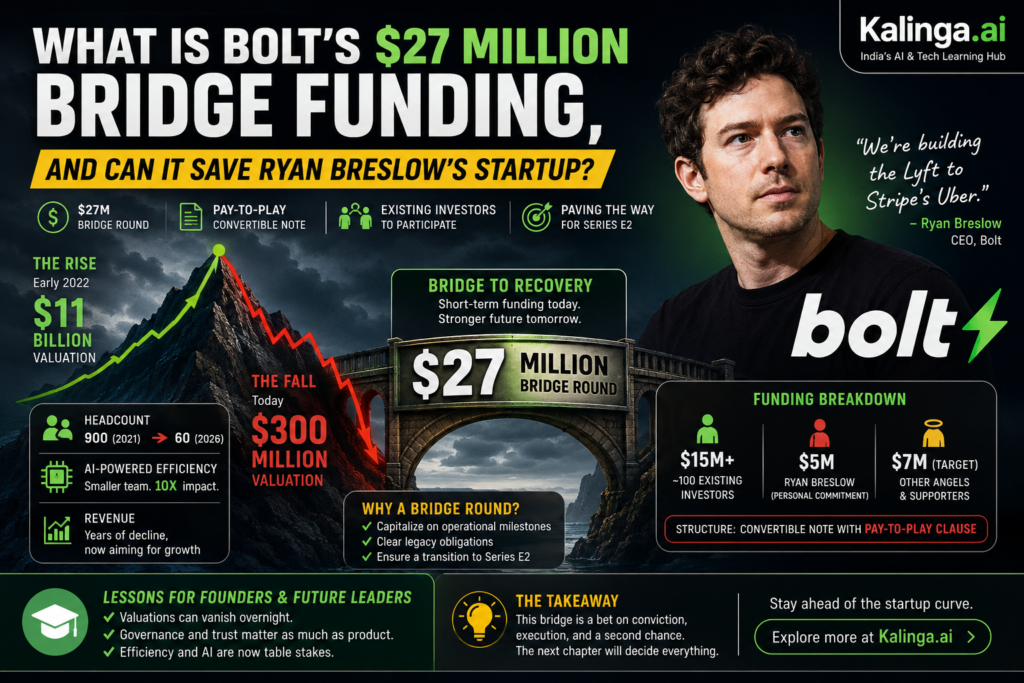
At its peak in early 2022, Bolt was valued at $11 billion. Since then, its valuation has fallen by 97%, down to roughly $300 million today. That’s not a small correction , it’s one of the steepest valuation collapses among startups that were once considered unicorns (private companies worth $1 billion or more).
Breslow stepped down as CEO in 2022 amid investor clashes and legal battles, then made a surprising return, being reinstated as CEO in March 2025. He argues the company would be in a stronger position today had he stayed in charge the whole time, claiming Bolt lost customers during the years he wasn’t running it.
What Is a Bridge Round, and Why Is Bolt Raising One?
Bridge round: a short-term round of financing meant to help a company survive financially until it can close a larger, more permanent fundraise. Think of it as a financial “bridge” connecting where a company is now to where its next big funding milestone will be.
Companies typically raise bridge funding for one of two very different reasons. Either they’re doing well and just need six to twelve months to hit a milestone that will justify a bigger round at a better valuation, or they’re running low on cash and need time to restructure or reach profitability before investors will commit more. Bolt’s bridge sits closer to the second category, though Breslow insists the company is nearing profitability and returning to growth after years of shrinking revenue.
Bolt’s bridge funding is up to $27 million, structured as a convertible note , a loan that converts into company equity (ownership shares) at a discount once Bolt closes its next full round. According to Bolt’s own press release, the funding is meant to help the company “capitalize on operational milestones, clear legacy obligations, and ensure a transition” toward a future Series E2 round.
What Is a Pay-to-Play Provision, and Why Does It Matter?
Is Bolt’s bridge round different from a normal fundraise? Yes , this one carries a “pay-to-play” clause, a punitive term rarely seen in healthy fundraising environments.
Pay-to-play: an investment term that punishes existing investors who choose not to participate in a new funding round by stripping them of a large portion of their equity or converting their preferred shares into less valuable common shares. In plain terms, it’s a pressure tactic: invest more money now, or lose value in what you already own.
Companies typically only use pay-to-play provisions when they’re in a weak negotiating position and need to force alignment among existing investors. Its presence in Bolt’s bridge round is one of the clearest signals that this financing is about survival, not just acceleration.
Why Is Ryan Breslow Raising This Bridge Funding Now?
Why didn’t Bolt just raise a normal, larger round instead? Because Bolt already tried that , and it collapsed publicly and messily two years ago.
In an earlier attempt, Breslow tried to raise $450 million at a $14 billion valuation. That deal fell apart after existing investors, including BlackRock and Hedosophia, sued to block it. The lawsuit followed revelations that an investor named as a lead backer had actually denied participating, while another had reportedly offered $250 million in “marketing credits” rather than actual cash. All parties later voluntarily dismissed that lawsuit.
This time, Breslow says the situation is different: Bolt’s board and a “majority of preferred” shareholders have already signed off on the new bridge round before it went public, unlike the earlier failed attempt. He’s also putting his own money where his mouth is , Breslow is personally committing $5 million to the round, and one unnamed angel investor has confirmed through a wealth manager that he plans to participate.
- Bolt’s roughly 100 existing investors are expected to contribute at least $15 million collectively, per Breslow’s estimate
- Breslow himself is contributing $5 million personally
- The round is structured as a convertible note with a pay-to-play clause
- Bolt has shrunk headcount from 900 employees in 2021 to about 60 today
- Breslow credits AI tools with helping the smaller team “get probably 10 times more done”
Bridge Round vs. Series Round vs. Down Round: What’s the Difference?
Understanding startup fundraising terminology helps make sense of why Bolt chose this particular structure instead of a traditional priced round.
| Feature | Bridge Round | Series Round (e.g., Series E2) | Down Round |
| Purpose | Short-term survival or runway extension | Major capital raise for growth | Raising money at a lower valuation than before |
| Typical structure | Convertible note (converts to equity later) | Priced equity round with a set valuation | Priced equity round, valuation explicitly reduced |
| Who usually invests | Existing investors | Mix of existing and new investors | Mix, often with tougher terms for founders |
| Risk signal | Can indicate weakness or just short-term timing needs | Generally seen as a growth signal | Usually seen as a negative signal for company health |
| Bolt’s situation | Currently raising this now (up to $27M) | Aiming for this next (Series E2) | Implied by the 97% valuation drop since 2022 |
Can Bolt Actually Recover?
Does Bolt have a real path back to relevance? It’s genuinely uncertain , Breslow is confident, but the company’s own trajectory over the last few years suggests recovery is far from guaranteed.
Breslow frames Bolt’s ambitions boldly, positioning the company against payments giant Stripe by saying he wants Bolt to become “the Lyft to Stripe’s Uber” , essentially, the credible number-two player in a market dominated by one giant. He’s betting heavily on Bolt’s “super app” strategy, which bundles checkout with financial services, crypto, and peer-to-peer payments into a single one-click experience.
He also claims that despite shrinking Bolt’s team from 900 to about 60 people, AI tools are letting the company operate far more efficiently and ship products faster than before. Whether that efficiency claim translates into actual revenue growth and investor confidence, though, is something only time , and Bolt’s next fundraise , will reveal.
Notably, Breslow has turned down offers to walk away entirely. He’s mentioned that friends offered him millions to start an entirely new company instead of continuing what he’s described as a difficult turnaround at Bolt, but he’s chosen to stay.
Lessons for Students and Young Professionals Watching This Story
For anyone in India studying startups, fintech, or entrepreneurship, Bolt’s saga is a useful real-world case study in several ways:
- Valuations are not permanent , a company can lose 97% of its paper value in a few years, even after being celebrated as a unicorn.
- Founder identity matters , Breslow’s personal conviction and financial commitment ($5 million of his own money) is being used as a signal to persuade other investors.
- Legal and governance issues can sink a raise , Bolt’s earlier $450 million round collapsed due to lawsuits over misrepresented investor commitments, not just market conditions.
- Efficiency narratives around AI are becoming a standard pitch , founders across industries, not just Bolt, are using AI-driven productivity claims to justify smaller teams and leaner operations.
- Not every round is a growth story , bridge rounds with pay-to-play clauses are often survival mechanisms, and it’s worth learning to read between the lines of a company’s official press language.
FAQ: Bolt’s Bridge Funding, Explained
How much money is Ryan Breslow raising for Bolt? Breslow is raising up to $27 million in bridge funding for Bolt, structured as a convertible note from existing investors.
What is a pay-to-play provision in startup funding? It’s a clause that penalizes existing investors who don’t participate in a new funding round, typically by reducing the value or preference status of their existing shares.
Why did Bolt’s valuation drop so much? Bolt hit an $11 billion valuation in early 2022 but has since fallen 97% to around $300 million, following years of shrinking revenue, leadership turnover, and a failed prior fundraising attempt.
Is Ryan Breslow still the CEO of Bolt? Yes, Breslow was reinstated as Bolt’s CEO in March 2025, roughly three years after he had originally stepped down from the role.
What happened to Bolt’s earlier $450 million fundraising attempt? It collapsed after investors including BlackRock and Hedosophia sued Bolt, alleging misrepresentation about who was actually committing money to the round; the lawsuit was later voluntarily dismissed by all parties.
How many employees does Bolt have now compared to its peak? Bolt’s headcount has fallen from about 900 employees in 2021 to roughly 60 employees today, with Breslow crediting AI tools for maintaining productivity despite the smaller team.
Final Word
Bolt’s story isn’t over yet , this bridge funding is a bet that Ryan Breslow’s conviction, a leaner AI-powered team, and investor loyalty can pull a fallen unicorn back from the edge. If you want to keep learning how real startup finance, fundraising terms, and founder decisions actually play out, explore more breakdowns like this one on Kalinga.ai.