WACKER Pune GCC: How Will It Drive Engineering and Digital Transformation?
What happens when a global chemicals and biotechnology company wants to make its technology operations more scalable without building everything from scratch? WACKER is establishing a global capability centre (GCC) in Pune with HCLTech to strengthen engineering, IT, and digital transformation capabilities from India.
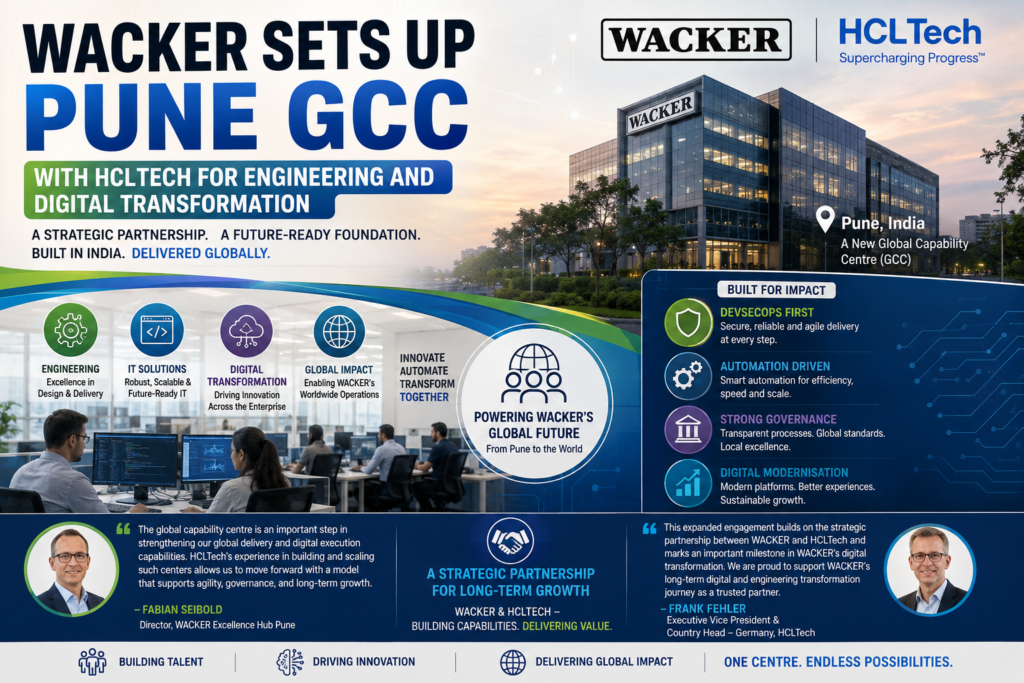
The WACKER Pune GCC will support the company’s global engineering, IT, and digital transformation initiatives. HCLTech will help build and scale the centre through a phased operating model focused on DevSecOps, automation, governance, and digital modernisation.
The move is significant because the centre is not being positioned simply as another offshore delivery unit. WACKER says the GCC will become part of its global delivery and digital execution capabilities, giving the company a flexible and scalable technology foundation from India.
For India’s expanding GCC ecosystem, the development also reflects a broader shift: global companies are increasingly using Indian centres not only for routine technology support, but also for engineering, digital transformation, governance, and specialised capabilities.
Why WACKER Is Building a GCC in Pune
A global company needs more than technology tools to execute a digital transformation strategy. It needs people, engineering capabilities, operating processes, governance, and the ability to scale those capabilities as business requirements change.
That is the context behind WACKER’s decision to establish a GCC in Pune.
WACKER Chemie AG, a global chemicals and biotechnology company, has established the new centre in collaboration with HCLTech. According to the company, the GCC will support global engineering, IT, and digital transformation initiatives while providing a flexible and scalable delivery model.
The choice of Pune also places the centre within one of India’s established technology and engineering ecosystems. However, the source material does not provide specific hiring numbers, investment figures, or a detailed timeline for the GCC, so its eventual scale should not be assumed.
What is a GCC?
A Global Capability Centre is a company-owned or company-controlled operation established in another location to provide specialised capabilities for the parent organisation.
GCCs can support areas such as technology, engineering, analytics, finance, research, cybersecurity, and digital operations. In WACKER’s case, the focus is explicitly on engineering, IT, and digital transformation rather than simply providing generic back-office support.
That distinction matters. The centre is expected to contribute to WACKER’s global technology execution, meaning capabilities developed in Pune can support initiatives beyond India.
Question → Direct Answer: Why does WACKER need a GCC?
The WACKER Pune GCC is intended to give the company a scalable technology delivery foundation for global engineering, IT, and digital transformation work. Instead of treating technology execution as a collection of isolated projects, the centre provides a dedicated operating structure that can grow with WACKER’s requirements.
WACKER’s Fabian Seibold, Director, WACKER Excellence Hub Pune, described the centre as an important step toward strengthening global delivery and digital execution capabilities.
The company also sees HCLTech’s experience in building and scaling such centres as an important part of the model.
What the WACKER Pune GCC Will Actually Do
The most important question is not simply where WACKER is opening the centre, but what work will happen there.
The answer provided by the company is broad but strategically important. The GCC will support three major areas: engineering, IT, and digital transformation.
These areas cover a wide range of technology activities. Engineering capabilities can support technical projects, while IT capabilities can strengthen technology operations. Digital transformation, meanwhile, focuses on modernising how technology is developed, delivered, governed, and used across the organisation.
The centre will also focus on DevSecOps, automation, governance, and digital modernisation through HCLTech’s phased operating model.
Engineering becomes part of the digital strategy
Engineering and IT are increasingly interconnected in large enterprises.
A digital transformation programme cannot succeed simply because a company deploys new software. The organisation also needs engineering teams capable of building, integrating, maintaining, and improving technology systems.
For WACKER, the GCC creates a dedicated structure through which engineering and digital capabilities can be developed in India while supporting global requirements.
Question → Direct Answer: Is this only an IT support centre?
No. Based on WACKER’s description, the Pune GCC is intended to support engineering as well as IT and digital transformation. Its scope therefore extends beyond conventional technology support into broader global delivery and digital execution.
That distinction is also reflected in the company’s language around building a future-ready technology delivery foundation from India.
The centre is therefore better understood as a capability-building operation rather than simply a location for outsourcing individual technology tasks.
Why DevSecOps and Automation Matter
Two terms in the announcement deserve particular attention: DevSecOps and automation.
DevSecOps is an approach that integrates security into software development and IT operations instead of treating security as a separate step at the end of the process.
The idea is straightforward. Development teams, operations teams, and security teams work more closely throughout the technology lifecycle. This can help organisations make security part of how software and systems are designed, tested, deployed, and maintained.
For a global organisation undergoing digital modernisation, that operating approach can become particularly important because technology environments can become increasingly complex as more systems are connected.
Automation is the second major pillar.
Automation uses software and technology to perform repeatable tasks with limited manual intervention. In an enterprise environment, automation can be used to reduce repetitive work, standardise processes, and support more consistent operations.
WACKER and HCLTech specifically identify automation as one of the areas of focus for the new GCC.
Question → Direct Answer: Why put DevSecOps and automation inside the GCC strategy?
Because the centre is being designed around modern technology delivery rather than simply adding more people to existing processes. DevSecOps addresses how software and security can work together, while automation can reduce repetitive operational work and support scalable delivery.
The announcement does not quantify how much work will be automated or identify specific systems that will be modernised. Those details will likely become clearer as the centre develops.
How the Phased Operating Model Could Scale the GCC
One of the most important details in the announcement is HCLTech’s phased operating model.
Rather than attempting to create every capability simultaneously, a phased approach allows an organisation to establish an initial operating foundation and expand capabilities over time.
For WACKER, this model is intended to support the centre’s technology workforce and strengthen its operational capabilities.
The company specifically highlights agility, governance, and long-term growth as benefits of the collaboration.
What does a phased model mean?
A phased operating model generally means that capabilities are introduced progressively rather than all at once. In this case, the source identifies the model as a way for HCLTech to support WACKER’s GCC while focusing on areas such as DevSecOps, automation, governance, and digital modernisation.
The exact phases, milestones, headcount targets, and delivery timelines have not been disclosed in the provided announcement.
That makes it important to distinguish between what is confirmed and what is still unknown.
Confirmed by the announcement
- WACKER has established a GCC in Pune.
- The centre was established in collaboration with HCLTech.
- Its scope includes engineering, IT, and digital transformation.
- HCLTech will help build and scale the centre’s technology workforce.
- The operating model will be phased.
- Key focus areas include DevSecOps, automation, governance, and digital modernisation.
- The GCC will support WACKER’s global initiatives.
Not disclosed in the announcement
- Total GCC investment
- Final employee headcount
- Exact hiring timeline
- Number of engineering teams
- Specific technology platforms
- Individual projects that will be migrated to Pune
- Revenue or cost targets for the centre
This distinction matters for understanding the WACKER Pune GCC without overstating what has actually been announced.
What This Means for India’s GCC Ecosystem
India’s GCC story is evolving.
Earlier models of global delivery often focused heavily on cost optimisation and access to large technology workforces. Modern GCCs can have a much broader mandate, including engineering, digital transformation, product development, analytics, cybersecurity, and strategic technology execution.
WACKER’s Pune centre fits into this broader direction.
The company is not describing the centre merely as a support operation. Instead, it is connecting the GCC directly to its global engineering, IT, and digital transformation initiatives.
That makes the announcement relevant beyond WACKER itself.
Question → Direct Answer: What does the WACKER GCC say about India’s role?
It shows how India can serve as a strategic base for global engineering and technology execution, not just a location for routine IT services.
The Pune GCC is expected to provide WACKER with a flexible delivery model while helping establish a future-ready technology foundation from India.
For India’s technology professionals, that distinction can matter because strategic GCCs typically require capabilities that go beyond basic application maintenance.
The announcement does not provide enough information to determine the centre’s eventual contribution to India’s GCC employment market, but its engineering and digital focus suggests that specialised technology capabilities will be important to its development.
WACKER and HCLTech: Who Does What?
The partnership works because the two organisations bring different capabilities to the table.
| Area | WACKER | HCLTech |
| GCC ownership and strategic direction | Leads the GCC and its global objectives | Supports the GCC operating model |
| Global engineering initiatives | Defines business and engineering requirements | Helps build delivery capabilities |
| IT transformation | Sets organisational priorities | Supports technology execution |
| Technology workforce | Builds capabilities through the GCC | Helps build and scale the workforce |
| DevSecOps | Applies capabilities to WACKER requirements | Focus area within the operating model |
| Automation | Part of WACKER’s digital modernisation agenda | Supports implementation and scaling |
| Governance | Establishes business expectations | Supports operational governance |
| Digital modernisation | Defines transformation priorities | Helps execute and scale technology capabilities |
The collaboration therefore is not simply about one company supplying another with technical staff.
HCLTech is helping WACKER establish and scale the operating capabilities of the centre, while WACKER remains the organisation whose global engineering and digital objectives the GCC is intended to serve.
Question → Direct Answer: Why is HCLTech involved?
HCLTech is supporting WACKER in building and scaling the GCC, including its technology workforce and operational capabilities. The partnership also draws on HCLTech’s experience in establishing and scaling capability centres.
Frank Fehler, Executive Vice President and Country Head – Germany at HCLTech, described the expanded engagement as part of the strategic partnership between the two companies and linked it to WACKER’s longer-term digital and engineering transformation journey.
What the Pune GCC Means for Technology Talent
For professionals, the most interesting part of a new GCC is often the talent question.
What skills will companies actually need?
In WACKER’s case, the announcement points toward a combination of engineering, IT, DevSecOps, automation, governance, and digital modernisation.
That creates a useful signal for students and young professionals trying to understand where enterprise technology careers are heading.
A traditional IT role may focus on maintaining an existing system. A transformation-oriented role can require professionals to understand how systems are redesigned, automated, secured, governed, and integrated into wider business operations.
Skills worth watching
Professionals interested in this type of GCC environment can pay attention to:
- DevSecOps and secure software delivery
- Cloud and enterprise IT fundamentals
- Automation and scripting
- Software engineering
- Digital transformation
- Technology governance
- Systems integration
- Data and analytics
- Cybersecurity fundamentals
- Business-technology communication
The announcement does not say that WACKER will hire specifically for every one of these skills. Instead, these areas reflect the capabilities explicitly associated with the centre’s stated operating model.
Question → Direct Answer: What should freshers learn for GCC careers?
Freshers should build strong fundamentals in software, cloud, automation, security, and problem-solving while learning how technology supports business operations.
Technical knowledge alone is increasingly not enough for transformation-oriented roles. Professionals also need to understand requirements, communicate with stakeholders, and work within structured engineering and governance processes.
For students in India, the GCC expansion therefore represents more than another category of employer. It reflects the changing nature of technology work itself.
Why GCCs Are Becoming Strategic Technology Hubs
The WACKER announcement also highlights a larger shift in how multinational companies think about their Indian operations.
A GCC can provide access to a concentrated technology workforce, but its strategic value depends on what the organisation chooses to build there.
If a centre handles only repetitive support tasks, its role may remain operational. If it develops engineering, transformation, automation, governance, and other specialised capabilities, it can become more deeply connected to the parent company’s global technology strategy.
The WACKER Pune GCC is being positioned in the second direction.
WACKER says the centre will strengthen its ability to execute digital and engineering initiatives globally. That makes the relationship between the Indian centre and the global organisation central to its purpose.
Definition + Expansion: Digital modernisation
Digital modernisation is the process of updating technology, systems, and operating practices so an organisation can work more effectively with modern digital capabilities.
It can involve software, infrastructure, automation, security, data, workflows, and governance. In WACKER’s case, digital modernisation is one of the stated focus areas of the Pune GCC’s operating model.
The centre is therefore being designed around an ongoing transformation agenda rather than a single technology implementation.
What Could Come Next for WACKER’s Pune Centre?
The next stage will be execution.
Establishing a GCC creates the structure, but its long-term value will depend on how effectively the centre develops capabilities and connects them to WACKER’s global priorities.
The company has already identified several building blocks: engineering, IT, digital transformation, DevSecOps, automation, governance, and digital modernisation.
The phased operating model should provide a mechanism for developing these capabilities progressively.
However, several questions remain open.
How large will the technology workforce become? Which global engineering programmes will be supported from Pune? How much of WACKER’s digital transformation portfolio will involve the centre? And how quickly will the GCC move from capability building into large-scale global execution?
The announcement does not answer these questions yet.
Question → Direct Answer: What will determine the GCC’s long-term success?
Its success will depend on how effectively the Pune centre develops scalable capabilities and translates them into global engineering and digital outcomes for WACKER.
Technology centres are not valuable simply because they exist. Their strategic value comes from the work they perform, the expertise they develop, and their connection to the organisation’s wider goals.
That is why WACKER’s emphasis on agility, governance, and long-term growth is particularly important.
The Bigger Picture
The WACKER Pune GCC is another example of how India’s GCC landscape is moving toward more specialised and globally integrated technology work.
For WACKER, the objective is clear: strengthen global engineering, IT, and digital transformation capabilities through a scalable centre in Pune, with HCLTech helping establish and expand the operating model.
For HCLTech, the engagement adds another opportunity to apply its GCC-building experience to a global enterprise.
For technology professionals, the bigger takeaway is that GCC roles are increasingly connected to areas such as engineering, automation, security, governance, and digital transformation.
And for India’s technology ecosystem, the direction is equally significant. The country is increasingly being used not simply as a place to deliver technology services, but as a base from which multinational companies can build capabilities that support global operations.
The WACKER Pune GCC is still at the beginning of that journey. Its eventual impact will depend on what the company builds from this foundation.
FAQ
What is the WACKER Pune GCC?
The WACKER Pune GCC is a global capability centre established by WACKER Chemie AG in Pune in collaboration with HCLTech. It will support WACKER’s global engineering, IT, and digital transformation initiatives.
What will the WACKER Pune GCC focus on?
The WACKER Pune GCC will focus on engineering, IT, and digital transformation, with the operating model emphasising DevSecOps, automation, governance, and digital modernisation.
What is HCLTech’s role in the WACKER GCC?
HCLTech will help WACKER build and scale the GCC’s technology workforce and strengthen its operational capabilities through a phased operating model.
Why is the WACKER Pune GCC important for India?
The centre demonstrates how multinational companies are using India for global engineering and digital transformation capabilities, rather than limiting Indian operations to routine IT support.
What skills could be relevant to the WACKER GCC?
The capabilities explicitly associated with the centre include engineering, IT, DevSecOps, automation, governance, and digital modernisation. Professionals interested in GCC careers can build foundational skills across these areas.
Has WACKER announced the size of its Pune GCC?
The provided announcement does not disclose the GCC’s investment amount, final employee headcount, or detailed hiring timeline. Those figures should therefore not be assumed until WACKER provides further information.