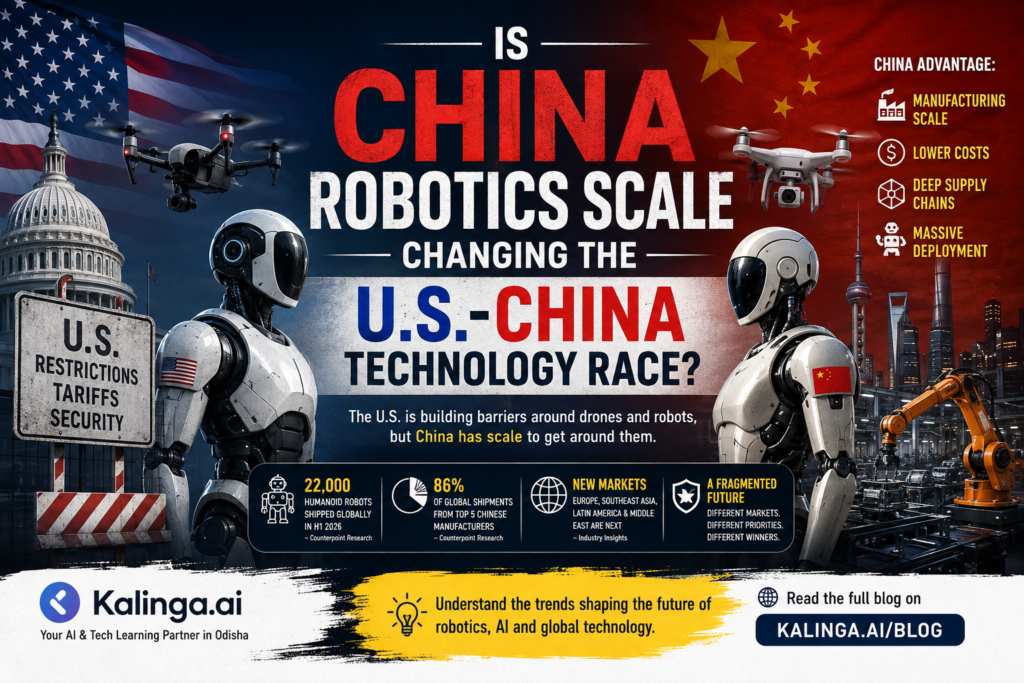
Why the U.S. Is Putting Up Barriers Around Robotics
Imagine buying a robot that is cheaper, more capable, and already being produced at enormous scale,only to discover that your country is increasingly restricting access to it. That is the tension now emerging between the U.S. and China robotics industries.
The U.S. is tightening restrictions on foreign-made advanced robotic systems and imposing steep tariffs on imported drones and their components, largely on national-security grounds. But these policies may protect parts of the American market without solving the deeper issue: China has built a significant manufacturing, supply-chain, and cost advantage in robotics.
The question, therefore, is no longer simply whether the U.S. can keep Chinese robots and drones out. It is whether the American robotics industry and its allies can build enough domestic and allied capacity to compete once access to Chinese manufacturing is restricted.
What are the new U.S. restrictions on robotics?
The U.S. has recently taken several steps to limit the presence of foreign-made technology in strategically important industries. In July and August 2026, Washington tightened restrictions on foreign-made advanced robotic systems and announced steep tariffs on imported drones and drone components. The drone tariffs are scheduled to take effect in September 2026, with additional component tariffs following in 2027.
These actions build on the Federal Communications Commission’s Covered List, established in 2021. The list initially focused on telecommunications and surveillance equipment from companies such as Huawei, ZTE, and Hikvision before expanding to foreign-made drones and, more recently, advanced robotic devices.
Definition , Covered List: The FCC’s Covered List identifies communications equipment and services considered to pose unacceptable national-security or public-safety risks.
The broader strategy is straightforward: reduce dependence on foreign technology in sectors considered strategically sensitive. Robotics and drones increasingly fall into that category because they combine physical machines with software, sensors, communications systems, batteries, and increasingly sophisticated AI.
Question → Direct Answer: Can these restrictions stop Chinese robotics companies from competing globally?
Not necessarily. They can make it harder for Chinese companies to sell certain products in the U.S., but they do not remove China’s manufacturing capacity, domestic demand, supply-chain depth, or ability to sell into other international markets.
That distinction is critical.
The U.S. can restrict access to its market. It cannot automatically restrict what Chinese companies manufacture, how much they produce, or where else those products can be sold.
China Robotics Has a Scale Advantage
The biggest difference between the two sides may not be a single breakthrough technology. Instead, it is scale.
The U.S. and China remain deeply connected through global robotics supply chains, but their competitive strengths are different. According to Ankur Saxena, an investment director at TDK Ventures, robotics does not depend on one single technology in the way semiconductors can. That makes it harder for one country to control the entire competitive equation through restrictions alone.
China robotics companies have increasingly benefited from the country’s massive manufacturing ecosystem, extensive supplier networks, and ability to produce hardware at competitive prices.
Why manufacturing scale matters
Definition , Manufacturing scale: Manufacturing scale refers to the ability to produce large quantities of products efficiently, often reducing the cost of each individual unit as production increases.
For robotics, scale can create a powerful feedback loop.
More production means more robots deployed in real environments. More deployed robots can generate more operational data. That data can help companies improve their systems, while larger production volumes can lower manufacturing costs further.
This creates a cycle:
- More factories produce more robots.
- More robots enter real-world environments.
- Real-world deployment generates operational experience and data.
- Higher volumes help companies reduce costs.
- Lower prices make additional deployments easier.
- More deployments can accelerate further improvement.
Saxena told TechCrunch that China’s advantage lies in manufacturing scale, supply-chain depth, and cost, while the U.S. leads in areas such as frontier AI, software, and semiconductor innovation.
Question → Direct Answer: Why does scale matter so much for humanoid robots?
Humanoid robots are expensive and technically complicated machines. Companies that can manufacture components internally, access established supply chains, and produce robots in larger volumes can potentially reduce costs faster than smaller competitors.
This is where China robotics has an important advantage.
The humanoid robot numbers
The difference is particularly visible in humanoid robots.
Counterpoint reported that global humanoid robot shipments reached 22,000 units in the first half of 2026, with the vast majority coming from Chinese manufacturers. U.S. companies, by comparison, are operating at a much smaller scale.
Even more striking is the concentration among the industry’s leading manufacturers.
The world’s five largest humanoid robot makers by shipments in the first half of 2026 were:
- AgiBot
- Unitree
- Galbot
- UBTECH
- Leju Robotics
All five are Chinese companies, and together they accounted for 86% of global humanoid robot shipments in the first half of 2026, according to Counterpoint.
That does not mean Chinese companies will automatically dominate every future robotics category. But it shows how quickly China robotics manufacturers have moved from experimentation toward volume production.
Can Tariffs and Restrictions Close the Robotics Gap?
This is where the debate becomes more complicated.
A tariff can increase the price of an imported product. A regulatory restriction can prevent a product from entering a market. But neither measure automatically creates a competing domestic factory, supplier network, battery ecosystem, motor manufacturer, sensor company, or robotics workforce.
Question → Direct Answer: Can tariffs alone make U.S. robotics competitive?
No. Tariffs can change the economics of imported products, but long-term competitiveness also depends on manufacturing capacity, supply chains, engineering talent, component availability, investment, and the ability to produce at scale.
That is why China’s cost advantage is such an important part of the discussion.
Mandal told TechCrunch that Chinese humanoid manufacturers are reducing costs partly by bringing more of the technology stack in-house and taking advantage of China’s established manufacturing base. Unitree, for example, is developing more components internally, while companies such as XPeng can draw on existing experience in chips and vehicle manufacturing as they expand into robotics.
The lesson extends beyond humanoid robots.
A robotics company does not operate in isolation. It depends on motors, actuators, batteries, chips, sensors, mechanical components, software, factories, logistics, and testing infrastructure.
If many of those capabilities already exist within a country’s industrial ecosystem, a robotics company can potentially move faster and lower its costs.
The cost curve problem
This creates one of the biggest challenges for the U.S. robotics industry.
Saxena argued that sanctions cannot simply overcome a cost curve; instead, competing with China’s manufacturing advantage requires significant long-term investment in building capacity.
That is a very different strategy from simply restricting imports.
It means building factories, developing suppliers, investing in automation, supporting research, and creating enough demand to make large-scale production economically viable.
For the U.S., the competitive question could therefore shift from:
How do we keep Chinese robots out?
to:
How do we make American and allied robots competitive enough that customers actively choose them?
That is a much harder question.
Where Will Chinese Robotics Companies Expand Next?
If Chinese robotics companies face greater restrictions in the U.S., the global robotics market does not simply disappear.
Instead, competition could move elsewhere.
China has a huge domestic market, while other regions are experiencing labor shortages, demographic changes, and growing demand for automation. These conditions could create new opportunities for Chinese manufacturers that compete primarily on price and production volume.
Europe, Southeast Asia, Latin America and the Middle East
According to Counterpoint’s Soumen Mandal, Chinese robotics companies are already targeting price-sensitive markets across Europe, Southeast Asia, Latin America, and the Middle East, particularly where labor shortages create demand for automation.
This could create a very different global market from the one many people imagine.
Instead of one global robotics industry where companies compete everywhere on equal terms, different regions could increasingly develop their own preferred suppliers and standards.
Mandal expects humanoid robot companies to potentially follow a path similar to Chinese electric-vehicle manufacturers:
- Build manufacturing scale domestically.
- Expand into international markets.
- Establish local production where demand becomes large enough.
- Adapt products to regional requirements.
Countries dealing with labor shortages and demographic decline could become particularly important markets for humanoid robots, especially in manufacturing and other environments involving repetitive physical work.
Question → Direct Answer: Why could labor shortages accelerate humanoid robot adoption?
When companies struggle to find enough workers for repetitive or physically demanding tasks, automation becomes more attractive. Humanoid robots could eventually address some of these tasks if their capabilities and economics become suitable for real-world deployment.
The important word is eventually. The source material does not establish that humanoid robots have already solved these labor shortages at scale.
Drones Show What a Fragmented Robotics Market Could Look Like
The drone industry offers an early example of what could happen to robotics more broadly.
Rather than a single global market, the industry could split into different ecosystems based on security requirements, price, supply chains, and regional policies.
Bentzion Levinson, founder and CEO of Virginia-based drone maker Heven AeroTech, described an increasingly divided drone market: a U.S.-led ecosystem centered on American-made, NDAA-compliant systems and a China-led ecosystem focused on lower-cost, high-volume production.
Definition , NDAA-compliant: In this context, NDAA compliance refers to meeting U.S. defense-related requirements that restrict certain foreign technologies and suppliers.
That distinction matters because the cheapest product may not always be the preferred product.
For a consumer choosing a recreational drone, price may dominate the decision. For a government agency, defense organization, or critical-infrastructure operator, security and supply-chain trust may be more important.
Two markets, two competitive strategies
The emerging picture could look something like this:
| Market segment | Likely competitive advantage | Main priority |
| Low-cost consumer drones | Chinese manufacturers | Price and volume |
| Defense drones | U.S. and allied manufacturers | Security and reliability |
| Critical infrastructure | U.S. and allied manufacturers | Security, autonomy and trust |
| Mass-market robotics | Chinese manufacturers | Manufacturing scale and cost |
| Specialized robotics | Regional/global competitors | Application-specific performance |
| Humanoid robots | Strong Chinese presence, growing global competition | Cost, scale and deployment |
Levinson argued that Western manufacturers are unlikely to beat Chinese companies in the low-end consumer drone market purely on cost. Instead, U.S. and allied companies could focus more heavily on long-range autonomous systems for defense and critical infrastructure, where security requirements matter more.
This is an important strategic shift.
The competition may no longer be about building the cheapest robot.
It may be about building the right robot for the right market.
The Next Robotics Battle May Be About Batteries and Payloads
Robots and drones are physical machines, which means their performance is constrained by physics as much as by software.
Levinson suggested that competition could increasingly shift from the drone itself toward the technology powering it and the equipment it carries. He specifically pointed to battery constraints as an increasingly important issue as drones become more capable.
Question → Direct Answer: Why are batteries important to robotics?
A more capable autonomous machine generally needs enough energy to operate its motors, sensors, computers, communications equipment, and payload. If battery technology cannot keep pace, improvements in software or hardware may still be limited by how long and how far the machine can operate.
This highlights an important point about the global robotics market: robotics is not only an AI story.
It is also a manufacturing story.
It is a battery story.
It is a semiconductor story.
It is a supply-chain story.
And increasingly, it is an energy-efficiency story.
That creates opportunities for companies that may never build a complete humanoid robot or drone themselves.
Why Asia Could Become the Middle Ground
If the global robotics industry becomes more fragmented, countries elsewhere in Asia could benefit.
Japan has decades of experience in industrial robotics and precision manufacturing. South Korea has major strengths in electronics, batteries, and automobiles. Taiwan is a major semiconductor manufacturing hub.
But there is an important limitation: none of these countries can simply replace China overnight.
Chinese components remain deeply embedded across global robotics supply chains, making a complete separation difficult.
That could nevertheless create an interesting middle ground.
South Korean and Japanese companies could combine manufacturing expertise from automotive and electronics industries with growing robotics capabilities.
Hyundai, which owns Boston Dynamics, and Toyota are among the automakers investing in robotics and exploring humanoid robots. Their existing experience with vehicles, manufacturing, and autonomous systems gives them a useful foundation.
Question → Direct Answer: Could Asian countries replace China’s robotics industry?
Not immediately. Japan, South Korea, and Taiwan have important capabilities, but the source material indicates that China’s manufacturing scale and deep integration into robotics supply chains make it difficult for any single country to replace China.
Instead, the more realistic outcome may be diversification.
Companies could source different parts from different countries, assemble products regionally, and build specialized ecosystems around specific industries.
What a Regional Robotics Market Means for the Future
One of the most interesting possibilities is that the future robotics industry may not divide neatly into “American” and “Chinese” camps.
Instead, it could become regional.
Yang Fang of Beagle Technology told TechCrunch that robotics companies may increasingly design machines around the labor needs, working conditions, and customers of their home markets. Chinese companies could focus on products suited to China and nearby markets, while U.S. companies could concentrate on industries across North America.
That creates several possible regional models.
China-led ecosystem
China could continue competing primarily through:
- High-volume manufacturing
- Lower production costs
- Deep domestic supply chains
- Large domestic demand
- Expansion into price-sensitive overseas markets
U.S.-led ecosystem
The U.S. could increasingly compete through:
- Frontier AI
- Robotics software
- Semiconductor innovation
- Autonomous systems
- Defense applications
- Critical infrastructure
- Security-focused robotics
Asian diversification ecosystem
Japan, South Korea, and Taiwan could occupy parts of the middle:
- Precision manufacturing
- Batteries
- Electronics
- Automotive robotics
- Semiconductors
- Industrial automation
The result would not necessarily be a clean separation.
It could be a complicated web of regional supply chains.
Question → Direct Answer: Will the world have two separate robotics industries?
Probably not in such a simple form. The more likely scenario described by the industry experts is a fragmented global robotics market where Chinese companies compete heavily on cost and scale, U.S. and allied companies emphasize security-sensitive applications, and countries such as Japan, South Korea, and Taiwan develop specialized positions.
What Students and Young Professionals Should Watch
For anyone studying AI, robotics, engineering, electronics, or business, this shift offers a useful lesson.
The future of robotics will not be determined by AI models alone.
A student interested in this industry should pay attention to the entire technology stack.
Five areas worth following
- AI and robotics software: Robots need systems that can perceive environments, make decisions, and perform tasks.
- Semiconductors: Computing hardware remains essential to autonomous machines.
- Batteries and energy systems: Greater autonomy requires efficient and reliable power.
- Manufacturing: Production scale can determine whether advanced technology becomes affordable.
- Supply chains: Access to motors, sensors, chips, batteries, and other components can influence how quickly companies can scale.
The China robotics story is therefore useful even if you never work directly for a robotics company.
It demonstrates how technology leadership can come from different sources.
One country may lead in AI research. Another may lead in manufacturing. Another may specialize in batteries or semiconductors.
The companies that connect those capabilities effectively could become the strongest competitors.
A practical takeaway for Indian students
For students and young professionals in India, the changing robotics landscape also makes manufacturing and applied AI worth watching closely.
India does not need to reproduce every part of another country’s industrial model to participate in the global robotics market. Opportunities can emerge in software, automation, components, industrial applications, AI-enabled machines, and regional deployment.
The most valuable skill may be understanding how these pieces fit together.
A robotics engineer who understands manufacturing economics can think differently from one focused only on algorithms. Similarly, an AI developer who understands sensors, hardware limitations, and real-world deployment can build more practical systems.
That broader perspective could become increasingly valuable as the global robotics market becomes more regional.
The Bigger Lesson: Scale Can Be a Technology Advantage
The most important takeaway from the current U.S.-China robotics competition is that technological leadership is not determined only by who invents something first.
It is also determined by who can build it repeatedly, affordably, and at scale.
China robotics manufacturers have demonstrated a significant advantage in humanoid robot shipments and manufacturing scale. At the same time, U.S. companies retain major strengths in frontier AI, software, and semiconductor innovation.
That creates an unusual competitive landscape.
The U.S. may have strengths at the technological frontier, while China has strengths in turning physical technology into large-scale products.
The next phase of the race could therefore depend on whether these strengths become more connected.
If the U.S. and its allies can develop competitive manufacturing ecosystems, they may be able to narrow the gap in physical robotics.
If Chinese companies continue reducing costs and expanding outside the U.S., they could build even larger global markets elsewhere.
And if Japan, South Korea, Taiwan and other countries strengthen their positions, the industry could become more distributed than ever.
The biggest change may not be that one country wins.
It may be that the global robotics industry stops behaving like one market at all.
FAQ
What is China’s biggest advantage in robotics?
China’s biggest advantage is manufacturing scale, supply-chain depth, and cost competitiveness. Chinese manufacturers accounted for the vast majority of global humanoid robot shipments in the first half of 2026, with the five largest manufacturers accounting for 86% of global shipments, according to Counterpoint.
Why is the U.S. restricting Chinese drones and robots?
The U.S. is restricting certain foreign-made drones, drone components, and advanced robotic systems primarily on national-security grounds. These measures are part of a broader effort to reduce reliance on foreign technology in strategically important industries.
Are Chinese humanoid robots cheaper than U.S. robots?
The source material indicates that Chinese manufacturers have been able to cut humanoid robot prices faster than many U.S. competitors because of manufacturing scale, supply-chain depth, in-house component development, and China’s existing industrial base.
Where could Chinese robotics companies expand outside the U.S.?
Chinese robotics companies are already targeting markets in Europe, Southeast Asia, Latin America, and the Middle East, particularly areas facing labor shortages and growing demand for affordable automation.
Could Japan and South Korea compete with China in robotics?
Yes, both countries have important capabilities. Japan has deep experience in industrial robotics and precision manufacturing, while South Korea has strengths in electronics, batteries, and automobiles. However, the source indicates that neither can simply replace China’s deeply embedded manufacturing and component ecosystem.
Will the global robotics market split into regional ecosystems?
That is a likely direction according to the industry experts cited by TechCrunch. The emerging model could feature Chinese companies competing heavily on cost and scale, U.S. and allied companies focusing on security-sensitive applications, and Asian manufacturers developing specialized positions between those ecosystems.
Conclusion
The U.S. is building barriers around foreign robotics and drones, but China robotics companies have something tariffs cannot easily remove: scale. The coming competition may therefore be less about completely separating the two countries and more about creating regional ecosystems with different strengths, standards, supply chains, and customers.
For the next generation of engineers, founders, and AI professionals, the message is clear: don’t watch robotics as an AI-only race. Manufacturing, batteries, semiconductors, software, supply chains, and deployment economics may matter just as much as the robot itself.