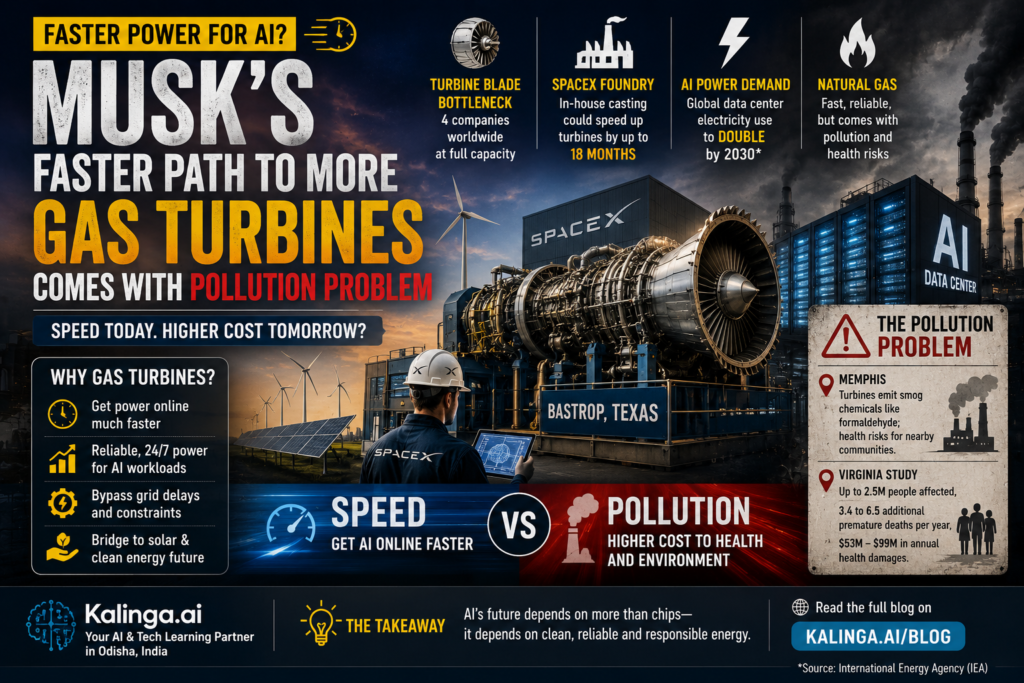
AI may run on GPUs, but those GPUs are useless without electricity,and getting that electricity quickly is becoming one of the biggest infrastructure challenges in the AI boom. Gas turbines are emerging as a fast way to power new data centers, but the shortcut comes with serious pollution and public-health concerns.
Elon Musk says SpaceX is building a new foundry in Bastrop, Texas, that could manufacture difficult-to-produce turbine blades and vanes internally, potentially accelerating natural-gas turbine deployment by up to 18 months. The idea could help solve a major AI infrastructure bottleneck, but it also raises a difficult question: what happens when faster AI power means more fossil-fuel emissions?
Why AI Data Centers Are Turning to Gas Turbines
The AI infrastructure race has traditionally been described as a battle for GPUs. Companies need Nvidia’s latest chips, massive server clusters, advanced networking, cooling systems, and enormous data centers to train and operate increasingly capable AI models.
But another bottleneck has moved into the spotlight: electricity.
The International Energy Agency projects that global data center electricity consumption will roughly double by 2030. At the same time, electricity grids can take years to expand, while AI companies want new computing capacity much sooner.
That mismatch creates a problem.
A technology company can order servers and build a data center, but if the local grid cannot provide enough electricity, the facility may sit waiting for power.
Question → Direct Answer: Why is electricity becoming an AI bottleneck?
AI data centers require enormous amounts of electricity, and expanding traditional grid infrastructure can take considerable time. As AI computing capacity grows faster than available power infrastructure in some locations, companies are looking for ways to generate electricity closer to their data centers.
This is where gas turbines enter the picture.
Instead of waiting for a new transmission line, power plant, or grid connection, companies can install generation capacity directly at or near a data center.
Natural gas is particularly attractive because it can provide dispatchable power,electricity that can be generated when needed rather than only when weather conditions allow.
That does not make natural gas environmentally neutral. It simply makes it useful for companies trying to get electricity online quickly.
Definition + Expansion: What are gas turbines?
Gas turbines are machines that burn a fuel such as natural gas to produce hot expanding gases that drive a turbine and generate electricity.
In a data center context, a gas-fired power plant can operate independently of the broader grid and provide electricity directly to computing infrastructure. This can help developers avoid waiting for grid upgrades, but the combustion process also produces air pollutants and greenhouse-gas emissions.
That trade-off is becoming increasingly important as AI companies build larger facilities.
According to the source article, hyperscalers including Amazon, Google, Meta, OpenAI, and Microsoft are among the companies pursuing or considering natural-gas-based power strategies for data center development.
The basic calculation is easy to understand:
AI demand is rising → data centers need more electricity → grid capacity can become a bottleneck → companies seek faster private power → natural gas becomes an attractive option.
The difficult part is what comes next.
The faster these facilities come online, the more important their environmental impact becomes.
Musk’s SpaceX Foundry Targets a Critical Turbine Bottleneck
Elon Musk says he has identified a particularly stubborn obstacle in the natural-gas power supply chain: manufacturing the blades and vanes used inside gas turbines.
On August 30, 2026, Musk confirmed that SpaceX is building what appears to be a turbine-component foundry in Bastrop, Texas. The confirmation followed reporting by The Information and investigation by Corey Trinetti, who tracks AI infrastructure sites.
According to the source article, job listings described a “blades and vanes foundry,” while SpaceX had reportedly acquired roughly 830 acres near its existing Starlink factory in Bastrop between March and June.
Musk’s explanation was direct.
He said SpaceX and Tesla are each building 100 GW/year of solar production capacity as quickly as possible, but argued that natural gas would still be needed to supplement and bootstrap solar for several years. He identified turbine blade and vane casting as the limiting factor and said in-house casting could accelerate natural-gas turbines coming online by up to 18 months.
Why turbine blades are so difficult to manufacture
A turbine blade might look like a relatively ordinary mechanical component.
It is anything but.
The hottest sections of a gas turbine operate under extreme conditions. According to The Information, the blades can experience temperatures of roughly 3,000 to 3,600°F,around 800°F hotter than the melting point of the metal alloy used to make them.
So how can a metal component survive temperatures beyond its melting point?
The answer involves sophisticated engineering.
The blades use internal cooling channels and thermal-barrier coatings, combined with highly specialized casting techniques. The manufacturing process is designed to create components capable of operating under extraordinary thermal and mechanical stress.
Question → Direct Answer: Why can’t turbine blades simply be manufactured like ordinary metal parts?
The hottest turbine blades need to survive temperatures and stresses that ordinary cast-metal components cannot tolerate. Their specialized internal cooling structures, coatings, and crystal structure require extremely precise manufacturing processes.
The source article says only four companies worldwide have mastered the relevant casting process well enough to produce these components at industrial scale, and those suppliers are currently operating at capacity.
That creates a bottleneck.
Even if companies have the money to build new power plants, they may still have to wait for the specialized turbine components required to operate them.
The single-crystal challenge
The manufacturing process becomes even more demanding because each blade must be cast as a single, unbroken crystal.
Why?
Microscopic seams or boundaries inside ordinary cast metal can become weak points under extreme heat and mechanical stress.
The blades therefore need to be produced slowly in a vacuum furnace so that the crystal structure develops without those problematic seams.
The challenge exists in jet engines too, but power-plant turbine blades are considerably larger, making the manufacturing challenge even harder.
Question → Direct Answer: What could SpaceX gain by making turbine blades itself?
If SpaceX successfully develops the capability, it could reduce its dependence on a small number of suppliers and potentially accelerate the deployment of natural-gas power for its AI infrastructure. The source article describes this as a potential strategic advantage because other AI infrastructure developers currently depend on a small global supplier base.
But there is a major caveat.
Building the foundry is not the same as proving that it can manufacture these components reliably at industrial scale.
The engineering challenge remains substantial.
Why the AI Boom Needs More Than GPUs
The most interesting part of this story is that it changes how we should think about AI infrastructure.
For years, AI hardware discussions focused on processors.
How many GPUs can a company buy?
How quickly can Nvidia deliver them?
How much computing power can a data center fit into one building?
Those questions remain important. But the source article points to another constraint: physical infrastructure.
A modern AI data center needs far more than computing chips.
It requires:
- Electricity generation
- Grid connections
- Transmission capacity
- Cooling systems
- Buildings and land
- Networking equipment
- Backup power
- Batteries or other energy systems
- Semiconductor supply
- Specialized industrial components
This means the AI race is increasingly becoming an infrastructure race.
Definition , AI infrastructure: AI infrastructure is the physical and digital foundation required to build and operate AI systems, including computing hardware, data centers, networks, electricity, cooling, and supporting industrial systems.
The bigger AI models become, the more resources their supporting infrastructure requires.
That is why the gas turbine supply chain suddenly matters to AI companies.
A turbine is not an AI chip.
But without enough electricity, thousands of AI chips cannot do much.
Gas Turbines Offer Speed, but Pollution Is the Trade-Off
The appeal of gas-fired power is easy to understand.
If a data center can generate electricity locally, it may not have to wait for the grid to catch up.
But there is another side to the equation.
Gas turbines produce air pollution.
The source article highlights growing legal challenges and health research around natural-gas turbines being deployed to power data centers.
The most visible example is Memphis, where SpaceXAI has operated gas turbines to power its Colossus data centers since 2024.
What happens in Memphis?
In Memphis, the NAACP has repeatedly accused the company of operating turbines without the permits or pollution controls required under federal law.
The concern is not simply about carbon emissions.
The turbines can also emit smog-forming compounds and hazardous pollutants such as formaldehyde, which are associated with health risks including asthma, respiratory disease, and certain cancers.
The data center is also located near neighborhoods that already experience significant industrial pollution.
Researchers at the University of Memphis conducted a limited analysis and reported that air pollution became “slightly worse” because of the data center.
Question → Direct Answer: Why is the Memphis case important?
Memphis illustrates how the rapid deployment of private gas-fired power can create environmental and community concerns when large computing facilities are placed near existing populations and industrial pollution sources.
The issue therefore goes beyond a technical debate over how quickly AI companies can obtain electricity.
It becomes a question about who bears the environmental cost of that electricity.
A data center may provide economic activity and computing capacity while nearby communities experience additional pollution.
That tension is likely to become more important as AI infrastructure expands.
What Virginia’s Health Study Found
Memphis is not an isolated example.
The source article points to Virginia’s Data Center Alley, another major concentration of data center infrastructure.
A study commissioned by the Piedmont Environmental Council examined a facility with eight full-time gas turbines and used the U.S. Environmental Protection Agency’s COBRA health-impact model.
The study estimated that emissions from the turbines could affect more than 2.5 million people across multiple counties.
It also estimated 3.4 to 6.5 additional premature deaths per year, with annual health-related damages estimated at $53 million to $99 million.
These are estimates from a study commissioned by an environmental organization, rather than a universal finding about every gas-powered data center. They nonetheless illustrate why the environmental costs of on-site power are becoming part of the AI infrastructure debate.
Question → Direct Answer: Does every data center powered by natural gas create the same health impact?
No. The health impact depends on factors such as the location, emissions controls, turbine configuration, operating hours, surrounding population, and existing pollution levels. The Virginia study provides an estimate for a specific facility rather than a universal figure for all data centers.
That distinction matters.
It is easy to frame the discussion as “AI versus the environment,” but the actual issue is more complicated.
The question is how companies can expand computing capacity while minimizing the health and environmental consequences of the energy systems supporting it.
How On-Site Power Is Changing Data Center Infrastructure
Traditionally, a data center could connect to the electrical grid and consume power supplied by utilities.
But the rapid growth of AI is putting pressure on that model.
Grid expansion involves planning, permitting, transmission construction, generation capacity, and coordination between multiple stakeholders.
AI companies, meanwhile, are competing to bring new computing capacity online quickly.
That creates an incentive to build power generation directly alongside the data center.
The new data center equation
The traditional model looks roughly like this:
Data center → grid connection → electricity
The emerging model can look more like:
Data center → private generation → electricity
That private generation can include natural gas, solar, batteries, or combinations of technologies.
Musk’s comments illustrate one version of this strategy.
He says SpaceX and Tesla are rapidly building solar capacity but expects natural gas to remain necessary as a supplement while solar capacity expands.
This is sometimes described as using one energy source to bootstrap another.
The basic idea is that a company can use dispatchable generation to provide reliable electricity while expanding renewable capacity.
But whether that transition happens quickly enough,and whether the interim pollution costs are acceptable,is a much larger policy and engineering question.
Gas Turbines vs Solar and the Grid: What’s the Difference?
There is no single perfect energy source for an AI data center.
Each approach has different advantages and limitations.
| Power approach | Main advantage | Main challenge | Data center relevance |
| Natural gas | Can provide dispatchable power quickly | Air pollution and fossil-fuel emissions | Useful where grid power is constrained |
| Solar | Renewable generation with low operating emissions | Variable output and storage requirements | Important for long-term clean-energy strategies |
| Grid power | Connects data centers to broader electricity infrastructure | New grid capacity can take time | Conventional foundation for many facilities |
| Batteries | Can store electricity and provide backup or balancing | Storage duration and cost constraints | Useful alongside generation and grid power |
| Hybrid systems | Combines multiple power sources | More complex infrastructure | Potential way to balance reliability and sustainability |
Question → Direct Answer: Is natural gas necessarily replacing solar?
Not according to Musk’s stated strategy. He says SpaceX and Tesla are building large-scale solar capacity while using natural gas as a supplement and bootstrap source for several years.
That distinction is important.
The emerging model may not be “gas instead of solar.”
It could be gas plus solar plus grid power plus storage, at least during a transitional period.
The problem is that a transition can last longer than expected.
If AI demand keeps increasing, companies may continue relying on gas-fired generation because it provides dependable power while other infrastructure catches up.
That could turn what was supposed to be a temporary solution into a long-term source of emissions.
Can Faster Turbine Manufacturing Make AI Infrastructure Sustainable?
This is where the story becomes genuinely paradoxical.
Faster turbine manufacturing could help solve one AI infrastructure problem.
But it could simultaneously accelerate another problem.
If SpaceX successfully manufactures turbine blades internally, it could potentially increase the supply of equipment needed to generate natural-gas power.
That would help AI companies bring electricity online faster.
But more natural-gas generation can also mean more emissions if the turbines operate without adequate pollution controls or if communities are exposed to increased pollutants.
So the technological achievement and environmental concern can both be true at the same time.
Question → Direct Answer: Does solving the turbine supply bottleneck solve AI’s energy problem?
It can address one part of the problem,the availability of turbine equipment,but it does not solve the broader questions of fuel supply, emissions, grid capacity, renewable integration, energy storage, or environmental impact.
That is the key lesson.
Infrastructure bottlenecks rarely exist in isolation.
Solve one bottleneck and another can become visible.
First it was GPUs.
Then electricity.
Then turbine manufacturing.
Then perhaps batteries, transmission, cooling, or another component of the infrastructure stack.
AI’s rapid expansion is exposing these dependencies one by one.
The real challenge is speed versus sustainability
AI companies want infrastructure quickly.
Communities want clean air.
Utilities need time to expand grids.
Manufacturers need time to produce specialized equipment.
Governments need to balance economic growth, national competitiveness, environmental rules, and public health.
These goals do not always align.
The future of AI infrastructure will therefore depend not only on who can build the largest data center, but on who can build one quickly, reliably, and responsibly.
What This Means for India’s AI and Data Center Growth
The issue is particularly relevant for India as the country expands its digital infrastructure and AI ambitions.
India’s growing demand for cloud computing, AI services, digital platforms, and data centers means electricity infrastructure will increasingly matter alongside chips and software.
The exact U.S. circumstances described in this article should not automatically be applied to India. But the broader lesson is highly relevant: AI growth requires physical infrastructure, and electricity is one of its most important foundations.
For Indian technology professionals, that means opportunities may emerge far beyond AI model development.
Consider the supporting ecosystem:
- Data center engineering
- Power management
- Renewable energy
- Battery storage
- Cooling technology
- Semiconductor manufacturing
- Industrial automation
- Energy-efficient computing
- Grid modernization
- AI infrastructure software
The next generation of AI jobs may therefore sit at the intersection of computing and energy.
A student studying computer science does not need to become a power engineer to understand this trend.
But understanding how electricity reaches an AI data center can provide a much more realistic picture of how the AI industry actually operates.
What Students and Young Professionals Should Understand
One of the easiest mistakes in AI discussions is to think everything starts and ends with software.
It doesn’t.
Every AI service eventually touches physical infrastructure.
When you ask an AI chatbot a question, servers somewhere have to process that request. Those servers consume electricity, generate heat, require cooling, depend on networking equipment, and operate inside buildings that need power infrastructure.
At large scale, those requirements become enormous.
Question → Direct Answer: Why should AI students care about energy infrastructure?
Because the growth of AI depends on more than algorithms and GPUs. Electricity generation, data centers, cooling, networking, batteries, and industrial supply chains increasingly determine how quickly AI companies can expand.
If you’re preparing for a career in AI, consider developing knowledge across adjacent fields.
Five areas worth learning
- AI infrastructure: Understand how models move from research environments into large-scale production.
- Data centers: Learn the basics of servers, networking, cooling, and power systems.
- Energy technology: Follow developments in solar, batteries, natural gas, and grid infrastructure.
- AI efficiency: Explore ways to reduce the computing and energy required for AI workloads.
- Sustainability: Understand how environmental constraints influence technology deployment.
This broader perspective can help you see opportunities that pure AI-model discussions might miss.
The companies building the next generation of AI infrastructure will need people who understand how software interacts with the physical world.
The Bigger Question: How Much Power Should AI Consume?
The debate around gas turbines ultimately points to a much larger question.
How much electricity should society devote to AI?
AI can provide valuable capabilities, from productivity tools to scientific research and automation. But the infrastructure required to operate these systems has physical consequences.
The more data centers companies build, the more electricity they need.
The more electricity they need, the more generation capacity becomes necessary.
And the faster they want that capacity, the greater the pressure to use technologies that can be deployed quickly.
Natural gas can fit that requirement.
But pollution cannot simply be treated as an external detail.
The Memphis and Virginia examples in the source article show why local communities, regulators, researchers, and environmental organizations are paying attention.
The central challenge is no longer simply building more AI. It is building the energy system that can support AI without shifting unacceptable costs onto communities and the environment.
Musk’s turbine foundry could become an important example of how AI infrastructure companies are attempting to solve supply-chain constraints themselves.
But whether that makes the overall AI energy system better depends on what happens beyond the factory floor.
FAQ
Why are gas turbines being used for AI data centers?
Gas turbines are being considered for AI data centers because they can provide dispatchable electricity without requiring companies to wait entirely for new grid infrastructure. As AI increases electricity demand, private generation can offer a faster path to powering new computing facilities.
Why is Elon Musk building a turbine blade foundry?
Elon Musk says SpaceX is building an in-house foundry to cast turbine blades and vanes, which he identifies as a major bottleneck in natural-gas turbine production. He says the capability could accelerate turbine deployment by up to 18 months.
Why are turbine blades difficult to manufacture?
The hottest turbine blades operate at temperatures of approximately 3,000 to 3,600°F and require specialized cooling channels, thermal-barrier coatings, and precise casting. The source article says the blades must be formed as single crystals to avoid microscopic seams that could fail under extreme conditions.
What are the pollution concerns around natural-gas data centers?
Natural-gas turbines can emit air pollutants, including smog-forming compounds and hazardous chemicals such as formaldehyde. The source article highlights concerns in Memphis and Virginia about potential health impacts associated with on-site gas-fired power generation.
Could solar replace natural gas for AI data centers?
Solar can contribute significantly to powering AI infrastructure, but solar generation is variable and may require grid connections or energy storage to provide continuous power. Musk says SpaceX and Tesla are building large-scale solar capacity while using natural gas as a supplement and bootstrap source during the transition.
Is the AI energy problem only about electricity generation?
No. AI’s energy challenge involves an entire infrastructure chain that includes electricity generation, transmission, data centers, cooling, chips, networking, batteries, and specialized equipment. The turbine-blade shortage shows how a single industrial component can become a bottleneck for the broader AI infrastructure ecosystem.
Conclusion
The rise of gas turbines reveals an uncomfortable truth about the AI boom: building smarter models also means building enormous physical infrastructure to power them.
Musk’s SpaceX foundry could potentially remove a major bottleneck in turbine manufacturing and accelerate the deployment of natural-gas power. But faster infrastructure does not automatically mean cleaner infrastructure. The pollution concerns emerging around data centers in Memphis and Virginia show why the next phase of AI development will have to balance speed, reliability, energy demand, and public health.
For students and professionals entering the AI industry, that is perhaps the most important takeaway: the future of AI will not be built by software engineers alone. It will also depend on energy experts, hardware engineers, manufacturers, infrastructure planners, and people capable of connecting digital growth with the physical world.