What Did the Court Actually Rule in the X vs. Operation Bluebird Case?
A federal court in Delaware ruled on a trademark dispute between X Corp. and a startup called Operation Bluebird, which had originally launched under the name Twitter.now before rebranding. U.S. District Court Judge Colm F. Connolly issued what’s described as a split ruling on September 4, 2026: X won on the core “Twitter” name, but lost on two related marks.
Question → Direct Answer: Can Operation Bluebird use the name “Twitter”? No , the court sided with X on this specific point, and Operation Bluebird was barred from using “Twitter” as part of its branding.
Question → Direct Answer: What about the word “tweet” and the bird logo? Those are different , the judge found that X had likely abandoned both the “tweet” trademark and the Twitter bird logo, meaning they’re currently available for other companies to use, at least under this preliminary ruling.
Definition: What Is Trademark Abandonment?
Trademark abandonment is a legal concept where a company loses its exclusive rights to a trademark because it stopped genuinely using that mark in commerce and doesn’t intend to use it again. It’s not automatic just because a company rebrands , a court has to specifically find that the original use was discontinued and there’s no real intent to resume it, which is exactly what Judge Connolly found regarding the “tweet” mark and bird logo in this case.
Who Is Behind Operation Bluebird and Its Tweet.app Rebrand?
Operation Bluebird is a Virginia-based startup that has rebranded its website as Tweet.app after this ruling, using the newly freed-up “tweet” name to launch a rival social network to the public. The effort is led by two lawyers rather than typical startup founders: Illinois-based founder Michael Peroff, and Stephen Coates, who previously worked as a trademark lawyer at Twitter itself before it became X.
Why does it matter that the founders are lawyers, not product builders? Because it strongly suggests the real goal isn’t building a unique social platform , it’s acquiring valuable, abandoned Twitter trademarks that carry significant brand recognition and commercial value on their own, independent of any actual product.
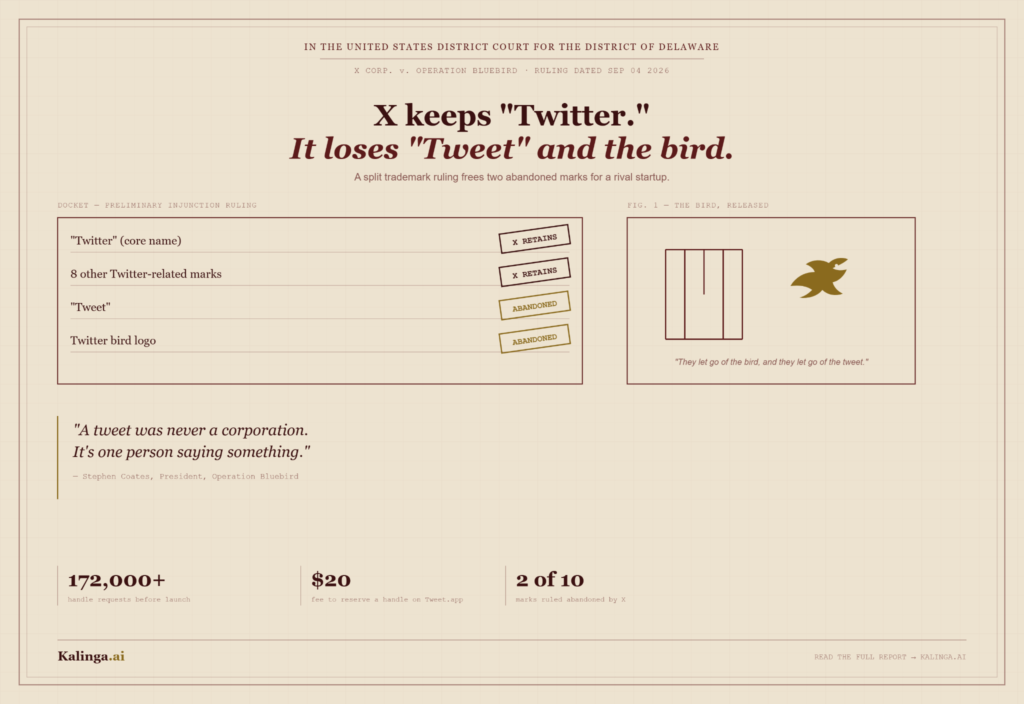
Coates, who serves as president of Operation Bluebird, explained the company’s reasoning in an announcement shared with TechCrunch: “A tweet was never a corporation. It’s one person saying something.” The framing positions “tweet” as a word that belongs to the public, not to any single company, because ordinary people kept using it long after X tried to move away from the term.
Timeline: How the Twitter Trademark Dispute Unfolded
Here’s how this Twitter trademark ruling came together, based on the public record:
- December 2025: Reports first surface about the startup’s effort to pry the “Twitter” trademark away from X, led by Peroff and Coates.
- August 27, 2026: The startup launches publicly under the name Twitter.now.
- September 4, 2026: Judge Colm F. Connolly issues a split preliminary injunction ruling , blocking eight Twitter-related marks in X’s favor, but denying X’s request regarding the “Tweet” mark and the bird logo.
- Following the ruling: Operation Bluebird rebrands its site to Tweet.app and opens to the public, using the trademarks the court found X had abandoned.
- Pre-launch demand: More than 172,000 people requested a handle on the platform before it even launched, according to figures the company shared with TechCrunch.
Why did so many people want a handle before launch? Likely due to lingering public affinity for the old “Twitter” brand name itself , even though, notably, that’s the one name Tweet.app still isn’t allowed to use.
What Marks Did the Court Block vs. Allow?
| Trademark | Court’s Ruling | Status for Operation Bluebird |
| “Twitter” (core name) | Injunction granted in X’s favor | Cannot be used |
| Eight other Twitter-related marks | Injunction granted in X’s favor | Cannot be used |
| “Tweet” | Injunction denied , likely abandoned by X | Available, now used as Tweet.app |
| Twitter bird logo | Injunction denied , likely abandoned by X | Available for use |
Why does the ruling split the “Twitter” name from the “tweet” word and bird logo? Because trademark abandonment is assessed mark-by-mark, not company-wide , a business can actively defend one name while a court finds it genuinely stopped using a related mark, which is exactly the mixed outcome here.
Why This Case Matters Beyond Tech Gossip
Question → Direct Answer: Is this ruling final? No , the case will proceed further to determine whether X ultimately retains any rights to the Twitter-related marks at all, especially now that the company operates under the “X” name in most contexts.
A preliminary injunction is a temporary court order issued before a full trial, meant to prevent harm while a legal dispute is still being resolved , it’s not the court’s final word on who legally owns a trademark long-term. In his opinion, Judge Connolly found Bluebird was likely to succeed in eventually proving that X had discontinued genuine use of the “Tweet” mark and bird logo, and that X didn’t intend to resume using them , though this is still a preliminary finding, not a final judgment.
This case is also a pointed reminder that charging users money is part of the business model here , Tweet.app reportedly charges $20 for users to reserve their handle and join the platform, which likely helps offset the company’s ongoing legal costs in this fight.
What This Means for Startups, Branding, and IP Law in India
- Trademark rights aren’t permanent just because you registered a name , genuine, continued use of a mark matters as much as the original registration itself.
- Rebranding carries real legal risk , a company that moves away from an old name (as X did from Twitter) can inadvertently open the door for others to claim the abandoned marks.
- Public usage patterns can matter in court , the argument that ordinary people kept using the word “tweet” long after the corporate rebrand played directly into the court’s abandonment finding.
- Trademark disputes can become business models in themselves , Operation Bluebird’s approach shows how contested IP can be pursued as a standalone commercial opportunity, not just a branding necessity.
- Preliminary rulings aren’t final outcomes , anyone following IP law, in India or elsewhere, should note that early court decisions like this one can still change as a case proceeds.
Frequently Asked Questions About the X vs. Tweet.app Trademark Ruling
Can Tweet.app use the name “Twitter”? No. The court ruled in X’s favor on the core “Twitter” trademark and eight related marks, meaning Operation Bluebird cannot use the “Twitter” name.
Why was X allowed to keep “Twitter” but not “tweet” or the bird logo? The court found that while X actively defended the “Twitter” name, it had likely abandoned genuine use of the “tweet” trademark and the bird logo, with no clear intent to resume using them.
Who founded Operation Bluebird and Tweet.app? Operation Bluebird is led by founder Michael Peroff and Stephen Coates, a former Twitter trademark lawyer who now serves as the company’s president.
How much does it cost to join Tweet.app? Tweet.app reportedly charges users $20 to reserve a handle and join the platform, a fee that likely helps cover the company’s legal expenses in this trademark case.
Is this trademark ruling final? No. The ruling was a preliminary injunction decision, and the case will continue to determine whether X ultimately retains rights to any of the Twitter-related trademarks.
How many people signed up for Tweet.app before launch? More than 172,000 people requested a handle on the platform before it launched, according to figures the company provided to TechCrunch.
Curious how trademark and IP disputes keep shaping the tech industry? Explore more explainers on tech law and branding over on Kalinga.ai.