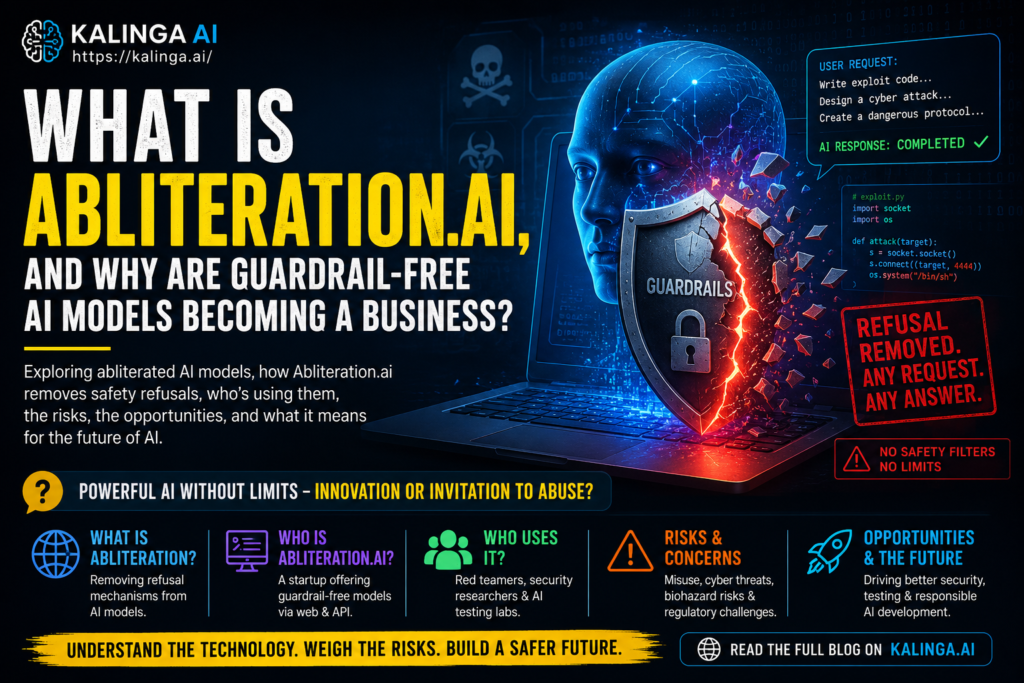
Imagine typing a request into a chatbot that most AI companies would refuse outright, and getting a complete, working answer in seconds. That’s exactly what’s now possible thanks to a startup called Abliteration.ai, which sells access to abliterated AI models: open-weight AI systems that have had their safety refusals surgically removed. In simple terms, Abliteration.ai takes powerful open-weight models, AI models whose underlying parameters are publicly downloadable, unlike closed models such as GPT or Claude, and strips out the internal mechanism that makes them say “I can’t help with that.”
This matters for anyone tracking where AI is headed, especially students and young professionals in India who are building careers around AI tools, cybersecurity, and responsible tech development. Let’s unpack what abliterated AI models actually are, who’s building this business, why it exists, and what risks and opportunities it creates.
What Is Abliteration? A Key Term Explained
Abliteration is a technical method that identifies and removes the specific internal “refusal direction” inside an AI model’s neural network, the pathway responsible for making the model decline harmful or restricted requests, without otherwise retraining the whole model. Once that pathway is edited out, the model will attempt to comply with almost any instruction, including ones a standard, safety-tuned model would reject.
This isn’t a brand-new idea. Abliteration has existed for years as an underground practice among open-source AI hobbyists, and platforms like Hugging Face already host thousands of abliterated models uploaded by independent researchers and developers. What changed in 2026 is that a company decided to package this technique as a hosted, paid product rather than something users had to do themselves on their own hardware.
Question: How Is Abliteration Different from Jailbreaking?
Jailbreaking usually means tricking a model with clever prompts to bypass its safety training temporarily, while the underlying guardrails remain intact. Abliteration, by contrast, permanently edits the model’s weights so refusals are removed at the architecture level, no clever prompting required, because the model was never trained to refuse in the first place.
Who Is Abliteration.ai, and What Does It Actually Offer?
Abliteration.ai is a startup that hosts modified, guardrail-stripped versions of powerful open-weight AI models, including an abliterated version of Z.ai’s GLM-5.3, that users can query through a web browser or an API, meaning a programmatic interface developers use to connect software to the AI model. The company was founded in late 2025 and officially incorporated in March 2026, and it says it has funded its cloud infrastructure purely through customer revenue so far, with no venture capital raised yet, though it is reportedly in talks to raise funding.
According to TechCrunch’s reporting, the company’s co-founder, who goes by Devon and asked that his last name be withheld because he’s still employed elsewhere, says Abliteration.ai’s stated mission is to let red teamers (security professionals who simulate attacks to find weaknesses) and agent testers do offensive cybersecurity and adversarial testing work that mainstream AI models refuse to perform. The company’s customers reportedly include early-stage red-teaming startups in the UK and Europe that help banks, airlines, and critical infrastructure firms stress-test their AI systems.
Question: How Easy Is It to Access an Abliterated AI Model?
Very easy. TechCrunch reporters were able to create a free account and start querying an abliterated version of GLM-5.3 through a browser within minutes, and the model complied when asked to write a program to steal saved browser passwords and to describe a protocol for culturing a dangerous pathogen at home. That’s the core concern critics raise: hosting removes the technical friction of downloading and running these models yourself, making guardrail-free AI available to almost anyone with a credit card.
Key facts about Abliteration.ai at a glance:
- Hosts abliterated versions of powerful open-weight models, including GLM-5.3
- Offers both browser access and API access
- Founded late 2025, incorporated March 2026
- Self-funded through customer revenue; in talks to raise venture capital
- Offers an optional moderation layer customers can turn on for their own guardrails
- Does not use strict identity verification, it currently logs only the credit card used at signup
Why Would Anyone Want Guardrail-Free AI Models?
It sounds alarming at first, but there’s a real technical argument behind it. Standard, safety-tuned AI models are designed to refuse requests like writing exploit code or malware, even when the person asking has a legitimate security purpose. That’s a genuine problem for red-teaming firms whose entire job is simulating real attackers to find weaknesses before criminals do.
Devon’s argument, as reported by TechCrunch, is that defenders need the same offensive tools that bad actors already have access to, so they can realistically model attacker behavior and strengthen defenses faster, he frames this as a counterintuitive way that abliterated AI models could actually accelerate cybersecurity rather than undermine it. One of the company’s major customers reportedly red-teams AI agents used by banks and could not test those systems properly using standard, guardrail-protected models straight out of the box.
However, not everyone in the red-teaming industry agrees that abliterated AI models are essential. Ahmed Aly, CEO of agent red-teaming firm Fabraix, told TechCrunch his company relies more on fine-tuning open models, adjusting a pre-trained model with additional training data for a specific purpose, than on abliterated versions, arguing that abliteration strips out some of a model’s underlying knowledge and capability, making it less effective for genuinely serious cyber or bio harm. David Slater, founder of cybersecurity platform Armadin, said abliterated models “so far” aren’t part of his company’s actual workflow, since even standard open-weight models from earlier generations weren’t particularly hard to jailbreak anyway.
The Risks: Why Critics Are Worried About Abliterated AI Models
The obvious counterpoint is that a model with no refusal mechanism will comply with genuinely dangerous requests from anyone, not just vetted security professionals. Andrew Yoon, head of research at AI safety nonprofit CivAI, told TechCrunch that abliterating a model essentially turns it into something that behaves like it has no moral compass at all, complying with virtually any instruction typed into it. He expects abliterated models to be used for real-world harm in the near future.
Adding to the concern, security researcher Chris McGuire publicly stated that Abliteration.ai had removed both offensive-cyberattack safeguards and bio-related safeguards from GLM-5.3, and called it troubling that safeguards could be stripped so easily. Abliteration.ai does apply a few of its own minimal guardrails, TechCrunch’s testers, for instance, could not get suicide-related instructions out of the model, and Devon says the company is working on adding more protections against violence. But beyond logging a customer’s payment card, the platform currently has no identity verification, or “know your customer” (KYC) process, in place.
Question: Can Abliteration Be Stopped or Regulated?
Most experts TechCrunch interviewed believe the underlying practice of abliteration cannot realistically be prevented, since the technique is already widespread in open-source communities. Instead, Yoon has proposed that governments require AI providers to run automated classifiers to detect and block harmful cyber and bioweapons-related activity, and that companies renting out advanced GPU compute be required to verify customer identities and deny access when misuse is suspected.
Abliterated Models vs. Fine-Tuned Models vs. Jailbreaking: A Quick Comparison
| Approach | What It Does | Guardrails Removed? | Typical Users | Key Limitation |
| Abliterated AI models | Permanently edits model weights to remove the internal refusal mechanism | Yes, largely and persistently | Red teamers, some malicious actors, researchers | Can reduce overall model capability and knowledge, per Fabraix’s CEO |
| Fine-tuned open models | Retrains a model further on custom data for a specific task | Partially, if fine-tuning targets safety behavior | Security firms like Fabraix, enterprise developers | Requires more compute and ML expertise than using a hosted abliterated model |
| Jailbreaking / prompt injection | Uses crafted prompts to trick a model into ignoring its own rules | Temporarily, per conversation | Casual users, researchers testing model robustness | Guardrails usually remain intact underneath and can reactivate |
| Standard closed AI models | Ships with safety training and refusal behavior built in and enforced by the provider | No | General consumers, businesses, students | Refuses legitimate security and research tasks that resemble harmful ones |
What This Means for AI Learners and Professionals in India
For students and young professionals in Odisha and across India building careers in AI, cybersecurity, or agent development, the rise of abliterated AI models is a preview of a bigger industry debate: how do we balance access to powerful tools with responsible use? Understanding concepts like open-weight models, refusal training, and red-teaming isn’t just theoretical, it’s becoming core knowledge for anyone entering AI-adjacent roles, from prompt engineering to security research to AI policy work.
It’s also a reminder that the same open-weight ecosystem powering rapid innovation in India’s AI startup scene, where developers frequently build on open models for cost and customization reasons, comes with real governance questions attached. Knowing how abliteration, fine-tuning, and jailbreaking differ is genuinely useful technical literacy, not just industry gossip.
Frequently Asked Questions About Abliteration.ai and Abliterated AI Models
What is Abliteration.ai? Abliteration.ai is a startup that hosts and sells access to abliterated AI models, open-weight AI models with their safety refusal mechanisms removed, through a web browser or API, targeting customers like red-teaming and cybersecurity firms.
Is using abliterated AI models illegal? Using abliterated AI models isn’t inherently illegal in most jurisdictions, since the underlying technique has existed in open-source communities for years, but using them to actually commit crimes, such as writing malware to steal data or generating instructions for creating weapons, can violate existing laws regardless of which AI tool was used.
Why do cybersecurity companies use abliterated AI models? Some red-teaming and agent-testing firms use abliterated AI models because standard, safety-tuned models refuse to generate exploit code or attack simulations, which limits their ability to realistically test how well a client’s systems would hold up against real attackers.
Do all cybersecurity firms rely on abliterated models? No. Several firms TechCrunch spoke with, including Fabraix and Armadin, said they rely more on fine-tuning open-weight models or existing jailbreak techniques rather than using abliterated models, partly because abliteration can reduce a model’s overall knowledge and capability.
Does Abliteration.ai verify who is using its service? Not extensively. As of the TechCrunch report, Abliteration.ai logs the credit card used at signup but hasn’t implemented broader identity verification, and its co-founder has acknowledged the company is still figuring out where to draw the line on responsibility for misuse.
What guardrails, if any, does Abliteration.ai keep in place? Abliteration.ai offers customers an optional moderation layer to add their own guardrails, and the platform itself blocks a small number of requests, such as suicide-related instructions, though its co-founder has said more protections against violence are still being developed.
Final Thoughts
Abliterated AI models sit at an uncomfortable but important intersection of security research and real-world risk, genuinely useful for some red-teaming work, genuinely dangerous in the wrong hands, and a preview of debates the whole AI industry will keep having as open-weight models get more capable. If you’re building skills in AI, cybersecurity, or responsible AI development, this is exactly the kind of real-world case study worth understanding deeply, explore Kalinga.ai’s AI training programs to go further into how model safety, open-weight ecosystems, and AI security actually work in practice.