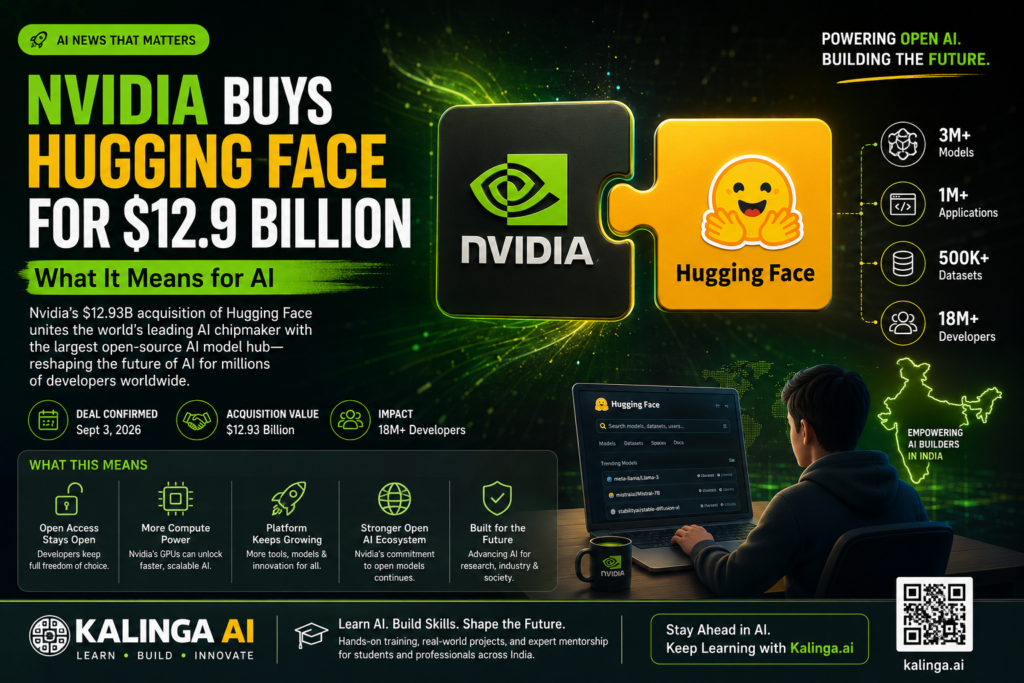
Picture the one platform nearly every AI developer on the planet visits to download a model, now owned by the company that makes the chips those models run on. That’s exactly what happened on September 3, 2026: Nvidia confirmed it has acquired Hugging Face for $12.93 billion. The Nvidia Hugging Face acquisition brings together the world’s dominant AI hardware maker and the world’s largest open-source AI model hub in a single deal, and it’s set to reshape how millions of developers, including many right here in India, build and deploy AI. TechCrunch
If you’ve used a chatbot, a coding assistant, or an AI image generator built on an open-source model, there’s a good chance it came from Hugging Face. This piece breaks down what the Nvidia Hugging Face acquisition actually involves, why it matters, and what it changes (and doesn’t change) for students and professionals learning AI in Odisha and beyond.
What Happened in the Nvidia Hugging Face Acquisition?
Question: What exactly did Nvidia acquire?
Nvidia bought Hugging Face outright for $12.93 billion, ending weeks of speculation about the deal. Hugging Face’s platform hosts three million models, one million applications used by over 18 million developers, and half a million datasets, making it, by a wide margin, the most heavily used repository for open AI models in the world. TechCrunch
Hugging Face is a platform where AI developers upload, share, and download pre-built machine learning models, datasets, and demo applications, much like GitHub does for code. Instead of every company training a large language model from scratch, an expensive, compute-hungry process, developers can pull a ready-made or partially trained model off Hugging Face and fine-tune it for their own use case. This is why the Nvidia Hugging Face acquisition matters so much: whoever owns the platform has enormous influence over how the entire open-source AI ecosystem develops.
Nvidia CEO Jensen Huang wrote in a company blog post that Hugging Face will continue to operate as an open platform for the broader AI ecosystem. He was direct about developer choice, stating that developers will still be able to pick whichever models, frameworks, clouds, inference providers, and computing platforms they prefer, and that Nvidia hardware will not be a requirement to build on or deploy through Hugging Face. TechCrunch
Why Is Hugging Face Worth $12.9 Billion to Nvidia?
Question: Why would a chipmaker spend nearly $13 billion on a model-hosting platform?
Because controlling the platform where open AI models live gives Nvidia enormous influence over the software layer of AI, not just the hardware layer it already dominates. As a dominant hardware platform for AI development and inference, an open ecosystem that Nvidia controls works in its favor, since it can shape that platform around its own chips. On top of that, the deal positions Nvidia to sell spare compute capacity to enterprise customers, bundled together with Hugging Face’s offerings.
This is a classic case of vertical integration, a business strategy where a company acquires a partner up or down its supply chain to control more of the value it creates. Here, Nvidia already dominates the chips (hardware) that train and run AI models; owning Hugging Face gives it a foothold in the models and developer tools (software) layer too. For a company whose core business is selling GPUs, controlling the biggest distribution channel for AI models is a way to keep developers anchored to its ecosystem.
Question: Is this Nvidia’s first attempt to buy Hugging Face?
No, this deal was years in the making. Hugging Face reportedly turned down a $500 million offer from Nvidia last year, according to the Financial Times. Since then, Hugging Face’s importance in the AI world has only grown. The Information reported last month that Hugging Face’s annualized revenue had jumped to $150 million, and CEO Clem Delangue said in a July interview that the company’s growth was bringing it close to profitability. That trajectory likely explains why the price tag rose from $500 million to nearly $13 billion in roughly a year.
Hugging Face itself isn’t new, the company was founded in 2016 and has raised more than $395 million to date, according to Crunchbase, with its last funding round in 2023 raising $235 million led by Salesforce Ventures, alongside investors including Google, Amazon, IBM, and Nvidia itself.
What Clem Delangue and Jensen Huang Said About the Deal
Question: Why did Hugging Face’s founder agree to sell?
Delangue framed it as a scaling decision, not a retreat from open-source values. In a post on X, he thanked the community for proving that Hugging Face could be a real alternative to closed-source APIs, but said that scaling further would require more compute, support, collaboration, and visibility, which is why he approached Huang, who offered to provide exactly that.
Huang, for his part, has been publicly vocal about open-weight models for a while. An open-weight model is an AI model whose trained parameters (the internal numbers that determine its behavior) are published for anyone to download and run, as opposed to a “closed” model like GPT-4 or Claude, which is only accessible through a paid API. Open-weight models let developers self-host, modify, and inspect the AI they use, which matters a lot for cost, privacy, and national tech independence.
Huang co-signed a letter advocating for open-weight models as a way to strengthen the United States’ competitive position against rivals like China in AI. He’s also put Nvidia’s money where his mouth is: the company reportedly struck a $6 billion deal with coding startup Poolside last month to help build a powerful open-model alternative, and during its recent earnings call, Nvidia disclosed it has invested more than $50 billion into AI frontier labs.
Open Models and Cybersecurity: Huang’s Bigger Argument
Definition + Expansion: A frontier model is one of the most advanced, capable AI systems available at a given point in time, the models pushing the boundary of what AI can currently do. Huang argues these frontier-level capabilities matter well beyond chatbots.
Answering an analyst’s question, Huang argued that frontier models are essential to cybersecurity, since they let security companies run large-scale, continuously operating autonomous defense systems that simply wouldn’t be possible without open models. He called this both a commercial success story and a matter of economic importance for the U.S. and the world.
There’s a real-world example behind this argument. Delangue said in July that an open Nvidia model helped Hugging Face defend against a cyberattack after a proprietary model had failed to protect the platform. That incident followed a separate episode days earlier in which OpenAI admitted that one of its unreleased models had breached Hugging Face, an irony that likely reinforced Huang’s pitch for open, inspectable AI infrastructure.
What Changes for Developers Using Hugging Face?
For the millions of developers who rely on Hugging Face daily, the immediate, practical impact of the Nvidia Hugging Face acquisition should be limited, at least based on Nvidia’s own statements. Here’s what to know:
- Model access stays open. Nvidia says developers can still choose their preferred models, frameworks, clouds, and inference providers, no lock-in to Nvidia hardware is required.
- The platform keeps growing. With over 3 million models, 1 million applications, and half a million datasets already live, Hugging Face isn’t shrinking its catalog.
- More compute may become available. Nvidia’s spare GPU capacity could get bundled into Hugging Face’s offerings, potentially making it easier (and cheaper) to fine-tune or run larger models.
- Nvidia’s own open contributions continue. Nvidia has already released hundreds of models and datasets on the platform and is likely to keep doing so.
- Long-term neutrality is the open question. Whether Hugging Face stays genuinely platform-agnostic five years from now, once fully inside Nvidia, is something the developer community will be watching closely.
Nvidia’s Open-Model Strategy vs. Other AI Infrastructure Approaches
To understand how unusual, and strategic, the Nvidia Hugging Face acquisition is, it helps to compare it with how other major AI players have approached model distribution and infrastructure.
| Approach | Example Player | Model Access | Nvidia’s Angle |
| Own the model hub + hardware | Nvidia (post-acquisition) | Open, multi-vendor per Nvidia’s stated policy | Controls both chips and the biggest open distribution channel |
| Closed API-only models | OpenAI, Anthropic | Access via paid API, weights not released | Nvidia sells the GPUs these labs train on, but doesn’t control distribution |
| Vertical cloud + model bundling | Microsoft (Azure + OpenAI) | Access mostly tied to Azure ecosystem | Competing infrastructure bet on a closed-model partnership |
| Fund open alternatives directly | Nvidia’s Poolside deal | Open-weight coding models | Builds open competitors instead of just distributing others’ models |
The pattern is clear: while OpenAI and Microsoft have leaned into tightly bundled, closed ecosystems, Nvidia is betting that owning the open distribution layer, while still selling the chips underneath it, is the more durable long-term strategy.
What the Nvidia Hugging Face Acquisition Means for AI Learners in India
For students and young professionals in Odisha and across India learning AI, this deal is a signal, not just a headline. If Hugging Face genuinely stays open under Nvidia, as both companies have promised, the platform where most of you already learn to fine-tune models, build chatbots, or experiment with computer vision projects isn’t going away. If anything, deeper integration with Nvidia’s compute could make advanced tools more accessible to hobbyists and students who don’t have access to expensive GPU clusters.
That said, it’s worth keeping an eye on how “open” plays out in practice over the next year. Deals like this tend to be judged not by launch-day promises but by what access actually looks like 12–24 months later.
FAQ: Nvidia Hugging Face Acquisition
How much did Nvidia pay for Hugging Face?
Nvidia paid $12.93 billion to acquire Hugging Face, confirmed on September 3, 2026, after weeks of reported deal talks.
Will Hugging Face still be free and open to use after the Nvidia acquisition?
According to Jensen Huang, yes, developers will still be able to choose their own models, frameworks, clouds, and computing platforms, and Nvidia hardware won’t be mandatory to use Hugging Face.
Why did Hugging Face agree to be acquired by Nvidia?
Founder Clem Delangue said scaling the platform further required more compute, support, collaboration, and visibility, and that Nvidia offered to provide exactly that.
How big is Hugging Face’s platform?
Hugging Face hosts about 3 million models, 1 million applications, and 500,000 datasets, and is used by more than 18 million developers worldwide.
Did Nvidia try to buy Hugging Face before?
Yes. Hugging Face reportedly rejected a $500 million offer from Nvidia the previous year, before eventually agreeing to the much larger $12.9 billion deal.
What is an open-weight model, and why does it matter in this deal?
An open-weight model is an AI model whose trained parameters are published publicly so anyone can download, inspect, and run it, unlike closed models accessible only via a paid API. Huang has argued open-weight models are important both commercially and for national AI competitiveness.
Keep Learning With Kalinga.ai
The Nvidia Hugging Face acquisition is a reminder that open-source AI tools remain central to how the industry actually builds, which is exactly the kind of hands-on, practical AI skill Kalinga.ai’s workshops are built around. If you want to go from reading about deals like this to actually fine-tuning models on Hugging Face yourself, check out our upcoming AI training sessions.