What Happened in the Seattle Times Lawsuit?
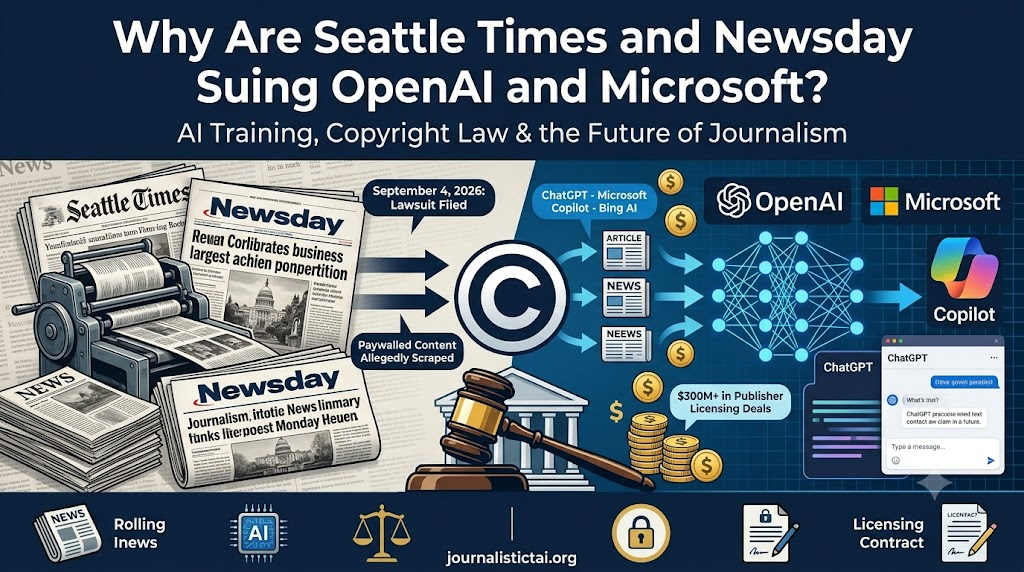
The Seattle Times and Newsday filed their complaint in the U.S. District Court for the Southern District of New York, accusing OpenAI and Microsoft of copyright infringement related to their journalism. According to Reuters, the newspapers allege that content from their websites, including material behind paywalls, was scraped and incorporated into datasets used to train and operate AI products.
The lawsuit is part of a broader confrontation between publishers and AI companies over training data.
Question: What is the central allegation in the Seattle Times lawsuit?
The newspapers allege that OpenAI and Microsoft copied their copyrighted journalism without permission and used it in AI systems, while those systems can produce passages or close paraphrases of the original reporting and potentially reduce the need for users to visit publisher websites.
That distinction is important because the lawsuit is not simply about whether AI can “read” information.
It concerns how copyrighted material is acquired, stored, incorporated into datasets, and potentially reproduced or transformed by AI systems.
The newspapers argue that these practices can undermine the economic foundation that pays for professional journalism.
What products are involved?
The lawsuit concerns AI systems and products associated with OpenAI and Microsoft, including:
- ChatGPT
- Microsoft Copilot
- Bing’s AI features
Reuters reported that the complaint alleges articles were incorporated into datasets used to train and operate these products.
The companies’ relationship also matters because Microsoft is a major partner and investor in OpenAI and uses OpenAI technology in products such as Copilot.
What Is the AI Copyright Dispute About?
To understand the Seattle Times lawsuit, it helps to understand what “AI training” actually means.
AI training data is the information used to teach a machine-learning model patterns in language, images, code, or other forms of data. For large language models, training material can include enormous quantities of text that help the model learn relationships between words, concepts, facts, and writing patterns.
A large language model does not simply function like a digital folder containing articles. During training, information is processed to adjust the model’s parameters, allowing it to generate new responses based on learned patterns.
However, that does not automatically answer the copyright question.
The legal debate is partly about whether copyrighted works can lawfully be copied or processed for AI training, and under what circumstances. Another question is whether AI-generated outputs can reproduce protected expression from those works.
These are related but distinct issues.
Question: Does AI training automatically mean an AI model is storing complete copies of every article it reads?
No. AI training and conventional document storage are different technical processes. However, publishers can still challenge the copying and use of their works during the training process, as well as the behavior of AI systems that allegedly reproduce or closely paraphrase protected content.
That distinction is at the heart of the larger AI copyright lawsuit debate.
Why journalism is particularly important
News organizations invest substantial resources in reporting.
A journalist may spend days or weeks investigating a story, contacting sources, checking documents, interviewing people, editing drafts, and working with editors before publication.
If an AI system can provide a user with a detailed answer based on that reporting without requiring the user to visit the original publication, publishers worry about losing some of the economic value generated by their work.
That value can come from:
- Website visits
- Digital subscriptions
- Advertising
- Memberships
- Licensing
- Brand recognition
- Reader relationships
The issue therefore extends beyond copyright law.
It is also about who gets paid when information moves from traditional journalism into AI products.
What Do Seattle Times and Newsday Claim OpenAI and Microsoft Did?
According to reporting from Reuters and GeekWire, the newspapers allege that OpenAI and Microsoft scraped their websites, including content behind paywalls, and used articles in datasets supporting AI products.
“Scraping” generally means automatically collecting information from websites using software.
Web scraping itself is not automatically illegal. The legal question depends on what information was collected, how it was accessed, what rights applied to the material, and how the information was subsequently used.
In this case, the publishers argue that the alleged copying and use of their journalism violated their rights.
The lawsuit alleges AI can reproduce journalism
One particularly significant allegation involves the ability of AI systems to reproduce passages from the newspapers’ reporting.
GeekWire reported that the complaint included examples in which ChatGPT allegedly reproduced Seattle Times and Newsday journalism nearly word for word. One example cited an 88-word verbatim passage from Seattle Times coverage of the Boeing 737 MAX crashes after a user prompted the chatbot with the article’s headline and web address.
These allegations will ultimately have to be evaluated through the legal process.
Question: Why would alleged verbatim reproduction matter?
Because reproducing substantial portions of copyrighted expression can raise different legal concerns from simply using information or facts contained in an article. The distinction between facts, ideas, expression, transformation, and substantial copying can be important in copyright disputes.
The case therefore puts the behavior of AI systems under a microscope.
Why Is the Seattle Times Lawsuit Especially Significant?
At first glance, the case might look like another publisher-versus-AI-company copyright dispute.
But the Seattle Times lawsuit has an unusual feature: Microsoft and OpenAI have previously supported journalism initiatives involving the newspaper.
GeekWire reported that Microsoft Philanthropies has funded some Seattle Times journalism projects. In 2024, Microsoft and OpenAI jointly funded a $10 million Lenfest Institute AI fellowship, which included both The Seattle Times and Newsday among its inaugural participating newsrooms. The Seattle Times has said it maintains editorial independence.
That history makes the lawsuit especially striking.
The organizations were not simply strangers interacting from opposite sides of the technology industry.
There had been cooperation and financial support alongside the emerging conflict over AI training.
Does previous funding prevent a lawsuit?
No.
Financial support for journalism projects and copyright disputes over the use of journalism are separate issues.
A company can support a newsroom through a fellowship or grant while that newsroom maintains separate legal claims about how its copyrighted material is used.
The existence of previous funding does, however, make the dispute more complicated from a business and industry perspective.
Question: Why does the funding relationship matter?
It demonstrates how quickly relationships between media organizations and technology companies can become complicated when AI changes the value of content. A company can be a supporter of journalism while also developing products that publishers believe compete with their traditional business models.
That tension may become increasingly common as AI companies and media organizations negotiate partnerships, licenses, and access to content.
How Does This Case Compare With The New York Times Lawsuit?
The Seattle Times lawsuit follows a legal path established by another major case.
In December 2023, The New York Times sued OpenAI and Microsoft, alleging copyright infringement related to the use of its journalism. The case became one of the most closely watched legal disputes surrounding AI training and copyrighted content.
The new Seattle Times and Newsday lawsuit shares several themes with the New York Times case.
| Issue | Seattle Times & Newsday | New York Times |
| Defendants | OpenAI and Microsoft | OpenAI and Microsoft |
| Core dispute | Alleged unauthorized use of journalism | Alleged unauthorized use of journalism |
| AI products | ChatGPT, Copilot and Bing AI features alleged in complaint | ChatGPT and related OpenAI/Microsoft systems |
| Copyright concerns | Training and alleged reproduction of journalism | Training and alleged reproduction of journalism |
| Key economic concern | Potential substitution for publisher websites and subscriptions | Potential substitution for publisher websites and subscriptions |
| Filing | September 2026 | December 2023 |
| Broader significance | Adds another major publisher challenge | One of the foundational AI-publisher copyright cases |
The cases are not identical, and the allegations and evidence in each lawsuit must be evaluated independently.
But together, they illustrate a larger industry conflict.
The legal debate is not only about training
One reason these cases are difficult is that “AI copyright” is actually a collection of different questions.
Consider these separate scenarios:
- An AI company copies an article while collecting training data.
- A model learns patterns from a large collection of copyrighted works.
- A chatbot produces a factual summary of an article.
- A chatbot closely paraphrases protected expression.
- A chatbot reproduces a substantial passage.
- An AI product answers a question in a way that reduces the need to visit the original publisher.
Each scenario can raise different legal and economic questions.
Question: Does winning one AI copyright argument automatically settle all of these issues?
No. Courts may need to distinguish between training, copying, model behavior, generated outputs, and market effects. A ruling about one part of the AI pipeline may not automatically answer every other question.
Why Are Publishers Worried About AI Search and Traffic?
Traditional online journalism depends heavily on readers reaching publisher websites.
A user searches for a topic, clicks a result, reads an article, and may encounter advertisements, subscription offers, newsletters, or other stories.
Generative AI can change that journey.
Instead of clicking through several search results, a user can ask a chatbot a question and receive a synthesized answer directly inside the AI interface.
That creates what publishers sometimes describe as a zero-click information experience: the user gets an answer without necessarily visiting the website where the original reporting appeared.
The Seattle Times and Newsday argue that this dynamic can weaken the economic incentives supporting journalism.
GeekWire reported that the complaint argues AI-generated substitute content threatens the survival of independent journalism.
Why this matters for smaller publishers
Large national newspapers may have multiple revenue streams, established subscriber bases, and major brands.
Smaller regional publications can have fewer resources.
If AI systems increasingly become the place where people discover and consume information, publishers may worry about losing the direct audience relationships that support their businesses.
That creates a difficult feedback loop:
less traffic → fewer subscriptions and advertising opportunities → less money for reporting → less original journalism → fewer high-quality sources for future AI systems.
This is closely related to the metaphor used in the lawsuit, which described generative AI as a “snake eating its own tail.”
The basic argument is straightforward: if AI systems consume journalism while reducing the economic value of journalism, they could eventually weaken the ecosystem that produces the information AI systems depend on.
Are OpenAI and Microsoft Saying the Same Thing as the Publishers?
No.
The companies and publishers have fundamentally different positions in this debate.
Microsoft told GeekWire that it was surprised by the lawsuit and said it was willing to discuss potential solutions.
OpenAI’s broader position in copyright disputes has included arguments that its models can be trained using publicly available information and that such uses can be protected under applicable copyright doctrines.
The legal question, however, is ultimately for courts to decide.
Question: Has a court already decided that all AI training on copyrighted journalism is legal?
No. The legal landscape remains contested, with multiple lawsuits, different factual records, and competing arguments about copyright, fair use, transformation, market effects, and AI development.
That uncertainty is one reason the current lawsuits matter so much.
Could Licensing Be an Alternative to Lawsuits?
Yes.
Licensing is one possible path between publishers and AI companies.
Under a licensing arrangement, an AI company pays a publisher for specified rights to use content under agreed terms.
This approach can potentially provide publishers with revenue while giving AI companies more predictable access to high-quality information.
OpenAI has already entered licensing agreements with multiple publishers. GeekWire reported that the Seattle Times complaint references licensing deals involving outlets including The Associated Press, News Corp, and Axel Springer, with publicly disclosed terms for three deals totaling more than $300 million.
But licensing is not a universal solution.
Publishers may disagree about pricing, control, attribution, access, duration, training rights, model outputs, and whether an agreement should cover archived material.
AI companies, meanwhile, may argue that requiring permission for every piece of training data could make model development difficult or expensive.
That is why litigation and licensing are developing simultaneously.
Licensing vs. litigation
| Approach | Potential advantage for publishers | Potential challenge |
| Licensing | Provides negotiated compensation | Requires agreement on price and rights |
| Litigation | Can establish legal precedent | Expensive, slow, and uncertain |
| Blocking access | Can restrict some forms of automated collection | May not resolve broader legal questions |
| Partnerships | Can create shared AI products or programs | Requires trust and carefully defined terms |
| Hybrid model | Combines licensing and technical controls | More complex to manage |
Question: Is licensing better than litigation?
It depends on the parties and the rights involved. Licensing can create a negotiated business relationship, while litigation can establish legal boundaries when the parties cannot agree.
What Could the Seattle Times Lawsuit Mean for AI?
The consequences could extend far beyond two newspapers.
If courts impose meaningful restrictions on how AI companies acquire or use copyrighted journalism, developers may need to reconsider their data pipelines.
That could influence:
- What datasets companies can legally use
- How training data is documented
- How copyrighted content is filtered
- How publishers license material
- How AI companies compensate creators
- How chatbots respond to requests for specific articles
- How AI search products send traffic back to publishers
The case could also encourage more publishers to negotiate licensing agreements instead of waiting for legal disputes.
What could it mean for AI innovation?
AI companies argue that broad access to information can be important for developing capable models.
A restrictive legal environment could increase the cost of acquiring high-quality training material or require more extensive licensing.
On the other hand, publishers argue that allowing unrestricted commercial use of copyrighted journalism could undermine the economic incentives required to produce original reporting.
This creates a genuine policy challenge.
Question: Is this simply a fight between technology and journalism?
Not really. It is a fight over how two important industries can coexist when AI changes the economics of information.
AI needs high-quality information.
Journalism needs sustainable revenue.
The difficult question is how to build a system in which one does not destroy the other.
What Could Happen Next?
The lawsuit is still at an early stage, so no final conclusion should be drawn from the allegations alone.
The court will have to consider the claims, evidence, defenses, and applicable copyright law.
Several developments will be worth watching.
1. Evidence about training datasets
One important question will be what content was collected and how it was used.
The parties may dispute which articles were accessed, whether paywalls were bypassed, what datasets contained the material, and how those datasets were used.
2. Evidence about AI outputs
The newspapers’ examples of alleged reproduction could become important.
If a model produces substantial portions of protected journalism in response to particular prompts, the parties may argue about why that happened and whether the behavior is evidence of unlawful copying or another form of misuse.
3. The fair-use question
U.S. copyright law includes the doctrine of fair use, which can permit certain uses of copyrighted works without authorization.
Courts consider multiple factors rather than applying a simple “AI is allowed” or “AI is forbidden” rule.
The precise facts of each case matter.
4. The publisher business model
Courts may also consider arguments about market effects.
If AI-generated answers reduce visits, subscriptions, or licensing opportunities for publishers, those effects could become part of the broader dispute.
5. More licensing agreements
Regardless of the litigation, more media organizations may choose to negotiate directly with AI companies.
That could produce an increasingly divided ecosystem in which some publishers license content while others pursue legal or technical restrictions.
What Should Students and Young Professionals Understand About This Case?
For anyone learning AI, the most important lesson is that AI development is not purely a technical problem.
Building a powerful language model involves questions about data, copyright, privacy, attribution, economics, regulation, and public trust.
You do not need to become a copyright lawyer to understand the basic framework.
When evaluating an AI product, ask:
- Where does the information come from?
- Who originally created it?
- Was the content licensed or otherwise lawfully obtained?
- Does the AI identify its sources?
- Can the system reproduce copyrighted material?
- Who benefits financially from the generated answer?
- Does the AI product complement or replace the original source?
These questions are becoming increasingly important for students, journalists, developers, marketers, researchers, and business professionals.
Why this matters in India
India is also developing its own conversation around AI, copyright, and creative industries.
Indian technology professionals should therefore pay attention to international cases such as the Seattle Times lawsuit, even though the case is being heard under U.S. law.
Legal rules differ between countries.
A decision in the United States does not automatically determine how Indian courts will interpret copyright and AI training. But international cases can influence industry practices, licensing models, technology design, and the broader policy debate.
For Indian startups and creators, the practical lesson is simple: understand the rights attached to the data you use before building an AI product around it.
Why This Lawsuit Matters Beyond OpenAI and Microsoft
The Seattle Times and Newsday case is not simply another lawsuit involving two technology companies.
It represents a larger question about the future of the information economy.
For decades, publishers created content and distributed it through newspapers, websites, search engines, social networks, and apps.
Generative AI introduces another distribution layer.
Instead of sending people to a webpage, AI systems can potentially answer questions directly.
That can be incredibly useful for users.
But it creates a difficult economic question: if users stop visiting the original sources, how will those sources continue paying for original reporting?
The answer could involve licensing, attribution, revenue sharing, technical changes, regulation, new business models, or some combination of all of them.
The Seattle Times lawsuit is therefore worth watching not because it will necessarily settle every AI copyright question, but because it is another test of how copyright law and the economics of journalism adapt to generative AI.
Seattle Times and Newsday Lawsuit FAQ
Why did the Seattle Times and Newsday sue OpenAI and Microsoft?
The newspapers sued OpenAI and Microsoft on September 4, 2026, alleging that their journalism was copied without permission and used to train and operate AI systems. The lawsuit alleges that content from their websites, including paywalled material, was incorporated into datasets associated with AI products.
What is the main copyright issue in the Seattle Times lawsuit?
The central issue is whether OpenAI and Microsoft unlawfully copied and used copyrighted journalism in developing and operating AI systems. The case also raises questions about AI-generated outputs that allegedly reproduce or closely paraphrase publishers’ reporting.
Does the lawsuit involve ChatGPT and Microsoft Copilot?
Yes. The complaint identifies AI products including ChatGPT, Microsoft Copilot, and Bing’s AI features in its allegations about the use of journalism in AI systems.
Why is the Seattle Times lawsuit unusual?
The case is notable because Microsoft and OpenAI have previously supported journalism initiatives involving The Seattle Times and Newsday. GeekWire reported that Microsoft Philanthropies funds some Seattle Times projects and that Microsoft and OpenAI jointly funded a $10 million AI fellowship in 2024 involving both news organizations.
Is AI training on copyrighted content automatically illegal?
No simple rule applies to every situation. Copyright law involves questions about the nature of the use, the material involved, how it was obtained, how it was used, and the effect on the market. The legality of particular AI training practices remains the subject of ongoing litigation.
What could the lawsuit mean for the future of AI?
The case could influence how AI companies acquire training data, how publishers license journalism, how AI systems reproduce source material, and how the economic relationship between publishers and AI companies develops. It could also contribute to future legal standards governing AI and copyrighted content.
The Bigger Question: Who Pays for the Information AI Uses?
The Seattle Times lawsuit highlights a question that will become harder to ignore as generative AI becomes part of everyday search and information consumption.
AI systems need data.
Publishers need revenue.
Users want fast answers.
And creators want recognition and compensation for their work.
Those interests do not automatically align.
The outcome of this lawsuit will not single-handedly determine the future of AI copyright law. But it adds another important piece to a rapidly developing legal and economic puzzle involving OpenAI, Microsoft, publishers, journalists, creators, and AI users.
For students and young professionals entering the technology industry, understanding that intersection is increasingly valuable. The future of AI will depend not only on better models, but also on clearer rules for the information those models depend on.
For more explainers on AI, copyright, technology policy, and the changing digital economy, keep exploring Kalinga.ai.