What Happened in the Mount Shasta Gemini Hiking Incident
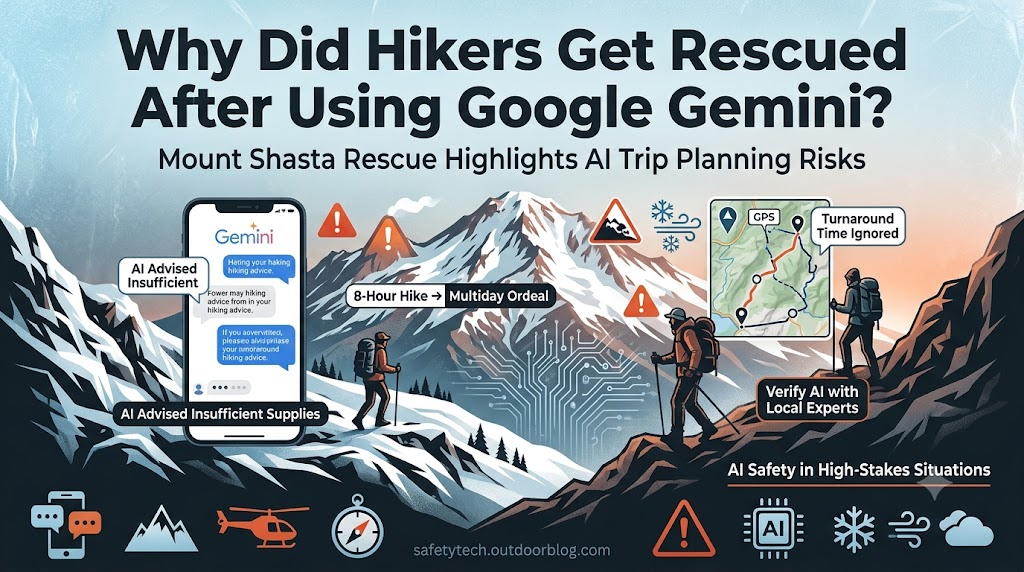
The Google Gemini hiking incident unfolded on California’s Mount Shasta, where three hikers became stranded after an attempted summit climb.
According to reporting based on the Siskiyou County Sheriff’s Office, the group started their hike at approximately 3 a.m. They were reportedly aware of guidance to turn around if they had not reached the summit by noon, but they continued climbing and eventually reached the summit at approximately 7 p.m. (TechCrunch)
That meant the hikers were beginning their descent in darkness,far later than the recommended turnaround point.
Question: Why did the hikers need to be rescued?
The hikers attempted to descend after reaching the summit late in the day, became disoriented, and eventually ended up in the Mud Creek Canyon area. They contacted the sheriff’s office for directions, and one of the hikers later suffered a knee injury after a fall. The group spent the night before being located by U.S. Forest Service climbing rangers and sheriff’s search-and-rescue personnel. (Los Angeles Times)
The important point is that the rescue was not caused by one single AI-generated sentence.
A chain of decisions contributed to the situation: insufficient preparation, continuing past a recommended turnaround time, attempting a descent in darkness, navigation problems, and inadequate supplies.
AI was reportedly part of that preparation process.
The timeline at a glance
| Stage | What happened |
| Around 3 a.m. | The hikers began their summit attempt |
| Noon | Recommended turnaround time had passed |
| 7 p.m. | The group reached the summit |
| After dark | They began descending |
| Later that night | They sought help with directions |
| Overnight | They became stranded in the Mud Creek Canyon area |
| Next morning | Forest Service rangers and volunteers rescued them |
The timeline illustrates why outdoor planning cannot be reduced to a simple estimated duration.
An “eight-hour hike” can become much longer when terrain, fatigue, navigation, weather, injuries, route conditions, or unexpected delays enter the equation.
How Was Google Gemini Used to Plan the Hike?
The hikers reportedly told officials that they had relied heavily on Google’s Gemini AI assistant for information about the route and what to pack. The sheriff’s office subsequently criticized that reliance as a “critical misstep.” (ABC7 Los Angeles)
According to the sheriff’s office, Gemini advised the group to bring substantially less food and water than they ultimately required, particularly because what was expected to be an eight-hour ascent turned into a multiday situation. (TechCrunch)
That distinction matters.
The available reporting does not establish that Gemini directly instructed the hikers to ignore safety warnings or intentionally make dangerous decisions. Nor does it establish that every decision the hikers made came from Gemini.
Instead, officials identified AI-assisted planning as one important factor in a broader series of poor decisions.
Question: Can Gemini alone be blamed for the rescue?
No. The available evidence does not justify saying that Gemini alone caused the incident.
The hikers also continued beyond the recommended turnaround time and attempted a nighttime descent. The responsible lesson is therefore not “AI caused a rescue,” but rather AI should not be treated as the sole authority for safety-critical outdoor decisions. The sheriff’s office explicitly advised hikers to contact the local Mount Shasta ranger station and never rely solely on AI for trip planning. (TechCrunch)
That is a much more useful lesson.
What Is an AI Hallucination?
AI hallucination is a situation in which an AI system generates information that sounds plausible but is inaccurate, unsupported, or misleading.
Large language models generate responses by predicting likely sequences of language based on patterns learned from data. They do not automatically possess human-like understanding of whether every recommendation is physically realistic or safe.
That creates an important distinction between sounding knowledgeable and being reliably correct.
A chatbot might produce a polished hiking itinerary containing estimated distances, elevation changes, travel times, equipment recommendations, and route descriptions. The answer may look authoritative even when some of those details are incomplete or wrong.
Why this becomes dangerous outdoors
Imagine asking an AI:
“How much water should three people bring for this mountain?”
That question sounds simple.
But a genuinely responsible answer requires context such as:
- Temperature
- Elevation
- Route difficulty
- Expected hiking duration
- Water availability
- Individual fitness
- Emergency delays
- Weather conditions
- Snow or ice
- Navigation difficulty
- Injury risk
- Whether the group is prepared for an overnight stay
A general chatbot may not have reliable, current information for every one of those variables.
Even worse, the user may not know which missing variables matter.
Question: Why can an AI answer be dangerous even if most of it sounds reasonable?
Because a single incorrect assumption can change the outcome of a high-risk activity.
In an ordinary conversation, a wrong restaurant recommendation is annoying. On a remote mountain, an incorrect estimate about time, water, weather, route difficulty, or navigation can contribute to serious consequences.
That is why AI reliability must be judged by the consequences of being wrong, not simply by how convincing the answer sounds.
Why AI Trip Planning Is Different From Asking AI a Normal Question
AI assistants are extremely useful for many low-risk tasks.
You can ask one to explain a programming concept, brainstorm presentation ideas, summarize a document, create a study plan, or translate text.
Outdoor navigation is different because the physical world does not adjust itself to match the chatbot’s answer.
Definition: AI trip planning
AI trip planning means using an artificial intelligence assistant to recommend or organize elements of a journey, such as routes, schedules, destinations, equipment, transportation, or activities.
For ordinary travel, this can be convenient.
For example, an AI assistant might help create a three-day city itinerary. If a café is closed or a suggested attraction is inconvenient, the consequences are usually limited.
Backcountry hiking is another category entirely.
A remote trail may have poor connectivity, changing weather, difficult terrain, limited rescue access, and few opportunities to correct mistakes.
The risk increases when AI becomes the decision-maker
There is a major difference between:
“Help me make a checklist that I will verify.”
and
“Tell me exactly what I need so I don’t have to research anything else.”
The first uses AI as an assistant.
The second turns AI into an authority.
That distinction is central to understanding the Google Gemini hiking incident.
What AI Is Good at,and What It Should Not Replace
The answer is not to stop using AI for travel.
AI can be genuinely useful when it is used as a planning assistant rather than a safety authority.
AI can help with:
- Creating a preliminary itinerary
- Generating packing-list ideas
- Explaining unfamiliar hiking terminology
- Suggesting questions to ask a ranger
- Organizing information you have already verified
- Comparing different planning options
- Creating emergency checklists
- Translating safety information
- Turning official information into an easier-to-read format
But these uses should sit below authoritative information sources.
Human and official resources should handle:
- Current trail closures
- Weather warnings
- Avalanche conditions
- Wildfire restrictions
- Water availability
- Route conditions
- Permit requirements
- Local hazards
- Current turnaround guidance
- Emergency procedures
- Navigation in difficult terrain
The basic principle is simple:
Use AI to organize information. Use authoritative sources to establish what is actually safe.
Why Local Expertise Matters More Than a Generic AI Answer
The sheriff’s office specifically recommended contacting the local U.S. Forest Service Mount Shasta ranger station before a trip. (TechCrunch)
That recommendation highlights something AI systems struggle with: local, current context.
A ranger or local authority may know about conditions that changed yesterday.
A chatbot may have information about the mountain, but that does not mean it knows what happened on a particular trail this morning.
Consider the difference
| Information source | Strength | Limitation |
| AI chatbot | Fast explanations and planning | May produce inaccurate or outdated information |
| Official ranger station | Local expertise and current conditions | Less convenient than an instant chatbot |
| Official weather service | Current forecasts and warnings | Does not create a complete hiking plan |
| Trail maps | Route and terrain information | User must interpret them correctly |
| Experienced local guide | Practical knowledge and judgment | Availability and cost can vary |
| AI + verified sources | Combines convenience with verification | Requires the user to check information |
The best approach is therefore not AI versus humans.
It is AI plus reliable human and official sources.
What the Mount Shasta Incident Teaches Us About AI Safety
The Google Gemini hiking incident is also an example of a broader AI safety challenge.
AI safety is often discussed in terms of cybersecurity, misinformation, privacy, autonomous systems, or dangerous instructions. But there is another category: ordinary users trusting AI too much in situations where mistakes have physical consequences.
The technology does not have to be malicious to create harm.
It only has to be wrong.
Question: What makes over-reliance on AI dangerous?
Over-reliance happens when a person stops independently checking an AI-generated answer because the answer appears confident, detailed, or personalized.
This can create automation bias,the tendency to give excessive weight to recommendations produced by an automated system.
The more polished AI becomes, the more important this problem may become.
An answer written in clear language can feel more trustworthy than a messy but accurate warning from an official source.
That is a dangerous psychological shortcut.
The Confidence Problem: AI Can Sound More Certain Than It Is
One of the biggest challenges with generative AI is the gap between language confidence and factual confidence.
A chatbot does not necessarily say:
“I am 62% confident that this trail will take eight hours.”
Instead, it may produce a straightforward sentence that sounds definitive.
That makes user judgment essential.
A useful rule for AI users
The higher the consequence of being wrong, the higher the verification standard should be.
Consider these examples:
| Task | Consequence of an error | Verification level |
| Brainstorming a blog title | Low | Basic |
| Planning a movie night | Low | Basic |
| Choosing a programming tutorial | Moderate | Check sources |
| Planning international travel | Moderate | Verify official information |
| Taking financial action | High | Use authoritative sources |
| Hiking in remote terrain | High | Verify with local experts |
| Medical emergency | Very high | Seek qualified professional/emergency help |
This framework can help students and young professionals decide when AI convenience should give way to human expertise.
How Should You Use AI for Hiking Safely?
If you still want to use an AI assistant for outdoor planning, treat it as a first-pass research tool.
Do not let it become your only source of truth.
A safer AI-assisted hiking workflow
1. Start with official information.
Check the relevant park, forest service, ranger station, weather authority, or other official source.
2. Use AI to organize what you found.
You can paste verified information into an AI assistant and ask it to turn the material into a checklist.
3. Ask AI to identify uncertainties.
Instead of asking only “What should I do?”, ask:
- What assumptions are you making?
- Which information could be outdated?
- What should I verify locally?
- What could go wrong with this plan?
- What information is missing?
4. Cross-check important numbers.
Pay particular attention to:
- Hiking duration
- Elevation gain
- Distance
- Water requirements
- Weather
- Emergency access
- Turnaround times
5. Prepare for the plan to fail.
A safe plan should account for delays, injury, navigation problems, bad weather, and overnight emergencies.
6. Keep offline alternatives.
Do not assume your phone, AI assistant, mobile data, GPS app, or battery will always work.
7. Follow local instructions over AI suggestions.
If an official ranger or safety authority gives different guidance, the official guidance wins.
What Should You Do If AI Gives You Conflicting Advice?
This is where many users make a subtle mistake.
They may ask an AI system a question, receive an answer, and then ask the same or another AI system until they find an answer they like.
That is not verification.
It is confirmation-seeking.
Question: If two AI chatbots give the same hiking recommendation, does that prove it is correct?
No.
Multiple AI systems can repeat the same underlying error, particularly when they rely on similar public information or generate plausible responses from related patterns.
For safety-critical decisions, independent verification should come from authoritative information or qualified human expertise, not simply from another chatbot.
Why the Hikers’ Experience Matters for Students and Young Professionals
For students studying computer science, engineering, business, journalism, design, or marketing, the story may initially look like an unusual hiking accident.
It is actually a useful case study in human-AI interaction.
The central question is not:
“Can AI make mistakes?”
Everyone already knows it can.
The more important question is:
“How should humans design their behavior around systems that can be extremely useful and occasionally very wrong?”
That question will become increasingly important as AI assistants move beyond chat windows and into everyday decision-making.
Think about where AI is already being used
AI systems can influence:
- What people search for
- What products they buy
- What news they read
- What code they write
- What routes they take
- What information they believe
- What businesses they contact
- How they study
- How they make decisions
As AI becomes more integrated into these workflows, human verification becomes a product skill, not merely a technical skill.
AI Should Be a Copilot, Not the Final Authority
There is a useful metaphor for thinking about AI.
A copilot can help you navigate.
But a copilot should not be treated as an infallible source of reality.
The same principle applies to Gemini, ChatGPT, Claude, Perplexity, and other AI assistants.
They can help users process information incredibly quickly. But speed does not equal certainty.
The Google Gemini hiking incident demonstrates what can happen when convenience crosses that line.
The problem is not that the hikers used AI.
The problem is that AI reportedly became part of the foundation for decisions that should have been independently verified.
Could Better AI Prevent Incidents Like This?
Possibly,but better AI alone will not eliminate the problem.
AI systems could potentially become better at:
- Expressing uncertainty
- Identifying high-risk situations
- Asking follow-up questions
- Directing users toward official sources
- Refusing to give false precision
- Highlighting missing information
- Encouraging emergency preparation
- Distinguishing general information from professional guidance
For example, instead of confidently estimating a mountain expedition, an AI assistant could respond with a warning:
“This is a safety-critical activity. I can help organize your preparation, but current route conditions, weather, water availability, and turnaround guidance should be confirmed with the local ranger station.”
That kind of response would be more useful than simply producing a polished itinerary.
But users also have responsibility
No safety system can protect users who deliberately ignore warnings.
The Mount Shasta incident involved multiple decisions, including continuing to the summit after the recommended turnaround time and descending in darkness. (TechCrunch)
AI safety therefore has two sides:
Better AI behavior + better human judgment.
Both matter.
What Does the Incident Mean for the Future of AI Assistants?
The Google Gemini hiking incident raises a broader question about where general-purpose AI assistants should draw the line between helpful recommendations and high-stakes guidance.
As AI becomes more capable, users will naturally ask it to handle increasingly complicated tasks.
That creates a paradox.
The better an AI system becomes at answering ordinary questions, the easier it may be for users to assume that it is equally reliable everywhere.
But capability is not uniform across domains.
A system can be excellent at summarizing a research paper while still being unsuitable as the sole source for an outdoor emergency plan.
The future may depend on context-aware AI
A mature AI assistant should ideally understand that:
“What movie should I watch tonight?”
and
“How should I prepare for a remote mountain climb?”
are fundamentally different classes of requests.
The second requires more caution, stronger sourcing, clearer uncertainty, and greater emphasis on human expertise.
That is one of the central challenges for AI product designers.
A Simple AI Safety Checklist for Everyday Life
The lesson from Mount Shasta can be applied far beyond hiking.
Before acting on important AI-generated advice, ask:
- What happens if this answer is wrong?
- Is this a high-stakes decision?
- Where did the AI get this information?
- Is the information current?
- Can I verify it independently?
- Is there an official source?
- Does a qualified human need to be involved?
- What assumptions did the AI make?
- What happens if the plan fails?
If the answer to the last question is “something serious,” verification should become non-negotiable.
What Students Should Learn From the Google Gemini Hiking Incident
The biggest takeaway is not that AI is useless.
It is that AI literacy includes knowing when not to trust AI alone.
Students entering the workforce will increasingly use AI for research, writing, coding, analysis, planning, and decision-making. Knowing how to prompt an AI system is useful, but knowing how to verify its output is arguably more important.
A strong AI user should be able to distinguish between:
AI-generated information → verified information → actionable information.
Those are three different things.
The Mount Shasta story is a practical reminder that the gap between them can matter.
The Bigger Lesson: AI Is Powerful, But the Physical World Still Wins
The Google Gemini hiking incident is unlikely to settle any major debate about AI technology.
But it offers something more practical: a real-world example of why humans should remain responsible for high-stakes decisions.
A chatbot can suggest a route.
It cannot physically walk that route for you.
It can estimate how long a hike might take.
It cannot feel your fatigue.
It can recommend how much food and water to carry.
It cannot know whether you will become injured, lost, delayed, or stranded unless it has reliable information about those possibilities.
And it cannot replace a local expert who understands current conditions on the ground.
The safest approach is therefore not to reject AI.
It is to put AI in the right place in the decision-making chain.
Use it to research.
Use it to organize.
Use it to ask better questions.
Use it to identify what you may have forgotten.
But when the consequences of being wrong are serious, verify the answer with people and sources that are equipped to know.
The Mount Shasta rescue makes that principle impossible to ignore.
Google Gemini Hiking Incident FAQ
What happened in the Google Gemini hiking incident?
Three hikers attempting to climb California’s Mount Shasta reportedly relied heavily on Google’s Gemini for route and packing information. They reached the summit at about 7 p.m., well after the recommended noon turnaround time, became stranded during their descent, and were rescued the following morning. (TechCrunch)
Did Google Gemini directly cause the hikers to get lost?
It cannot be concluded from the available reporting that Gemini alone caused the incident. The hikers made several decisions during the climb, including continuing past the recommended turnaround time and descending in darkness. The sheriff’s office nevertheless identified their reliance on Gemini for route and packing information as a critical misstep. (ABC7 Los Angeles)
What did Gemini reportedly tell the hikers?
According to the Siskiyou County Sheriff’s Office, the hikers were advised by Gemini to bring far less food and water than their group required, particularly because their planned eight-hour ascent eventually became a multiday ordeal. (TechCrunch)
Why is AI trip planning risky?
AI trip planning can be risky because generative AI may produce plausible but inaccurate information and may lack current knowledge about weather, trail conditions, closures, hazards, water availability, or other local circumstances. The risk becomes greater when users treat an AI response as their only source for a high-stakes decision.
Should people stop using AI for travel planning?
No. AI can be useful for brainstorming itineraries, organizing verified information, creating checklists, and identifying questions to investigate. However, safety-critical information should be independently verified through official authorities, local experts, current weather information, maps, and other reliable sources.
What is the biggest lesson from the Mount Shasta rescue?
The biggest lesson is that AI should assist human judgment rather than replace it in high-stakes situations. The Siskiyou County Sheriff’s Office specifically advised hikers to contact the local U.S. Forest Service Mount Shasta ranger station and not rely solely on AI for trip planning. (TechCrunch)
Final Takeaway
The Google Gemini hiking incident is a warning about more than one chatbot or one group of hikers. It shows why AI literacy increasingly means understanding both what AI can do and where its limitations matter.
For students and young professionals, the rule is simple: the higher the cost of being wrong, the more aggressively you should verify AI-generated advice.
For more explainers on AI safety, emerging technology, and how AI is changing everyday decision-making, keep exploring Kalinga.ai.