What Is Foxconn AI Demand and Why Does It Matter?
Foxconn AI demand refers to the growing orders and manufacturing activity linked to AI infrastructure, particularly AI servers, cloud hardware, networking equipment, and related information and communication technology products.
That matters because the AI boom is no longer just about companies developing chatbots or large language models. Every AI model requires physical infrastructure: processors, servers, networking systems, storage, cooling equipment, power systems, and data centers.
Foxconn sits close to the center of that hardware ecosystem.
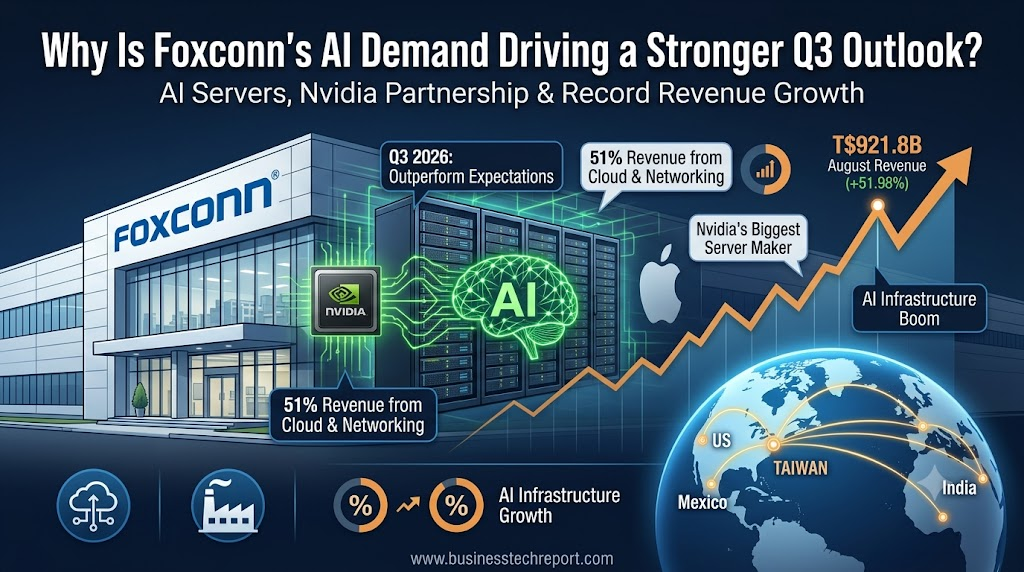
Reuters reported on September 5 that Foxconn expects its third-quarter performance to outperform market expectations, citing continued AI demand and the seasonal increase in ICT product activity during the second half of the year.
Definition + Expansion
AI server manufacturing is the process of assembling and producing the specialized computing systems used to train and run artificial intelligence models.
AI servers typically require powerful processors and high-speed networking components because AI workloads can involve enormous amounts of data and computation. Companies such as Nvidia supply important computing components, while manufacturers such as Foxconn help turn those components into complete systems that can be deployed in data centers.
That makes Foxconn an important link between semiconductor technology and the physical infrastructure behind the AI economy.
Question: Why is Foxconn benefiting from AI?
Answer: Foxconn manufactures hardware used in the rapidly expanding AI infrastructure market, including servers and networking products.
As technology companies and cloud providers invest more heavily in AI computing capacity, manufacturers capable of producing complex hardware at scale can benefit from that spending.
Why Does Foxconn Expect a Strong Third Quarter?
Foxconn’s latest statement points to two major factors: continued AI demand and the traditional second-half peak season for ICT products.
The company said its visibility for the third quarter had improved compared with the previous month and that overall performance was expected to exceed market expectations. Foxconn did not provide a specific numerical forecast.
This distinction is important.
Foxconn is not saying that it knows exactly how much profit or revenue it will generate in Q3. Instead, it is indicating that current operating conditions look stronger than previously expected.
AI Demand Is Still Growing
The biggest driver is the continued expansion of AI infrastructure.
Technology companies are spending heavily on computing capacity to support generative AI, AI agents, cloud services, and other workloads. That spending eventually reaches manufacturers responsible for building the servers and networking systems that power those applications.
Reuters previously reported that Foxconn’s cloud and networking products, which include AI servers, represented 51% of its second-quarter revenue, crossing the 50% mark for the first time.
That shift gives investors an important clue about where Foxconn’s growth is coming from.
The Second-Half ICT Peak Season
AI is not Foxconn’s only source of demand.
The company also produces a wide range of information and communication technology products. The second half of the year is traditionally an important period for electronics manufacturing, with consumer and enterprise technology demand increasing ahead of major product cycles and holiday sales.
Foxconn said the combination of growing AI demand and the second-half ICT peak season should allow operations to gain momentum.
Question: Is AI the only reason for Foxconn’s stronger outlook?
Answer: No. Foxconn specifically pointed to both growing AI demand and the seasonal improvement in ICT product activity.
That combination is giving the company greater visibility into its third-quarter performance.
Foxconn’s Recent Numbers Show How Powerful the AI Cycle Has Become
The company’s latest outlook comes after several strong financial indicators.
In August 2026, Foxconn reported revenue of T$921.8 billion, equivalent to approximately $29.15 billion, according to Reuters. Revenue increased 51.98% year over year, making it Foxconn’s highest-ever August revenue. It was also the second consecutive month in which revenue exceeded T$900 billion.
Those numbers provide useful context for the company’s optimistic third-quarter commentary.
Foxconn had already reported a 35% year-over-year increase in second-quarter profit, beating analyst expectations.
The results suggest that AI infrastructure is becoming an increasingly important contributor to the company’s overall business.
Key Foxconn Signals
- 35%: Year-over-year increase in Q2 profit.
- 51%: Share of Q2 revenue from cloud and networking products.
- T$921.8 billion: August 2026 revenue.
- 51.98%: Year-over-year August revenue growth.
- T$900 billion+: Revenue exceeded this level for the second consecutive month.
- Q3 2026: Foxconn expects performance to outperform market expectations.
The figures do not mean Foxconn is becoming exclusively an AI company. Instead, they show how AI is becoming a major growth engine within a much broader electronics manufacturing business.
How Important Is Nvidia to Foxconn’s AI Strategy?
One of the most important relationships in the story is Foxconn’s connection with Nvidia.
Foxconn is described by Reuters as Nvidia’s biggest server maker, putting the Taiwanese manufacturer directly into the supply chain behind Nvidia’s AI computing ecosystem.
Nvidia designs the computing technologies used in many AI systems, while Foxconn helps manufacture and assemble the physical infrastructure needed to deploy those systems.
This creates a powerful relationship between semiconductor design and large-scale hardware manufacturing.
Question: What does Foxconn actually contribute to the Nvidia ecosystem?
Answer: Foxconn manufactures servers and related hardware infrastructure that incorporates technologies used in AI computing systems.
The distinction matters because Nvidia’s AI business is not limited to selling individual chips. Modern AI infrastructure requires complete computing systems, networking equipment, and data-center hardware.
Foxconn’s manufacturing capabilities therefore allow it to benefit from rising demand for the broader AI infrastructure ecosystem.
Foxconn Is More Than an AI Server Company
It would be a mistake to describe Foxconn as simply an AI manufacturer.
The company has long been one of the world’s most important electronics manufacturing partners and is also a major Apple supplier. Its operations span consumer electronics, cloud and networking products, computing infrastructure, and other technology hardware.
This diversification matters.
If AI infrastructure demand slowed sharply, Foxconn would still have exposure to other technology markets. At the same time, the company’s existing manufacturing scale gives it an advantage when AI infrastructure customers need to increase production quickly.
AI Infrastructure vs. Consumer Electronics
| Area | AI Infrastructure | Consumer Electronics |
| Examples | AI servers, networking systems | Smartphones and other devices |
| Main demand driver | AI computing investment | Consumer and enterprise purchases |
| Hardware complexity | High | Varies by product |
| Growth trend | Strong AI-driven demand | More dependent on product cycles |
| Foxconn exposure | Major and growing | Long-established |
| Key partners | Nvidia and cloud ecosystem | Apple and other electronics brands |
This combination helps explain why Foxconn AI demand is particularly significant.
The company can participate in the AI expansion without abandoning its established electronics manufacturing business.
Why AI Servers Are So Important to the New Hardware Economy
For years, many people associated AI primarily with software.
Today, that picture is incomplete.
Training and running advanced AI systems requires massive amounts of computing infrastructure. That infrastructure has to be manufactured, assembled, transported, installed, powered, cooled, and maintained.
This is creating an entire industrial layer beneath the AI software boom.
The AI Hardware Chain
A simplified AI infrastructure chain looks like this:
- Chip designers develop processors and accelerators.
- Semiconductor manufacturers produce advanced chips.
- Component suppliers provide memory, networking, storage, and other parts.
- Server manufacturers assemble complete computing systems.
- Data-center operators deploy the systems.
- Cloud and AI companies use that infrastructure to provide services.
- Businesses and consumers interact with AI applications.
Foxconn operates primarily within the hardware manufacturing portion of this chain.
That position can be highly valuable when demand for AI computing rises rapidly.
Question: Why can’t AI companies simply build their own servers?
Answer: Large-scale server manufacturing requires specialized factories, supply-chain relationships, engineering capabilities, and production capacity.
Outsourcing manufacturing allows technology companies to focus more heavily on designing products, developing software, building AI models, and operating services while specialized manufacturers handle much of the physical production.
Foxconn’s AI Growth Still Faces Political and Economic Risks
The AI story is strong, but Foxconn itself warned investors not to ignore broader risks.
The company said it remained necessary to monitor the effects of the volatile global political and economic situation.
That warning matters because electronics manufacturing depends on global supply chains.
Components may cross several borders before a finished server reaches a data center. Changes in tariffs, trade restrictions, export controls, diplomatic relationships, transportation costs, or regional disruptions can therefore affect manufacturing economics.
Major Risks to Watch
- Trade restrictions: New tariffs or export controls can raise costs.
- Geopolitical tensions: Taiwan’s strategic position creates additional uncertainty.
- Supply constraints: AI hardware requires specialized components with limited capacity.
- Customer concentration: Large customers can have an outsized effect on manufacturing demand.
- AI spending cycles: Heavy infrastructure investment may eventually slow.
- Economic uncertainty: Weak global demand could affect traditional electronics businesses.
Foxconn’s positive Q3 outlook should therefore not be interpreted as a guarantee of uninterrupted growth.
It is better understood as evidence that current demand conditions remain favorable.
Foxconn’s Outlook Fits Into a Much Larger AI Manufacturing Boom
Foxconn’s results are part of a broader pattern across Asian manufacturing.
Reuters reported earlier in September that factory activity in several Asian economies was supported by strong demand for chips, computers, and other AI-related products.
This is important because AI investment is increasingly influencing traditional manufacturing indicators.
When cloud companies expand data centers, they create demand not just for GPUs but also for servers, networking equipment, power infrastructure, cooling systems, memory, storage, and semiconductor packaging.
In other words, AI is becoming an industrial demand driver.
Question: Does Foxconn’s outlook prove that the AI boom will continue indefinitely?
Answer: No. It shows that demand remains strong at this point in 2026, but it does not guarantee that AI investment will maintain the same growth rate indefinitely.
Technology investment cycles can accelerate and slow. Companies building AI infrastructure must eventually balance spending against revenue, efficiency, and returns.
Foxconn’s comments are therefore a useful indicator of current demand rather than a prediction of the entire AI industry’s future.
What Does Foxconn’s AI Growth Mean for India?
For Indian technology professionals, Foxconn’s expansion is worth watching because India is increasingly becoming part of global electronics and semiconductor supply chains.
Reuters reported in August that Foxconn was continuing to expand its global manufacturing footprint, including operations in India, Mexico, and Texas.
This creates potential relevance for India’s electronics manufacturing ecosystem.
The country has been seeking to expand semiconductor manufacturing, electronics assembly, component production, and technology infrastructure. As global companies diversify manufacturing locations, India could become an increasingly important part of that strategy.
Opportunities for Indian Students and Professionals
The growth of AI hardware creates career opportunities beyond machine learning research.
Students can explore areas such as:
- Semiconductor engineering
- Electronics manufacturing
- Embedded systems
- Cloud infrastructure
- Data-center operations
- Networking
- Supply-chain management
- Industrial automation
- Robotics
- AI infrastructure engineering
- Hardware testing and quality assurance
This is an important lesson from the Foxconn story: the AI economy needs far more than AI software developers.
The physical infrastructure behind AI requires engineers, technicians, operations professionals, logistics specialists, manufacturing experts, and supply-chain managers.
Foxconn vs. Traditional Electronics Manufacturing
The company’s transformation also illustrates how the economics of electronics manufacturing are changing.
Traditional Model
In a traditional consumer electronics cycle, demand can depend heavily on smartphone launches, personal computers, televisions, and other consumer products.
Production rises and falls according to product launches, seasonal purchases, and consumer spending.
AI Infrastructure Model
AI infrastructure has a different demand structure.
Cloud providers and technology companies may continuously invest in additional computing capacity because AI services require ongoing infrastructure expansion.
That does not eliminate cyclicality, but it creates a new source of large-scale hardware demand.
The Strategic Shift
| Factor | Traditional Electronics | AI Infrastructure |
| Core demand | Consumer purchases | Computing capacity |
| Major driver | Product launches | AI investment |
| Infrastructure intensity | Moderate to high | Very high |
| Production model | Product-cycle driven | Capacity-expansion driven |
| Example | Smartphones | AI servers |
| Growth opportunity | Mature and competitive | Rapidly expanding |
Foxconn’s challenge is to capture this new opportunity without becoming overly dependent on a single technology cycle.
Why Foxconn’s August Revenue Matters
The T$921.8 billion August revenue figure is particularly interesting because it provides a concrete indicator behind Foxconn’s optimistic Q3 commentary.
The figure represented a 51.98% year-over-year increase and marked Foxconn’s highest August revenue on record.
It also followed another month in which revenue exceeded T$900 billion.
For investors and technology observers, this creates a stronger case that the company’s positive outlook is supported by actual business momentum rather than only expectations about future AI spending.
Still, revenue growth alone does not tell the entire story.
Profitability, capital expenditure, component costs, customer concentration, and future demand will also determine whether this growth can translate into sustained shareholder returns.
What Should Investors Watch Next?
Foxconn does not provide numerical forecasts, so its qualitative statements become particularly important for understanding management’s view.
The company has indicated that its third-quarter visibility improved and that performance should exceed market expectations.
The next key signals will therefore come from actual quarterly results and commentary around AI infrastructure demand.
Five Things to Monitor
- AI server demand – Is demand continuing to accelerate?
- Cloud and networking revenue – Does the segment remain above half of revenue?
- AI customer spending – Are major technology companies maintaining infrastructure investment?
- Manufacturing capacity – Can Foxconn scale production efficiently?
- Geopolitical conditions – Do tariffs, trade restrictions, or political tensions affect costs?
These indicators can help separate short-term excitement from durable business growth.
What Foxconn’s Q3 Outlook Says About the AI Economy
The most important takeaway is not simply that one Taiwanese manufacturer expects a strong quarter.
It is that AI demand is increasingly visible in the financial performance of companies that build the physical infrastructure behind AI.
Foxconn’s business provides a useful lens through which to understand this shift.
The AI economy requires enormous amounts of physical hardware, and companies capable of manufacturing that hardware at global scale are becoming strategically important.
Question: What is the biggest takeaway from Foxconn’s Q3 outlook?
Answer: Strong AI infrastructure demand is becoming a major driver of Foxconn’s business, helping the company expect third-quarter performance above market expectations.
At the same time, Foxconn’s warning about global political and economic volatility shows that AI growth does not exist separately from trade, manufacturing, and geopolitics.
The future of AI will depend not only on better models, but also on whether the world can manufacture and deliver enough hardware to run them.
Frequently Asked Questions
What is Foxconn’s outlook for Q3 2026?
Foxconn expects its third-quarter 2026 performance to outperform market expectations, citing continued AI demand and the seasonal second-half peak in ICT products. The company did not provide a specific numerical forecast.
Why is Foxconn benefiting from AI?
Foxconn manufactures servers and other technology hardware used in AI infrastructure. Its cloud and networking business, which includes AI servers, represented 51% of its second-quarter revenue, according to Reuters.
How much did Foxconn’s revenue grow in August 2026?
Foxconn reported August revenue of T$921.8 billion, up 51.98% year over year. Reuters reported that it was the company’s highest August revenue on record.
Is Foxconn an Nvidia supplier?
Yes. Reuters describes Foxconn as Nvidia’s biggest server maker, making the company an important manufacturer within Nvidia’s AI hardware ecosystem.
Is Apple still important to Foxconn?
Yes. Foxconn remains a major Apple supplier, even as AI servers and cloud networking products become increasingly important to its business.
What are the biggest risks to Foxconn’s AI growth?
The major risks include geopolitical and economic volatility, supply constraints, trade restrictions, changing AI infrastructure spending, and potential slowdowns in global technology demand. Foxconn itself warned that the global political and economic environment needs to be monitored.
Key Takeaways
- Foxconn expects Q3 2026 performance to outperform market expectations.
- AI-related demand is a major reason for the stronger outlook.
- Foxconn’s cloud and networking products accounted for 51% of Q2 revenue.
- August revenue reached a record T$921.8 billion, up 51.98% year over year.
- Foxconn is a major server manufacturer for Nvidia and a major supplier to Apple.
- AI is turning semiconductor and electronics manufacturing into an increasingly important part of the AI economy.
- Global politics, trade policy, and supply-chain risks remain important variables.
- India’s expanding electronics manufacturing ecosystem could benefit from the broader shift toward diversified AI hardware production.
Final Takeaway
Foxconn’s latest outlook is another sign that the AI boom is becoming a hardware story as much as a software story. As demand for AI computing grows, manufacturers capable of building the servers and infrastructure behind that demand are becoming increasingly important to the global technology economy.
For students and young professionals, the message is equally important: the AI career opportunity extends beyond writing models and applications. The next phase of AI will also need people who can build, operate, connect, manufacture, and scale the machines that make AI possible. keep exploring kalinga.ai for more.