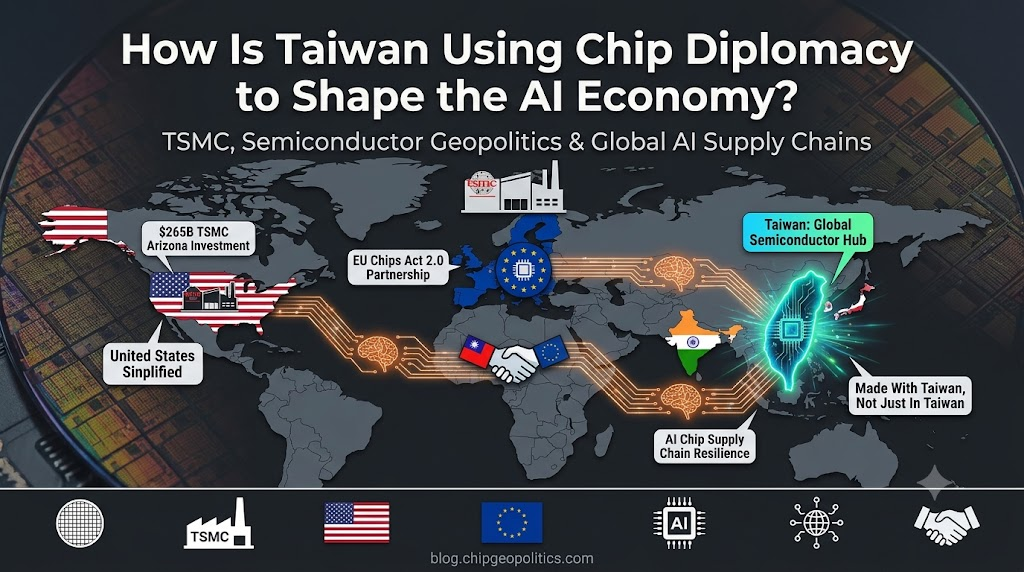
Taiwan Chip Diplomacy Is Turning Semiconductors Into Strategic Power
What if the most important diplomatic asset in the AI race is not oil, weapons or data,but the tiny chips that make advanced AI possible?
That is increasingly the position Taiwan finds itself in. Taiwan chip diplomacy is becoming a major part of the island’s international strategy as the United States and European Union seek greater access to Taiwanese semiconductor expertise and manufacturing.
At the recent SEMICON Taiwan trade show, Taiwanese officials and industry leaders presented the island as a reliable, democratic technology partner while signaling that its semiconductor companies are prepared to expand manufacturing overseas. Reuters reported that Taiwan is simultaneously facing pressure from Washington and growing interest from Europe to increase investment outside the island.
The result is a complicated balancing act: Taiwan wants to strengthen its global partnerships without giving away the very semiconductor advantage that gives it strategic influence.
What Is Taiwan Chip Diplomacy?
Taiwan chip diplomacy is the use of semiconductor manufacturing strength, technology partnerships and overseas investment to build international relationships and strategic influence.
Taiwan is home to some of the world’s most important semiconductor companies, including TSMC, whose advanced chips support AI applications. Because modern AI systems depend heavily on powerful computing hardware, control over semiconductor production has become closely connected to economic and geopolitical power.
This gives Taiwan an unusual position.
It has limited formal diplomatic recognition compared with many major economies, yet its semiconductor industry is deeply integrated into the technology systems of countries around the world.
That creates what could be called a technology-based diplomatic advantage.
Why does this matter?
Taiwan cannot rely on conventional diplomatic influence alone. Instead, its semiconductor ecosystem gives other countries a practical reason to deepen economic and technological relationships with the island.
The strategy is not simply about selling chips.
It is increasingly about building partnerships around:
- Semiconductor manufacturing
- AI infrastructure
- Supply-chain resilience
- Research and development
- Advanced packaging
- Technology investment
- Manufacturing capacity
- Economic security
That is why Taiwan chip diplomacy matters far beyond the semiconductor industry.
Why Are Semiconductors So Important to AI?
AI may look like software, but advanced AI ultimately depends on enormous amounts of computing hardware.
Training and running sophisticated AI models requires powerful processors, memory, networking equipment and data centers. Semiconductors sit at the center of this infrastructure.
AI chip supply chains therefore have become a strategic component of the global AI race.
When a country controls an important part of that supply chain, its influence can extend beyond technology and into trade, national security and foreign policy.
Question → Direct Answer
Why are Taiwan’s chips strategically important to AI?
Because advanced AI systems require large amounts of specialized computing power, while Taiwan is home to companies that play critical roles in producing and supplying the semiconductor technology behind that computing infrastructure.
This creates an unusual relationship between AI development and semiconductor geopolitics.
Countries cannot easily build competitive AI ecosystems if they lack reliable access to advanced chips.
That is one reason governments are now treating semiconductor manufacturing as a strategic capability rather than simply another industrial sector.
Taiwan’s Semiconductor Advantage Is Becoming Diplomatic Leverage
Taiwan’s semiconductor strength gives it something that many countries want: a highly developed technology ecosystem capable of supporting the AI boom.
At SEMICON Taiwan, President Lai Ching-te emphasized that Taiwanese companies were expanding internationally and connected the island’s chip strength with democracy and the rule of law. Reuters reported that he described the goal in terms of resilience and shared prosperity. (Reuters)
This messaging is important.
Taiwan is effectively presenting its semiconductor industry as part of a broader community of technology partners that share democratic values and an interest in resilient supply chains.
Question → Direct Answer
Is Taiwan using chips as a political tool?
Not simply as a political tool, but Taiwan is using its semiconductor importance to strengthen economic and diplomatic relationships with countries that depend on its technology.
That distinction matters.
Taiwan is not suggesting that every chip transaction is diplomatic. Instead, the island’s semiconductor position gives it additional influence when negotiating investment, supply-chain cooperation and technology partnerships.
The United States Wants More Chip Manufacturing in America
Taiwan’s biggest challenge is that its most important international partner also wants more semiconductor production outside Taiwan.
The United States has been encouraging Taiwanese technology companies to increase manufacturing and investment on American soil. This is partly about reducing supply-chain vulnerabilities and building more domestic semiconductor capacity.
The pressure is particularly significant for TSMC.
According to Reuters, TSMC’s planned investment in Arizona has reached $265 billion, following an additional $100 billion investment announcement in July. (Reuters)
Taiwanese companies are also planning another $20 billion of investment in the United States, according to Taiwan’s economy minister. (Reuters)
Why does Washington want Taiwanese companies in the U.S.?
Several objectives overlap:
- Increase domestic semiconductor manufacturing
- Reduce dependence on overseas production
- Strengthen AI hardware supply chains
- Improve supply-chain resilience
- Support U.S. technology competitiveness
- Reduce exposure to geopolitical disruption
This creates an important tension.
Taiwan benefits from having strong relationships with the United States, but manufacturing expansion abroad could gradually reduce the geographic concentration that has helped make Taiwan’s semiconductor industry so strategically important.
TSMC Is at the Center of the Global Shift
TSMC is central to the semiconductor story because of its role as a major contract chip manufacturer.
Rather than primarily selling consumer devices under its own brand, TSMC manufactures chips designed by other companies.
That business model has made it deeply connected to the global technology industry.
AI companies need computing hardware. Computing hardware requires advanced semiconductors. And advanced semiconductor production depends on highly sophisticated manufacturing ecosystems.
This makes TSMC strategically important to the AI economy.
Definition + Expansion
Foundry: A semiconductor foundry is a company that manufactures chips designed by other companies.
TSMC is one of the world’s most important foundries. Its manufacturing capabilities allow technology companies to design processors without necessarily owning the enormous factories and specialized production infrastructure needed to manufacture them.
That makes the company an important bridge between chip designers and the physical hardware required for AI.
Taiwan Is Moving From “Made in Taiwan” Toward “Made With Taiwan”
One of the most revealing comments in the Reuters report came from Foxconn chairman Young Liu.
He argued that Taiwanese companies increasingly need to think about how to “make with Taiwan, not in Taiwan”,meaning companies should preserve Taiwanese expertise while manufacturing closer to the markets they serve. (Reuters)
That idea could become one of the defining themes of the next phase of semiconductor globalization.
For decades, Taiwan’s semiconductor advantage has been strongly associated with production on the island.
Now the model is evolving.
Question → Direct Answer
Why are Taiwanese chip companies expanding overseas?
They are expanding overseas because customers and governments increasingly want semiconductor capacity closer to major markets, while companies also need to respond to trade policies, tariffs and supply-chain concerns.
This does not necessarily mean Taiwan is abandoning its domestic semiconductor ecosystem.
Instead, the emerging model could look more like a distributed network:
Taiwan expertise + global manufacturing + regional supply chains.
That could make semiconductor production more resilient while allowing Taiwanese companies to remain deeply involved in global technology markets.
Semiconductor Tariffs Are Adding More Pressure
Trade policy is another factor reshaping Taiwan’s semiconductor strategy.
Reuters reported that Taiwan reached a deal with Washington earlier in 2026 to increase investment in the United States in exchange for reduced export tariffs, although uncertainty remains. U.S. Commerce Secretary Howard Lutnick also said semiconductor tariffs were coming for companies that do not manufacture chips in the United States.
For semiconductor companies, this changes the economics of where factories should be located.
A company may have to consider more than:
Where can we manufacture most efficiently?
It must also ask:
Where can we manufacture while minimizing tariff and geopolitical risks?
That is a major shift.
The old semiconductor calculation
Companies traditionally emphasized:
- Manufacturing cost
- Skilled workforce
- Infrastructure
- Electricity
- Water
- Logistics
- Access to suppliers
The new calculation
They increasingly need to add:
- Tariff exposure
- Government incentives
- National-security policy
- Export restrictions
- Geopolitical stability
- Customer location
- Supply-chain diversification
This is why semiconductor geopolitics is becoming increasingly important to technology businesses.
Why the European Union Wants Taiwanese Investment
The United States is not the only major economy trying to attract Taiwanese semiconductor investment.
The European Union is also seeking stronger ties.
According to Reuters, the EU sent European Commission official Kilian Gross to SEMICON Taiwan to promote the bloc’s Chips Act 2.0 and attract Taiwanese companies. (Reuters)
The EU’s interest reflects a broader ambition: develop greater semiconductor and AI infrastructure capacity within Europe.
Question → Direct Answer
Why does Europe want Taiwanese chip investment?
Europe wants stronger semiconductor capacity and more resilient technology supply chains, while Taiwanese companies bring manufacturing expertise and established connections to the global chip ecosystem.
For Taiwan, Europe offers another opportunity to diversify its international partnerships.
For Europe, Taiwan offers access to one of the world’s most important semiconductor ecosystems.
That creates a mutually beneficial relationship.
Taiwan, the U.S. and EU Have Different Goals
The semiconductor relationship between Taiwan and its partners is not identical everywhere.
Each side has different priorities.
| Region | Main priority | What it wants from Taiwan | What Taiwan gains |
| Taiwan | Global influence and resilience | International partnerships and investment | Diplomatic and economic support |
| United States | Domestic chip capacity | Manufacturing and investment | Stronger supply-chain security |
| European Union | Semiconductor resilience | Taiwanese investment and expertise | Deeper technology ties |
| Global AI industry | Reliable AI hardware | Advanced chips and manufacturing capacity | Greater access to computing infrastructure |
This is where Taiwan chip diplomacy becomes especially interesting.
Taiwan is not simply responding to demands from other economies.
It can use competition among major economies to build relationships with multiple partners.
What Does This Mean for the Global AI Chip Supply Chain?
The semiconductor industry is gradually moving toward a more geographically distributed model.
That does not mean Taiwan’s importance is disappearing.
In fact, Taiwan could remain central precisely because companies want its expertise while simultaneously building manufacturing capacity elsewhere.
Think of it as a hub-and-network model.
Taiwan remains an important technological hub, while factories, suppliers and partnerships increasingly spread across different countries.
A simplified supply-chain model
Taiwan
→ Semiconductor expertise
→ Advanced manufacturing
→ Chip design ecosystem
→ Packaging and testing expertise
United States
→ AI companies
→ Data centers
→ Semiconductor investment
→ Domestic manufacturing incentives
European Union
→ Semiconductor investment
→ Industrial policy
→ AI infrastructure
→ Supply-chain diversification
The result could be a semiconductor ecosystem that is more distributed than before.
Is Taiwan Sharing Its AI Wealth?
The phrase “AI wealth” can sound like Taiwan is simply distributing money or giving away chips.
That is not what is happening.
The deeper issue is how the economic benefits of the AI boom are distributed across countries and companies.
Taiwan has accumulated enormous expertise around semiconductors. As AI demand grows, other economies want access to that expertise, manufacturing capability and investment.
Taiwan appears increasingly willing to expand internationally,but that expansion comes with strategic questions.
Question → Direct Answer
Does overseas chip investment weaken Taiwan’s semiconductor advantage?
Not necessarily. Overseas factories can help Taiwanese companies remain globally competitive, but there is a strategic trade-off if too much advanced manufacturing and expertise moves away from Taiwan.
The challenge is finding the right balance.
Taiwan needs enough global presence to satisfy partners and customers while maintaining a strong domestic ecosystem.
Why Supply-Chain Resilience Matters for AI
Imagine an AI company developing a new model that requires thousands of advanced processors.
If the chips are delayed, the data center cannot operate at full capacity.
If a critical manufacturing region faces disruption, chip deliveries can be affected.
If export controls change, a company may suddenly lose access to particular hardware.
This is why AI chip supply chain resilience has become a strategic priority.
The biggest concerns include:
- Geopolitical tensions
- Trade restrictions
- Export controls
- Natural disasters
- Manufacturing concentration
- Energy shortages
- Transportation disruptions
- Shortages of specialized components
The semiconductor industry is therefore becoming less focused on maximum efficiency alone.
Increasingly, it is also about resilience.
What Taiwan’s Strategy Means for India
For Indian technology professionals and students, this story may seem distant.
It isn’t.
India is rapidly expanding its semiconductor ambitions and AI infrastructure, which means global changes in chip manufacturing could affect India’s technology ecosystem.
A more geographically distributed semiconductor industry could create opportunities for India in areas such as:
- Semiconductor manufacturing
- Chip design
- Electronics assembly
- Advanced packaging
- AI data centers
- Semiconductor software
- Engineering services
- Supply-chain management
The biggest lesson is that AI competitiveness is not determined only by algorithms.
It also depends on the physical infrastructure underneath them.
Question → Direct Answer
Why should Indian AI professionals care about Taiwan’s chip diplomacy?
Because India’s future AI ecosystem will depend partly on reliable access to advanced computing hardware, and changes in global semiconductor manufacturing can influence hardware availability, investment and technology costs.
For students, this also highlights an important career trend.
AI jobs will not exist only in machine-learning research.
The AI economy needs semiconductor engineers, hardware designers, data-center specialists, cloud engineers, chip verification experts, supply-chain professionals and policy specialists.
Taiwan’s Semiconductor Strategy Has Risks
Taiwan’s growing chip diplomacy provides opportunities, but it also creates difficult risks.
The first is overdependence.
If too much of the global semiconductor ecosystem remains concentrated in one geography, disruptions can have worldwide consequences.
The second is political pressure.
As semiconductors become more strategically important, governments may increasingly expect Taiwanese companies to align their investment decisions with national-security priorities.
The third is competition.
The United States, Europe and other economies want to build more domestic semiconductor capacity. China is also investing heavily in domestic AI chip alternatives.
Reuters recently reported growing momentum among Chinese AI chipmakers seeking to reduce dependence on Nvidia hardware.
That means Taiwan cannot assume its current position will remain unchanged forever.
Could Taiwan Lose Its Semiconductor Edge?
It is unlikely that Taiwan’s semiconductor position will disappear simply because manufacturing expands overseas.
The harder question is whether its competitive advantage can remain concentrated in the broader ecosystem rather than only in factories.
A semiconductor advantage includes much more than physical production.
It can involve:
- Engineering talent
- Supplier networks
- Manufacturing know-how
- Research
- Equipment expertise
- Quality control
- Logistics
- Customer relationships
- Process technology
- Industry experience
Moving one factory does not automatically move the entire ecosystem.
This is why Taiwan may be able to internationalize manufacturing while retaining significant strategic influence.
Taiwan Chip Diplomacy Is Really About Technology and Trust
The most interesting part of Taiwan’s strategy may not be the chips themselves.
It is the relationship between technology, trust and international partnerships.
At SEMICON Taiwan, Taiwan’s officials emphasized democracy, freedom and a rules-based international order. Deputy Foreign Minister Francois Wu said Taiwan uses technology to connect with the world rather than control it, according to Reuters.
That message is deliberate.
Taiwan is positioning itself as more than a semiconductor producer.
It wants to be seen as a trusted technology partner.
This matters because governments increasingly view technology infrastructure as a national-security issue.
A reliable technology partner can therefore become a strategic partner.
What Happens Next in the Global Chip Race?
The semiconductor landscape is likely to become increasingly international.
Instead of one country manufacturing everything, production could become distributed across multiple regions.
Taiwan will remain important because of its expertise, while the United States and European Union are likely to continue encouraging more local investment.
At the same time, other economies,including India, Japan and South Korea,have incentives to strengthen their own semiconductor capabilities.
The result could be a more competitive but also more complicated global chip ecosystem.
Three trends to watch
1. More overseas Taiwanese investment
Taiwanese companies are already expanding internationally, with the U.S. attracting substantial new commitments. Reuters reported another $20 billion in planned Taiwanese company investment in the United States.
2. Greater semiconductor localization
Governments increasingly want critical chips manufactured closer to home.
3. AI increasing demand for chips
The continued expansion of AI infrastructure means demand for advanced computing hardware remains a major force shaping semiconductor investment. Reuters has reported strong AI chip demand and rising forecasts from suppliers such as Broadcom.
What Students and Young Professionals Should Learn From This
If you’re studying computer science, electronics, AI or business, the Taiwan semiconductor story offers a useful lesson.
AI is not just software.
Every chatbot, AI agent, image generator and large language model ultimately depends on physical infrastructure.
That infrastructure includes:
Chips → Servers → Networking → Data Centers → Cloud Platforms → AI Applications
Understanding that entire chain can give students a broader perspective than learning AI models alone.
Skills worth watching
For technical students:
- Semiconductor fundamentals
- Computer architecture
- GPU computing
- AI accelerators
- Embedded systems
- Cloud infrastructure
- Data-center engineering
For business and policy students:
- Technology policy
- Supply-chain management
- Geopolitics
- Trade policy
- Semiconductor economics
- AI governance
The future AI economy will need people who understand both technology and the systems surrounding it.
FAQ: Taiwan Chip Diplomacy and the AI Chip Race
What is Taiwan chip diplomacy?
Taiwan chip diplomacy refers to Taiwan leveraging its semiconductor expertise, manufacturing capabilities and international technology partnerships to strengthen economic and strategic relationships with other countries.
Why is Taiwan important to the global AI industry?
Taiwan is home to major semiconductor companies and a highly developed chip manufacturing ecosystem. Advanced AI systems require large quantities of powerful computing hardware, making semiconductor manufacturing strategically important to AI development.
Why does the U.S. want more Taiwanese chip manufacturing?
The United States wants to strengthen domestic semiconductor production, improve supply-chain resilience and reduce dependence on overseas manufacturing. Taiwanese companies are therefore being encouraged to expand investment and production in the U.S. (Reuters)
How much is TSMC investing in Arizona?
Reuters reported that TSMC’s planned investment in Arizona has reached $265 billion, following an additional $100 billion investment announcement in July 2026. (Reuters)
Why does Europe want Taiwanese semiconductor investment?
The European Union wants to strengthen its semiconductor capabilities and supply-chain resilience. It is therefore seeking greater investment and cooperation from Taiwanese technology companies, including through its Chips Act 2.0 initiative. (Reuters)
Could overseas expansion weaken Taiwan’s semiconductor advantage?
It could create a strategic trade-off, but overseas manufacturing does not automatically eliminate Taiwan’s advantage. Taiwan’s broader ecosystem includes engineering expertise, suppliers, manufacturing knowledge and technology relationships that cannot easily be relocated overnight.
The Bigger Picture: Chips Are Becoming the New Geopolitical Infrastructure
The Taiwan semiconductor story is ultimately about something much larger than factories.
It shows how AI, semiconductors, trade and geopolitics are becoming tightly connected.
Taiwan has a rare strategic asset: an advanced semiconductor ecosystem that the world’s biggest technology economies need.
The United States wants more production at home. Europe wants greater investment. Taiwan wants stronger international relationships while preserving its technological advantage.
That makes Taiwan chip diplomacy one of the most important stories to watch as the AI economy expands.
For India and other emerging technology economies, the lesson is equally important: winning the AI race requires not only better models, but also reliable access to the chips, infrastructure and supply chains that make those models possible.
If you want to understand where AI is heading next, don’t watch only the latest model release,watch the semiconductor supply chain underneath it .keep exploring kalinga.ai .