How Did Two Men Survive Nine Days in a Nepal Flood Tunnel?
What would you do if you were trapped underground for nine days with no electricity, no phone signal and almost no food or clean water? Two hydropower workers in Nepal survived exactly that situation after catastrophic floods and mudslides buried tunnels in the Trishuli valley in late August 2026.
The Nepal flood tunnel rescue became one of the most extraordinary survival stories from the disaster. Mechanical foreman Sanjay Sah and worker Kabir Maharjan survived inside an air-filled chamber at the Upper Trishuli 3A hydropower project while rescuers fought mud, water, unstable debris and repeated rain to reach them.
According to Reuters’ reconstruction, the men were finally discovered after rescuers heard possible sounds from inside the tunnel. Crews drilled through the debris, spotted a hand and eventually opened a small passage. By the morning of the rescue, the two men were pulled into daylight after spending nine days underground.
Their survival offered a rare moment of hope during a disaster that killed more than 1,300 people and left thousands missing across Nepal and neighbouring Tibet, according to the Reuters report.
Why Were Workers Trapped in the Nepal Flood Tunnel?
Why were so many workers trapped underground?
Direct answer: A powerful landslide and flood struck Nepal’s Trishuli valley after a glacier collapsed upstream, overwhelming hydropower facilities and burying tunnel entrances under enormous quantities of water, mud, rock and debris.
The disaster began on August 26, 2026, when a glacier collapsed at Langtang Lirung mountain, approximately 25 miles upstream from the affected area, according to Reuters.
The resulting landslide created a massive wall of water and debris that raced through the valley.
Villages were flattened, infrastructure was destroyed and a network of 12 hydropower projects was affected. Nearly 900 workers were estimated to have been inside those facilities when the disaster struck.
The scale of the event made an immediate evacuation extremely difficult.
The warning came too late
Kabir Maharjan had called his wife, Hira Shova Maharjan, at approximately 7:30 a.m. before beginning his shift at the Upper Trishuli 3A hydropower project.
He told her he had to enter the tunnel and that there would be no network inside.
About an hour later, the glacier collapse triggered the catastrophic flood.
Officials in Kathmandu were monitoring hydropower stations through electricity-control systems. As individual stations disappeared from their screens, the seriousness of the situation became clear.
At approximately 9:15 a.m., officials ordered the Upper Trishuli 3A facility to evacuate.
By then, conditions were already extremely dangerous.
Sah, who worked in the powerhouse control room, moved between floors warning colleagues individually, according to the Reuters reconstruction.
Outside, workers attempting to escape were caught by the flood.
Reuters reported that officials later identified footage showing approximately 30 workers being swept away by a wave many times their height.
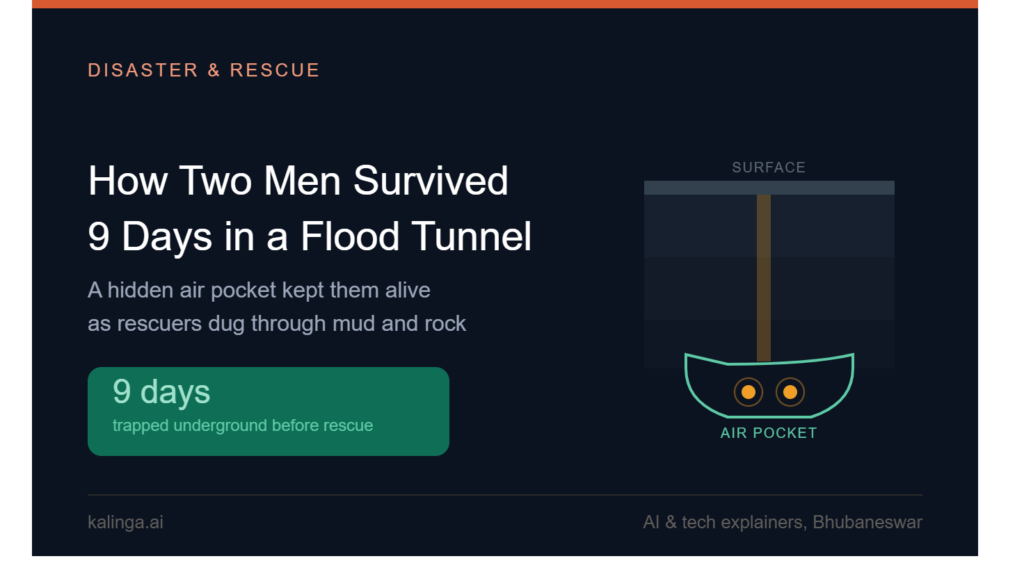
What Is an Air Pocket and Why Did It Save the Survivors?
Definition — Air pocket: An air pocket is an enclosed or partially enclosed space where breathable air remains trapped after surrounding areas are flooded or blocked.
In underground disasters, an air pocket can temporarily become a survival zone. It can provide oxygen even when surrounding passages are filled with water or debris.
That appears to have been crucial for Sah and Maharjan.
The men found shelter in a shorter cable-duct tunnel that was less exposed to floodwater and sloped upward. The tunnel was approximately 160 metres from the exit, according to the engineers involved in the rescue.
The chamber gave the two men something the workers elsewhere in the facility did not have: enough trapped air to remain alive while the outside world searched for them.
But surviving inside an air pocket is not the same as being safe.
The men had no normal access to food or drinking water. Darkness surrounded them, and the tunnel remained blocked by debris.
Maharjan eventually drank the same muddy water in which he was sleeping, according to his wife.
Sah said he recited Hindu prayers to maintain his courage.
The Nepal flood tunnel rescue therefore depended on two separate challenges: keeping the men alive inside the tunnel and creating a safe route through the debris before the remaining air or their physical strength ran out.
How Did the Two Men Survive for Nine Days?
How did Kabir Maharjan and Sanjay Sah stay alive for nine days?
Direct answer: The men survived because they were sheltered in an air-filled section of the tunnel that remained protected from the worst floodwater. They endured darkness, cold, injuries and a severe lack of food while waiting for rescuers to reach them.
Their circumstances were extremely difficult.
Maharjan drifted in and out of consciousness in muddy water. When he was eventually rescued, he was severely disoriented.
At the hospital, he did not initially recognise his wife.
He asked her why she had not given him a bed sooner, illustrating how confused he was after spending so long underground.
Water became both a threat and a lifeline
One of the most remarkable details of the survival story is that Maharjan drank muddy water from the tunnel.
Ordinarily, contaminated water can create serious health risks. But in a survival situation, dehydration can become an immediate threat.
The men were essentially trapped between two dangers: the hostile environment around them and the limited resources available inside their shelter.
Their survival cannot simply be reduced to one technique or decision.
The physical structure of the tunnel protected them from the initial flood. The remaining air allowed them to breathe. Their ability to remain sheltered prevented them from being swept away with other workers.
And, ultimately, rescuers reached them before the conditions became fatal.
The psychological challenge
Nine days in complete darkness can be difficult to imagine.
There was no normal sense of time, no reliable communication and no certainty that anyone outside knew where the men were.
Sah reportedly relied on prayer to maintain his courage.
Meanwhile, Maharjan’s family had almost no information about whether he was alive.
His wife initially believed the powerhouse might have been safe. She repeatedly called her husband and other people who might have information.
When officials later showed her photographs of the destroyed site, hope became increasingly difficult to maintain.
She nevertheless tried to remain strong for her two sons, aged 15 and 10, according to Reuters.
Why Was the Rescue Operation So Difficult?
Why did it take nine days to reach the trapped workers?
Direct answer: Rescuers had to work through unstable ground covered by enormous quantities of mud, rock, timber and debris while heavy rain repeatedly caused water and material to collapse back into excavated areas.
The problem was not simply locating the tunnel.
Rescuers first needed to create a stable working platform before they could safely excavate.
According to the Reuters reconstruction, some sections were buried beneath 15 to 30 metres of landslide material.
That meant conventional digging was extremely difficult.
Water kept undoing the rescue work
Rain became one of the operation’s biggest obstacles.
Several nights of heavy rainfall refilled excavated shafts with fresh water and debris.
Crews could spend hours removing material only to see their progress partially destroyed by another downpour.
This created a dangerous cycle:
Dig → stabilize → encounter debris → remove material → rain arrives → water and debris return.
The rescuers were effectively racing both the mountain and the weather.
Heavy machinery could not immediately enter
Lawmaker and engineer Sagar Dhakal and tunnel engineer Shri Ram Neupane reached the site by military helicopter the day after the disaster.
But bringing heavy equipment into the area was not immediately possible because the debris was too saturated.
Prakash Pokhrel, a geologist with Nepal’s disaster management authority, described the ground as unstable.
The rescuers therefore had to build the conditions needed for excavation before serious digging could begin.
That delay was critical.
Every additional hour meant the trapped workers remained underground while rescuers faced increasingly unstable conditions.
How Did Rescuers Find the Right Tunnel?
How did rescuers know where to dig?
Direct answer: A borehole drilled from above helped confirm the tunnel’s actual alignment, giving rescuers a fixed reference point for excavation.
The site contained multiple tunnel access routes, making the search especially complicated.
Engineering drawings reviewed by Reuters showed that one route extended more than 180 metres toward the underground powerhouse.
Rescuers believed that passage was completely flooded and therefore unlikely to contain survivors.
Neupane instead focused on a shorter cable-duct tunnel.
This tunnel had several advantages.
It was less exposed to floodwater, sloped upward and was relatively close to an exit.
Most importantly, it was the location where Maharjan and Sah had taken shelter.
The five-inch breakthrough
One of the operation’s crucial moments came when rescuers drilled a five-inch borehole from above.
The hole helped establish the tunnel’s actual position.
That may sound like a relatively small technical achievement compared with the enormous excavation around it.
But in a rescue operation underground, knowing precisely where a tunnel lies can make the difference between targeted excavation and blindly removing tonnes of material.
The borehole essentially gave rescuers a fixed point to work toward.
From there, crews could combine drilling, controlled blasting and heavy equipment to progressively open a path.
How Did Rescuers Finally Reach the Survivors?
What happened during the final stage of the rescue?
Direct answer: Rescuers created a route through mud and debris, used a high-pressure water jet to clear a blocked section and eventually heard possible sounds from inside the tunnel before finding a survivor’s hand.
The final breakthrough came after days of painstaking work.
The rescue team encountered a wall of mud-filled debris that could not easily be removed.
Instead of attacking it directly, Dhakal’s crew tried a different approach.
They identified a natural channel approximately 15 metres above the tunnel and used a high-pressure water jet to force water through it.
During testing, the method cleared approximately 4 to 5 metres of material in minutes.
It provided a possible route forward.
But the mountain was still unstable.
A collapse nearly trapped the rescuers
Heavy rain triggered another partial collapse.
Several rescuers were temporarily trapped themselves.
The operation stopped for hours while colleagues worked to persuade them to continue.
The passage was then reinforced using metal sheeting and gabion wire.
This illustrates an important aspect of the Nepal flood tunnel rescue: the rescuers were not operating in a controlled environment.
Every attempt to reach the survivors carried risks for the people doing the digging.
What Was the Moment the Survivors Were Found?
When did rescuers know that someone was alive inside?
Direct answer: At approximately 4 a.m. on the 10th day, a heavy-equipment operator reported hearing a possible sound from inside the tunnel, and rescuers soon began detecting noises while drilling.
Initially, nobody knew whether the sounds were coming from a survivor or were simply echoes from the rescue team’s own voices.
That uncertainty did not stop the rescuers from investigating.
Ganga Baral, who led the rescue team, said crews repeatedly stopped their machines so they could listen.
They called into the darkness:
“Where are you? Are you there?”
Sometimes they believed they could hear someone responding.
The estimated distance to the source narrowed to approximately 15 to 20 metres.
Then came the breakthrough.
A light revealed a hand.
The final metres
Even after seeing the hand, the rescue was not over.
Another 5 to 10 metres of mud-filled tunnel separated the rescuers from the trapped worker.
By approximately 7 a.m., soldiers broke through a small opening.
Then came the confirmation everyone had been waiting for.
A voice came from inside.
The word was “hunuhuncha,” which loosely translates to “we are here.”
After nine days of uncertainty, the rescuers finally knew that the men had survived.
What Happened When the Men Were Pulled Out?
Were the survivors able to walk out of the tunnel?
Direct answer: No. Both men were too weak to stand and had to be carried or placed on a stretcher when rescuers brought them out.
Sah, whose face was covered in mud, was carried on a rescuer’s back.
Despite his exhaustion, he managed to raise one hand toward a camera.
Maharjan’s condition was more serious, and he was carried out on a stretcher.
The rescue team had spent days fighting unstable terrain to reach them.
For the families, the emotional impact was overwhelming.
When Maharjan’s sons heard that their father was alive, they reportedly shouted:
“Mummy, Papa is back!”
Dhakal, who coordinated the operation from outside the tunnel, cried when the two men emerged.
The physical rescue was complete.
The medical recovery, however, had only begun.
What Happened to Kabir Maharjan After the Rescue?
What condition was Maharjan in after nine days underground?
Direct answer: Maharjan was taken to hospital with a serious infected wound on his leg and significant confusion following his prolonged confinement underground.
Doctors operated on the wound, according to his wife.
When Hira Shova visited him, Maharjan did not initially recognise her.
He asked where he was.
For his family, however, the confusion was secondary to the fact that he had survived.
His wife described him as being blessed with another life.
The emotional contrast is striking.
Only days earlier, she had been preparing herself for the possibility that her husband was dead. Now she was sitting beside him in a hospital room.
That is part of what made the Nepal flood tunnel rescue so powerful: the rescue did not erase the disaster’s enormous human cost, but it provided one family with an outcome they had almost stopped believing was possible.
Were Other Survivors Found?
Were Maharjan and Sah the only people rescued alive from the tunnels?
Direct answer: No. The day after the two men were rescued, Chinese national Lu Haitao was found alive inside a tunnel at the separate Upper Trishuli-1 hydropower project.
His discovery strengthened hopes that other workers might also have survived in air pockets or protected sections of tunnels.
According to the Reuters report, 121 workers were still believed to be trapped in tunnels as of Monday.
That meant the successful rescue at Upper Trishuli 3A had implications beyond the two men.
It showed that survival was possible even after several days underground.
Why the rescue changed the search strategy
Before the two men were found, rescuers had to make difficult decisions about where to deploy limited equipment and personnel.
More than 7,500 houses had been destroyed across the valley, according to Dharam Raj Uprety, chief of Nepal’s National Disaster Risk Reduction and Management Authority.
Rescue teams therefore faced multiple emergencies simultaneously.
The discovery of survivors demonstrated that apparently devastated hydropower sites could still contain people alive underground.
That provided a reason to continue searching difficult tunnel environments.
What Does the Nepal Flood Tunnel Rescue Teach Us About Disaster Response?
What can emergency teams learn from this rescue?
Direct answer: The rescue demonstrates the importance of detailed tunnel maps, communication systems, geological assessment, targeted drilling, adaptable rescue techniques and the ability to prioritize locations where trapped people may have access to breathable air.
Several lessons stand out.
1. Know the infrastructure before disaster strikes
Rescuers benefited from engineering drawings showing the location and dimensions of tunnel routes.
That information helped them identify which passages were more likely to contain survivable conditions.
For complex underground facilities, accurate maps can become life-saving tools.
2. Look for survivable spaces
The rescuers did not simply assume that every flooded tunnel contained no survivors.
They considered the possibility of trapped air pockets.
That approach helped direct attention toward areas where workers could potentially remain alive.
3. Adapt when conventional methods fail
Heavy machinery could not immediately solve the problem.
The rescue team experimented with drilling, controlled blasting, high-pressure water and other methods.
The natural channel above the tunnel became particularly important when crews encountered a difficult mud blockage.
4. Technology helps, but judgment matters
The five-inch borehole was valuable because it provided accurate alignment information.
But technology alone did not complete the rescue.
Engineers and rescuers had to interpret the terrain, choose where to dig and constantly reassess risks.
5. Rescuers also need protection
The partial collapse that trapped several rescuers demonstrates the danger of rushing into unstable underground areas.
A rescue attempt can create additional casualties if the environment is not properly stabilized.
Rescue Method Comparison: What Techniques Were Used?
The Nepal flood tunnel rescue involved multiple techniques rather than one single solution.
| Rescue technique | Purpose | Main challenge |
| Borehole drilling | Confirm tunnel alignment | Required accurate positioning |
| Heavy machinery | Remove large quantities of debris | Ground was initially too saturated |
| Controlled blasting | Break difficult obstructions | Required careful operation near unstable areas |
| High-pressure water jet | Clear mud-filled passage | Depended on finding a usable channel |
| Manual listening and calling | Detect survivors | Sounds could be confused with echoes |
| Tunnel reinforcement | Stabilize excavated passages | Rain continued to threaten the route |
The key lesson is that complex disasters often require a combination of engineering methods.
No single tool could remove the entire mountain of debris.
The operation progressed because rescuers repeatedly changed tactics when conditions changed.
Why Are Hydropower Tunnels Especially Difficult During Floods?
Why can flooding at a hydropower project become so dangerous?
Direct answer: Hydropower facilities can contain extensive underground spaces, tunnels, access routes and machinery areas that may become flooded or blocked when extreme water and debris enter the system.
A hydropower project is not simply a dam or power station.
It can include tunnels that connect different parts of the facility, underground powerhouses, ventilation systems and cable routes.
These structures can provide shelter in one scenario and become dangerous traps in another.
The Trishuli valley disaster demonstrated both sides of that reality.
The tunnel where Maharjan and Sah sheltered became their survival chamber because it retained air and avoided the worst floodwater.
Elsewhere, other passages were believed to be completely flooded.
This is why detailed knowledge of underground infrastructure is so important during emergencies.
What Does This Disaster Mean for Nepal’s Hydropower Sector?
Nepal relies heavily on hydropower as a major part of its electricity infrastructure, making the safety of hydropower workers and facilities an important national concern.
The 2026 disaster also highlighted the vulnerability of infrastructure located in mountainous terrain.
Mountain environments can be exposed to landslides, floods, glacier-related hazards and extreme rainfall.
For hydropower developers and operators, disaster planning therefore needs to consider not only normal operational risks but also cascading natural hazards.
A glacier collapse upstream can rapidly become a flood downstream.
That flood can then trigger landslides, destroy roads and isolate facilities.
Once access routes disappear, rescue operations become much more difficult.
The Nepal flood tunnel rescue illustrates why emergency plans must account for interconnected failures rather than treating each hazard separately.
Could Better Early-Warning Systems Have Helped?
Could earlier warnings have prevented some deaths?
Direct answer: The Reuters reconstruction shows that evacuation orders were issued after officials recognized the rapidly worsening situation, but it does not establish that a specific alternative warning system would have prevented the deaths.
That distinction matters.
The disaster developed rapidly after the glacier collapse.
Officials were monitoring hydropower facilities remotely, and the loss of stations from control screens helped reveal that something was seriously wrong.
But the affected infrastructure was spread across a dangerous mountain valley.
Communication was also difficult.
At the Upper Trishuli 3A site, the station manager was abroad, delaying communication with workers.
The disaster therefore raises broader questions about emergency communication, evacuation routes and worker awareness.
Reuters also reported that rescuers later identified an escape ladder that might have saved as many as two-thirds of the workers inside, according to engineer Suraj Dahal.
But workers did not know where to go during the emergency.
That is an important disaster-preparedness lesson: an emergency exit is only useful if workers know where it is and can reach it under pressure.
What Should Observers Watch Next?
What happens after the successful tunnel rescues?
Direct answer: Search teams are expected to continue looking for missing workers, while authorities assess damaged hydropower facilities and the wider destruction caused by the floods and mudslides.
The discovery of Maharjan and Sah provided hope that other missing workers might still be alive.
At the same time, rescuers must balance that hope with the dangers of unstable terrain.
Several priorities remain important:
- Search remaining tunnels for possible survivors.
- Identify additional air pockets and protected chambers.
- Stabilize unstable excavation areas.
- Recover victims where survival is no longer possible.
- Assess damage to hydropower infrastructure.
- Restore access to isolated areas.
- Review evacuation procedures and emergency communications.
- Determine how future mountain disasters can be detected and managed more effectively.
The challenge is enormous because the tunnel rescue operation is only one part of a much larger disaster response.
Why This Story Matters Beyond Nepal
The story of two workers surviving nine days underground is dramatic, but its wider significance is about how humans respond when conventional rescue methods fail.
The rescue combined engineering, geology, heavy machinery, improvisation, persistence and human communication.
It also showed why infrastructure knowledge matters during disasters.
A tunnel map that appears ordinary during normal operations can become a critical survival document after a flood.
A small borehole can become a vital connection between rescuers and survivors.
A few metres of stable ground can determine whether someone survives.
And a sound in the darkness can change an entire rescue operation.
For students and young professionals, this is a useful reminder that engineering is not only about designing systems that work under normal conditions.
It is also about designing, mapping and managing systems that can be understood when everything goes wrong.
Key Takeaways
The Nepal flood tunnel rescue can be understood through several crucial facts:
- Kabir Maharjan and Sanjay Sah survived nine days trapped inside a hydropower tunnel.
- The disaster began on August 26, 2026, after a glacier collapse triggered a devastating landslide and flood.
- More than 1,300 people were killed, according to the Reuters report, with thousands missing across Nepal and neighbouring Tibet.
- The disaster affected 12 hydropower projects and nearly 900 workers.
- Maharjan and Sah survived in an air-filled chamber inside the Upper Trishuli 3A hydropower project.
- Rescuers faced 15 to 30 metres of mud, rock, timber and debris in some areas.
- A five-inch borehole helped confirm the tunnel’s alignment.
- A high-pressure water jet helped clear 4 to 5 metres of debris during testing.
- Rescuers eventually heard sounds, saw a hand and opened a passage to the survivors.
- Both men were too weak to walk and had to be carried out.
- Lu Haitao, a Chinese national, was subsequently found alive at another hydropower station.
- The rescue renewed hope for other missing workers believed to remain underground.
The most important lesson is simple: even after a catastrophic flood, survival underground can remain possible when trapped workers find protected spaces with breathable air and rescue teams can accurately locate and reach them.
The story also demonstrates how difficult modern disaster response can be. Rescuers were not simply digging through dirt; they were navigating unstable geology, flooding, collapsing passages and their own risk while racing to reach people who could still be alive.
FAQ: Nepal Flood Tunnel Rescue
How did two men survive nine days in a Nepal tunnel?
Kabir Maharjan and Sanjay Sah survived nine days because they sheltered in an air-filled section of a tunnel at the Upper Trishuli 3A hydropower project. The chamber protected them from the worst floodwater while allowing them to breathe, although they endured darkness, muddy water, injuries and a lack of food.
What caused the Nepal floods in August 2026?
According to the Reuters reconstruction, a glacier collapsed at Langtang Lirung mountain on August 26, 2026, triggering a powerful landslide and wall of water that devastated parts of Nepal’s Trishuli valley.
How were the trapped workers found?
Rescuers eventually heard possible sounds while drilling toward the tunnel. They estimated the source was approximately 15 to 20 metres away, then saw a hand through the debris. Soldiers subsequently opened a small hole and heard the survivors say they were there.
How long were the workers trapped?
Kabir Maharjan and Sanjay Sah were trapped for nine days before being rescued from the Upper Trishuli 3A hydropower tunnel.
What made the rescue so difficult?
The rescue was complicated by enormous quantities of mud, rock, timber and debris, with some areas buried under 15 to 30 metres of material. Heavy rain repeatedly refilled excavated areas with water and debris, while unstable ground created risks for rescuers.
What equipment and techniques were used?
Rescuers used drilling, controlled blasting, heavy machinery, a five-inch borehole and a high-pressure water jet. They also reinforced passages with metal sheeting and gabion wire to reduce the risk of collapse.
Were more survivors found after Maharjan and Sah?
Yes. The following day, Chinese national Lu Haitao was found alive inside a tunnel at the Upper Trishuli-1 hydropower project. The discovery raised hopes that additional missing workers could still be alive.
Why was an air pocket important?
An air pocket provided breathable air in an otherwise flooded or blocked underground environment. For Maharjan and Sah, the air-filled chamber was likely a crucial reason they could survive until rescuers reached them.
What can Nepal learn from the tunnel rescue?
The rescue highlights the importance of accurate tunnel maps, worker evacuation training, emergency communication, geological assessment, access to specialized rescue equipment and the ability to identify protected spaces where survivors may remain alive.
The Nepal flood tunnel rescue is ultimately a story of survival against extraordinary odds. Two men entered a tunnel before a catastrophic flood and emerged nine days later, weak, injured and disoriented—but alive.
For readers interested in engineering, disaster technology and emergency response, the story offers a powerful case study in how infrastructure, human judgment and persistence can intersect when lives depend on every metre of progress.
For more explainers on technology, engineering and major developments shaping the world, explore further learning resources from Kalinga.ai.