Why Did the AfD Win Saxony-Anhalt?
Question: Why did the AfD win the Saxony-Anhalt election?
Direct answer: The AfD benefited from voter dissatisfaction with established parties, concerns about immigration and economic security, and support for its positions on Russia and Ukraine.
Saxony-Anhalt is one of the smaller and poorer states in the former communist eastern part of Germany. The result therefore reflects local frustrations, but it is also being viewed as a warning about the broader political direction of Germany.
During the campaign, the AfD Germany leadership presented itself as an alternative to what it described as an established political system that had become tired and disconnected from voters.
Its campaign focused on issues including immigration, public safety, national identity and economic concerns. The party also opposed continued German support for Ukraine and argued for restoring closer relations with Moscow.
According to figures cited by German broadcaster ARD, “peace in Europe” was the second-largest factor influencing how people voted in Saxony-Anhalt.
Who Voted for the AfD?
The voting breakdown highlighted important demographic differences.
Reuters reported that the party performed particularly strongly among men. 50% of men voted for the AfD, compared with 39% of women, according to the reported breakdown.
The party also attracted more support from voters who were less economically secure and less educated.
These numbers do not mean every AfD voter shares the same motivation. Rather, they show that the party has developed a broad electoral coalition around dissatisfaction with mainstream politics and specific policy issues.
The AfD Germany result is therefore important not simply because of the percentage it received, but because it demonstrates the party’s ability to convert political dissatisfaction into a large electoral bloc.
What Does the Result Mean for Friedrich Merz?
Question: Does the AfD victory threaten Friedrich Merz immediately?
Direct answer: It creates major political pressure on Merz, but he has rejected calls to resign and said he will not fundamentally change course.
Merz’s conservative Christian Democratic Union, or CDU, suffered its worst election result in decades in Saxony-Anhalt, according to Merz himself.
The chancellor acknowledged the scale of the setback while defending his government’s broader reform agenda.
“I will not deviate by even a millimetre from my fundamental conviction that we must defend our freedom, especially now, against Russia,” Merz said, according to Reuters.
That position matters because the AfD has taken the opposite approach on several major foreign-policy questions.
The AfD Germany leadership wants Germany to end its support for Ukraine and restore ties with Moscow. Merz has argued that abandoning Ukraine would not improve the European security situation and would instead make it worse.
Why Is Merz Under Pressure?
Merz is already dealing with weak approval ratings, according to the Reuters report, while his government is attempting to revive economic growth through reforms and increased spending in selected areas.
The Saxony-Anhalt result adds another challenge: convincing voters that mainstream conservative politics can address their concerns without cooperating with the AfD.
Merz also faces additional state elections in the coming weeks and into next year.
That means the political consequences of the Saxony-Anhalt vote may become clearer through a series of subsequent elections.
If the CDU performs poorly elsewhere while the AfD continues to gain support, pressure on Merz’s strategy could intensify.
If mainstream parties recover, the Saxony-Anhalt result could instead be treated as a particularly severe regional warning.
Can the AfD Actually Form a Government?
Question: Can the AfD govern Saxony-Anhalt after winning 44% of the vote?
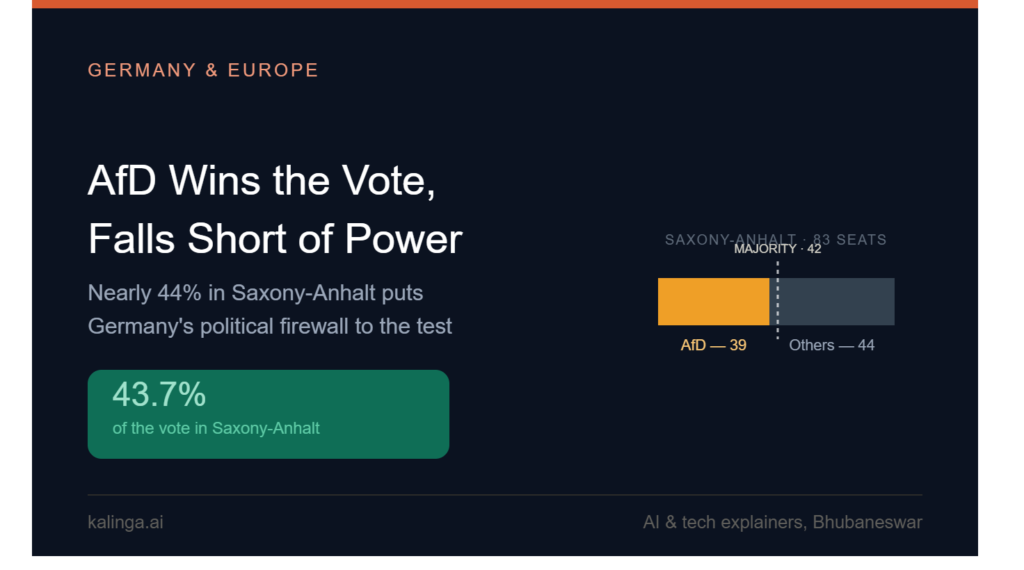
Direct answer: Not by itself. The party won 39 of the state’s 83 seats and therefore needs additional support to reach a governing majority.
This is one of the most important details of the AfD Germany election result.
Winning the largest share of votes does not automatically mean winning enough seats to govern alone. The AfD needs support from other lawmakers or parties to create a viable governing arrangement.
Its national co-leader Tino Chrupalla has appealed directly to CDU lawmakers.
Chrupalla argued that a “centre-right conservative majority” could be created in Saxony-Anhalt and criticized the longstanding refusal of mainstream parties to work with the AfD.
That creates a difficult strategic question for CDU lawmakers: should they cooperate with the party that won the largest share of the vote, or maintain the political barrier that mainstream German parties have historically used to prevent AfD participation in government?
Potential Paths to Government
The political possibilities can be simplified like this:
| Political path | What it would mean | Main challenge |
| AfD-led government | AfD gains enough outside support to govern | Requires support beyond its 39 seats |
| AfD-CDU cooperation | Conservative lawmakers help the AfD form a majority | Would challenge the CDU’s firewall |
| Alternative coalition | Other parties combine to prevent AfD rule | Requires sufficient numbers and political agreement |
| Minority arrangement | A government operates without a conventional majority | Could face repeated legislative difficulties |
The situation remains politically fluid.
The key issue is not merely whether the AfD Germany party won the election. It is whether that electoral victory can be translated into executive power.
What Is Germany’s “Firewall” Against the AfD?
Question: What does Germany’s political “firewall” mean?
Direct answer: The firewall refers to the longstanding policy of mainstream German parties refusing to form governing alliances or formally cooperate with the AfD.
Definition — Firewall: In German politics, the “firewall” is an informal political barrier intended to prevent the AfD from gaining governing power through cooperation with mainstream parties.
The policy has been particularly important for the CDU, which has traditionally rejected working with the AfD despite overlaps on some conservative issues.
The AfD argues that this exclusion is undemocratic. Mainstream parties counter that cooperation with the party would cross a political boundary they consider necessary.
The Saxony-Anhalt result puts that principle under renewed pressure because the AfD now has a very large parliamentary presence.
Why Is the Firewall So Important?
The firewall means that an AfD election victory does not automatically translate into an AfD government.
That distinction is critical when interpreting the AfD Germany result.
The party can win voters, become the largest parliamentary group and influence political debate while still being excluded from executive power.
But the larger its electoral support becomes, the more difficult maintaining that exclusion could become politically.
If the AfD continues to approach or exceed 40% in regional elections, mainstream parties may increasingly have to explain to voters why the largest party cannot participate in government.
At the same time, cooperating with the AfD could fundamentally reshape Germany’s political system and mainstream parties’ relationships with their own voters.
Is There Another Party That Could Work With the AfD?
Question: Which German party has shown openness to working with the AfD?
Direct answer: The populist left-wing BSW is the only German party mentioned by Reuters as having signalled readiness to work with the AfD.
The BSW, or Bündnis Sahra Wagenknecht, shares some positions with the AfD despite occupying a different position on the traditional left-right political spectrum.
Both parties have criticized mass immigration and oppose continued German support for Ukraine.
They also argue that sanctions against Russia have damaged German businesses by limiting access to Russian energy resources.
That creates an unusual political overlap.
Why Could the BSW Matter?
The BSW’s potential role demonstrates why German coalition politics cannot always be understood through a simple left-versus-right framework.
Parties can disagree on economic or social policy while finding common ground on foreign policy, immigration or sanctions.
For the AfD Germany leadership, the existence of even limited potential cooperation could become strategically important if it struggles to attract CDU lawmakers.
However, the Reuters report does not establish that an AfD-BSW government will actually form.
The immediate challenge remains finding enough parliamentary support to turn the AfD’s electoral victory into a governing majority.
Why Are France and Poland Concerned?
Question: Why did the Saxony-Anhalt election alarm Germany’s neighbours?
Direct answer: France and Poland are concerned because the result strengthens a German far-right party that opposes support for Ukraine and wants closer relations with Russia.
Germany occupies a central position in European politics and security. Changes in its domestic political balance can therefore affect how neighbouring countries assess the future of European cooperation.
French Finance Minister Roland Lescure described the result as a “very, very worrying signal.”
He linked the German result to what he described as a broader populist wave spreading internationally.
Poland has also expressed concern.
The concern is particularly relevant because the AfD Germany platform includes major changes to Berlin’s approach to Russia and Ukraine.
Merz, however, has explicitly rejected changing his government’s fundamental position.
Russia and the European Security Debate
The election also became part of the larger debate over Europe’s relationship with Russia.
Merz characterized the current political moment as a struggle over the survival of Western values and defended Germany’s continued support for Ukraine.
The AfD takes a different position, calling for an end to support for Ukraine and a restoration of ties with Moscow.
This means the political dispute is not only about immigration or domestic economic policy. It also involves Germany’s role in European security.
Why Does Eastern Germany Matter So Much?
Question: Why is Saxony-Anhalt politically significant beyond its size?
Direct answer: Saxony-Anhalt is part of the former communist East Germany, where economic, demographic and political differences have contributed to strong support for parties challenging the mainstream political system.
The state is relatively small, but its political symbolism is much larger.
Reuters reported that some voters are motivated by nostalgia for life in the former communist-run East Germany.
That sentiment exists alongside concerns about immigration, economic insecurity and dissatisfaction with established parties.
The AfD Germany campaign was able to combine these different sources of frustration into a message centered on political change and national identity.
The Eastern Germany Factor
The political divide between Germany’s eastern and western regions has long been an important feature of German politics.
Eastern states have sometimes produced stronger support for parties that position themselves against the political establishment.
The Saxony-Anhalt result suggests that this regional political pattern remains highly relevant in 2026.
But it would be misleading to describe the election as only an eastern German phenomenon.
The AfD’s national leadership has already used the result to look toward the 2029 German federal election, with Alice Weidel saying the party aims to win at least 40% in the next national election.
That ambition turns a regional election into a potential preview of a much larger national contest.
What Does the AfD Germany Result Mean for 2029?
Question: Could the Saxony-Anhalt result predict Germany’s 2029 national election?
Direct answer: It is too early to say, but the result gives the AfD a powerful political argument that it can become a dominant force in German elections.
Alice Weidel described the Saxony-Anhalt result as a milestone and said the party’s goal is to reach at least 40% in the next national election, scheduled for 2029.
That does not mean the AfD will receive 40% nationally.
State elections have their own candidates, local issues and political dynamics. Voters can also behave differently in regional and federal elections.
Still, a result of nearly 44% gives the party significant momentum.
It can now argue that its support is not limited to protest voters or fringe constituencies.
What Mainstream Parties Must Consider
The election creates a difficult balancing act for Germany’s established parties.
They need to respond to voters who are moving toward the AfD without simply copying its positions.
At the same time, they must decide whether maintaining the firewall is politically sustainable as the AfD’s electoral support grows.
For Merz, this is especially challenging.
His government needs to demonstrate progress on economic growth, reforms and other domestic concerns while maintaining its foreign-policy position on Ukraine and Russia.
If mainstream parties can address voter concerns successfully, the AfD’s momentum could weaken.
If voters remain dissatisfied, the party could use that frustration to expand further.
What Are the Main Issues Behind the AfD’s Rise?
Question: Which issues helped the AfD attract voters?
Direct answer: Immigration, economic insecurity, public safety, national identity and dissatisfaction with established parties were among the major themes highlighted in the Reuters report.
The party’s campaign promised cleaner and safer streets while emphasizing national pride and opposition to mass immigration.
It also criticized mainstream parties as disconnected from ordinary voters.
Several issues stand out:
- Immigration: The AfD campaigns for stricter immigration policies and deportation of immigrants.
- Economic concerns: The party gained support among voters described as less economically secure.
- Public safety: Campaign messaging emphasized cleaner and safer streets.
- National identity: The party promoted national pride and a stronger sense of German identity.
- Russia and Ukraine: The AfD wants Germany to stop supporting Ukraine and restore relations with Moscow.
- Political dissatisfaction: The party presented itself as an alternative to established political parties.
These issues do not affect all voters equally.
The strength of the AfD’s campaign came partly from combining several concerns into a broader argument that Germany’s traditional political leadership was failing to respond adequately.
How Should We Interpret the AfD’s 44% Vote Share?
Question: Does 44% mean that 44% of Germans support the AfD?
Direct answer: No. The nearly 44% figure refers specifically to the Saxony-Anhalt state election and should not be interpreted as a national German polling figure.
This distinction is essential.
The AfD Germany result is a state-level election outcome, not a measurement of nationwide support.
Saxony-Anhalt has its own political history, demographic characteristics and voter concerns.
Nevertheless, the result is politically significant because the AfD did not merely finish first by a narrow margin. It won nearly 44% of the vote and secured 39 of 83 seats.
That gives the party substantial influence over the formation of the next state government.
It also provides its national leadership with evidence that the party can potentially become a major governing force.
What Happens Next in Saxony-Anhalt?
Question: What is the immediate political challenge after the election?
Direct answer: The parties must determine how a government can be formed when the AfD is the largest parliamentary force but lacks an absolute majority.
The AfD will attempt to persuade individual conservative lawmakers to support it.
The CDU, meanwhile, must decide how to respond without abandoning its firewall policy.
Other parties could also explore alternatives, although the exact arithmetic and political agreements will determine what is possible.
The outcome will matter beyond the state because it could establish a precedent.
If the AfD enters government at state level for the first time in postwar Germany, other parties and voters will gain a real-world example of what AfD-led administration looks like.
If the party remains excluded despite winning the largest vote share, the firewall debate could become even more intense.
Why This Election Matters for Europe
The significance of the AfD Germany election result extends beyond domestic coalition negotiations.
Germany is Europe’s largest economy and one of its most influential political and security powers.
A stronger AfD could eventually influence debates over immigration, European integration, defence spending, sanctions against Russia and support for Ukraine.
For Germany’s neighbours, the question is therefore not simply who governs Saxony-Anhalt.
It is whether the political balance inside Germany is shifting in a way that could eventually affect Berlin’s European and foreign-policy priorities.
Merz has made clear that he does not intend to abandon his position on Ukraine or Russia in response to the result.
That sets up a larger political contest between the government’s current direction and the alternative offered by the AfD.
Key Takeaways From the AfD Election Victory
The AfD Germany result can be understood through several core facts:
- The AfD won nearly 44% of the vote in Saxony-Anhalt.
- It secured 39 of 83 seats, leaving it short of an absolute majority.
- Friedrich Merz called the result deeply shocking and said it had shaken the CDU.
- Merz ruled out working with the AfD and rejected suggestions that he should resign.
- The AfD is trying to attract individual CDU lawmakers to support its bid to govern.
- Germany’s political firewall against AfD cooperation is facing renewed pressure.
- The BSW is the only German party mentioned by Reuters as having signalled willingness to work with the AfD.
- France and Poland expressed concern about the result.
- The AfD wants Germany to end support for Ukraine and restore ties with Moscow.
- AfD co-leader Alice Weidel has set a target of at least 40% in the 2029 national election.
The most important point is that winning an election and forming a government are not the same thing.
The AfD Germany victory has dramatically changed the political conversation, but the next test is whether the party can convert its large vote share into governing power.
FAQ: AfD Germany and the Saxony-Anhalt Election
What is the AfD in Germany?
The Alternative for Germany, or AfD, is a German political party that Reuters describes in this report as far-right. Its policies include opposition to mass immigration, ending German support for Ukraine and restoring relations with Moscow.
How much of the vote did the AfD win in Saxony-Anhalt?
The AfD won nearly 44% of the vote in the September 2026 Saxony-Anhalt state election, making it the largest party in the election.
Does the AfD have a majority in Saxony-Anhalt?
No. The AfD won 39 of 83 seats in the state legislature, so it does not have an absolute majority and needs additional support to form a government.
Will Friedrich Merz resign after the AfD election result?
No. Friedrich Merz rejected suggestions that he should resign and said he would broadly continue his government’s reform agenda despite the CDU’s poor result.
What is Germany’s firewall against the AfD?
Germany’s political “firewall” is the longstanding refusal by mainstream parties to cooperate with or form governing alliances with the AfD. The Saxony-Anhalt result has increased pressure on that policy.
What could the AfD victory mean for Germany’s 2029 election?
The result gives the AfD significant political momentum, but a state election cannot directly predict a national result. AfD co-leader Alice Weidel has nevertheless said the party aims to win at least 40% in the 2029 national election. keep exploring kalinga.ai for more.