File Name: banned-gender-test-kits-india-ebay.jpg
Title: Banned Gender-Test Kits on eBay
Alt Text: Banned gender-test kits in India appeared on eBay despite local restrictions
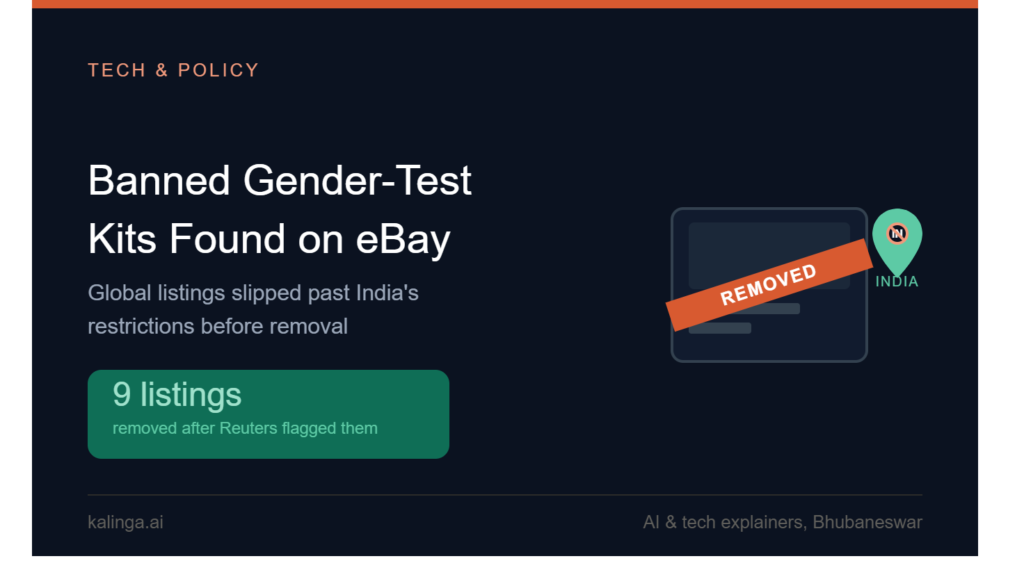
Caption: eBay removed gender-test kit listings after Reuters exposed their availability for delivery to India.
Description: The image should depict a digital e-commerce marketplace interface featuring a generic gender-test kit listing, an India delivery indicator, and a prominent restriction or removal visual. The composition should communicate the central issue of banned gender-test kits appearing on eBay and highlight the challenges global marketplaces face when enforcing country-specific regulations.
Why Did eBay Remove the Gender-Test Listings?
The immediate issue was straightforward: products advertised as ways to determine an unborn baby’s sex were appearing on eBay with delivery available to India.
Reuters identified at least nine listings, including products associated with brands such as SneakPeek and Peekaboo. Prices ranged from $6.99 to $156.59, with international shipping options available for Indian customers.
Question → Direct Answer: Why were the listings removed?
They were removed because the products violated Indian regulations and eBay’s own policies. After Reuters alerted the company, eBay said it was reviewing its controls to determine whether additional safeguards were needed.
The listings were created by third-party sellers, rather than eBay itself. That distinction matters because marketplace platforms often provide the infrastructure for independent sellers to list and ship products, while the platform must separately determine which products can legally be displayed or delivered in particular countries.
Definition + Expansion: Marketplace safeguards are technical and operational controls that platforms use to prevent restricted products from being listed, purchased, or shipped to prohibited destinations.
These safeguards can include keyword filters, product-category restrictions, seller rules, geographic blocking, checkout controls and shipping restrictions. But a product can potentially slip through when sellers describe it differently, listings are automatically generated or restrictions are not correctly connected to a destination country’s laws.
eBay told Reuters that it already had controls intended to prevent certain gender-prediction products from being visible in India. The company said the listings identified by Reuters violated local regulations and its policies.
What Products Were Being Offered?
The listings covered products marketed as tests for determining fetal sex during pregnancy.
One eBay listing featured the Peekaboo kit, produced by U.S.-based DNA Diagnostics Center. The listing marketed the product as a way to determine a baby’s gender at an early stage of pregnancy.
DNA Diagnostics Center told Reuters that it does not sell or distribute its kits for resale in India and said it does not control the actions of independent third parties after a product has been purchased.
SneakPeek did not respond to Reuters’ request for comment.
The distinction between manufacturer, seller and marketplace is important. A manufacturer can restrict distribution while an independent seller may nevertheless attempt to offer a product through an international marketplace.
What Does Indian Law Say About Prenatal Gender Determination?
The controversy exists within a much larger Indian public-policy context.
India introduced legislation in 1994 to regulate prenatal diagnostic techniques used for determining the sex of an unborn child. The law emerged amid concerns about sex-selective abortion and the declining number of girls being born relative to boys.
Question → Direct Answer: Is prenatal sex determination legally restricted in India?
Yes. India’s law prohibits the use of prenatal diagnostic techniques for determining the sex of a fetus, subject to the law’s specific provisions and permitted medical uses of diagnostic technology.
The legislation is commonly associated with the Pre-Conception and Pre-Natal Diagnostic Techniques (Prohibition of Sex Selection) Act, which seeks to prevent sex selection and misuse of prenatal diagnostic procedures.
The broader objective is not simply to regulate a particular medical test. It addresses the social consequences of using technology to select or discriminate based on the sex of an unborn child.
Reuters reported that violations can attract up to three years in prison, with tougher penalties for repeat offences.
Why Was the Law Introduced?
The expansion of ultrasound technology made it increasingly possible to determine fetal sex during pregnancy. Campaigners have argued that this contributed to sex-selective abortions, particularly where families strongly preferred sons.
Several social and economic factors have historically contributed to son preference, including inheritance customs, expectations that sons will support parents later in life and dowry-related pressures.
That context explains why India’s restrictions are significantly broader than a simple rule about whether a particular consumer product can be imported.
The concern is about the potential use of technology to facilitate sex selection.
How Did Banned Gender-Test Kits Appear on eBay?
This is arguably the most interesting technology question in the Reuters report.
eBay is a global marketplace with 136 million active buyers, according to the report. It does not operate a local Indian shopping website, but it offers international delivery to India.
That creates a complicated regulatory environment.
A seller could be located in one country, manufacture or source a product in another, list it on a global platform and attempt to ship it to a customer in India. The platform therefore has to understand not just what the product is, but also where it is being purchased and where it is being delivered.
Question → Direct Answer: Why can a product be legal in one country but restricted in another?
Because countries establish their own laws governing medical products, consumer goods and technologies. An international marketplace therefore cannot assume that a product permitted in its country of origin is automatically legal to sell or ship everywhere else.
The E-Commerce Enforcement Problem
Imagine a marketplace with millions of listings.
A restriction might need to account for:
- The product title
- Product description
- Images
- Seller-provided keywords
- Product category
- Seller location
- Customer location
- Shipping destination
- Local legislation
- Changes in regulations
- Attempts to bypass restricted-product filters
This is where automated moderation becomes difficult.
A marketplace can block an obvious phrase such as “gender prediction test.” But sellers may use different terminology, misspell product descriptions, upload images containing relevant information or place a restricted product inside a broader category.
This creates what can be described as a policy-to-platform gap: the law may clearly prohibit an activity, while translating that legal rule into thousands or millions of automated marketplace decisions is considerably harder.
Why Shipping and Checkout Controls Matter
The eBay investigation is particularly relevant because the problem was not merely that a product appeared somewhere on the internet.
The Reuters report found that listings were offering delivery to India.
That means geographic controls are an important part of marketplace compliance.
Definition + Expansion: Geographic restriction is a platform control that prevents a product from being displayed, purchased or shipped to customers in countries or regions where it is prohibited.
A sophisticated marketplace may apply restrictions at multiple stages.
For example:
- Search stage: prevent the product from appearing to customers in India.
- Listing stage: stop sellers from creating listings that violate destination-country rules.
- Checkout stage: prevent a buyer in India from purchasing the item.
- Shipping stage: stop fulfilment to a restricted destination.
- Post-listing monitoring: identify and remove listings that evade earlier controls.
eBay’s statement specifically mentioned its shipping and checkout experience as part of the review.
That is significant because blocking a product at checkout is different from preventing it from being visible in search results in the first place.
What Happened With Amazon?
The Reuters investigation also looked beyond eBay.
Amazon’s U.S. website lists gender-testing products, but Reuters found that those products were not offered for delivery to India.
That illustrates an important distinction between product availability and destination availability.
A product can remain available on a global website while being blocked from shipment to a particular country.
| Approach | What it does | Strength | Limitation |
| Search blocking | Hides restricted products from local users | Prevents discovery | Does not necessarily remove the listing globally |
| Listing restrictions | Stops sellers from posting prohibited products | Addresses the source | Requires accurate product classification |
| Checkout blocking | Prevents a transaction from completing | Strong last-mile control | Product may still be visible |
| Shipping restrictions | Prevents delivery to a prohibited country | Directly addresses cross-border access | May occur after discovery |
| Multi-layer controls | Combines listing, search, checkout and shipping restrictions | Strongest overall approach | More technically complex |
Question → Direct Answer: Which approach is most effective?
A layered approach is generally stronger than relying on a single filter. Blocking a restricted product at search, listing, checkout and shipping stages provides multiple opportunities to catch an attempted transaction.
The eBay episode demonstrates why this matters: even if a platform has controls in place, an individual listing can still expose a weakness that requires investigation.
Why Is Google Also Involved?
The Reuters report identifies a second, separate issue involving Google search results.
India’s health ministry sent two notices dated August 9 to Google concerning search results associated with the Peekaboo website.
The notices reportedly argued that Google’s Indian search engine was providing information that led users to webpages promoting or advertising gender prediction of an unborn child.
This is different from an e-commerce marketplace.
Google does not necessarily sell the product simply because a webpage appears in its search results. Instead, the search engine acts as a discovery layer that can direct users toward external websites.
Question → Direct Answer: Why would India ask Google to remove search results?
Because search results can make restricted information or commercial offers easier to discover. Authorities can request that specific links be removed or restricted from search results for users in a particular country.
Reuters said the notices included screenshots of searches such as “peekaboo test,” “buy peekaboo test online” and “boy or girl.”
A Reuters check on Tuesday found that those searches still returned links to the Peekaboo website.
Google and India’s health ministry did not respond to Reuters’ queries.
What Does This Reveal About Online Regulation?
The bigger story is not simply that several listings were removed.
It is about how digital platforms enforce local laws at global scale.
An offline retailer in India is operating within a specific legal environment. A global digital marketplace may have sellers, servers, customers and logistics networks spanning dozens or hundreds of jurisdictions.
That makes compliance a technical problem as well as a legal one.
One Product, Multiple Rules
Consider the journey of an internationally sold consumer product:
Manufacturer → Seller → Marketplace → Search → Customer → Checkout → Shipping → Delivery
At each point, a different control may be required.
A manufacturer may restrict distribution. A marketplace may prohibit the listing. A search engine may limit discoverability. A payment system may flag the transaction. A shipping provider may restrict delivery.
The more fragmented the process becomes, the greater the chance that responsibility is distributed across several companies.
Question → Direct Answer: Does removing a listing solve the entire problem?
Not necessarily. Removing a specific listing addresses that listing, but platforms may also need to identify similar products, repeat sellers, alternative descriptions and other ways the same restricted item could reappear.
That’s why eBay’s decision to conduct an internal review is important.
The question is not only “Why was this listing available?” but also “Could the same type of listing appear again?”
AI and Automated Moderation Could Become Part of the Solution
Modern marketplaces increasingly rely on automated systems to classify listings and detect policy violations.
Artificial intelligence can potentially help platforms identify restricted products by analysing more than individual keywords.
For example, a moderation system could examine:
- Product titles
- Product descriptions
- Images
- Seller behaviour
- Product categories
- Shipping destinations
- Historical enforcement data
- Similar listings
Instead of searching only for one prohibited phrase, an AI system could attempt to understand what a product actually does.
Definition + Expansion: AI content moderation uses machine-learning systems to detect and classify potentially prohibited content or products.
This can be useful when sellers deliberately or accidentally use different terminology. However, AI moderation is not a substitute for legal interpretation or human review, particularly where regulations differ between countries.
False positives can also be a problem. A platform may incorrectly remove legitimate medical or educational content if its automated system interprets context too broadly.
Why Human Oversight Still Matters
The Reuters investigation itself demonstrates the value of external scrutiny.
A cybersecurity firm, FalconFeeds, initially flagged the eBay listings to Reuters. Reuters then reviewed the listings and contacted eBay, after which the company removed them and began reviewing its safeguards.
That sequence illustrates an important principle in platform governance:
Automated enforcement works best when combined with monitoring, reporting and human investigation.
A platform can build filters, but researchers, regulators, journalists, users and civil-society organisations can uncover edge cases that automated systems miss.
This is especially important for products governed by country-specific laws.
What Should Global Marketplaces Learn From the eBay Case?
There are several practical lessons.
1. Country-specific compliance needs more than a keyword filter
A product restriction should be connected to the buyer’s destination and not simply the seller’s location.
2. Checkout is not the first line of defence
Preventing a purchase at checkout is useful, but stopping the product from appearing in the first place can reduce exposure.
3. Shipping data can be a critical compliance signal
Knowing where a customer wants an item delivered can determine whether the transaction is permissible.
4. Third-party sellers increase complexity
When millions of independent sellers create listings, marketplaces need systems capable of monitoring new and modified listings continuously.
5. Enforcement should cover re-listing
Removing one listing is only one step. Platforms should also investigate whether similar listings exist under different sellers, titles or categories.
6. Search engines face a related but distinct responsibility
A search engine may not host or sell a product, but its results can influence how easily users discover restricted commercial content.
What Does This Mean for Indian Consumers?
For consumers, the most important lesson is simple: availability online does not mean legality in India.
An international marketplace may display a product because its systems have not yet applied the relevant Indian restriction. That does not make the transaction lawful.
This is particularly important for products involving healthcare, medicines, medical diagnostics and other regulated technologies.
Consumers should not treat an international website’s checkout page as proof that a product is legally permitted in India.
Question → Direct Answer: If an international website allows delivery to India, does that mean the product is legal to use in India?
No. A website’s ability to process or offer an order does not override Indian law. The legality of a product or its intended use depends on the applicable Indian regulations.
The Bigger Technology Story
At first glance, the eBay episode might look like a narrow dispute about a handful of product listings.
It is actually a useful case study in platform governance, cross-border e-commerce and automated compliance.
The internet has made commerce global, but laws remain largely national.
That creates an ongoing challenge for technology companies: How do you build one global platform that behaves differently when the law changes from one country to another?
The answer increasingly involves a combination of policy databases, geographic controls, automated detection, seller verification, transaction monitoring and human oversight.
But no system is perfect.
The fact that Reuters could identify listings that eBay subsequently removed demonstrates why continuous testing matters. A platform’s compliance system should be treated less like a static rulebook and more like a security system that requires regular auditing.
Key Takeaways
Here is what readers should remember from the Reuters investigation:
- At least nine eBay listings offering gender-test kits were identified as available for delivery to India.
- The listed prices ranged from $6.99 to $156.59.
- eBay removed the listings after Reuters raised the issue.
- The company said it was reviewing its shipping and checkout controls.
- India restricts prenatal sex determination under legislation introduced in 1994.
- Violations can carry prison sentences, according to the Reuters report.
- Amazon’s U.S. website listed similar products but did not offer them for delivery to India.
- India’s health ministry separately asked Google to address search results linking to webpages promoting gender prediction.
- The episode highlights the difficulty of enforcing country-specific laws on global digital platforms.
FAQ: eBay, Gender-Test Kits and Indian Law
Why did eBay remove gender-test kits from listings available in India?
eBay removed the listings after Reuters identified at least nine gender-test kit listings that could be delivered to India. The company said the listings violated local regulations and eBay policies and that it was reviewing its controls.
Are prenatal gender tests legal in India?
India prohibits prenatal sex determination under its law governing pre-conception and pre-natal diagnostic techniques. The restrictions were introduced to combat sex selection and associated discrimination against female fetuses.
Can an international website legally sell a product in India just because it is legal elsewhere?
No. Products and services can be subject to different laws in different countries. A product’s legality in its country of origin does not automatically establish that it can legally be sold, shipped or used in India.
What were the prices of the gender-test kits found on eBay?
Reuters reported that the identified listings ranged from $6.99 to $156.59, with international delivery options to India.
Why did India also target Google search results?
The health ministry sent notices to Google concerning search results that linked users to webpages associated with gender prediction. The issue is distinct from eBay’s marketplace listings but involves the same broader concern about making prohibited gender-prediction services or products accessible online.
What does this case teach us about e-commerce technology?
It shows that global marketplaces need multiple layers of compliance, including product detection, seller monitoring, geographic restrictions, search controls, checkout checks and shipping restrictions. It also demonstrates why external monitoring and human review remain important alongside automated systems.
Final Takeaway
The eBay case is a reminder that global e-commerce does not erase local laws. As marketplaces and search engines become increasingly automated, the challenge is no longer just identifying what a product is,it is understanding whether that product can legally be discovered, purchased or delivered in a specific country.
For technology platforms, that means building compliance into the entire customer journey rather than relying on a single filter. keep exploring kalinga.ai for more.