Why Are the Houthis Attacking Saudi Arabia Again?
Imagine waking up to reports that missiles and drones have targeted several cities in a major oil-producing country while crude prices are already near $100 a barrel. That is the situation facing Saudi Arabia after Iran-backed Houthis launched attacks across four southern Saudi cities on September 8, 2026.
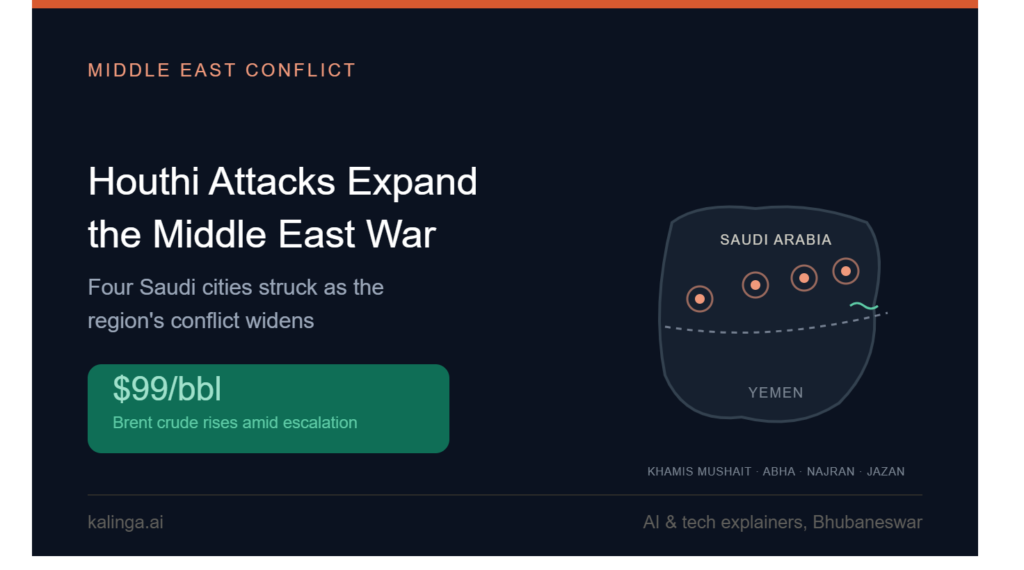
The Houthi attacks on Saudi Arabia targeted military and energy-related sites in Khamis Mushait, Abha, Najran and Jazan, according to Reuters. Saudi authorities said 73 people were wounded, including women and children, while fires were reported at several sites.
The attacks matter beyond Saudi Arabia because they come during a wider conflict involving Iran, the United States and Israel, with fighting already disrupting energy markets and shipping routes. The latest escalation raises concerns that the war could spread into another strategically important part of the Middle East.
Why Did the Houthis Attack Four Saudi Cities?
The immediate reason given by the Houthis was retaliation against Saudi Arabia and its role in the broader conflict. Houthi spokesperson Yahya Saree accused Riyadh of escalating the war by conducting airstrikes in Yemen and said the group would respond.
Saudi Arabia, meanwhile, has been involved in fighting the Houthis in Yemen for more than a decade. A Saudi-led Arab coalition has battled the movement since the Yemen conflict intensified, although fighting had eased considerably in recent years.
Question → Direct Answer: Why are the Houthis attacking Saudi Arabia?
The Houthis said the attacks were a response to Saudi military action in Yemen and part of a broader operation against Saudi targets. The attacks also come as the wider Middle East war has reignited fighting involving Iran and the United States.
According to Reuters, the Houthis said they launched a broad operation deep into Saudi territory using drones and missiles. Targets included a Saudi airbase and facilities belonging to Saudi Arabia’s state oil company.
The locations are important because they are not all concentrated in one area. Khamis Mushait, Abha, Najran and Jazan stretch across Saudi Arabia’s southwestern region, close to Yemen and the Red Sea.
That geographic spread makes the Houthi attacks on Saudi Arabia more significant than an isolated border incident. It suggests an attempt to demonstrate the group’s ability to reach multiple strategic locations.
Which Saudi Cities Were Targeted?
The reported targets were:
- Khamis Mushait: A southern Saudi city where the Houthis said they targeted a Saudi airbase.
- Abha: A nearby city where targets belonging to Saudi Aramco, Saudi Arabia’s state oil company, were reported.
- Najran: A Saudi city near the Yemen border that was also targeted.
- Jazan: A major Red Sea port city that contains a large refinery and power plant.
Saudi authorities reported fires at the targeted sites. Reuters said 73 people were wounded, with women and children among those injured.
Confirmed independent images of the aftermath were not immediately available, and Reuters said witnesses could not be reached in Saudi Arabia, where media is tightly controlled.
What Happened During the Houthi Attacks on Saudi Arabia?
The attacks combined missiles and drones, according to the Houthis’ account reported by Reuters.
This is significant because drones and missiles give armed groups different ways of threatening infrastructure over long distances. A missile can provide speed and range, while drones can offer another method of reaching targets and potentially complicating defensive systems.
Definition + Expansion: Drone and missile attacks are strikes using unmanned aircraft or guided or unguided missiles to hit targets from a distance. In modern Middle Eastern conflicts, these weapons have increasingly been used to threaten military bases, energy facilities and shipping infrastructure.
The Houthi operation reportedly targeted both military and energy-related locations. That combination matters because attacks on military facilities can have direct security consequences, while attacks near energy infrastructure can create wider economic concerns.
The reported injuries also show the human consequences of the escalation. Saudi authorities said 73 people were hurt, while Reuters described the number as suggesting the attacks were among the biggest against Saudi Arabia since the United States and Israel launched their war against Iran in February.
The Houthis also released images showing smoke and explosions from what they said were trucks hit in separate strikes near the Saudi-Yemen border on Monday.
Later on Tuesday, Houthi-controlled media reported that Saudi warplanes had conducted four airstrikes in Yemen’s Jubah district, east of the capital Sanaa.
That sequence points to a familiar pattern in regional conflicts: one side conducts strikes, the other retaliates, and each new attack can create pressure for another response.
Why Are the Houthi Attacks on Saudi Arabia Significant?
The significance of the Houthi attacks on Saudi Arabia goes far beyond the number of missiles or drones involved.
Saudi Arabia is one of the world’s most important energy producers and a major political and economic power in the Middle East. Jazan, meanwhile, is strategically important because it sits on the Red Sea and contains energy infrastructure.
Question → Direct Answer: Why does an attack on southwestern Saudi Arabia matter globally?
Southwestern Saudi Arabia contains important energy and transport infrastructure, and the attacks occurred during an already disruptive regional conflict. Further escalation could increase concerns about Middle East energy supplies, shipping and global oil prices.
Reuters reported that fighting in the Gulf had resumed after a month of relative calm in August. Iran and the United States were again exchanging fire, while oil prices were rising because traders were increasingly concerned about supply disruptions.
Brent crude was up more than 2% on September 8, moving above $99 a barrel, according to Reuters.
That creates a potentially dangerous feedback loop.
More attacks can increase fears about energy supplies. Higher supply fears can push oil prices higher. Higher energy prices can raise transportation and manufacturing costs around the world.
For countries that import large amounts of crude oil, including India, prolonged disruption in global energy markets can eventually affect fuel prices, inflation and economic growth.
How Does the Conflict Connect to Iran, the US and Israel?
The Houthi attacks on Saudi Arabia are part of a much larger regional picture.
The Houthis control most of Yemen’s populated areas, including the capital Sanaa, and are backed by Iran. Their involvement means that fighting involving the Houthis can intersect with the wider confrontation between Iran and the United States.
Reuters described the broader Gulf war as a test of wills between Washington and Tehran, with both sides attempting to use economic pressure to force the other to yield.
The United States has been trying to increase the flow of oil to global markets by guiding ships through the Strait of Hormuz while restricting Iranian exports with a blockade.
Iran, meanwhile, has announced plans for a “maritime exclusion zone” extending from the perimeter of the US blockade through the Strait of Hormuz and into the Gulf.
Question → Direct Answer: Why is Iran important to understanding the Saudi attacks?
Iran’s support for the Houthis links the Yemen conflict to the wider confrontation involving Tehran, Washington and regional allies. This means a local attack can have consequences far beyond the Saudi-Yemen border.
Iran still has missiles and drones capable of threatening oil tankers and US military bases across the region, according to Reuters.
The United States has also attacked Iranian tankers, while Iran said it used newer and more capable ballistic missiles against American ships.
This creates several overlapping conflict zones:
- Yemen and southern Saudi Arabia
- The Persian Gulf
- The Strait of Hormuz
- US-Iran military confrontation
- Red Sea shipping routes
When these areas become connected through military action, the economic consequences can spread quickly.
Why Are Oil Prices Rising After the Latest Attacks?
Oil markets react not only to actual supply losses but also to the possibility of future disruptions.
That is particularly important in the current conflict because the Middle East contains some of the world’s most important energy infrastructure and shipping routes.
The Houthi attacks on Saudi Arabia add another layer of risk at a time when global markets are already dealing with disruptions caused by the wider war.
Reuters reported that Brent crude prices rose above $99 a barrel on Tuesday, gaining more than 2%.
What Happens When Oil Supply Is Threatened?
Consider the basic chain:
Military attack → Supply fears → Higher oil prices → Higher fuel costs → Higher transportation costs → Inflation pressure
The impact does not necessarily remain within the country where the attack occurred.
Oil is a globally traded commodity. If traders believe that production, refining or transportation could be disrupted, prices can rise even before physical supplies disappear.
Question → Direct Answer: Can attacks on Saudi Arabia affect fuel prices in other countries?
Yes. Saudi Arabia is a major player in global energy markets, so threats to its energy infrastructure can increase global supply concerns. If higher prices persist, consumers and businesses in oil-importing countries can face higher fuel and transportation costs.
Reuters also reported that US diesel prices had already reached a record average retail price of more than $5.90 per gallon.
That shows how geopolitical conflict can eventually become an everyday economic issue.
A conflict thousands of kilometres away can influence the price of transporting goods, operating vehicles and running businesses.
What Is the Strait of Hormuz and Why Does It Matter?
If the Middle East war continues to expand, one of the most important places to watch is the Strait of Hormuz.
The Strait is a narrow waterway connecting the Persian Gulf with the Gulf of Oman and the wider Arabian Sea. It is one of the world’s most strategically important energy corridors.
Before the war, about one-fifth of global oil and liquefied natural gas shipments passed through the strait, according to Reuters.
Definition + Expansion: The Strait of Hormuz is a strategic maritime passage through which a large share of global energy shipments traditionally travels. Any prolonged disruption there can create major concerns for oil and gas markets because alternative routes are limited.
That is why Iran’s threats involving a maritime exclusion zone have attracted international attention.
Washington is trying to keep energy flowing through the waterway, while Tehran is threatening measures that could restrict maritime movement.
Why Does a Maritime Exclusion Zone Matter?
A maritime exclusion zone is an area where access or movement can be restricted for security or military reasons.
In this conflict, the concept is particularly important because commercial vessels, military ships and energy tankers all depend on safe passage through regional waters.
Iran’s Supreme National Security Council secretary Mohsen Rezaei said the country’s approach toward US warships and bases had been fundamentally recalibrated.
The language indicates that the maritime dimension of the conflict could become even more important.
How Could the Houthi Attacks Affect Global Energy Supplies?
The Houthi attacks on Saudi Arabia create an additional risk because they target a country at the centre of the global energy system.
Saudi Arabia has extensive oil production, refining and export infrastructure. The Reuters report specifically identified targets associated with Saudi Arabia’s state oil company and noted that Jazan contains a large refinery and power plant.
The attacks do not automatically mean that global oil supplies have been permanently reduced.
However, markets may respond to the possibility of future disruptions.
Three Levels of Energy Risk
The current situation can be understood through three different risks.
| Risk level | What it means | Possible market effect |
| Infrastructure damage | Energy facilities are directly damaged | Local or regional supply disruption |
| Shipping disruption | Tankers face danger or restrictions | Higher transport and insurance costs |
| Wider regional war | Multiple energy-producing areas become targets | Potential major global supply shock |
The key issue is escalation.
One isolated incident may be manageable. A series of attacks affecting multiple energy-producing countries or major shipping routes would be much harder for markets to absorb.
That is why the Houthi attacks on Saudi Arabia are being watched alongside developments involving Iran, the United States and the Strait of Hormuz.
What Does the Renewed Yemen Fighting Mean?
Saudi Arabia and the Houthis have been on opposing sides of the Yemen conflict for more than a decade.
The war had become significantly calmer in recent years, creating hopes that the country could move toward a more stable political situation.
But Reuters reported that a ceasefire in Yemen had broken down and that the Houthis were threatening shipping near the mouth of the Red Sea.
Question → Direct Answer: Was the Yemen conflict already calm before the latest attacks?
Fighting in Yemen had eased in recent years, but the broader conflict had not been permanently resolved. The latest regional escalation has contributed to renewed fighting and new threats involving Saudi Arabia and Red Sea shipping.
The International Organization for Migration said more than 18,500 people had fled their homes because of fighting along Yemen’s west coast during the three days before the report.
That figure highlights another dimension of the conflict: displacement.
Military escalation is not simply about oil prices or geopolitics. It also affects civilians who may lose access to homes, jobs, schools and basic services.
Why Are Shipping Routes Becoming a Major Battleground?
The geography of the Middle East makes shipping particularly important.
The region connects major oil-producing countries with consumers in Asia, Europe and other parts of the world. Several narrow maritime passages serve as critical routes for commercial vessels.
The Houthi attacks on Saudi Arabia are particularly concerning because the Houthis have previously threatened shipping around the Red Sea.
The Red Sea connects the Indian Ocean to the Mediterranean through the Suez Canal, making it an important trade route between Asia and Europe.
Definition + Expansion: Maritime security refers to protecting ships, ports, shipping lanes and offshore infrastructure from military threats, piracy or other disruptions. During a regional war, maritime security becomes essential because commercial shipping can be affected even when vessels are not directly involved in the conflict.
For global businesses, shipping disruption can have consequences beyond energy.
Longer routes can mean:
- Higher fuel consumption
- Higher insurance costs
- Longer delivery times
- Increased freight prices
- Greater uncertainty for manufacturers
- Potential shortages of certain imported goods
This is one reason a conflict concentrated in the Middle East can become an issue for businesses and consumers elsewhere.
What Could the Saudi Attacks Mean for the Global Economy?
The global economy is highly interconnected.
Energy prices influence transportation. Transportation costs influence supply chains. Supply-chain costs influence the price of goods.
This makes the Houthi attacks on Saudi Arabia relevant even to people who have no direct connection to the Middle East.
Why India Should Watch the Situation
For Indian readers, oil prices are particularly important because India imports a large share of the crude oil it consumes.
The Reuters report does not quantify the impact of the latest attacks on Indian fuel prices, so it would be premature to claim that the attacks will directly increase prices at Indian petrol pumps.
But prolonged global oil-price increases can create broader economic pressure in oil-importing countries.
Potential effects include:
- Higher transportation expenses
- Greater pressure on inflation
- Increased costs for businesses
- Higher import bills
- Pressure on household budgets
The crucial factor is duration.
A short-lived price spike may have a limited economic effect. A prolonged energy disruption could be much more significant.
What Role Does Saudi Arabia Play in the Conflict?
Saudi Arabia has a complicated position in the current crisis.
It is a US ally and has historically opposed the Houthis in Yemen. At the same time, Saudi Arabia is one of the world’s most important energy producers and therefore has a strong interest in preventing the regional conflict from disrupting oil infrastructure.
The Houthi attacks on Saudi Arabia put those interests under pressure.
Riyadh must respond to attacks on its territory while also considering the risk that further escalation could threaten energy infrastructure and regional stability.
Saudi-led coalition spokesperson Colonel Turki al-Malki said the coalition would take necessary operational measures to deter the Houthis and confront what he described as the group’s hostile approach.
The Houthis, meanwhile, say Saudi Arabia contributed to the escalation through airstrikes in Yemen.
This creates a familiar cycle:
Saudi strikes → Houthi retaliation → Saudi response → Further Houthi retaliation
Breaking such a cycle becomes more difficult when the conflict is connected to larger US-Iran tensions.
Could the Conflict Spread Further?
There is no certainty about what happens next.
However, the latest developments show how quickly separate conflicts can become connected.
The Houthi attacks on Saudi Arabia came after a period of relative calm in August, while fighting between Iran and the United States had also resumed.
The combination creates several potential escalation pathways.
Scenario 1: Limited Retaliation
Saudi Arabia could respond with limited military action, with both sides avoiding a broader escalation.
Under this scenario, energy markets could remain volatile but may stabilise if attacks decrease.
Scenario 2: Continued Saudi-Houthi Escalation
If attacks continue on both sides, southern Saudi Arabia and western Yemen could become a more active front.
That could increase civilian displacement and put additional pressure on energy and transport infrastructure.
Scenario 3: Wider Regional Escalation
The most serious possibility would involve the Yemen conflict becoming tightly integrated with the US-Iran confrontation.
That could increase risks around the Red Sea, Persian Gulf and Strait of Hormuz simultaneously.
It could also put greater pressure on global energy markets.
These are scenarios rather than predictions. The available Reuters report does not establish which path will occur.
How Does Technology Shape the Conflict?
The latest attacks also demonstrate how modern warfare increasingly depends on relatively inexpensive technologies.
Drones and missiles allow military actors to threaten targets without necessarily sending conventional aircraft or large numbers of ground forces.
Question → Direct Answer: Why are drones important in modern conflicts?
Drones can provide a relatively flexible way to conduct surveillance or attacks over distance. When combined with missiles and other weapons, they can create additional challenges for air-defence systems and critical infrastructure.
For technology observers, this is an important part of the story.
The same broader technological ecosystem includes:
- Unmanned aerial systems
- Long-range missiles
- Satellite communications
- Navigation technologies
- Electronic warfare
- Air-defence networks
- Real-time intelligence systems
However, technology does not eliminate the political causes of conflict.
Weapons can change the speed, range and cost of attacks, but the underlying disputes remain political and strategic.
Why Humanitarian Consequences Matter
It is easy to focus on oil prices, missiles and geopolitical strategy when analysing a major conflict.
But the Houthi attacks on Saudi Arabia also have a human dimension.
Saudi authorities reported 73 wounded, including women and children. Meanwhile, the International Organization for Migration reported that more than 18,500 people had fled their homes because of fighting along Yemen’s west coast over three days.
Those numbers represent people rather than abstract geopolitical statistics.
Displacement can create pressure on neighbouring communities, humanitarian organisations and local infrastructure.
It can also make long-term peace harder because communities affected by repeated violence may face economic losses, destroyed infrastructure and continuing insecurity.
What Should Readers Watch Next?
For anyone trying to understand where the conflict goes from here, several indicators are especially important.
1. Further attacks on Saudi energy infrastructure
If additional strikes target refineries, oil facilities or power plants, concerns about supply disruption could increase.
2. Saudi military response
The scale and location of any Saudi retaliation could influence whether the conflict remains geographically limited.
3. Iranian involvement
Any direct or indirect escalation involving Iran could connect the Yemen front more closely to the Gulf war.
4. Strait of Hormuz shipping
The most important global economic signal may be whether commercial vessels continue to move through the Strait normally.
5. Oil prices
Brent crude moving further above the $99-per-barrel level could signal that markets are pricing in greater supply risk.
6. Red Sea shipping
Continued threats to commercial vessels could create additional pressure on global supply chains.
7. Civilian displacement
The number of people leaving conflict-affected areas will provide another indication of how severely the fighting is affecting Yemen’s population.
Key Takeaways
The latest Houthi attacks on Saudi Arabia are significant because they combine military, geopolitical, energy and humanitarian risks.
Here are the most important points:
- The Houthis attacked four Saudi cities on September 8, 2026.
- The targeted locations were Khamis Mushait, Abha, Najran and Jazan.
- The Houthis said they used drones and missiles.
- Saudi authorities reported 73 people wounded, including women and children.
- Targets included a Saudi airbase and energy-related facilities.
- Jazan contains a major refinery and power plant.
- The attacks came after a month of relative calm in August.
- Brent crude rose more than 2%, moving above $99 a barrel.
- About one-fifth of global oil and liquefied natural gas shipments passed through the Strait of Hormuz before the war.
- Iran has threatened a new maritime exclusion zone around the Strait of Hormuz.
- More than 18,500 people fled their homes because of fighting along Yemen’s west coast over three days, according to the International Organization for Migration.
- The conflict could affect global energy prices and shipping if attacks continue or spread.
FAQ: Houthi Attacks on Saudi Arabia
Why did the Houthis attack Saudi Arabia?
The Houthis said their attacks were a response to Saudi military action in Yemen. The group described the operation as a broad attack targeting locations deep inside Saudi territory.
Which Saudi cities were targeted by the Houthis?
The reported targets were Khamis Mushait, Abha, Najran and Jazan in southwestern Saudi Arabia. The targets included a Saudi airbase and facilities associated with the country’s state oil company.
How many people were injured in the attacks?
Saudi authorities reported that 73 people were wounded, including women and children.
Why are the Houthi attacks on Saudi Arabia important for oil prices?
The attacks occurred near important Saudi energy infrastructure during an already disruptive regional war. Concerns about damage to energy facilities or further attacks can increase fears of supply disruptions and contribute to higher oil prices.
What is the Strait of Hormuz?
The Strait of Hormuz is a strategically important waterway connecting the Persian Gulf with the Gulf of Oman. Before the war, approximately one-fifth of global oil and liquefied natural gas shipments passed through it.
How are the Houthis connected to Iran?
The Houthis are a Yemen-based movement backed by Iran. Their involvement in the wider conflict means attacks involving the group can become connected to the broader confrontation between Iran and the United States.
Is the Yemen conflict over?
No. Although fighting had eased in recent years, the broader conflict had not been permanently resolved. Reuters reported that a ceasefire had broken down and that fighting had resumed along Yemen’s west coast.
Could the attacks affect consumers outside the Middle East?
Yes. A prolonged regional conflict could affect global oil prices, shipping costs and supply chains. Oil-importing countries could face additional economic pressure if energy prices remain elevated for an extended period.
What happens if attacks continue?
Continued attacks could increase military escalation between Saudi Arabia and the Houthis and potentially create wider risks for Red Sea shipping and regional energy infrastructure. The ultimate outcome remains uncertain.
Final Takeaway
The Houthi attacks on Saudi Arabia are more than another episode in the long-running Yemen conflict. They have arrived at a moment when the Middle East is already dealing with renewed US-Iran fighting, threats to major shipping routes and oil prices approaching $100 a barrel.
For the rest of the world, the key question is whether the latest strikes remain a contained Saudi-Yemen confrontation or become another front in a much wider regional war. Follow Kalinga.ai for more explainers on how geopolitical events, technology and energy markets intersect. keep exploring kalinga.ai for more.