What Is Happening in the West Bank?
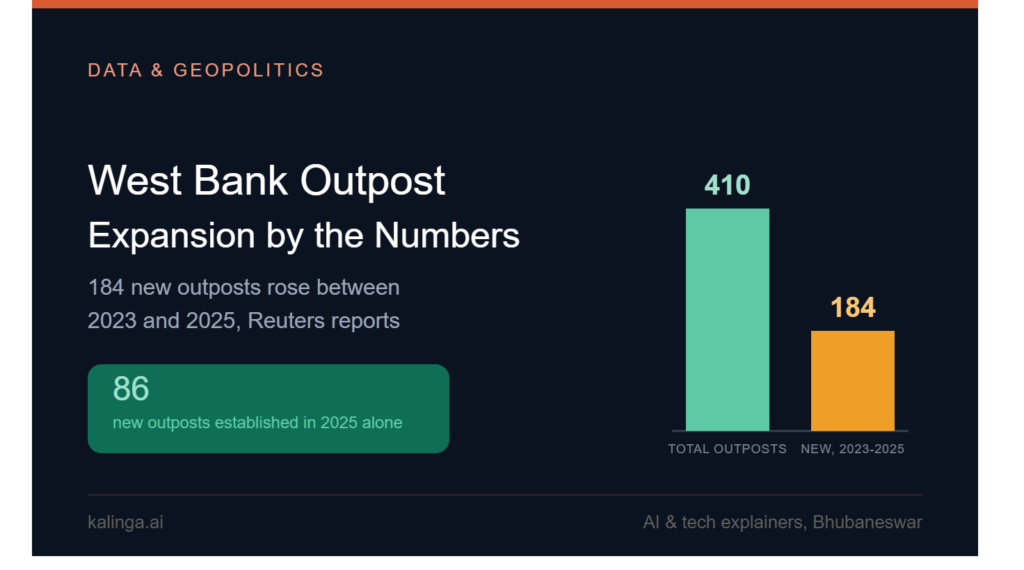
The West Bank is seeing a rapid expansion of Israeli settler outposts, particularly farm-based communities that can begin with little more than a few buildings and livestock. Reuters reports that the Libi brothers have helped establish at least nine new farming outposts, while Peace Now estimates that settlers established 184 unauthorized outposts between 2023 and 2025.
Definition: What is a settler outpost?
A settler outpost is a settlement site established without the advance authorization required under Israeli law in areas of the West Bank under Israeli administrative control.
These sites can begin on a much smaller scale than conventional settlements. A prefabricated house, a livestock enclosure, fencing and access roads can create a physical presence on land before a larger permanent community develops.
Reuters reports that there are about 410 total outposts, according to Peace Now and the West Bank Palestinian government. Peace Now says 86 new outposts were established in 2025 alone, while Reuters independently corroborated a sample of 30 through visits and satellite imagery.
Question → Why is this important?
The significance is not simply the number of buildings. The West Bank settler land grab described by Reuters involves changing who can physically access and use large areas of land, sometimes before formal legal recognition occurs.
Peace Now and Kerem Navot say the outposts collectively cover nearly one-fifth of West Bank territory, with most of that expansion occurring since the current Netanyahu government took office in 2022.
That makes the issue much larger than individual farms. It is about land access, settlement policy, security, political control and the future geography of the West Bank.
Who Are the Libi Brothers and What Role Do They Play?
Eliav and Harel “Coco” Libi are Israeli settlers who own Libi Construction and Infrastructure, a company involved in construction, infrastructure and settlement-related activities.
Reuters describes the brothers as prominent figures within a hardline settler movement. Their activities extend from agricultural outposts to construction and government contracting.
From farming outposts to a construction network
The brothers’ company is building a factory in Shilo designed to produce prefabricated buildings used in outposts. Reuters reported seeing at least five warehouses, prefabricated houses, construction materials and excavators at the site.
The factory matters because prefabricated structures can make settlement construction faster and less expensive than building conventional neighborhoods from scratch.
The Libi brothers have also been connected to farming outposts across the West Bank. Reuters reported that their broader business activities include quarrying sand, manufacturing cement, constructing roads and settlements, and operating farms.
Question → Why do the Libi brothers matter to this story?
They illustrate how settlement expansion can operate as an ecosystem rather than as isolated acts of construction.
A company can supply buildings and machinery. Farmers can bring livestock. Roads and fences can extend physical control. Government agencies can provide permits, funding or security. Later, an outpost can receive formal recognition and become eligible for further development.
The Reuters investigation does not allege that the Libis themselves were directly responsible for killings or arson. However, it reports that outposts they helped establish have been associated with documented intimidation, violence and displacement.
The company rejected Reuters’ characterization, calling the reporting based on “false claims” and saying it operates according to law and equally toward every religion, race and gender.
How Does the West Bank Settler Land Grab Work?
The West Bank settler land grab described in the Reuters investigation is not necessarily a single event in which land changes ownership overnight. Instead, it can involve a gradual process in which physical presence expands until Palestinian access to surrounding land becomes increasingly restricted.
Definition: What is land-based settlement expansion?
Land-based settlement expansion is the gradual extension of a settlement’s physical and economic footprint through structures, grazing, roads, fencing, agriculture and other infrastructure.
In the West Bank, Reuters reports that some farming outposts use:
- Livestock to graze large areas.
- Fences to define or restrict access.
- Roads to connect remote sites.
- Prefabricated buildings for rapid occupation.
- Agricultural activity to establish an ongoing presence.
- Government permits and grants to support development.
- Security coordination to protect outposts.
- Later government recognition to facilitate permanent expansion.
Question → Can land control expand without an immediate formal eviction?
Yes. Physical access can change even when a traditional property transfer or formal eviction does not occur.
Reuters cites Israeli activist Dror Etkes as estimating that the Libis have restricted Palestinian access to approximately 10,000 hectares, or 25,000 acres, around the Jordan Valley,an area roughly comparable in size to Paris.
The Reuters investigation also describes Palestinian herders who say they experienced intimidation, disruption of electricity and water, livestock intrusion and pressure to leave.
That distinction is important. A land dispute can involve not only who legally owns a parcel but also who can safely reach it, graze animals on it, cultivate it, build on it or remain living nearby.
Why Are Settler Outposts Expanding So Quickly?
Several factors identified in the Reuters investigation help explain the pace of Israeli settlement expansion.
First, farm outposts can be cheaper and faster to establish than conventional settlements. The Farms Association itself says such farms are less expensive than traditional permitted settlements while allowing settlers to secure large areas of land.
Second, political support has become more explicit. Reuters reports that senior Israeli officials have increasingly described farm outposts as strategically important.
Third, an outpost that begins without authorization may eventually receive government recognition. Reuters reported that almost half of the 54 settlements approved by the Israeli government in 2025 were existing outposts that had not previously received approval, according to Peace Now.
The recognition pathway
The difference between an unauthorized outpost and an established settlement is therefore important.
| Stage | Typical characteristics | Potential effect |
| Initial farm/outpost | Few structures, livestock, limited infrastructure | Creates a physical presence |
| Expansion | More buildings, fences, roads and grazing | Increases control over surrounding land |
| Security coordination | Protection or coordination with authorities | Makes the site more sustainable |
| Recognition | Government grants legal status under Israeli law | Enables broader development |
| Settlement growth | Permanent infrastructure and housing | Creates a larger, established community |
Question → Why does retrospective recognition matter?
Recognition can transform an initially unauthorized site into a settlement that can receive additional infrastructure and government support.
Reuters reported that the government had recognized at least three outposts built by the Libis, including one established in 2025. Malachei Hashalom, founded by Eliav Libi in 2015, was retroactively recognized in 2023 and fully legalized in 2026, according to the investigation.
This helps explain why critics describe outposts as potential building blocks for a much larger settlement system.
What Do the Numbers Show About Settlement Growth and Violence?
The expansion of outposts is occurring alongside a sharp increase in reported settler violence.
According to data from the U.N. Office for the Coordination of Humanitarian Affairs cited by Reuters, at least 16 Palestinians were killed and more than 1,100 injured in Israeli settler attacks in 2025, a record in the data cited.
Through August 2026, OCHA data cited by Reuters showed 23 Palestinians killed and more than 1,000 injured in settler attacks.
For comparison, the same data showed one settler killed and 22 settlers injured by Palestinians in 2026.
Key figures at a glance
| Indicator | Reported figure |
| Unauthorized outposts established, 2023–2025 | 184 |
| New outposts established in 2025 | 86 |
| Estimated total outposts | About 410 |
| Palestinians killed in settler attacks, 2025 | At least 16 |
| Palestinians injured in settler attacks, 2025 | More than 1,100 |
| Palestinians killed in settler attacks through Aug. 2026 | 23 |
| Palestinians injured through Aug. 2026 | More than 1,000 |
| Settlers killed by Palestinians in 2026 | 1 |
| Settlers injured by Palestinians in 2026 | 22 |
Question → Why does violence matter when discussing settlement expansion?
Violence can change whether people are able to remain on or access their land. Reuters’ reporting connects outpost expansion with accounts of intimidation and displacement from Palestinian herding communities.
The investigation says at least 434 people, mainly semi-nomadic Bedouin herders, have fled areas near outposts associated with the Libis since 2022, based on a Reuters tally of displacement data gathered by B’Tselem.
Israel’s military has said soldiers are required to stop attacks on Palestinians and their property. A U.N. inquiry cited by Reuters, however, said Israeli forces routinely shielded settler violence in some cases.
How Are the Israeli Government and Military Involved?
One of the most consequential elements of the investigation is the reported relationship between settlers, government agencies and military institutions.
Reuters found that the Israeli government provided the Libis with a factory license, grazing permits and an agricultural grant. Government records reviewed by Reuters show that the Libis’ company and two settlements received 168,586 shekels, about $56,000, between 2021 and 2025, with another 107,357 shekels, about $36,000, approved for 2026.
The Defense Ministry also hired the Libis for work involving heavy machinery, including demolition-related work in Gaza.
Definition: What does “regularization” mean here?
In this context, regularization refers to efforts to establish a new regulatory framework that can give previously unauthorized farm outposts official status, subject to stated conditions.
An Israeli military official told Reuters that regularization involved creating such a framework “subject to strict conditions and security coordination.”
Question → Is the military formally aligned with the Libi brothers?
The Israeli military denied having formal relations with the brothers. However, Reuters reported broader coordination between the military and some farm outposts, while senior military leaders have publicly addressed settler organizations.
At a July 2026 Farms Association security conference, Central Command chief Avi Bluth reportedly described a “huge change” in the military’s perception of farms, saying those coordinating with the army were now viewed positively for security.
In May, Bluth showed reporters a slide stating that 160 farms had been established in coordination with the military.
The military and government did not answer Reuters’ questions about their relationship with the Farms Association.
What Does “Practical Sovereignty” Mean for the West Bank?
The phrase “practical sovereignty” is central to understanding the political dimension of the West Bank settler land grab.
Finance Minister Bezalel Smotrich has described a strategy in which settlements progressively absorb territory without necessarily requiring an immediate formal annexation of the entire West Bank.
In June, Smotrich described this approach as imposing “practical sovereignty” over the West Bank, according to Reuters.
Why this concept matters
Formal annexation is a legal and diplomatic act. Practical control can develop incrementally through settlement construction, roads, agriculture, security arrangements and government recognition.
That is why the debate over outposts is also a debate about the future political map of the region.
Reuters reported that Netanyahu’s government has almost doubled the number of West Bank settlements granted legal status to 231 since 2022, according to Peace Now.
Palestinian officials argue that this expansion makes the creation of an independent and geographically contiguous Palestinian state more difficult.
Israeli supporters of settlement expansion reject that framing and point to historical, biblical and political connections between the Jewish people and the West Bank.
Question → Does settlement expansion automatically mean formal annexation?
No. Settlement expansion and annexation are different political and legal processes.
However, critics argue that extensive settlement growth can produce a situation resembling de facto or “practical” annexation by changing control and access on the ground.
How Did the Farms Association Change the Strategy?
The Farms Association emerged after the 2024 violence surrounding the killing of 14-year-old Israeli settler Benjamin Achimeir.
Its board includes Eliav Libi and other hardline settlers who have faced international sanctions. According to its own description, the organization works with farmers and senior military figures to develop educational farms and encourage military service.
The association openly describes farm outposts as strategically valuable because they can secure large areas of land at lower cost than conventional settlements.
Question → Why is the Farms Association significant?
It represents an attempt to organize farming outposts into a broader institutional system involving education, agriculture, infrastructure and security.
A settler involved with an organization that coordinates settlement activity with the army told Reuters that military attitudes toward these farms changed after the October 7, 2023 attacks, with the army allegedly beginning to guide settlers on where farms should be established.
The Farms Association says government support includes infrastructure, fencing, security and agricultural grants.
This is significant because it potentially moves the model from isolated settler initiatives toward a more coordinated settlement strategy.
How Are Palestinian Communities Being Affected?
The human impact is one of the most important parts of the Reuters investigation.
Near Duma and the Jordan Valley, Palestinian residents described pressure from settlers around newly established outposts. Reuters reported that six families left the area around Mitzpe Michal under duress, according to B’Tselem.
The al-Abayyat family said settlers brought cattle into their garden, deposited rotting dates near their home, played loud music and disrupted water and electricity connections. Reuters also reviewed videos relating to the family’s allegations.
In March, an excavator demolished the family’s home. The Israeli military said the structures had been illegally constructed and that Israeli authorities carried out the demolition while soldiers provided security.
Duma and Giborei David
The situation around Duma has become particularly contentious.
Residents told Reuters that construction of the Giborei David outpost was followed by increased harassment. They said 11 Bedouin herding families were displaced in March and alleged that water resources and electricity infrastructure were affected.
Duma council head Suleiman Dawabsheh also said settlers had confiscated about 700 hectares, or 1,700 acres, of land.
Reuters could not independently verify every allegation, and the Libi company rejected the broader characterization of its activities.
In August, Palestinian resident Thameen Dawabsheh, 35, was fatally shot by an off-duty Israeli soldier during a protest outside Duma. The military said Dawabsheh had thrown stones at Israeli civilians. B’Tselem said the soldier worked as a security guard for Giborei David, although Reuters could not independently confirm the employment relationship.
The Israeli government granted Giborei David official state recognition in March.
What Happened After the Duma Arson Attack?
The history of Duma illustrates how violence can create cycles of retaliation and further political tension.
In 2015, a settler from Adei Ad killed a Palestinian couple and their toddler in an arson attack on their Duma home. The attacker was later convicted of murder and received three consecutive life sentences.
Israel subsequently legalized Adei Ad.
A later episode in 2024 began when 14-year-old Benjamin Achimeir was killed while herding sheep. Israeli investigators charged Ahmed Dawabsheh, a 21-year-old Duma resident, with the killing and said he was inspired by Islamic State. Reuters said it could not establish Dawabsheh’s plea or current case status.
The killing triggered revenge attacks by settlers in Palestinian villages including Duma. The U.N. and Amnesty International said four Palestinians, including a child, were killed and dozens of homes were burned.
The Israeli military detained six settlers after the attacks, but Reuters reported they were released within months without charge.
These episodes show why settlement expansion and violence cannot easily be examined as separate issues. Each new outpost can alter local access to land, while each violent incident can deepen mistrust and trigger further confrontation.
Why Are International Sanctions Increasing?
The international response has also intensified.
In May and June 2026, Australia, Canada, France, Norway and the United Kingdom imposed coordinated sanctions on the Libi brothers, accusing them of illegal land seizure and facilitating settler violence, according to Reuters.
The United Kingdom had previously sanctioned Harel Libi and imposed an asset freeze on Coco’s Farm.
The United States had imposed sanctions on extremist settlers under President Joe Biden, but President Donald Trump’s administration lifted those sanctions in 2025, according to Reuters. The Trump administration has also softened the longstanding U.S. position on Israeli settlements and international law.
Question → What do sanctions actually do?
Sanctions can restrict financial transactions, freeze assets and increase the economic and diplomatic costs associated with targeted individuals or organizations.
They do not, by themselves, resolve disputes over land or settlement policy.
The UK also sanctioned the Farms Association and Ahavat Gilad, an organization that the Farms Association says operates and manages it.
At the same time, Reuters reported that Israel’s National Security Ministry approved a project with Ahavat Gilad worth up to 8 million shekels, about $2.6 million, over three years. The ministry said the project was intended to reduce violence among young settlers and promote positive activities and military enlistment.
This creates a striking policy contrast: some Western governments are imposing sanctions over settler activity while an Israeli government ministry is funding an organization linked to the settler movement.
What Does the Libi Family’s Business in Gaza Add to the Story?
The Libi family’s activities also extend beyond the West Bank.
Reuters reported that Libi Construction and Infrastructure supplied excavators, bulldozers and drivers to the Israeli military in Gaza in 2025, when the military was using civilian contractors for demolition work.
Human rights organizations have argued that the systematic destruction of civilian property violated the rules of war. Israel’s military has said such demolition was necessary to clear booby traps and enable military operations.
Eliav Libi told a settler conference that he operated bulldozers in Gaza alongside his 19-year-old son, David.
David Libi was killed by an explosion while operating heavy machinery in Gaza on May 29, 2025, according to an Israeli government statement. Hamas said it had attacked the machine with an explosive device.
After his son’s death, Eliav said he accelerated his work establishing and expanding outposts.
Question → Why is the Gaza connection relevant?
It demonstrates the breadth of the Libi family’s construction and heavy-equipment operations and connects their commercial activity to both Gaza and the West Bank.
However, the two contexts are different. The Gaza work occurred during a war, while the West Bank activity concerns settlement expansion and control over land under military occupation.
Keeping those contexts separate is essential to understanding the Reuters investigation accurately.
What Could the West Bank Settler Land Grab Mean for Palestinian Statehood?
The central political question is whether continued settlement expansion will make a negotiated two-state solution increasingly difficult.
The West Bank is not simply an empty geographical space. Palestinian towns, villages, agricultural areas and herding communities are spread across it, while Israeli settlements and outposts increasingly create additional layers of infrastructure and territorial control.
If settlements expand across strategically important areas, critics argue that it becomes harder to create a contiguous Palestinian state.
Britain’s Foreign Office said settler violence and illegal settlement expansion “seriously undermine the prospects for a two-state solution.”
Palestinian official Wasel Abu Yousef similarly told Reuters that settlement expansion was intended to hinder the establishment of an independent and geographically contiguous Palestinian state.
Israeli leaders supporting settlements offer a different interpretation, emphasizing Jewish historical, biblical and political ties to the West Bank and describing settlement communities as part of Israel’s security and national future.
Three possible consequences
- Greater territorial fragmentation: More settlements and outposts could make geographic continuity harder to achieve.
- More local friction: Expanded settlement footprints can increase encounters between settlers and Palestinian farmers or herders.
- Greater international pressure: Continued expansion and violence may lead to additional sanctions or diplomatic disputes.
The key point is that the West Bank settler land grab is not only a question about individual farms. It is connected to the larger dispute over sovereignty, borders and competing national claims.
Key Takeaways From the 2026 Reuters Investigation
The Reuters investigation highlights several developments that help explain the current situation:
- The number of outposts has grown rapidly. Peace Now counted 184 unauthorized outposts established from 2023 through 2025.
- Farm-based settlement is a central strategy. Livestock, fences, roads and prefabricated buildings can establish a physical presence quickly.
- The Libi brothers are prominent participants. Reuters links them to at least nine new farming outposts and a construction network.
- Government recognition can change an outpost’s trajectory. Some sites initially established without approval have subsequently received official status.
- Violence and displacement are major concerns. OCHA data cited by Reuters recorded 23 Palestinian deaths and more than 1,000 injuries from settler attacks through August 2026.
- Military-settler coordination has become more visible. Senior military officials have publicly discussed farm outposts and security coordination.
- International governments are divided in their response. Several Western countries sanctioned the Libis, while Israeli ministries continued supporting organizations connected to the settler movement.
- The political stakes extend beyond individual communities. Settlement expansion is increasingly tied to arguments over Palestinian statehood and possible de facto annexation.
FAQ: West Bank Settler Land Grab Explained
What is the West Bank settler land grab?
The West Bank settler land grab refers to the reported expansion of Israeli settlement and farm outpost activity into areas where Palestinians live, farm or herd livestock. Reuters’ investigation describes a gradual process involving buildings, livestock, fencing, roads, infrastructure, government support and, in some cases, later official recognition.
Who are the Libi brothers?
Eliav and Harel “Coco” Libi are Israeli settlers who own Libi Construction and Infrastructure. Reuters reports that they have helped establish at least nine farming outposts and operate a broader construction and infrastructure business connected to settlement activity.
How many settler outposts are there in the West Bank?
Peace Now and the West Bank Palestinian government estimate that there are about 410 total outposts. Peace Now says settlers established 184 unauthorized outposts between 2023 and 2025, including 86 in 2025 alone.
How does a farm outpost expand?
A farm outpost can begin with a small number of structures and livestock. Over time, settlers can add fencing, roads, additional prefabricated buildings and agricultural infrastructure, while security coordination or government recognition may make further development possible.
What is “practical sovereignty” in the West Bank?
“Practical sovereignty” is a term used by Israeli Finance Minister Bezalel Smotrich to describe increasing Israeli control over the West Bank through settlement development and related measures. It refers to establishing control on the ground without necessarily relying on immediate formal annexation.
Why is settlement expansion controversial?
Settlement expansion is controversial because it affects land access, Palestinian communities, Israeli security, international diplomacy and the prospects for a two-state solution. The United Nations and many European countries condemn Israeli settlements, while Israeli supporters cite historical, biblical and political claims to the West Bank.
Conclusion: Why This Story Matters
The West Bank settler land grab is best understood not as a single construction project but as a broader process involving agriculture, infrastructure, government policy, security coordination, displacement and political strategy. The Libi family’s activities provide Reuters with one detailed case study of how that system can operate on the ground.
For readers trying to understand the wider Israel-Palestinian conflict, the key question is no longer simply how many settlements exist. It is how rapidly new outposts are changing land access and political realities across the West Bank,and what that could mean for the region’s future.
For more clear, accessible explainers on geopolitics, technology and the forces shaping today’s world, keep exploring Kalinga.ai.