What Is Project Zorawar and Why Is Tata’s Light Tank Bid Important?
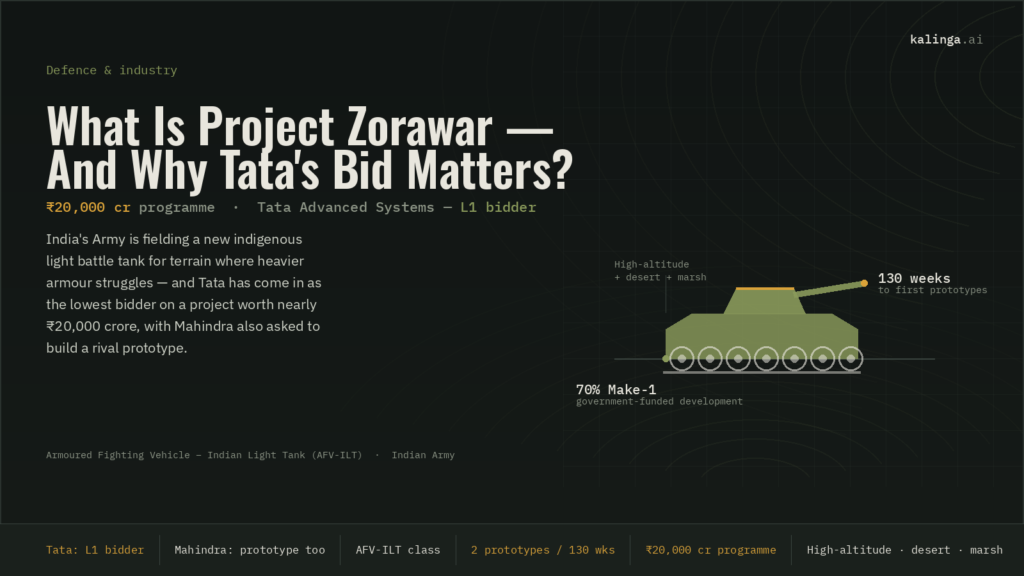
What happens when a conventional battle tank is simply too heavy for the battlefield it needs to reach? Project Zorawar is India’s answer: a new light battle tank programme designed for challenging terrain, with Tata Advanced Systems Ltd (TASL) emerging as the lowest bidder for a project valued at nearly ₹20,000 crore.
According to the Economic Times, TASL has been selected after a three-year technical and commercial evaluation process and will move towards developing and demonstrating two prototypes within 130 weeks. Mahindra Defence Systems, which emerged as the second-lowest bidder, will also be invited to develop a prototype.
The significance goes beyond one defence contract. Project Zorawar represents the Indian Army’s push for a new class of lighter, more mobile armoured vehicles and marks a major opportunity for India’s private defence industry.
Project Zorawar: What Is the Indian Army Building?
Project Zorawar is an Indian Army programme to develop an indigenous light battle tank capable of operating across high-altitude areas as well as marshlands and deserts.
Unlike traditional main battle tanks, which are generally designed around heavy armour and firepower, a light tank places greater emphasis on mobility, deployability and the ability to operate where heavier vehicles face limitations.
The Economic Times reports that the programme involves an Armoured Fighting Vehicle-Indian Light Tank (AFV-ILT). The platform is intended to give the Army an armoured capability that can function in environments where terrain, altitude and infrastructure can complicate the deployment of heavier systems.
Why does India need a light tank?
The basic problem is mobility.
A modern armoured vehicle needs to combine protection and firepower with the ability to actually reach and operate in the area where it is required. Extremely mountainous terrain creates a different set of requirements from the plains, deserts or conventional armoured warfare environments.
Question: Why can’t India simply use existing main battle tanks everywhere?
Because different operational environments place different demands on military vehicles. A lighter platform can potentially offer advantages in mobility and deployment in terrain where a heavier tank may be less practical.
That is the strategic thinking behind Project Zorawar.
Where is the Zorawar light tank expected to operate?
The AFV-ILT is being developed for multiple demanding environments rather than a single battlefield type.
The reported requirements include:
- Very high-altitude terrain
- Marshlands
- Desert environments
- Difficult terrain where mobility is especially important
- Operational conditions requiring rapid deployment of armoured capability
This makes the programme more than a conventional replacement exercise. It is an attempt to develop a platform around specific Indian operational requirements.
Tata Emerges as the Lowest Bidder for Project Zorawar
The biggest immediate development is that Tata Advanced Systems Ltd has emerged as the lowest bidder for Project Zorawar.
In government procurement, the lowest bidder is commonly referred to as L1, meaning the bidder offering the lowest evaluated commercial bid after meeting the required technical conditions.
Definition — L1 bidder: The L1 bidder is the technically qualified participant whose evaluated commercial offer is the lowest in a competitive procurement process.
Being L1 does not automatically mean the company has completed the entire programme. In the case of Project Zorawar, the next phase involves prototype development and demonstration before the programme can progress towards production.
According to the Economic Times, TASL is expected to develop and demonstrate two prototype tanks within 130 weeks.
What does Tata’s selection mean?
For Tata, the programme represents a significant step deeper into India’s tracked and armoured defence systems.
The company already has experience supplying defence equipment, including tactical trucks and infantry fighting vehicles, according to the Economic Times. The light tank programme would take that experience into a more complex category: tracked, armoured combat vehicles.
The report also states that Tata is understood to have offered a tank featuring an indigenous turret system and self-developed loitering munitions.
Question: Has Tata already received a final production contract?
Not yet. The current development is the progression of the procurement process towards the prototype and production stages. The Economic Times reports that the programme has moved towards the stage of issuing a Production Order (PO) after objections to the earlier selection process were examined and found to be invalid.
Why Will Mahindra Also Develop a Prototype?
One of the interesting aspects of Project Zorawar is that Tata’s L1 status does not mean Mahindra Defence Systems disappears from the programme.
Mahindra Defence Systems emerged as the second-lowest bidder and will also be invited to develop a prototype.
That approach gives the Army an opportunity to evaluate competing indigenous designs rather than relying entirely on a single prototype architecture.
Why are competing prototypes useful?
Defence equipment is ultimately judged by how well it performs against demanding operational requirements.
A prototype allows the Army to evaluate factors such as:
- Mobility
- Reliability
- Firepower
- Protection
- Performance at altitude
- Ability to operate across different terrain
- Maintainability
- Integration of onboard systems
Question: Why develop more than one prototype if Tata is L1?
Because a prototype is not merely a commercial quotation. It is a physical demonstration of whether the proposed design can meet the Army’s operational requirements.
For a complex platform such as a light tank, testing and evaluation are therefore critical.
Why Project Zorawar Is Different From a Conventional Tank Programme
The most important word in the programme may be light.
A light tank has to balance several characteristics that can work against one another. Adding protection can increase weight. Increasing weight can affect mobility. More equipment can increase complexity. And operating at high altitude introduces additional engineering challenges.
High-altitude mobility
Operating at very high altitude can be demanding for military equipment.
Vehicles need to function despite challenging terrain and environmental conditions, while the available infrastructure for moving and maintaining heavy equipment can also be limited.
That makes mobility a central consideration for Project Zorawar.
A successful light tank needs to provide meaningful armoured capability without becoming so heavy that it loses the mobility advantages for which it was designed.
Versatility across terrain
The Army’s reported requirement extends beyond mountains.
The AFV-ILT is expected to be capable of operating in marshlands and deserts as well. This creates a broader engineering challenge because terrain characteristics can vary dramatically.
A platform designed for only one environment could have limited utility. A platform capable of handling several difficult environments could provide greater operational flexibility.
Question: Is Project Zorawar only about mountain warfare?
No. Although high-altitude operations are a major reason for the programme, the reported requirement also covers marshlands and deserts. The objective is a versatile light armoured platform rather than a vehicle limited to one terrain type.
How the ₹20,000-Crore Project Will Move Forward
The reported value of Project Zorawar is nearly ₹20,000 crore, making it one of the more significant Indian private-sector defence development programmes.
However, the figure should not be interpreted as simply the price of a batch of finished tanks. The programme involves development, prototyping, evaluation and eventually production.
What is the Make-1 policy?
Make-1 is a defence procurement category under which the government provides funding support for the development of indigenous defence equipment.
Under the arrangement described by the Economic Times, the government can provide 70% funding for project development.
That model is particularly important for advanced defence technologies because companies face significant costs before a production-ready system exists.
Government-backed development funding can reduce the financial burden on private companies while helping India build domestic technological capabilities.
The 130-week prototype target
The next major milestone for TASL is the development and demonstration of two prototypes within 130 weeks.
That timeline makes prototype execution one of the most important stages of the programme.
The prototypes will have to move the concept from engineering plans into functioning vehicles capable of undergoing military evaluation.
Question: What happens during prototype development?
The manufacturer develops the proposed vehicle, integrates its major systems and prepares it for testing. The Army can then evaluate whether the platform satisfies the technical and operational requirements specified for the programme.
Tata vs Mahindra: What the Two Private Defence Players Bring
The presence of both Tata and Mahindra highlights how India’s defence industry has evolved beyond the traditional public-sector model.
| Factor | Tata Advanced Systems | Mahindra Defence Systems |
| Project position | Lowest bidder (L1) | Second-lowest bidder |
| Project role | Develop and demonstrate prototypes | Also invited to develop a prototype |
| Defence sector | Established private-sector defence player | Established private-sector defence player |
| Project objective | Indigenous light battle tank | Competing indigenous prototype |
| Key requirement | High-altitude and multi-terrain capability | High-altitude and multi-terrain capability |
The important point is that Project Zorawar is not simply a Tata-versus-Mahindra contest.
It is also a test of whether India’s private defence ecosystem can design, engineer, test and eventually manufacture a sophisticated tracked combat platform.
Why private-sector participation matters
For decades, India’s defence manufacturing ecosystem was heavily associated with government-owned organisations.
Private companies now have a growing role in areas ranging from vehicles and electronics to aerospace and weapons systems.
Project Zorawar takes that trend into a particularly demanding category: an indigenous armoured combat vehicle.
What Project Zorawar Means for India’s Private Defence Industry
The programme could become an important reference point for India’s broader defence-manufacturing ambitions.
Building a tank is significantly more complicated than assembling a commercial vehicle. It requires the integration of armour, mobility systems, weapons, sensors, communications and other military subsystems.
Success therefore depends on the wider industrial ecosystem, not only the prime contractor.
That can create opportunities for Indian companies involved in:
- Automotive engineering
- Advanced materials
- Electronics
- Sensors
- Communications
- Power systems
- Manufacturing
- Software
- Defence testing
- Maintenance and logistics
Question: Could Project Zorawar create opportunities beyond Tata and Mahindra?
Potentially, yes. Complex defence platforms typically depend on networks of suppliers and specialised technology providers. The scale of the programme could therefore contribute to a broader domestic industrial ecosystem, although the specific supplier opportunities and production arrangements will depend on later stages of the programme.
Why Indigenous Light Tanks Matter for India’s Military Technology
There is another important dimension to Project Zorawar: technological self-reliance.
India has been attempting to increase domestic defence production and reduce dependence on imported systems. Developing an advanced light tank domestically can contribute to that objective if the programme successfully progresses from prototype to production.
But indigenous development is not simply about replacing an imported product.
The bigger advantage is the ability to develop technology around India’s own operational requirements.
For example, an Indian-designed vehicle can be engineered from the beginning around the Army’s requirements for high-altitude operations rather than adapting a platform created for a completely different environment.
From vehicle to technology ecosystem
A modern combat vehicle is essentially a highly integrated technology platform.
It combines mechanical engineering with electronics, computing, communications, sensors and weapons systems.
That makes Project Zorawar relevant even to students and young professionals interested in technology careers.
The programme potentially touches disciplines such as:
- Mechanical engineering
- Electronics engineering
- Embedded systems
- Robotics
- Artificial intelligence
- Computer vision
- Materials science
- Automotive engineering
- Systems engineering
- Cybersecurity
The tank itself may be the most visible part of the project, but the technology ecosystem behind it is much larger.
What Happens After the Prototype Stage?
The prototype milestone is only one part of the journey.
Once prototypes are developed, they can undergo evaluation to determine whether they meet the Army’s requirements. Depending on the outcome, the programme can progress through subsequent procurement and production decisions.
This distinction matters because being the lowest bidder is not the same as having a fully operational tank in Army service.
The path from bid to battlefield capability can involve engineering development, testing, modifications, qualification and production.
A simplified Project Zorawar pathway
- Competitive procurement: Companies submit technical and commercial proposals.
- Bid evaluation: The proposals are assessed against the programme’s requirements.
- L1 selection: TASL emerges as the lowest bidder.
- Prototype development: TASL is expected to develop and demonstrate two prototypes.
- Parallel prototype: Mahindra Defence Systems will also develop a prototype.
- Testing and evaluation: The Army assesses the platforms against operational requirements.
- Further procurement decisions: Successful completion can lead to subsequent production steps.
Question: When will the Indian Army receive production Zorawar tanks?
The information currently reported does not establish a final induction date. The immediate milestone is prototype development and demonstration, with TASL expected to complete two prototypes within 130 weeks.
Why the Tata Selection Is a Bigger Story Than One Defence Contract
At first glance, the headline is straightforward: Tata has emerged as the lowest bidder for a nearly ₹20,000-crore light tank project.
But the underlying story is about how India builds sophisticated defence technology.
The programme brings together three major themes: the Army’s need for specialised armoured mobility, India’s push for indigenous defence production, and the expanding role of private-sector companies in military technology.
For Tata, it represents an opportunity to move further into tracked armoured platforms.
For Mahindra, the parallel prototype provides another route to demonstrate private-sector engineering capability.
For the Indian defence ecosystem, the programme creates a real-world test of whether domestic industry can deliver a complex military platform from development through evaluation and eventually production.
And for India’s technology workforce, it shows that modern defence engineering is no longer only about metallurgy and mechanical systems. It increasingly involves software, sensors, electronics, communications, autonomy and systems integration.
The Bottom Line on Project Zorawar
Project Zorawar is India’s effort to develop a new indigenous light battle tank for demanding environments, particularly very high-altitude terrain, while retaining versatility across marshlands and deserts.
Tata Advanced Systems has emerged as the lowest bidder in the nearly ₹20,000-crore programme, while Mahindra Defence Systems will also develop a prototype.
The immediate focus is now on turning competing designs into functioning prototypes. TASL is expected to develop and demonstrate two prototypes within 130 weeks.
The bigger question is what happens after testing. If the programme successfully moves into production, Project Zorawar could become a landmark example of India’s private defence industry delivering a sophisticated tracked combat platform for the Indian Army.
FAQ: Project Zorawar Light Tank
What is Project Zorawar?
Project Zorawar is an Indian Army programme to develop an indigenous light battle tank, formally described as an Armoured Fighting Vehicle-Indian Light Tank (AFV-ILT). The vehicle is intended to operate in very high-altitude areas as well as marshlands and deserts.
Who is the lowest bidder for Project Zorawar?
Tata Advanced Systems Ltd (TASL) has emerged as the lowest bidder for Project Zorawar. The Economic Times reported that TASL beat four other entities in the technical and commercial competition.
How much is Project Zorawar worth?
The Project Zorawar programme is valued at nearly ₹20,000 crore, according to the Economic Times. The programme includes development of an indigenous light battle tank and subsequent stages associated with procurement and production.
Will Mahindra develop a Zorawar tank prototype?
Yes. Mahindra Defence Systems, which emerged as the second-lowest bidder, will also be invited to develop a prototype. This allows the Army to evaluate competing indigenous approaches to the light-tank requirement.
How long does Tata have to develop the prototypes?
Tata Advanced Systems is expected to develop and demonstrate two prototype tanks within 130 weeks as the programme moves into its next major phase.
What is the Make-1 policy in Project Zorawar?
The Make-1 policy provides government funding support for indigenous defence development. In the arrangement reported for Project Zorawar, the government can provide 70% funding for project development, helping companies finance the costly development and prototyping phase.
keep exploring kalinga.ai for more.