RCS Pricing for Businesses in India: How Jio and Apple Are Challenging WhatsApp
If a company sends you an OTP, delivery update or promotional message on your phone, the next big battle may be happening inside your regular messaging app rather than WhatsApp.
The new RCS pricing for businesses in India marks a major shift in business messaging, with Reliance Jio introducing separate rates for marketing, transactional and OTP messages as Apple expands RCS support to iPhone users. The development effectively brings Apple into India’s business messaging market and creates a stronger competitive alternative to WhatsApp’s established position.
Businesses using Jio’s network will pay different rates depending on the type of RCS message, with new charges taking effect from September 1, 2026, according to emails seen by The Economic Times.
The move also matters because RCS is no longer limited to basic person-to-person texting. Businesses can use it for richer communication, while Apple, Google and telecom operators are building an ecosystem that could make RCS more important across both Android and iPhone users.
What Is Changing With RCS Pricing for Businesses in India?
The biggest change is that Jio has moved away from a single flat RCS business-message price and introduced separate pricing categories.
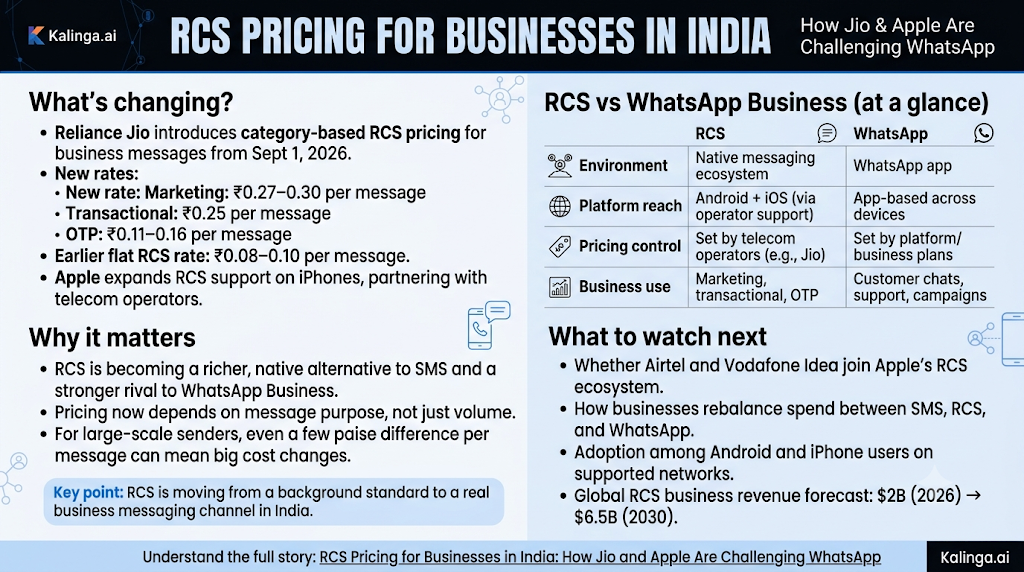
According to The Economic Times report, businesses will pay Rs 0.27–0.30 per marketing message, Rs 0.25 per transactional message, and Rs 0.11–0.16 per OTP message from September 1.
Previously, RCS pricing was reportedly around Rs 0.08–0.10 per message on a flat basis.
That means businesses could see significantly different costs depending on the category of message they send.
Question: What is the biggest change in India’s RCS business messaging market?
Jio is introducing category-based pricing for business RCS messages, while Apple is expanding RCS support on iPhones in partnership with telecom operators. Together, these developments could make RCS a much stronger competitor to established business messaging platforms.
The change is important for companies that send messages at scale, because even a difference of a few paise per message can become significant when millions of communications are sent.
The new pricing structure
| RCS message type | New Jio pricing | Typical business purpose |
| Marketing | Rs 0.27–0.30 | Promotions and campaigns |
| Transactional | Rs 0.25 | Order or service updates |
| OTP | Rs 0.11–0.16 | One-time passwords and verification |
| Earlier flat pricing | Rs 0.08–0.10 | Earlier RCS business messaging model |
The figures above come from the pricing details reported by The Economic Times based on emails seen by the publication.
Why Are Reliance Jio and Apple Entering Business Messaging?
For years, businesses in India have relied heavily on messaging platforms to communicate with customers. WhatsApp has become especially important for two-way communication, customer engagement and business interactions.
RCS offers another route.
The technology allows richer messages to be delivered through the native messaging environment on supported smartphones. Instead of requiring customers to install another application, RCS can operate through the phone’s messaging infrastructure.
Apple’s participation is particularly significant because iPhones previously had a more limited relationship with RCS.
The Economic Times reported that Apple and Google had made RCS interoperable between iOS and Android globally, while Apple’s business RCS rollout is expanding through partnerships with local telecom operators.
Question: Why does Apple’s entry matter so much?
Apple brings iPhone users into the expanding RCS ecosystem, giving businesses a potential way to reach customers across Android and iOS through a common messaging standard. This strengthens RCS as a cross-platform alternative to app-based messaging services.
Jio’s role is equally important in India because of its enormous subscriber base.
The report says Jio has more than 533.3 million subscribers, giving it the scale to potentially accelerate RCS adoption among Indian mobile users.
What Is RCS and How Does Business Messaging Work?
Before looking at RCS pricing for businesses in India, it helps to understand what RCS actually means.
RCS, or Rich Communication Services, is a messaging standard designed to upgrade traditional SMS with richer communication features.
RCS was developed by the global telecom industry body GSMA in 2007. Unlike traditional SMS, which is primarily text-based, RCS can support features such as read receipts, file sharing, group chats, location sharing and encryption.
For consumers, that can make messaging feel more like a modern internet-based communication service.
For businesses, the possibilities are even more interesting.
A company could use business RCS for marketing messages, transactional updates and OTPs. The message can potentially provide a richer interaction than conventional SMS, depending on the implementation and supported features.
What does A2P messaging mean?
The term A2P, or application-to-person messaging, refers to messages sent by an application or business system to an individual user.
Examples include:
- An online retailer sending an order confirmation.
- A bank sending a verification code.
- A travel company sending a booking update.
- A business sending a promotional campaign.
- A service provider sending an account notification.
The distinction matters because the new pricing announced by Jio specifically applies to business communications rather than ordinary person-to-person messaging.
Question: Is RCS simply an upgraded version of SMS?
RCS was designed to upgrade SMS with richer capabilities, but its ecosystem can support much more interactive communication than traditional text messaging. Business RCS can support different categories of communications, including marketing, transactional and OTP messages.
How Much Will Businesses Pay for RCS Messages?
The new RCS pricing for businesses in India introduces three major categories.
Marketing messages will cost Rs 0.27–0.30 per message. Transactional messages will cost Rs 0.25, while OTP messages will cost Rs 0.11–0.16.
These prices apply to Jio’s newly announced business RCS structure from September 1, according to the report.
The difference from the previous pricing model is substantial.
Under the earlier reported flat pricing of Rs 0.08–0.10 per message, businesses had a relatively straightforward cost structure. The new system makes the cost dependent on the purpose of the communication.
Question: How much more expensive can the new RCS pricing become?
The Economic Times reported that the new rates represent an increase ranging from about 10% to nearly 300%, depending on the message category and the earlier price paid.
This makes the financial impact highly dependent on how a business uses RCS.
A company sending mostly OTPs may face a different increase from a company running large promotional campaigns.
Why message category matters
Consider a business that communicates with customers in three ways:
Marketing: promotional offers, campaigns and advertisements.
Transactional: order confirmations, service updates and other non-promotional information.
OTP: one-time passwords used for authentication and verification.
Each category now has its own pricing range.
That structure gives telecom operators more flexibility to price different kinds of business traffic according to their commercial strategy.
Why Has Jio Introduced Different RCS Pricing Categories?
The shift to category-based pricing is significant because it moves RCS business messaging closer to a differentiated commercial model.
Not every business message has the same purpose or value to a company. An OTP is primarily a security or verification message, while a marketing message is designed to generate engagement or sales.
Jio’s new structure reflects that difference.
Question: Why are marketing, transactional and OTP messages priced differently?
The new structure separates business communications by purpose, allowing Jio to apply different rates to different types of RCS traffic. The report does not state that Apple or Google set these prices; instead, RCS commercial tariffs are determined largely by telecom operators.
This distinction is crucial.
Apple and Google are helping establish and expand the RCS ecosystem, but telecom carriers determine the commercial pricing in their respective markets.
Who sets RCS prices?
The Economic Times reported that Apple and Google do not set commercial RCS tariffs. Pricing is largely governed by telecom operators and can vary between markets based on competitive conditions.
That means India’s RCS pricing can develop differently from pricing in the United States, United Kingdom or European markets.
How Does RCS Compare With WhatsApp Business Messaging?
WhatsApp has become a major channel for business communication in India. Its strength comes from its enormous user base and the familiarity consumers already have with the platform.
RCS approaches the problem differently.
Instead of requiring users to communicate with a business through a separate messaging application, RCS is integrated into supported messaging infrastructure.
| Feature | RCS Business Messaging | WhatsApp Business Messaging |
| Core environment | Native messaging ecosystem | WhatsApp app |
| Cross-platform potential | Android and iOS through RCS support | WhatsApp across supported devices |
| Business messages | Marketing, transactional, OTP | Business communication and customer engagement |
| Telecom operator role | Central to RCS delivery and pricing | Less central to the app experience |
| App requirement | Designed around native messaging | Requires WhatsApp |
| Pricing model | Carrier-dependent | Platform/business pricing structure |
| Current Indian momentum | Accelerating with operator support | Already highly established |
The comparison does not mean RCS will immediately replace WhatsApp.
Instead, businesses could increasingly consider multiple messaging channels depending on their customer base and communication goals.
Question: Is RCS going to replace WhatsApp in India?
Not necessarily. The development creates stronger competition, but WhatsApp already has a deeply established business messaging ecosystem. RCS’s long-term impact will depend on adoption, pricing, reliability, features and how businesses and consumers respond.
The real change is that businesses may have another powerful channel to evaluate.
Why Is Apple’s RCS Entry Important for iPhone Users?
Apple’s role changes the potential scale of RCS.
Historically, messaging ecosystems were fragmented. Apple users had iMessage, Android users had different messaging experiences, and businesses often relied on SMS or third-party platforms to reach customers.
RCS is designed to make messaging more interoperable.
The Economic Times reported that Apple has been gradually enabling business RCS across markets including the US, UK, Germany, France and Spain, working with local telecom operators.
India is now becoming part of that broader expansion.
Question: What does Apple’s RCS support mean for Indian iPhone users?
It means businesses can potentially use RCS to send supported business communications to iPhone users on participating networks, expanding RCS beyond Android-focused communication.
The exact experience depends on device, carrier and service support, but Apple’s participation makes the standard more strategically important.
Will Airtel and Vodafone Idea Join Apple’s RCS Ecosystem?
Jio has taken the first major step in India by announcing its RCS pricing for businesses.
According to the report, Vodafone Idea and Bharti Airtel are also expected to join the Apple RCS ecosystem soon.
If that happens, RCS business messaging could become significantly broader across Indian telecom networks.
The importance of this development is easy to understand: businesses do not want to build messaging strategies around a channel that reaches only a small portion of their customers.
Broader operator participation makes a messaging standard more useful.
Question: Why would Airtel and Vodafone Idea joining matter?
Their participation could expand the number of Indian mobile users reachable through Apple’s RCS ecosystem and make RCS more attractive to businesses seeking broad network coverage.
However, the report says the two operators were expected to join; their future participation should not be treated as a completed rollout unless officially confirmed.
Why India Is Becoming a Major RCS Market
India is emerging as a particularly important market for RCS because of its enormous mobile-user base and rapidly expanding digital economy.
The Economic Times reported that RCS adoption is accelerating in India, which is emerging as the leading market for the service by volume.
Jio’s scale is one of the major reasons.
With a reported subscriber base of more than 533.3 million, Jio can potentially expose a huge number of users to RCS-enabled services.
For businesses, scale matters enormously.
A messaging technology becomes more useful when customers can receive it without downloading a new application or changing their normal communication habits.
Question: Why could India become a major RCS business market?
India combines a huge mobile-user base with widespread digital commerce and a large telecom market, while operator support is expanding RCS availability. The Jio-Apple partnership could therefore help push business RCS adoption at significant scale.
What Does the Shift Mean for Businesses?
The new RCS pricing for businesses in India means companies need to think about messaging not only as a technical channel but also as a cost decision.
Businesses that send millions of messages cannot ignore per-message pricing.
A difference of even a few paise can become meaningful when multiplied across large volumes.
At the same time, price is only one factor.
Companies will also care about whether RCS messages reach customers reliably, whether users interact with them, what features are available and whether the channel provides better engagement than conventional SMS or competing platforms.
Businesses will need to evaluate:
- Message cost: How much each category costs.
- Message volume: How many communications the company sends each month.
- Audience reach: Which customers can receive RCS messages.
- Device support: Whether customers use compatible Android or iOS devices and networks.
- Message purpose: Whether communications are marketing, transactional or OTP.
- Customer engagement: Whether richer messages produce better interactions.
- Alternative channels: Whether WhatsApp, SMS or other platforms remain more effective.
Question: Should every business immediately move its messaging to RCS?
No. Businesses should evaluate RCS alongside existing channels based on reach, cost, customer behaviour and communication requirements. The new pricing makes that comparison particularly important for companies with high message volumes.
What Does RCS Mean for Consumers?
For consumers, the competition could ultimately be beneficial if it results in better messaging experiences.
RCS is designed to provide features that traditional SMS does not offer, including read receipts, file sharing, group chats, location sharing and encryption.
That can make business messages feel less like one-way alerts and more like interactive digital communications.
Imagine receiving an order update where the message itself provides richer information instead of simply telling you to visit a website.
The exact features available depend on implementation and support, but the underlying goal is to modernise the basic messaging experience.
Question: Will consumers have to pay for RCS business messages?
The pricing discussed in this development is a business-side messaging tariff charged for business traffic, rather than a consumer fee for receiving an ordinary business message.
For users, the more visible change may instead be the type and quality of messages they receive.
Could RCS Become a Stronger WhatsApp Competitor?
The combination of Apple, Google and telecom operators gives RCS a potentially powerful structure.
Google has already supported RCS across Android, while Apple is expanding support for the standard on iPhones. Telecom operators provide the network infrastructure and determine commercial tariffs.
That creates a three-part ecosystem:
Apple + Google + telecom operators = broader RCS reach and infrastructure.
WhatsApp operates differently because Meta controls the application and its messaging environment.
This does not guarantee that RCS will defeat WhatsApp.
WhatsApp already benefits from strong consumer familiarity and established business adoption. RCS, however, has an important advantage in its connection to the phone’s native messaging experience.
Question: Why is the Jio-Apple partnership being viewed as a challenge to WhatsApp?
Because it expands the possibility of rich business messaging across both iPhone and Android ecosystems without depending exclusively on a third-party messaging app. The competitive impact will depend on adoption, pricing, features and business participation.
What Does the Global RCS Business Market Look Like?
The Indian development is part of a larger global expansion.
According to a recent Juniper Research study cited by The Economic Times, telecom operators are expected to generate $2 billion globally from RCS business traffic in 2026, compared with $1.2 billion in 2025.
The same forecast puts the annual figure at $6.5 billion by 2030.
The growth is expected to be driven by several factors, including Apple’s implementation of business RCS on iPhones, increasing support from mobile operators and changing pricing strategies.
These figures are forecasts rather than guaranteed outcomes.
Question: How large could the global RCS business market become?
Juniper Research forecasts that telecom operators could generate $6.5 billion annually from RCS business traffic by 2030, up from a projected $2 billion in 2026.
The forecast highlights why telecom companies and technology platforms are increasingly interested in business messaging.
What Are the Biggest Opportunities and Risks?
RCS has an obvious opportunity: making business communication richer while potentially reaching users through their native messaging environment.
But its commercial success is not guaranteed.
Pricing is one of the biggest factors.
If RCS becomes substantially more expensive for certain categories than earlier pricing models, businesses will compare its cost against SMS, WhatsApp and other communication channels.
Opportunities
- Richer customer communication.
- Greater cross-platform interoperability.
- Native messaging integration.
- Potentially stronger business engagement.
- Expanded reach as more telecom operators participate.
- Growing support from Apple and Google.
Challenges
- Higher business messaging costs in some categories.
- Dependence on telecom operator participation.
- Different pricing across markets.
- Need for broad device and network support.
- Strong competition from established messaging platforms.
Question: What will determine whether RCS succeeds commercially?
The most important factors will include pricing, network and device coverage, consumer adoption, business participation and the usefulness of richer messaging features.
Technology alone does not create a successful messaging ecosystem. Businesses need economic reasons to use it, and consumers need a reason to engage with it.
The Bigger Picture: India’s Business Messaging Battle Is Changing
The new RCS pricing for businesses in India is more than a telecom tariff announcement.
It signals a broader shift in how companies could communicate with customers.
For years, businesses have balanced SMS with app-based messaging platforms. Now RCS is becoming a more serious part of that equation, particularly as Apple brings iPhone users into the ecosystem.
Jio’s decision to introduce separate business categories also shows that RCS is developing into a commercial messaging market rather than remaining simply a technical standard.
The coming months will be important.
If Airtel and Vodafone Idea join the ecosystem as expected, more Indian customers could gain access to RCS business communication. That, in turn, could encourage more companies to experiment with the format.
The key takeaway is simple: RCS is moving from a background messaging standard toward a potentially major business communication channel in India.
Key Takeaways
Here are the most important facts about the new RCS pricing for businesses in India:
- Reliance Jio has introduced new pricing for business RCS messaging.
- The new rates apply from September 1, 2026, according to the report.
- Marketing messages cost Rs 0.27–0.30 each.
- Transactional messages cost Rs 0.25 each.
- OTP messages cost Rs 0.11–0.16 each.
- Earlier flat RCS pricing was reportedly Rs 0.08–0.10 per message.
- Depending on the category, the new structure represents increases of 10% to nearly 300%, according to the report.
- Apple has expanded RCS support to business messaging on iPhones in partnership with telecom operators.
- Vodafone Idea and Bharti Airtel are expected to join the Apple RCS ecosystem in India.
- Jio has more than 533.3 million subscribers, according to the report.
- RCS supports richer features than traditional SMS, including read receipts, file sharing, group chats, location sharing and encryption.
- Juniper Research forecasts global RCS business traffic revenue of $2 billion in 2026 and $6.5 billion annually by 2030.
- RCS is emerging as a stronger competitor to established business messaging platforms such as WhatsApp, but it is not guaranteed to replace them.
FAQ: RCS Pricing for Businesses in India
What is the new RCS pricing for businesses in India?
Reliance Jio’s new business RCS pricing separates messages into marketing, transactional and OTP categories. According to The Economic Times, marketing messages cost Rs 0.27–0.30, transactional messages Rs 0.25 and OTP messages Rs 0.11–0.16 from September 1, 2026.
Why has Jio changed RCS pricing for businesses?
Jio has introduced separate pricing categories for marketing, transactional and OTP business messages instead of the earlier reported flat RCS rate. This creates different costs depending on the purpose of the message.
What is RCS business messaging?
RCS business messaging uses the Rich Communication Services standard to allow companies to send richer communications than traditional SMS. It can support business messages such as marketing communications, transactional updates and OTPs.
How is RCS different from WhatsApp business messaging?
RCS is designed around the mobile messaging ecosystem and can support communication across compatible Android and iOS devices and networks. WhatsApp operates through its dedicated application. Both can support business communication, but their technical and commercial models are different.
Why is Apple supporting RCS business messaging in India?
Apple’s RCS support expands the potential reach of business messaging to iPhone users. Its partnership with telecom operators also helps create a broader ecosystem in which RCS can operate across supported networks.
Will RCS replace WhatsApp in India?
RCS could become a stronger competitor to WhatsApp, but there is no evidence that it will replace WhatsApp. WhatsApp already has an established business messaging ecosystem, while RCS is still expanding its operator and business adoption.
Final Takeaway
The new RCS pricing for businesses in India shows that business messaging is entering a more competitive phase, with Jio setting new carrier rates and Apple expanding RCS to iPhones. If more Indian telecom operators join the ecosystem, RCS could become an increasingly important alternative for businesses that want richer customer communication.
For more explainers on emerging technology, AI, telecom and India’s digital economy, explore Kalinga.ai’s latest technology coverage.