What happened in the Surat textile market fire?
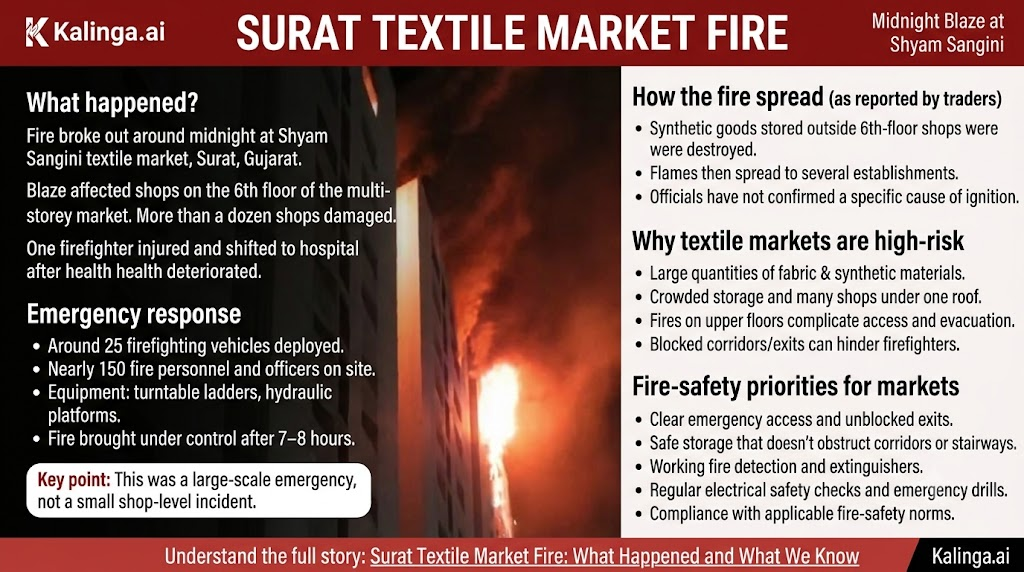
The Surat textile market fire erupted at around midnight at the Shyam Sangini textile market, a multi-storey commercial building in Surat. Officials said the blaze affected shops located on the sixth floor, where a large quantity of textile-related material was present.
The incident quickly developed into a major firefighting operation because of the intensity of the flames and the location of the affected shops. Fire authorities deployed a large number of vehicles, specialised equipment and personnel to reach and contain the fire.
Chief Fire Officer Basant Pareek said 25 firefighting vehicles, along with turntable ladders and hydraulic platforms, were used during the operation. Nearly 150 fire personnel and officers were involved in efforts to control the blaze.
What is the Surat textile market fire?
The Surat textile market fire refers to the major blaze that broke out around midnight at the Shyam Sangini textile market, damaging more than a dozen shops and injuring a firefighter.
The fire was concentrated on the market’s sixth floor, according to officials. Firefighters worked for several hours before the blaze was brought under control after approximately seven to eight hours.
The incident highlights the operational challenges involved in fighting fires inside large commercial buildings, particularly when combustible materials are stored in shops and access to upper floors is difficult.
Key takeaway: The fire was not a small shop-level incident; it required a large-scale emergency response involving dozens of vehicles and approximately 150 firefighters and officers.
Where did the fire break out?
The blaze occurred at the Shyam Sangini textile market in Surat, Gujarat. The fire affected shops on the building’s sixth floor, making firefighting more complicated because crews had to operate at considerable height.
Surat is one of India’s major textile and diamond business centres, and commercial textile markets can contain large quantities of fabric, synthetic materials, packaging and other goods. Once such materials catch fire, controlling flames and preventing further spread can become difficult.
Which part of the market was affected?
Officials said the fire affected shops on the sixth floor of the Shyam Sangini textile market.
Local traders told officials that synthetic goods kept outside the shops on the sixth floor were destroyed in the blaze. They said the fire then spread to several establishments.
This account helps explain why the incident escalated quickly. Goods stored outside individual shops can create additional fuel for a fire and may also obstruct access routes that firefighters need during an emergency.
Why does the location matter?
Fires on upper floors create several practical challenges.
Firefighters may have to move equipment and personnel vertically through a building while dealing with smoke, heat and potentially limited visibility. Specialised equipment such as hydraulic platforms and turntable ladders can therefore become particularly important.
The use of such equipment during the Surat textile market fire indicates the scale of the operation required to tackle flames in an elevated commercial area.
How did the fire spread?
The exact technical cause of the fire was not provided in the information released by officials in the report. However, local traders said synthetic goods stored outside shops on the sixth floor were destroyed and that the flames subsequently spread to several establishments.
It is important to distinguish between what officials confirmed and what traders reported. The available report establishes that the blaze affected multiple shops and that synthetic goods were among the materials destroyed, but it does not establish a final cause of ignition.
Did officials confirm what started the fire?
No specific cause of ignition was identified in the supplied report. Officials confirmed the location, firefighting response, duration and injury, while local traders described how the fire moved through the sixth-floor shops.
That distinction matters when reporting an active or recently concluded fire. A fire can spread rapidly because of combustible inventory, building layout, ventilation and other factors, but the presence of such conditions does not by itself establish how the fire began.
For the Surat textile market fire, the verified facts are therefore more useful than speculation about the source of ignition.
How did firefighters control the blaze?
The firefighting response was extensive. Authorities deployed 25 firefighting vehicles, including turntable ladders and hydraulic platforms, while nearly 150 fire personnel and officers worked to bring the blaze under control.
The operation continued for approximately seven to eight hours.
That duration illustrates the difficulty of tackling a large fire inside a multi-storey commercial property. Firefighters have to balance speed with safety while ensuring that flames are contained and that hotspots do not reignite after the main blaze appears to have been controlled.
How long did it take to control the fire?
The blaze was brought under control after approximately seven to eight hours, according to Chief Fire Officer Basant Pareek.
The extended response does not necessarily mean flames remained equally intense throughout the entire period. Large commercial fires can involve several stages, including initial suppression, access to affected areas, containment of spreading flames and checking for remaining hotspots.
Equipment used during the response
The response included several types of firefighting equipment:
- 25 firefighting vehicles
- Turntable ladders
- Hydraulic platforms
- Personnel and officers numbering nearly 150
- Hospital support for the firefighter who was injured during the operation
Turntable ladders and hydraulic platforms are particularly useful when crews need to reach elevated portions of a building from outside.
Their deployment during the Surat textile market fire reflects the challenge of reaching shops located on the sixth floor.
How many shops were damaged?
The fire damaged more than a dozen shops, according to officials cited in the report. The affected establishments were located on the sixth floor of the Shyam Sangini textile market.
Local traders said synthetic goods kept outside shops were destroyed before the fire spread to several establishments.
The precise financial value of the damaged goods was not provided in the supplied report. It would therefore be inappropriate to assign a monetary loss without an official assessment from authorities, traders or insurers.
Were all shops in the market destroyed?
No. The report says more than a dozen shops were damaged, particularly in the sixth-floor area affected by the fire. It does not state that the entire market was destroyed.
This distinction is important because a major fire in one section of a large commercial complex does not automatically mean every shop or floor suffered the same level of damage.
The eventual assessment may depend on direct fire damage, smoke exposure, water damage and the condition of electrical and structural systems.
What happened to the injured firefighter?
One firefighter was injured during the operation. Chief Fire Officer Basant Pareek said the firefighter’s health deteriorated during the response and that the person was shifted to a hospital for treatment.
The supplied report does not provide further medical details about the firefighter’s condition.
Was anyone else reported injured?
The report specifically identified one injured firefighter. No additional injuries were confirmed in the supplied information.
Firefighting operations in large commercial buildings can expose crews to multiple risks, including intense heat, smoke, falling materials and difficult working conditions. The injury underscores the risks faced by emergency personnel even when the primary objective is protecting property and containing the fire.
The firefighter’s hospitalization became one of the most significant human aspects of the Surat textile market fire, alongside the damage suffered by traders.
Why are textile markets particularly vulnerable to fires?
Textile markets can present a complex fire-safety environment because shops may contain substantial quantities of fabric and synthetic materials. Packaging, plastic materials and other commercial inventory can also contribute to the intensity of a fire.
However, it is important not to generalise about the cause of a particular incident. The supplied report does not establish that the material itself caused the Surat textile market fire.
Instead, the incident provides an opportunity to understand why fire prevention and emergency preparedness are particularly important in high-density commercial markets.
What makes a commercial textile building challenging during a fire?
Large amounts of combustible inventory, multiple shops, upper-floor locations and crowded storage arrangements can make firefighting more difficult.
A market building may contain many individual businesses operating within a shared structure. Firefighters therefore need to prevent flames from crossing from one shop to another while also ensuring that emergency routes remain usable.
Other practical factors can include the arrangement of merchandise, access for emergency vehicles and the availability of functioning fire-safety systems.
What does the Surat fire mean for traders?
For traders, a fire is not simply a building emergency. It can disrupt inventory, business operations, customer orders and supply chains.
The Surat textile market fire damaged more than a dozen shops, meaning affected traders may have to assess the condition of their stock, premises and business records.
The full economic impact cannot yet be determined from the available information. A proper assessment would require details about the value of damaged inventory, insurance coverage, business interruption and the time needed to restore affected shops.
What should affected traders do after a major market fire?
Traders should first follow instructions from authorities and building management, then document damage and inventory losses when the premises are declared safe to enter.
Depending on the circumstances, practical steps can include:
- Photographing visible damage after authorities permit access.
- Preparing an inventory of damaged goods.
- Preserving relevant invoices and stock records.
- Contacting insurers if the affected business has coverage.
- Coordinating with market management regarding structural and electrical safety.
- Waiting for professional safety assessments before reopening affected areas.
These are general post-fire measures, not specific instructions issued for the Shyam Sangini market.
How can fire safety improve in crowded commercial markets?
The incident also raises a broader question about preparedness in India’s busy commercial markets. Fire safety is most effective when prevention, detection, evacuation and firefighting systems work together rather than being treated as separate responsibilities.
A building can have firefighting equipment but still face serious challenges if emergency access is blocked or evacuation routes are difficult to use.
What are the most important fire-safety priorities for markets?
The key priorities are prevention, early detection, clear evacuation routes, accessible firefighting systems and regular emergency preparedness.
For commercial buildings, important areas of attention can include:
- Clear access routes: Fire engines and emergency teams need practical access to the building.
- Safe storage: Goods should not obstruct corridors, stairways or emergency exits.
- Fire detection: Early warnings can give occupants more time to evacuate.
- Firefighting equipment: Extinguishers and other systems need to be available and maintained.
- Electrical safety: Commercial properties should have electrical systems inspected and maintained appropriately.
- Emergency drills: Workers should know evacuation routes and assembly points.
- Building compliance: Owners and operators should follow applicable fire-safety requirements.
The Surat textile market fire demonstrates why these measures matter particularly in buildings where many businesses operate under one roof.
Surat textile market fire vs smaller shop fires
The scale of a fire can significantly influence the emergency response. A small shop fire may potentially be contained with limited resources, while a multi-storey market fire can require specialised equipment and a much larger deployment.
| Factor | Smaller shop fire | Multi-storey market fire |
| Typical location | Individual shop | Multiple shops or floors |
| Access challenge | Usually lower | Potentially high, especially on upper floors |
| Firefighting resources | May require fewer units | Can require multiple vehicles and specialised equipment |
| Evacuation | Smaller number of occupants | Potentially many workers and visitors |
| Inventory | Limited stock | Large quantities across multiple businesses |
| Spread risk | Often more contained | Can move between adjoining establishments |
| Emergency coordination | Relatively limited | Requires broader coordination |
The comparison does not mean every fire follows the same pattern. Conditions vary according to the building, materials, fire protection systems and emergency response.
In this case, the deployment of 25 vehicles and nearly 150 personnel shows that the Shyam Sangini incident was treated as a major firefighting operation.
Why the firefighter’s injury matters
Fire incidents are often reported primarily through property damage figures, but the risks to emergency workers are equally important.
During the Surat textile market fire, one firefighter was injured and later shifted to hospital after his health deteriorated. The incident illustrates the physical demands involved in prolonged firefighting operations.
Firefighters may have to work in difficult conditions for hours, particularly when a blaze involves upper floors and large quantities of commercial inventory.
Was the firefighter injured while fighting the fire?
Yes. Officials said a firefighter was injured during the firefighting operation and was taken to hospital after his health deteriorated.
The supplied report does not provide the nature or severity of the injury beyond the hospitalization.
That means further claims about the firefighter’s condition should wait for an official medical update.
What can we learn from the Surat fire incident?
The Surat fire incident offers several lessons that extend beyond one market or one city.
First, the speed at which a commercial fire can grow makes early detection and immediate reporting critical. Second, the physical layout of a building can strongly influence the response, particularly when flames are located on an upper floor.
Third, emergency preparedness must account for the reality of commercial markets: many shops, large inventories and potentially crowded working environments.
What is the biggest takeaway from the incident?
The biggest takeaway is that fire safety in large commercial markets requires preparation before an emergency begins, because firefighting becomes significantly more difficult once flames spread across multiple shops or reach upper floors.
The incident also shows the importance of specialised firefighting infrastructure. Turntable ladders and hydraulic platforms were among the equipment deployed in Surat, demonstrating why cities need emergency resources capable of responding to complex building fires.
What happens after a major market fire?
Once the visible flames are controlled, the emergency response does not necessarily end immediately.
Authorities and building managers may need to assess whether the affected structure and its utilities are safe. Traders may then begin documenting losses and determining whether businesses can resume operations.
For the Surat textile market fire, the supplied report confirms that the blaze was brought under control but does not provide a complete post-fire structural or financial assessment.
Will the full damage be known immediately?
Probably not. A complete assessment generally requires inspection of affected premises, inventory and infrastructure after the site is considered safe.
Visible damage may include burned stock and shop interiors, while less obvious damage can involve smoke, heat, water used during firefighting and electrical systems.
For that reason, the initial description of more than a dozen damaged shops should not automatically be treated as the final assessment of the incident’s total impact.
Key takeaways from the Surat textile market fire
The most important verified facts from the report can be summarised simply:
- The fire broke out at around midnight at the Shyam Sangini textile market in Surat.
- Shops on the sixth floor were affected.
- More than a dozen shops were damaged.
- Approximately 25 firefighting vehicles were deployed.
- The operation involved nearly 150 fire personnel and officers.
- Turntable ladders and hydraulic platforms were used.
- The blaze was brought under control after around seven to eight hours.
- One firefighter was injured and shifted to hospital.
- Local traders said synthetic goods stored outside shops were destroyed and that the fire spread to several establishments.
- The supplied report does not confirm a specific cause of ignition or provide a final estimate of financial losses.
These facts provide the clearest picture currently available without adding unverified speculation.
FAQ: Surat textile market fire
What happened in the Surat textile market fire?
The Surat textile market fire broke out around midnight at the Shyam Sangini textile market in Surat, Gujarat. The blaze affected shops on the sixth floor, damaged more than a dozen shops and injured one firefighter.
Where did the Surat textile market fire take place?
The Surat textile market fire took place at the multi-storey Shyam Sangini textile market in Surat, Gujarat. Officials said shops on the building’s sixth floor were affected.
How many firefighters responded to the Surat fire?
Nearly 150 fire personnel and officers were deployed during the response. Authorities also used approximately 25 firefighting vehicles, along with turntable ladders and hydraulic platforms.
How long did it take to control the Surat textile market fire?
Officials said the blaze was brought under control after approximately seven to eight hours of firefighting operations.
How many shops were damaged in the Surat fire?
The report said more than a dozen shops were damaged in the blaze. Local traders said synthetic goods kept outside shops on the sixth floor were destroyed and that the fire spread to several establishments.
Was anyone injured in the Surat textile market fire?
Yes. One firefighter was injured during the operation and was shifted to hospital after his health deteriorated, according to the Chief Fire Officer cited in the report.
Final takeaway
The Surat textile market fire was a major overnight emergency that required an extensive response from Gujarat’s fire services. With more than a dozen shops damaged, one firefighter injured and nearly 150 personnel deployed over several hours, the incident underlines the importance of fire preparedness in large commercial markets.
For traders, workers and building operators, the broader lesson is straightforward: fire prevention, accessible emergency routes and properly maintained safety systems can make a critical difference when a commercial fire breaks out. keep exploring kalinga.ai for more.