What is the TVK alliance meeting about?
The TVK alliance meeting is the second major alliance coordination meeting being held by Tamilaga Vettri Kazhagam (TVK) at its party headquarters in Chennai. According to the report, the meeting is intended to move the ruling coalition from a loose political arrangement towards a more formal coordination structure.
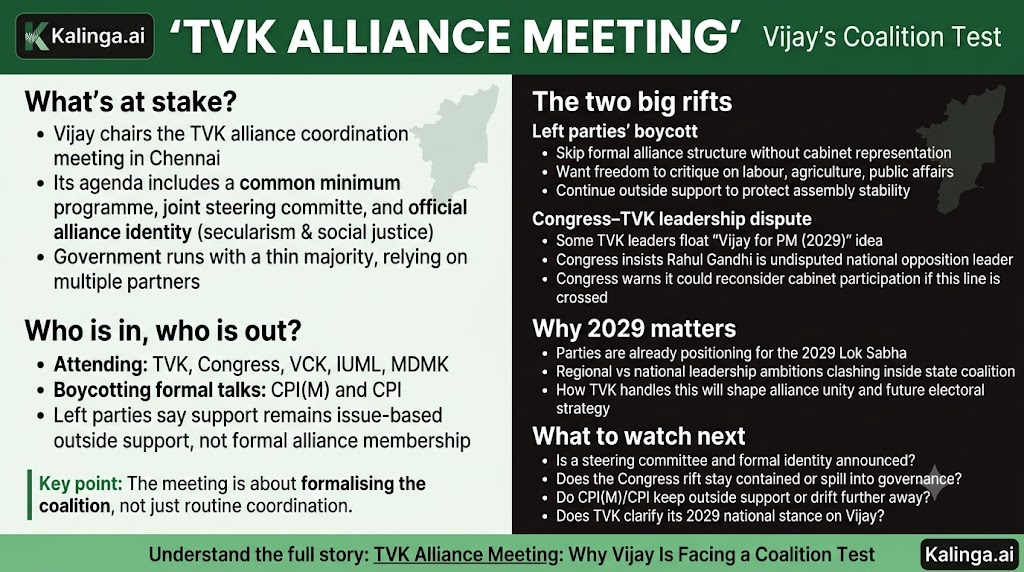
The discussions are expected to focus on three major issues: establishing a common minimum programme, creating a joint steering committee, and deciding on an official identity for the alliance.
A common minimum programme is particularly important in a coalition because different parties may agree to support the same government while maintaining different ideological priorities and political identities.
What is a common minimum programme?
A common minimum programme is an agreed set of policy priorities that coalition partners collectively support while remaining separate political parties.
It allows coalition partners to identify areas where they can cooperate without requiring every party to agree on every issue. In a government supported by multiple parties, such a framework can help reduce disagreements over governance priorities.
For the TVK-led coalition, the proposed programme is expected to be linked to themes of secularism and social justice, according to the supplied report.
Why is the meeting important?
The importance of the TVK alliance meeting goes beyond a routine discussion among coalition partners.
The government is described as having a thin majority and depends on support from multiple parties. That means maintaining communication between partners is essential for legislative stability and for building a coordinated political strategy for future elections.
The meeting also comes at a sensitive moment because not every ally is participating in the formal discussions.
Congress and VCK have confirmed participation, along with IUML and MDMK, while CPI(M) and CPI have chosen to stay away.
Why is Vijay chairing the alliance meeting?
Chief Minister C Joseph Vijay is scheduled to chair the TVK alliance meeting, placing him at the centre of discussions about the coalition’s future structure.
For Vijay, the meeting presents a leadership challenge. He has to bring together parties with different priorities while dealing with disagreements that extend beyond state-level governance.
A successful alliance meeting would help demonstrate that the TVK leadership can coordinate multiple parties around a common programme. Conversely, continued disagreements could make the coalition appear politically fragmented.
What does Vijay need to achieve?
Vijay needs to maintain coalition unity while establishing a workable structure for policy coordination and future electoral cooperation.
That means finding common ground on governance while avoiding unnecessary conflicts between parties that may have different ambitions.
The challenge is especially significant because some disagreements are not about state policy at all. The dispute over national opposition leadership and the possibility of Vijay being projected for the 2029 Lok Sabha election introduces a much larger political question.
The three major goals of the meeting
The reported agenda can be understood through three priorities:
- Common minimum programme: Create shared policy commitments.
- Joint steering committee: Establish a mechanism for coordination among coalition partners.
- Official alliance identity: Give the coalition a clearer political and organisational identity.
These mechanisms could make cooperation more predictable, particularly as the coalition prepares for future local-body and parliamentary political contests.
Why are CPI(M) and CPI boycotting the meeting?
One of the biggest developments surrounding the TVK alliance meeting is the decision by the Communist Party of India (Marxist), or CPI(M), and Communist Party of India, or CPI, to stay away.
The two Left parties have reportedly skipped the formal alliance discussions for the second consecutive time since July 1.
However, their absence does not necessarily mean that they have withdrawn support from the government.
Are CPI(M) and CPI opposing the government?
The Left parties are maintaining issue-based outside support rather than joining the formal alliance structure.
CPI(M) State Secretary P Shanmugam said the Left’s outside support remains issue-based and is intended to maintain assembly stability, according to the report.
This distinction is important. A party can support a government on selected legislative or political issues without becoming part of its formal coalition machinery.
What does “outside support” mean?
Outside support means a political party helps a government survive or pass measures without formally joining the government or taking cabinet positions.
In practical terms, the supporting party retains greater independence because it does not necessarily have to defend every government decision.
For CPI(M) and CPI, the arrangement allows them to support the government when necessary while retaining the ability to criticise its policies on issues such as labour, agriculture and public affairs.
The Left parties reportedly do not want to join a formal alliance structure intended to anchor future local-body and 2029 Lok Sabha arrangements without cabinet representation.
That position reflects a broader political calculation: participation in a formal alliance can provide influence, but it can also reduce a smaller party’s freedom to distance itself from unpopular government decisions.
TVK alliance meeting vs Left outside support
Understanding the difference between formal coalition participation and outside support is essential to understanding the current political situation.
| Feature | Formal alliance participation | Issue-based outside support |
| Participation in coordination meetings | Usually expected | Not necessarily |
| Cabinet representation | May be included | Not required |
| Policy position | Greater need for coordination | Can remain independent |
| Criticism of government | Potentially constrained politically | Greater freedom |
| Electoral coordination | More structured | Can be negotiated separately |
| Current example | Congress, VCK, IUML and MDMK | CPI(M) and CPI |
The distinction explains why the CPI(M) and CPI boycott does not automatically translate into the collapse of the government.
At the same time, repeated absence from formal alliance meetings can make long-term coordination more difficult.
Why does the Left want to stay independent?
The Left parties want to preserve political independence while continuing to provide issue-based support to the government.
According to the report, they are particularly interested in retaining the freedom to critique government policy on labour, agriculture and public affairs.
That position allows them to maintain their separate political identity rather than becoming fully associated with every decision taken by the ruling coalition.
What is the TVK-Congress rift about?
The other major challenge surrounding the TVK alliance meeting is the disagreement between TVK and Congress over national leadership.
The dispute centres on statements from TVK legislators and ministers suggesting that Chief Minister Vijay could be considered a potential prime ministerial candidate for the 2029 general elections.
Congress leaders have strongly objected to this positioning.
Why is Congress opposing the “Vijay for PM” idea?
Tamil Nadu Congress Committee leaders have asserted that Rahul Gandhi remains the undisputed leader of the national opposition bloc, making public calls for Vijay as a prime ministerial candidate politically contentious.
Congress Minister S Rajesh Kumar reportedly warned that attempts to undermine this position could lead Congress to reconsider its participation in the state cabinet.
That makes the issue more serious than an ordinary disagreement between coalition partners. If a dispute over national leadership begins affecting state-level cooperation, it could create additional pressure on the government.
How has TVK responded?
TVK leadership has attempted to reduce the significance of the dispute by describing the “Vijay for PM” statements as the personal opinions of individual lawmakers.
This approach allows the party leadership to distance itself from an explicit national leadership campaign while keeping the broader political question open.
For Vijay, the challenge is to prevent the issue from overwhelming the alliance’s immediate governance agenda.
The TVK alliance meeting therefore takes place against two different kinds of disagreement: the Left parties’ reluctance to formally join the alliance structure and Congress’s disagreement over national leadership.
Why does the 2029 Lok Sabha election matter?
The 2029 Lok Sabha election is still years away, but it is already influencing coalition calculations because parties often begin positioning themselves well before a national election.
For regional parties, national elections can raise questions about leadership, seat-sharing, alliance identity and the balance between state-level and national political ambitions.
The TVK coalition appears to be considering structures that could eventually support local-body and parliamentary electoral arrangements.
Is Vijay being positioned as a 2029 prime ministerial candidate?
The supplied report says some TVK legislators and ministers have positioned Vijay as a potential prime ministerial candidate, but TVK leadership has described those statements as personal opinions rather than an official party position.
That distinction is crucial.
A statement by an individual lawmaker does not necessarily represent the formal position of an entire political party. At the same time, repeated public statements can still create political pressure on coalition partners.
Congress’s response indicates that the issue is already significant enough to affect relations between the two parties.
Why could national politics affect Tamil Nadu governance?
Coalition partners can cooperate on state governance while having different preferences for national elections.
The problem arises when national ambitions begin influencing cabinet relationships, alliance structures or public messaging within the state.
For the TVK alliance meeting, maintaining that separation may be one of Vijay’s most important political tasks.
How strong is Vijay’s coalition government?
According to the supplied report, the TVK government relies on crucial numbers from several alliance partners.
Congress has five MLAs, while VCK, IUML and Left parties are described as having two MLAs each in the arrangement outlined in the report.
This makes coalition management particularly important because a government with a thin majority has less room for internal disputes.
Why is a thin majority politically important?
A thin majority means the government has less numerical room for defections, abstentions or disagreements among supporting parties.
Even when coalition partners remain broadly committed to the government, disagreements can become more consequential when the governing side has limited numbers.
This is why the relationship between TVK and Congress matters so much. Congress’s five MLAs represent an important component of the government’s legislative support.
The Left parties’ two MLAs each also matter in the broader arithmetic described in the report, even though CPI(M) and CPI are choosing outside support rather than formal alliance participation.
What does this mean for Vijay?
Vijay’s political challenge is not simply to win an argument at the TVK alliance meeting.
He needs to maintain a workable relationship with parties that have different expectations, protect the government’s legislative stability and create enough common ground for future electoral cooperation.
That requires political flexibility.
What could the TVK alliance meeting decide?
The meeting could help establish the organisational foundations of the coalition.
The most significant possible outcomes include agreement on a common minimum programme and progress towards a joint steering committee.
A formal alliance identity could also make it easier for voters and political workers to understand which parties are part of the governing arrangement and what the coalition stands for.
What are the likely areas of focus?
The key areas are alliance structure, shared policy priorities, coordination mechanisms and the coalition’s political identity.
The meeting is expected to address:
- A common minimum programme.
- A joint steering committee.
- An official identity for the alliance.
- Coordination between participating parties.
- The broader relationship between formal allies and outside supporters.
- Future local-body and parliamentary electoral arrangements.
The outcome could therefore influence not only immediate governance but also the coalition’s long-term political architecture.
What are the biggest challenges facing Vijay?
The TVK alliance meeting brings several competing political pressures together.
The first is organisational: how should the alliance be structured?
The second is ideological and policy-related: can parties with different priorities agree on a common programme?
The third is electoral: how should the coalition approach future local and national elections?
And the fourth is leadership: who should represent the broader opposition or coalition at the national level?
Can Vijay keep all alliance partners together?
Vijay can strengthen coalition unity if he separates immediate governance priorities from unresolved national leadership questions and gives different partners enough political space to retain their identities.
That does not mean every disagreement has to disappear.
Coalitions routinely contain parties that disagree on specific policies. What matters is whether those disagreements can be managed without threatening legislative stability or the basic functioning of the government.
For Vijay, the most practical objective may therefore be to establish clear rules for cooperation while allowing individual parties to maintain independent positions on issues outside the agreed programme.
Congress participation creates both support and pressure
Congress’s decision to attend the TVK alliance meeting is significant because the party is simultaneously challenging the emerging discussion around national leadership.
This creates an interesting political dynamic.
On one hand, Congress remains an important component of the state government. On the other, its leadership has made clear that there are limits to how far it will accept a competing national leadership narrative.
Why is Congress important to the coalition?
Congress has five MLAs in the political arrangement described in the report, making its participation important to the government’s legislative stability.
That numerical role gives Congress influence within the coalition.
However, political influence comes with expectations. Congress may seek clarity over alliance decision-making, leadership and the coalition’s future electoral strategy.
The disagreement over Rahul Gandhi and Vijay illustrates how a state-level alliance can encounter national-level political fault lines.
What does the Left boycott mean for the alliance?
The CPI(M) and CPI decision to stay away from formal talks sends a different message from the Congress dispute.
The Left is not primarily challenging the idea of Vijay’s national leadership. Instead, it is objecting to participation in a formal alliance structure without cabinet representation while maintaining issue-based support.
This gives the Left parties greater independence but also leaves the coalition’s formal structure less inclusive.
Does the boycott mean the government is unstable?
Not necessarily. The report says CPI(M) and CPI continue to provide issue-based outside support intended to maintain assembly stability.
However, the arrangement can become more complicated if future political disagreements require the government to rely on support from parties outside the formal coalition.
This is why a clear coordination mechanism could become important.
A steering committee that includes formal allies may improve coordination, but it would not automatically resolve the separate relationship with parties that prefer outside support.
Why alliance structure matters beyond one meeting
Political alliances are often discussed mainly in terms of election seat-sharing, but governance requires something more.
Once several parties support a government, they need mechanisms for discussing policy disagreements, coordinating legislative strategies and communicating with one another.
The proposed steering committee could serve that purpose.
What is a joint steering committee?
A joint steering committee is a coordination body through which alliance partners can discuss common political and governance priorities.
Such a mechanism can help parties resolve disagreements before they become public disputes.
For the TVK-led government, a steering committee could also create a regular channel between the different participating parties.
However, its effectiveness would depend on who participates, what authority it has and whether all important supporters are willing to use it.
What should observers watch after the meeting?
The most important developments may come after the TVK alliance meeting, rather than during it.
Observers should look for whether the coalition reaches agreement on its proposed organisational structure and whether Congress’s participation is accompanied by any clarification over national leadership.
The Left’s future position will also matter.
What are the four biggest things to watch?
Four issues stand out: alliance formalisation, Congress’s position, the Left’s outside-support model and the future 2029 strategy.
Watch for:
- Alliance structure: Whether a steering committee and formal identity are established.
- Congress relationship: Whether the leadership dispute remains contained or affects cabinet participation.
- Left support: Whether CPI(M) and CPI continue their current outside-support arrangement.
- 2029 positioning: Whether TVK leadership formally distances itself from or eventually embraces a larger national role for Vijay.
These developments will provide a clearer indication of whether the coalition is becoming more institutionalised or remaining a flexible political arrangement.
Key takeaways from the TVK alliance meeting
The political situation can be reduced to several important points:
- Vijay is chairing the TVK alliance meeting at the party headquarters in Chennai.
- The meeting is expected to discuss a common minimum programme.
- A joint steering committee is also under discussion.
- The coalition wants an official identity built around secularism and social justice.
- Congress, VCK, IUML and MDMK have reportedly confirmed participation.
- CPI(M) and CPI are boycotting the formal meeting for the second consecutive time since July 1.
- The Left says its support remains issue-based and outside the formal alliance structure.
- Congress leaders have objected to statements positioning Vijay as a possible 2029 prime ministerial candidate.
- TVK leadership has said those “Vijay for PM” statements reflect individual lawmakers’ opinions.
- The government relies on support from several parties, making coalition management especially important.
- The meeting is therefore a test of Vijay’s ability to balance governance, coalition unity and future electoral ambitions.
FAQ: TVK alliance meeting
What is the TVK alliance meeting?
The TVK alliance meeting is a major coordination meeting of Tamilaga Vettri Kazhagam and its political partners, chaired by Chief Minister C Joseph Vijay. It is expected to discuss a common minimum programme, a joint steering committee and the alliance’s formal identity.
Why are CPI(M) and CPI boycotting the TVK alliance meeting?
CPI(M) and CPI have chosen not to participate in the formal alliance discussions because they prefer to maintain issue-based outside support. CPI(M) State Secretary P Shanmugam said the arrangement allows the Left to retain political independence while supporting assembly stability.
What is the TVK-Congress rift about?
The TVK-Congress rift concerns national leadership ahead of the 2029 general elections. Some TVK legislators and ministers have promoted Vijay as a possible prime ministerial candidate, while Congress leaders have maintained that Rahul Gandhi remains the undisputed leader of the national opposition bloc.
Will Congress leave the Tamil Nadu cabinet?
The supplied report does not say that Congress has decided to leave the cabinet. It says Congress Minister S Rajesh Kumar warned that undermining the party’s position on national leadership could force Congress to reconsider its participation in the state cabinet.
What is the purpose of a common minimum programme?
A common minimum programme gives coalition partners an agreed set of policy priorities. It allows different parties to cooperate on governance while retaining their separate political identities and positions on issues outside the agreed framework.
Why is the TVK alliance meeting important for Vijay?
The meeting is important because Vijay must manage multiple political relationships while the government operates with a thin majority. He also faces disagreements over the formal role of the Left and the politically sensitive question of national leadership ahead of the 2029 Lok Sabha election.
Final takeaway
The TVK alliance meeting is more than an organisational exercise: it is a test of whether Vijay can turn a collection of political supporters into a stable and coordinated governing coalition. Congress remains an important participant but has drawn a line over national leadership, while CPI(M) and CPI prefer issue-based outside support rather than formal alliance membership.
The immediate challenge for Vijay is therefore clear: build a workable coalition structure without allowing disagreements over representation, ideology or future national ambitions to undermine Tamil Nadu’s government.
For more explainers on Indian politics, governance and major current affairs, follow Kalinga.ai for clear, context-first coverage.