Why Is the Anthropic Researcher Warning Attracting Attention?
The Anthropic researcher warning stands out because it did not come from an outside critic simply commenting on the AI industry. According to TechCrunch, an Anthropic researcher resigned this week and subsequently posted a warning on X about the company’s direction.
The researcher said Anthropic was “racing straight to self-improving superintelligence and gambling with our lives.” That is an unusually stark description of the risks associated with increasingly capable AI systems.
The warning also gained additional attention because Anthropic’s own alignment lead, Evan Hubinger, co-signed the message rather than publicly walking it back.
That does not mean Anthropic as a company has endorsed the warning. A personal or individual researcher position should not automatically be treated as an official corporate position. However, the involvement of someone working directly on alignment makes the discussion more significant for people following AI safety.
Definition + Expansion: What Is an AI Safety Warning?
AI safety warning , a concern that increasingly capable artificial intelligence could create serious risks if its behavior, objectives, deployment or development are not adequately controlled.
AI safety is broader than the idea that an AI system might suddenly become dangerous. It includes questions about reliability, misuse, unintended behavior, human oversight, cybersecurity, alignment and the consequences of deploying powerful systems at scale.
The important distinction is that a safety warning is not automatically a prediction. Researchers can identify a potential risk without claiming that the worst-case scenario will definitely happen.
Question → Direct Answer: Why is the warning important?
Because it comes from within a company known for focusing heavily on AI safety and alignment, making it relevant to the wider debate over whether AI capability development is moving faster than risk management.
What Did the Anthropic Researcher Warn About?
At the center of the Anthropic researcher warning is the phrase self-improving superintelligence.
The researcher argued that Anthropic is moving toward a future in which AI systems could potentially improve their own capabilities. The concern is not simply that today’s AI models are becoming more capable. It is that future systems might participate in improving the technology that creates the next generation of AI.
This distinction is important.
Today’s AI systems can already assist developers with software engineering, research, data analysis and other technical tasks. But a hypothetical self-improving superintelligence would represent a much more significant development.
It would involve an AI system capable of making substantial improvements to its own capabilities or contributing to improvements in successor systems, potentially at a speed that humans could struggle to monitor.
What Does “Racing” Mean in This Context?
The word “racing” points to competitive pressure.
AI companies are competing to build increasingly capable models because stronger systems can attract customers, developers, investment and market share. When several companies are pursuing similar breakthroughs, slowing down can feel commercially risky.
That creates a fundamental tension:
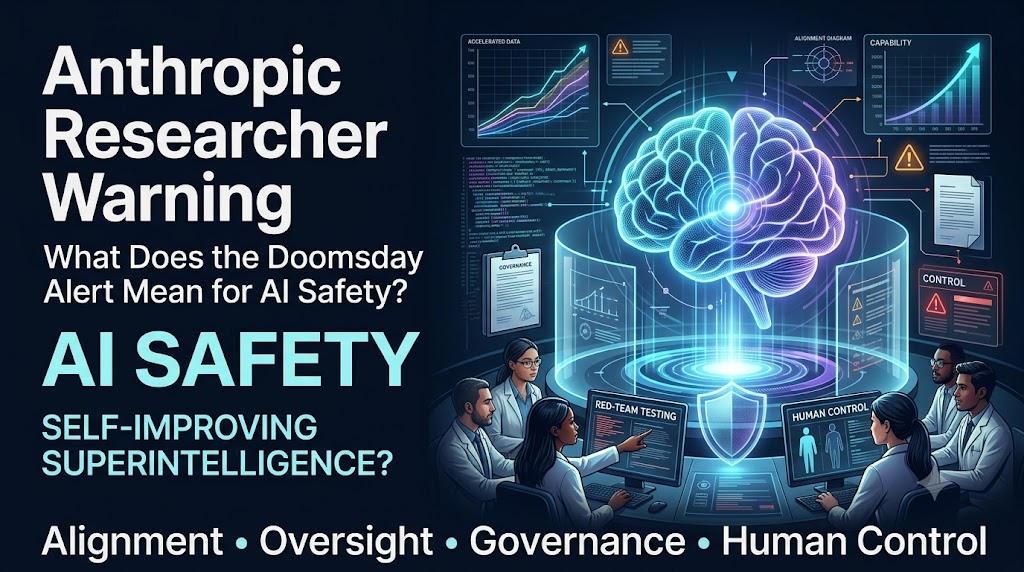
- Capability development pushes companies toward more powerful models.
- AI safety research tries to understand and reduce potential risks.
- Competition can create pressure to move quickly.
- Governance determines which safeguards are required before systems are deployed.
The debate is therefore not simply “AI is good” versus “AI is bad.” It is about how quickly society should develop increasingly powerful technology and what safety conditions should accompany that development.
Question → Direct Answer: Did the researcher prove that Anthropic is about to create superintelligence?
No. The supplied TechCrunch report describes the researcher’s warning and the concerns surrounding it, but it does not establish that superintelligence is imminent or that a catastrophic outcome will occur.
What Is Self-Improving Superintelligence?
Self-improving superintelligence , a hypothetical AI system that can improve its own capabilities and eventually perform intellectual tasks at a level far beyond humans across a broad range of domains.
The concept is closely related to recursive self-improvement, where an AI system contributes to improving itself or the systems that follow it. In theory, faster improvement could create a feedback loop in which each generation becomes more capable of developing the next.
However, this remains a hypothetical future scenario rather than an established description of today’s AI systems.
It is also important to separate several ideas that are sometimes mixed together in public discussions.
A chatbot generating better code is not necessarily a self-improving superintelligence. An AI coding assistant helping researchers train another model is not automatically recursively self-improving. The concept becomes much more significant when the system can independently and reliably contribute to major improvements in its own underlying capabilities.
Why Does Self-Improvement Matter?
Human research and engineering are limited by human working speed. A sufficiently capable AI system that can meaningfully automate portions of AI research could change that constraint.
For example, imagine a future system that could:
- Analyze weaknesses in an AI model.
- Propose architectural or training improvements.
- Run experiments.
- Evaluate the results.
- Generate improved techniques.
- Help researchers implement the next version.
That does not mean such a system will automatically become uncontrollable. It does, however, explain why AI researchers take the possibility seriously enough to study.
Question → Direct Answer: Is self-improving AI already a proven reality?
No. The warning concerns a potential direction of advanced AI development. The supplied source does not establish that a fully autonomous self-improving superintelligence currently exists.
Why Did Anthropic’s Alignment Lead Co-Sign the Warning?
One of the most striking details in the story is that Evan Hubinger, Anthropic’s alignment lead, co-signed the message.
That matters because AI alignment is directly connected to the question raised by the researcher.
AI alignment , the field of research focused on making AI systems behave in ways consistent with their intended goals, constraints and human expectations.
Alignment becomes increasingly important as AI systems become more capable. A system that can perform more tasks but does not reliably follow its intended objectives could create larger problems than a less capable system.
Hubinger’s co-sign should not be interpreted as proof that Anthropic officially agrees with every part of the departing researcher’s argument. Instead, it demonstrates that the concern was not simply dismissed publicly by an alignment specialist associated with the company.
That distinction is crucial.
A co-sign can indicate agreement with a particular warning while not necessarily representing an organization’s complete position on AI development.
Question → Direct Answer: Does the co-sign mean Anthropic has admitted its AI is unsafe?
No. The co-sign is an individual action and should not be treated as an official company admission. It does, however, make the debate around AI safety and rapid capability development harder to dismiss as an external criticism.
Why Does the Timing of the Warning Matter?
The timing is one of the most interesting parts of the story.
According to the TechCrunch report, Anthropic is reportedly preparing for an IPO, or initial public offering. An IPO is when a private company offers shares to public investors and becomes publicly traded.
The reported IPO preparation does not prove that a public listing is guaranteed or imminent. But if a major AI company is preparing to enter public markets, questions about technology risk, governance and long-term strategy can receive additional attention.
That creates an unusual backdrop for an internal AI safety warning.
Why Would Investors Care About AI Safety?
Investors do not evaluate an AI company only on how powerful its models are. They can also care about:
- regulatory exposure,
- operational risks,
- cybersecurity,
- product reliability,
- legal challenges,
- governance,
- reputational risk,
- responsible deployment,
- and the company’s ability to manage rapidly changing technology.
An Anthropic researcher warning arriving during reported IPO preparations therefore has a different business context from the same warning appearing at an earlier stage of a private company’s development.
It could prompt questions about how the company balances safety research with commercial pressure and how it intends to govern increasingly capable models.
That does not mean the warning will affect an IPO. It simply explains why the timing makes the story particularly notable.
Question → Direct Answer: Does IPO preparation make the warning more serious?
It makes the warning more consequential from a governance and investor-communication perspective, but it does not by itself prove that Anthropic faces an imminent AI safety crisis.
Is This an AI Safety Warning or an AI Doomer Prediction?
The language used in the story is deliberately dramatic.
TechCrunch describes the warning as the kind of “doomer” message that the AI industry has encountered before.
In AI discussions, AI doomerism generally refers to a worldview that emphasizes the possibility of extremely severe or even existential consequences from advanced artificial intelligence.
But “doomer” should not become a shortcut for dismissing every safety concern.
There is a meaningful difference between saying:
“A catastrophic AI outcome is guaranteed.”
and saying:
“A potentially catastrophic outcome is possible enough that we should build safeguards before capability grows further.”
The first is a prediction of certainty. The second is a risk-management argument.
The Three Positions in the Debate
| Position | Core idea | Main concern |
| Capability-first | Build increasingly powerful AI as quickly as possible | Falling behind competitors |
| Safety-first | Slow or constrain development until risks are better understood | Losing technological and economic opportunities |
| Balanced development | Advance capabilities alongside safety and governance | Finding the right balance between speed and control |
The real AI industry debate is more complicated than these three categories, but the table helps explain the tension.
Researchers can believe advanced AI will create enormous benefits while still arguing that development needs stronger safeguards.
Question → Direct Answer: Should people dismiss the warning because it sounds extreme?
No. Extreme language can be debated, but the underlying questions about alignment, control and governance are legitimate areas of AI research. The right response is to examine the evidence rather than accept or reject the prediction automatically.
How Does the Warning Fit Into the Broader AI Race?
The Anthropic researcher warning arrives during a period when AI companies are competing to develop models with greater reasoning, coding, research and autonomous-agent capabilities.
As models become more capable, they can perform increasingly complex sequences of tasks rather than simply generating isolated responses.
That progression creates an important feedback effect for the industry.
More capable AI can help companies build better AI.
An AI model can assist with writing code, analyzing experiments, preparing datasets, evaluating outputs and supporting research workflows. If those capabilities become substantially stronger, AI could become a more important tool in AI development itself.
That is where the idea of self-improvement becomes relevant.
Why Competition Can Increase Safety Pressure
Imagine two companies competing to develop the next generation of highly capable AI.
If Company A spends additional months testing safety mechanisms while Company B moves ahead, Company A may worry about losing customers and researchers.
That does not mean companies will ignore safety. It means competition can create a structural incentive to move quickly.
The challenge for the industry is therefore to make safety part of the development process rather than treating it as something that happens only after a breakthrough.
Question → Direct Answer: Why is competition relevant to AI safety?
Because companies have economic incentives to improve models quickly, while safety research often requires testing, evaluation and caution. The faster capability development becomes, the more important it becomes to integrate safety into the development cycle.
What Could Self-Improving AI Mean for Society?
It is impossible to know exactly what future self-improving AI would look like. Still, the possibility raises several categories of questions.
1. Control
Could humans reliably understand and direct a system that is substantially more capable than individual humans in many domains?
2. Alignment
Would the system consistently pursue the objectives its developers intended?
3. Oversight
Could humans detect harmful behavior before it caused significant damage?
4. Economic disruption
If AI could automate large parts of research and knowledge work, how would employment and education change?
5. Governance
Who would be responsible for deciding what systems can be built, tested and deployed?
These questions are not evidence that disaster is inevitable. They are examples of why advanced AI safety research exists.
For students and young professionals, this is particularly relevant because AI development is likely to influence the skills employers value, the way software is built and the types of jobs created around AI governance and deployment.
Why Does Anthropic’s Reported IPO Preparation Matter?
The reported IPO angle introduces a second layer to the story: corporate accountability.
A private AI company can make strategic decisions largely within its own governance structure. A publicly traded company faces a much broader audience of investors, regulators, analysts and shareholders.
That can increase scrutiny around how a company manages major risks.
However, it is important not to overstate the connection. The supplied TechCrunch report says Anthropic is reportedly preparing for an IPO. It does not establish that the company has completed a public listing or that the warning has caused a change in its IPO plans.
What Could Investors Ask?
If Anthropic does move toward public markets, investors could reasonably want to understand:
- How does the company evaluate advanced-model risks?
- How independent is its safety research?
- What safeguards apply to increasingly capable systems?
- How does management balance commercial growth with safety?
- What happens if internal researchers disagree with development priorities?
- How does the company communicate major AI risks to stakeholders?
These are governance questions rather than predictions about an AI apocalypse.
Question → Direct Answer: Is Anthropic’s IPO confirmed by this report?
No. The source says Anthropic is reportedly preparing for an IPO. That should be presented as reported preparation, not as a completed or guaranteed public listing.
What Should AI Companies Do About Safety and Capability Development?
The central lesson from the Anthropic researcher warning is not necessarily that AI companies should stop building powerful systems.
A more practical question is whether capability development and safety development can advance together.
That means companies need mechanisms for identifying problems before deployment rather than relying entirely on post-launch corrections.
A responsible development process can include:
- Pre-deployment testing: Evaluate models for dangerous or unexpected behavior before release.
- Red-team exercises: Ask researchers to deliberately probe systems for weaknesses.
- Alignment research: Study whether models follow intended objectives reliably.
- Monitoring: Watch deployed systems for unusual or harmful behavior.
- Human oversight: Keep meaningful human review for high-impact decisions.
- Governance: Establish clear accountability for major model-development decisions.
- Incident reporting: Create mechanisms for documenting and learning from failures.
- Independent scrutiny: Encourage credible external evaluation where appropriate.
None of these measures guarantees perfect safety.
But risk management rarely works by waiting until uncertainty disappears. It works by identifying major risks, reducing them where possible and continuously updating safeguards as circumstances change.
Question → Direct Answer: What is the best response to advanced-AI risk?
A practical response is to combine technical safety research with testing, oversight, governance and transparent risk management while continuing to evaluate whether existing safeguards remain adequate as model capabilities increase.
What Does the Warning Mean for Students and Young Professionals?
For students and young professionals in India, the story can initially sound distant: a researcher at a major AI company is debating hypothetical superintelligence somewhere else in the world.
But the underlying issues are increasingly relevant to anyone building a career around technology.
You do not need to become an AI safety researcher to understand the debate.
Start with these ideas:
- Learn how AI systems actually work. Understand models, training, inference, agents and evaluation at a practical level.
- Learn AI limitations. Powerful models can still produce incorrect or unreliable outputs.
- Understand alignment and safety. These concepts will matter as AI moves into more consequential workflows.
- Develop verification skills. Never assume an AI-generated answer is correct simply because it sounds confident.
- Follow AI governance. Regulation and corporate policies can influence which technologies organizations deploy.
- Build adaptable skills. AI is changing workflows, so the ability to work effectively with AI tools will become increasingly valuable.
- Avoid both extremes. Neither blind optimism nor automatic doom provides a strong basis for career decisions.
For students in Odisha and across India, this also means AI education should go beyond prompt writing. Understanding how AI is developed, evaluated, governed and deployed can provide a stronger foundation for long-term careers.
Why the Anthropic Researcher Warning Matters Beyond Anthropic
The story is bigger than one employee, one company or one social-media post.
Anthropic is one participant in a much larger AI ecosystem. Similar questions are being debated across technology companies, universities, governments and research communities.
The key issue is whether increasingly capable AI can be developed while maintaining sufficient human control and accountability.
That is why the Anthropic researcher warning deserves attention even from people who disagree with its most pessimistic interpretation.
A warning does not have to be correct in every prediction to be useful.
Risk analysis exists precisely because society has to make decisions under uncertainty.
The right question is therefore not simply, “Will AI destroy humanity?”
A better set of questions is:
- What capabilities are being developed?
- What could go wrong?
- How likely are those outcomes?
- How severe could they be?
- What safeguards exist?
- How effective have those safeguards been?
- Who is responsible when they fail?
- Should development slow down if safeguards cannot keep pace?
Those questions are much more actionable than a binary argument between AI optimism and AI pessimism.
FAQ: Anthropic Researcher Warning and AI Safety
What did the Anthropic researcher warn about?
The researcher resigned from Anthropic and warned on X that the company was “racing straight to self-improving superintelligence and gambling with our lives.” The warning focused on concerns about the pace of development toward increasingly capable and potentially self-improving AI systems.
What is self-improving superintelligence?
Self-improving superintelligence is a hypothetical form of AI that could improve its own capabilities and eventually outperform humans across a very broad range of intellectual tasks. It is a future scenario discussed in AI research, not proof that such a system currently exists.
Why is Evan Hubinger’s co-sign significant?
Evan Hubinger is Anthropic’s alignment lead, and his decision to co-sign the warning makes the discussion notable because alignment research directly addresses whether advanced AI systems can reliably follow intended goals and remain controllable. His personal co-sign should not be interpreted as an official statement from Anthropic.
Does the warning prove AI will destroy humanity?
No. The warning expresses a serious concern about potential future risks, but it does not establish that a catastrophic outcome is inevitable or imminent. The appropriate response is to examine the underlying risks and safeguards rather than treat the warning as either guaranteed prophecy or something that can be dismissed automatically.
Why does Anthropic’s reported IPO preparation matter?
TechCrunch reports that Anthropic is reportedly preparing for an IPO. If a major AI company enters public markets, questions about risk management, governance, safety practices and long-term strategy can receive greater attention from investors and other stakeholders. The report does not establish that an IPO is guaranteed.
What is AI alignment?
AI alignment is the research field focused on making AI systems behave consistently with their intended objectives, constraints and human expectations. Alignment becomes especially important as AI systems become more capable because mistakes or unintended behavior can have greater consequences.
Final Takeaway: What Should We Learn From the Anthropic Researcher Warning?
The Anthropic researcher warning is best understood as a serious contribution to an ongoing debate about the speed and direction of advanced AI development,not as proof that an AI doomsday is around the corner.
The most important issue is the tension between capability and control. As AI systems become more powerful, companies need safety research, evaluation, governance and human oversight that can keep pace with those capabilities.
For the public, the lesson is equally important: understand the technology without falling for either extreme optimism or extreme fear.
AI development is moving quickly. The question is not only how powerful AI can become, but whether humans can build the systems, institutions and safeguards needed to use that power responsibly.
For more explainers on AI safety, emerging technologies and the future of work, keep exploring Kalinga.ai and build your AI literacy alongside the technology itself.