Why Is Nscale Adding Fidji Simo to Its Board?
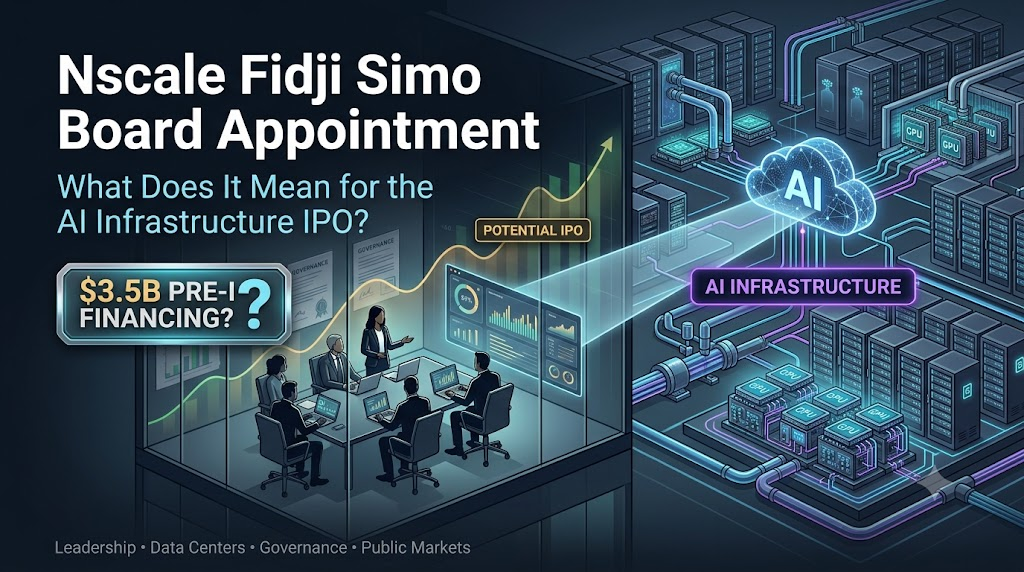
Nscale’s decision to appoint Fidji Simo comes at a particularly important moment for the company. The U.K.-based AI data-center startup is reportedly preparing for a potential IPO this fall while seeking a major round of financing before the listing.
The Nscale Fidji Simo appointment gives the company a board member with experience across AI, social media, consumer technology and public-market operations. Simo has held senior positions at OpenAI, Meta and Instacart, giving her exposure to companies operating at very different stages of technological and commercial scale.
Nscale founder and CEO Josh Payne said Simo understands what it takes to scale products used by billions of people and the infrastructure requirements that come with that scale.
That experience is particularly relevant to Nscale because the company is not primarily building a consumer AI application. It designs, builds and operates the physical infrastructure needed to support AI workloads.
Definition + Expansion: What Is AI Infrastructure?
AI infrastructure is the combination of computing hardware, data centers, networking, power, cooling and software systems required to develop and run artificial intelligence models.
When people use an AI chatbot or an AI-powered application, they typically see only the software interface. Behind that interface are large amounts of computing capacity, specialized chips, data storage, networking equipment and electricity.
Nscale is positioning itself on this infrastructure side of the AI economy.
Question → Direct Answer: Why does Simo’s experience matter to an infrastructure company?
Because scaling AI infrastructure involves more than buying computing hardware. It requires capital, operational discipline, governance, technology strategy and the ability to support customers as their computing requirements grow.
Who Is Fidji Simo and Why Does Her Experience Matter?
The Nscale Fidji Simo appointment is notable because Simo has experience at several highly visible technology companies.
Before joining Nscale’s board, Simo served as CEO of AGI deployment at OpenAI, effectively making her the No. 2 executive at the AI lab, according to the supplied source. She left OpenAI in July 2026, citing health reasons, but continues to advise the company on a part-time basis.
Her career also includes leadership at Instacart and Meta.
At Instacart, Simo served as chair and CEO and led the company through its 2023 IPO. Before that, she spent more than a decade at Meta, including serving as head of the Facebook app.
She also sits on the board of Shopify.
That combination gives her experience across three areas that are particularly relevant to Nscale:
- building and scaling technology businesses,
- operating products used at enormous scale,
- and navigating public-market expectations.
Why Is the Instacart IPO Experience Important?
An IPO is not simply a ceremonial moment when a company starts trading publicly.
A public listing can introduce additional expectations around financial reporting, governance, investor communication, risk management and operational discipline.
Someone who has already helped lead a company through an IPO can therefore bring practical experience that is different from purely technical expertise.
Question → Direct Answer: What makes Fidji Simo particularly relevant to Nscale?
Her experience combines AI leadership at OpenAI, large-scale technology operations at Meta, executive leadership at Instacart and direct experience taking a major technology company public.
What Is Nscale Building?
To understand why the company is attracting attention, it helps to look beyond the IPO story.
Nscale is a U.K.-based AI data-center startup that designs, builds and operates data centers for AI workloads.
That places the company in a part of the technology industry that has become increasingly important as AI models require more computing power.
Training and running advanced AI systems can require large clusters of specialized computing hardware. Those systems also generate substantial requirements for electricity, cooling, networking and physical space.
This creates a new infrastructure challenge.
The AI industry cannot expand indefinitely by simply building more software on top of existing computing capacity. It also needs the physical facilities that make large-scale computation possible.
AI Infrastructure Is the Physical Layer of AI
Think about the AI ecosystem as a stack.
At the top are applications people interact with directly: chatbots, coding assistants, image generators, enterprise copilots and autonomous agents.
Underneath those applications are AI models.
Under the models are computing resources.
And underneath the computing resources are the physical data centers, electricity systems, networking infrastructure and cooling technologies that keep everything running.
Nscale operates closer to that physical foundation.
Question → Direct Answer: Why are AI data centers becoming strategically important?
Because increasingly capable AI models require substantial computing capacity, and the availability of suitable data-center infrastructure can influence how quickly AI companies can train, deploy and scale those systems.
Why Is AI Infrastructure Becoming So Valuable?
The rapid growth of generative AI has changed how investors think about infrastructure.
In earlier technology cycles, much of the attention went toward software companies building applications for consumers and businesses. AI has shifted some of that attention toward the physical resources required to power computation.
The demand comes from several directions.
AI companies need computing for model training. They also need computing for inference, which is the process of generating outputs after a model has been trained.
Enterprise customers increasingly want to integrate AI into their own workflows. As usage grows, infrastructure providers need to deliver enough capacity to support those workloads reliably.
That creates a potential opportunity for companies such as Nscale.
Training vs. Inference
Training is the process of teaching an AI model patterns from large datasets by adjusting its internal parameters.
Inference is what happens when the trained model is used to generate an answer, prediction, image, code or other output.
Both can require substantial computing resources, although the exact requirements vary by model and workload.
As AI applications move from demonstrations to everyday products, inference can become particularly important because systems may need to respond to large numbers of users continuously.
Question → Direct Answer: Is AI infrastructure just about buying more chips?
No. Chips are essential, but AI infrastructure also involves data-center design, electricity, cooling, networking, storage, software management and reliable operations.
How Much Is Nscale Reportedly Raising Before Its IPO?
The financial scale of Nscale’s plans is one of the biggest reasons the story is attracting attention.
According to the supplied report, Bloomberg reported that Nscale is seeking up to $3.5 billion in pre-IPO financing.
That figure is significant because it illustrates the amount of capital that can be required to expand AI infrastructure.
Building and operating data centers is fundamentally different from launching a lightweight software product. Physical infrastructure requires land, buildings, power connections, cooling systems, networking and computing equipment.
It can therefore require enormous upfront investment.
The reported financing would come ahead of an anticipated IPO, although the precise structure, valuation and final amount could change.
Why Raise Money Before Going Public?
A pre-IPO financing round can potentially give a company additional capital before it enters public markets.
For an AI infrastructure company, that capital could support expansion and infrastructure development.
However, investors also need to consider the risks associated with capital-intensive businesses. Building infrastructure quickly can create significant costs, and future returns depend on sustained demand and effective utilization of the facilities.
Question → Direct Answer: Is Nscale definitely raising $3.5 billion?
The supplied source says Bloomberg reported that Nscale is looking to raise up to $3.5 billion before a planned IPO. “Up to” is important: it describes a reported fundraising target rather than a confirmed amount already raised.
What Does Fidji Simo Bring to Nscale’s Board?
The Nscale Fidji Simo appointment is especially interesting because of the combination of skills represented by the company’s board.
Simo brings experience from consumer technology, AI and public markets. Nscale says it deliberately built its board around executives with experience scaling companies and managing businesses at significant size.
Her experience can potentially help Nscale in several areas.
1. Scaling Operations
Simo has experience with products and platforms used by very large populations. That perspective can help a company think about what happens when infrastructure demand grows rapidly.
2. AI Industry Knowledge
Her recent role at OpenAI gives her direct experience with one of the world’s most important AI companies.
3. Public-Market Experience
Her role in leading Instacart through its 2023 IPO provides experience that could be particularly relevant if Nscale proceeds with its own listing.
4. Governance
A growing company needs more than technical expertise. It needs financial oversight, risk management and experienced directors who can challenge management when necessary.
5. Technology Strategy
Nscale is operating in a market where demand, hardware availability and AI model development can change quickly. Strategic experience can help companies respond to those shifts.
Question → Direct Answer: Is Simo joining Nscale as CEO?
No. The source says she has been appointed to Nscale’s board. Josh Payne remains Nscale’s founder and CEO.
Who Else Is on Nscale’s Board?
Simo is joining a board that already includes several prominent technology executives.
According to the supplied source, Nscale’s board includes:
- Fidji Simo
- Sheryl Sandberg
- Susan Decker
- Nick Clegg
The composition is noteworthy because these leaders bring experience from major technology businesses and large-scale corporate operations.
A board with this kind of experience can be valuable when a company is moving from startup growth toward a potentially much larger corporate structure.
The board is not responsible for running every technical or operational decision. Its role is more closely connected to oversight, strategy, governance and accountability.
That distinction matters when evaluating the Nscale Fidji Simo appointment.
Why Could the Nscale IPO Be Significant for AI Infrastructure?
A successful Nscale IPO could provide a visible public-market benchmark for AI infrastructure businesses.
The AI boom has already produced enormous interest in companies supplying computing power, chips, cloud services and data-center capacity. But much of the public conversation still focuses on AI applications and model developers.
An infrastructure-focused listing could give investors another way to participate in the AI growth story.
Instead of betting only on which model or application becomes dominant, investors could evaluate the companies providing the physical resources required by multiple AI workloads.
Three Layers of the AI Economy
| Layer | What it includes | Example business focus |
| AI applications | Chatbots, copilots, agents and consumer tools | End-user products |
| AI models and platforms | Foundation models and AI development platforms | Model development |
| AI infrastructure | Data centers, computing, networking and power | Physical AI capacity |
These layers are interconnected.
An application company needs models. Model companies need computing. Computing requires infrastructure.
That means infrastructure providers can potentially benefit from demand across multiple parts of the AI ecosystem.
Question → Direct Answer: Why could an Nscale IPO matter beyond Nscale itself?
It could provide investors with a clearer public-market view of how AI infrastructure companies are valued and how much investors are willing to pay for businesses supporting the expanding AI computing economy.
How Does Nscale Compare With Other AI Infrastructure Businesses?
Nscale operates in a highly competitive infrastructure ecosystem.
Traditional cloud providers already operate enormous data-center networks. Specialized infrastructure companies can differentiate themselves by focusing on AI workloads, high-density computing, specialized facilities or particular geographic markets.
The competitive landscape can therefore be understood through business models rather than simply company names.
| Business model | Primary role | Key advantage | Main challenge |
| Traditional cloud provider | Broad computing and cloud services | Scale and established customer base | Huge capital requirements |
| Specialized AI infrastructure provider | AI-focused computing capacity | Purpose-built AI infrastructure | Competition and utilization |
| AI data-center operator | Physical facilities for AI workloads | Infrastructure specialization | Power, cooling and construction |
| AI model company | Builds foundation models | Proprietary AI technology | Compute costs and model competition |
| AI application company | Delivers end-user products | Direct customer relationships | Rapidly changing AI capabilities |
Nscale’s position is particularly interesting because it sits between physical infrastructure and the rapidly expanding demand for AI computing.
Its success will depend not only on demand for AI but also on how effectively it can turn infrastructure investment into reliable, commercially valuable capacity.
What Are the Biggest Opportunities and Risks for Nscale?
The Nscale Fidji Simo appointment comes as the company is benefiting from strong AI infrastructure interest, but rapid growth also creates challenges.
Major Opportunities
Growing AI compute demand: More powerful AI systems generally require more computing infrastructure.
Enterprise adoption: Businesses are increasingly incorporating AI into software and internal operations, potentially creating additional demand for computing.
Infrastructure specialization: AI workloads can have different requirements from traditional computing, creating opportunities for purpose-built facilities.
Capital availability: The reported pre-IPO fundraising effort suggests substantial investor interest in Nscale’s growth story.
Experienced leadership: The company is adding directors with significant technology and corporate experience.
Major Risks
Capital intensity: Data centers require substantial upfront investment.
Power constraints: AI infrastructure needs reliable and often large amounts of electricity.
Hardware cycles: Changes in computing hardware can affect the economics of existing facilities.
Competition: Large cloud providers and other infrastructure companies can compete for the same customers.
AI market volatility: Demand can change if AI companies alter their model architectures, infrastructure strategies or spending.
IPO uncertainty: A planned or anticipated IPO is not the same as a completed public listing.
Question → Direct Answer: Is Nscale’s growth guaranteed because AI demand is growing?
No. AI demand creates an opportunity, but infrastructure companies still have to manage capital costs, competition, energy requirements, hardware changes, customer concentration and execution risk.
Why Is the Board Appointment Important Ahead of an IPO?
The timing of the Nscale Fidji Simo appointment provides a useful lesson in how startups evolve.
Early-stage companies can often operate with small leadership teams focused heavily on product development. As they become larger, they need stronger governance systems and executives who understand financial, operational and regulatory complexity.
An IPO can accelerate that transition.
Public investors generally want greater transparency about a company’s finances, strategy and risks. Directors therefore need to understand not just technology but also corporate governance and capital markets.
Simo’s background fits that transition particularly well.
She has experience as an operator, technology executive and board member. Most importantly for this particular moment, she has already participated in an IPO process at Instacart.
Question → Direct Answer: Why add an experienced board member before an IPO?
An experienced director can help a growing company prepare for the governance, strategic oversight, financial discipline and investor expectations that accompany a potential public listing.
What Does the Nscale Story Mean for India’s AI Ecosystem?
For Indian students, startups and technology professionals, Nscale’s story offers a useful reminder that AI is much bigger than chatbots.
India’s AI conversation often focuses on software engineering, AI applications, digital services and model development. But the growth of AI also creates demand for physical infrastructure.
That includes:
- data-center engineering,
- cloud computing,
- semiconductor technologies,
- networking,
- power management,
- cooling systems,
- cybersecurity,
- infrastructure software,
- AI operations,
- and data-center construction.
This means the AI job market is likely to extend beyond people who train machine-learning models.
A student interested in AI infrastructure could explore cloud engineering, data-center operations, electrical engineering, networking, hardware systems or energy management.
The broader lesson is simple: AI is an entire technology stack, not a single product category.
Question → Direct Answer: What can Indian students learn from Nscale?
AI career opportunities can exist across software, hardware, infrastructure, energy, networking, cybersecurity, operations and governance. Understanding the complete AI ecosystem can reveal career paths beyond traditional AI development.
What Should Students and Young Professionals Learn From Nscale?
The Nscale Fidji Simo story also demonstrates why technology careers increasingly benefit from cross-disciplinary knowledge.
Simo’s career spans social media, consumer technology, AI, corporate leadership and public markets. Her trajectory shows that senior technology roles can require an understanding of both technology and business.
For students and freshers, that does not mean everyone needs to become a CEO.
Instead, consider building a combination of skills.
A Practical AI Infrastructure Learning Path
- Learn basic AI concepts. Understand machine learning, generative AI, inference and foundation models.
- Understand cloud computing. Learn how computing resources are provisioned and managed.
- Study data centers. Learn about servers, networking, cooling, power and physical infrastructure.
- Explore AI chips. Understand why GPUs and other accelerators matter for AI workloads.
- Learn business fundamentals. Revenue, capital expenditure, margins and valuation become important when analyzing infrastructure companies.
- Follow AI markets. Track how startups, cloud providers and AI labs are investing in computing.
- Develop communication skills. Technology leaders need to explain complex infrastructure decisions clearly.
- Understand governance. As AI becomes more important, responsible deployment and corporate oversight will matter increasingly.
This approach creates a more complete picture of the technology industry.
What Could Happen Next for Nscale?
Several developments could determine whether Nscale successfully converts its current momentum into a major public company.
First, investors will watch whether the reported up to $3.5 billion financing effort moves forward and under what terms.
Second, attention will likely remain on Nscale’s infrastructure expansion and ability to serve AI customers.
Third, the company’s board will face greater scrutiny if the IPO process advances.
Finally, the broader AI market will matter enormously. If AI companies continue expanding their computing requirements, infrastructure providers could benefit. If spending slows or infrastructure becomes oversupplied, the economics could become more difficult.
The Nscale Fidji Simo appointment therefore should not be viewed in isolation.
It is one piece of a much larger transition from startup growth to institutional scale.
Question → Direct Answer: What is the biggest thing to watch next?
The key indicators are Nscale’s reported financing plans, infrastructure expansion, customer demand and progress toward a potential IPO. None of those outcomes should be treated as guaranteed until confirmed.
FAQ: Nscale, Fidji Simo and the Potential IPO
Who is Fidji Simo?
Fidji Simo is a technology executive who has held senior roles at OpenAI, Meta and Instacart. She was CEO of AGI deployment at OpenAI, previously served as chair and CEO of Instacart, and led Instacart through its 2023 IPO.
Why did Nscale appoint Fidji Simo?
Nscale appointed Simo to its board because of her experience scaling major technology businesses, working in AI and navigating public-market requirements. Her background is particularly relevant as Nscale prepares for a potential IPO.
What is Nscale?
Nscale is a U.K.-based AI infrastructure company that designs, builds and operates data centers for AI workloads. Its business is focused on providing the physical infrastructure required to support growing AI computing demand.
Is Nscale going public?
Nscale is reportedly preparing for a potential IPO this fall, according to the supplied source. However, an anticipated IPO is not the same as a completed public listing, and its timing or terms could change.
How much money is Nscale reportedly raising?
Bloomberg reportedly said Nscale is looking to raise up to $3.5 billion in pre-IPO financing. The phrase “up to” indicates a target rather than a confirmed amount already raised.
Who else is on Nscale’s board?
The supplied source says Nscale’s board includes technology executives Sheryl Sandberg, Susan Decker and Nick Clegg, alongside newly appointed board member Fidji Simo.
Final Takeaway: Why the Nscale Fidji Simo Appointment Matters
The Nscale Fidji Simo appointment is more than a high-profile executive joining a startup board.
It comes at a moment when Nscale is positioning itself at the center of the AI infrastructure boom, while reportedly preparing for a potential IPO and seeking up to $3.5 billion in pre-IPO financing.
Simo brings a rare combination of experience: AI leadership at OpenAI, large-scale technology operations at Meta, an executive role at Instacart and direct experience with an IPO.
For Nscale, that could be valuable as it moves from rapid startup growth toward a potentially much larger and more closely scrutinized business.
For the wider AI industry, the story highlights something easy to overlook: the AI boom depends not only on models and applications but also on the physical infrastructure that makes those systems possible.
For students and young professionals, that means the AI opportunity is much broader than learning to build chatbots. Data centers, cloud computing, chips, networking, energy, cybersecurity, governance and finance are all becoming part of the AI economy.
Follow Kalinga.ai for more explainers on AI companies, infrastructure, emerging technology and the business decisions shaping the next phase of the AI industry.