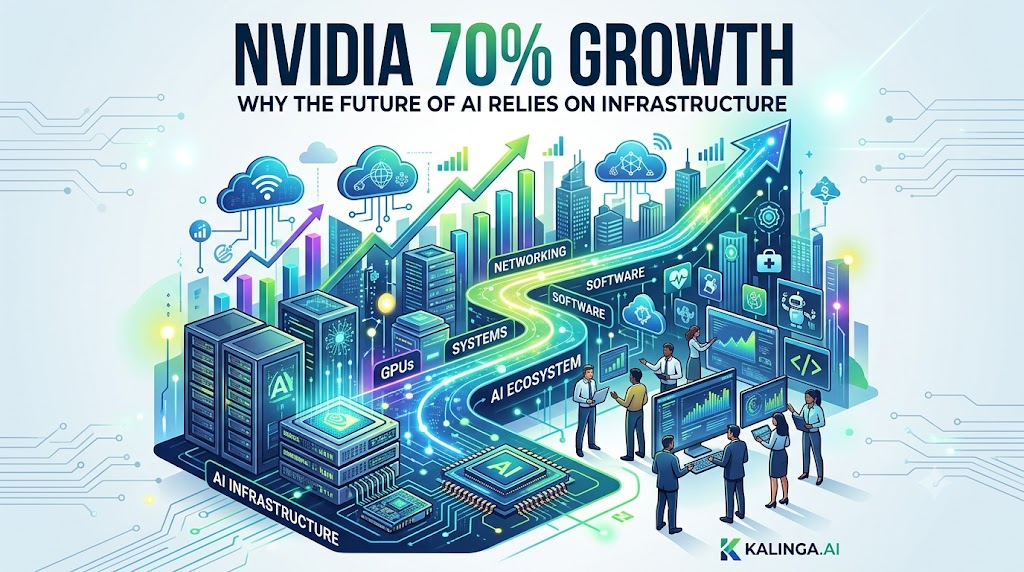
Why does Jensen Huang expect Nvidia to grow 70% next year?
Imagine a company that already expects to generate roughly $400 billion in annual revenue , and its CEO says it could still grow another 70% the following year.
That is the scale of the Nvidia story in 2026. Nvidia CEO Jensen Huang said at the Goldman Sachs Communacopia + Technology conference on September 10 that he remains confident the company could achieve 70% year-over-year growth next year, potentially taking revenue to around $680 billion based on current analyst expectations for the present fiscal year.
The key reason behind the Nvidia 70% growth outlook is not simply that the company sells powerful GPUs. Huang argues that Nvidia has become deeply embedded across the entire AI ecosystem, from memory and data centers to cloud providers, AI labs, startups and the companies building the next generation of AI applications.
TechCrunch reported that Huang described Nvidia as a “foundational platform” of the AI industry, emphasizing that the company works with essentially every major category of AI developer.
Definition + Expansion: What is Nvidia’s 70% growth forecast?
Nvidia 70% growth refers to Jensen Huang’s expectation that Nvidia’s revenue could increase by approximately 70% year over year in the company’s next fiscal year.
This is a forecast, not a guaranteed result. The estimate reflects Huang’s confidence that demand for AI computing infrastructure will remain extremely strong and that Nvidia will continue capturing spending from companies building and operating increasingly large AI systems.
Question → Direct Answer: Is the 70% figure Nvidia’s official guaranteed revenue?
No. The 70% growth figure is Jensen Huang’s outlook rather than a guaranteed result. It represents his confidence in Nvidia’s future demand based on the company’s visibility into AI infrastructure projects, customers and partners.
What does Nvidia’s 70% growth forecast mean in revenue?
Percentages can sound abstract, so the easiest way to understand the forecast is to translate it into dollars.
According to the figures reported by TechCrunch, analysts expect Nvidia to finish its current fiscal year with approximately $400 billion in revenue. If revenue subsequently increased by 70%, Nvidia would generate roughly $680 billion the following year.
| Metric | Approximate figure |
| Expected current-year revenue | $400 billion |
| Huang’s projected growth | 70% |
| Implied next-year revenue | $680 billion |
| Approximate additional revenue | $280 billion |
| Key growth driver | AI infrastructure demand |
That potential $280 billion increase is what makes the forecast extraordinary. It would mean Nvidia adding revenue equivalent to the annual sales of a massive global technology business in a single year.
But the important point is that Huang is not presenting the forecast as a bet on one particular GPU generation.
His argument is that Nvidia now participates in almost every major layer of AI computing.
Definition + Expansion: What is AI infrastructure?
AI infrastructure is the combination of computing hardware, networking, data centers, power, memory, software and cloud systems required to develop and operate artificial intelligence.
A modern AI data center is therefore much more than a collection of chips. It needs high-performance processors, networking systems, memory, cooling, electricity, buildings and software capable of coordinating enormous numbers of computing components.
That broader infrastructure opportunity is central to Nvidia’s strategy.
Question → Direct Answer: Why is the $680 billion figure important?
It shows how extraordinary Huang’s forecast is. If Nvidia reaches approximately $400 billion in the current fiscal year and grows 70%, revenue could approach $680 billion, illustrating how quickly AI infrastructure spending could expand.
Why is Nvidia more than a chip company?
For years, Nvidia was widely associated with graphics processing units, or GPUs.
GPUs are processors originally designed to handle graphics workloads, but their ability to perform many calculations simultaneously made them extremely useful for machine learning. As AI models became larger and more computationally demanding, Nvidia GPUs became a core component of AI data centers.
Huang argues that this description is now outdated.
At the Goldman Sachs conference, he explained that people still sometimes think of Nvidia as a company that simply manufactures chips. His response was that the scale of a modern Nvidia computing system is dramatically different from the GPUs sold during the company’s early gaming-focused years.
Huang said one modern GPU system can cost about $8.5 million, contain around 2 million parts, consume approximately 250,000 kilowatts, and require thousands of units to be shipped.
That is closer to an industrial computing platform than a conventional computer component.
Definition + Expansion: What is a GPU?
A GPU, or graphics processing unit, is a processor designed to perform many calculations in parallel, making it highly effective for graphics and AI workloads.
Modern AI systems use GPUs to train models and run what is called inference , the process of using a trained model to generate an answer, prediction, image, video or other output. Nvidia has built hardware, networking and software around these workloads, creating a broader platform rather than selling an isolated chip.
Question → Direct Answer: Why does Nvidia want to be seen as a platform?
Because a platform can capture value from multiple parts of the computing ecosystem. Instead of depending only on individual chip sales, Nvidia can participate in networking, complete computing systems, software and the wider infrastructure required to run AI.
How fast are Nvidia’s AI systems selling?
Huang also pointed to strong demand for Nvidia’s integrated AI computing systems.
One example is the GB200 NVL72 system, which combines 36 Grace CPUs with 72 Blackwell GPUs. Huang said sales of this particular computer system were experiencing 27% month-to-month growth.
That figure is significant because it illustrates how AI customers are increasingly buying complete computing platforms rather than individual processors.
Large AI models require enormous amounts of computing power. Connecting many GPUs together allows them to operate as part of a much larger system, which is why networking and high-speed communication between processors are increasingly important.
Definition + Expansion: What is a GPU computing system?
A GPU computing system combines multiple processors, networking technologies, memory and other components into a coordinated platform for demanding workloads such as AI.
For AI companies, buying a complete system can make it easier to deploy the computing capacity needed for training and inference. For Nvidia, it also creates a larger business opportunity than selling individual chips.
Question → Direct Answer: What does 27% monthly growth tell us?
It indicates that demand for Nvidia’s complete AI computing systems is still accelerating. Huang used the figure as evidence that the market is not simply buying individual GPUs but increasingly investing in large-scale AI infrastructure.
How is Nvidia embedded across the AI ecosystem?
This is arguably the most important part of the Nvidia 70% growth argument.
Huang said Nvidia runs essentially every major type of AI model and works with companies including Anthropic, OpenAI and Google, as well as organizations developing open-weight AI models.
That creates an unusual position.
If an AI company succeeds, Nvidia can potentially benefit because the company needs computing infrastructure. If another AI company succeeds, Nvidia can benefit again.
The same logic applies to cloud providers, AI-native startups and data-center operators.
Huang described Nvidia as being connected to the ecosystem from memory-chip suppliers all the way through data-center projects and startups.
He also said Nvidia tracks every gigawatt of land, power and data-center shell around the world.
That gives the company an unusually broad view of where future AI computing capacity is being developed.
Definition + Expansion: What is an AI ecosystem?
An AI ecosystem is the network of companies, infrastructure providers, researchers, cloud platforms, chipmakers and software developers that collectively build and operate AI systems.
Nvidia sits at the hardware and infrastructure center of much of this ecosystem. Its customers include companies that develop AI models, cloud providers that rent computing capacity and businesses building applications on top of AI.
Question → Direct Answer: Why does Nvidia’s ecosystem position matter for growth?
It gives Nvidia visibility into demand from multiple parts of the market. If AI model development, cloud computing, data centers and AI applications all expand simultaneously, Nvidia can potentially benefit from several layers of that growth.
Which companies are challenging Nvidia?
The Nvidia 70% growth forecast comes at a time when competition is becoming more intense.
Nvidia is no longer competing only with traditional semiconductor companies. Some of its biggest customers are also developing alternatives.
According to TechCrunch, major hyperscalers including Amazon, Microsoft and Google are developing their own AI chips. AI labs such as Anthropic and OpenAI are also working on custom silicon or infrastructure strategies.
Meanwhile, semiconductor competitors such as Cerebras and startups such as Etched are pursuing alternative approaches to AI computing.
| Competitor type | Examples | Why it matters to Nvidia |
| Hyperscalers | Amazon, Microsoft, Google | Can design chips for their own cloud workloads |
| AI labs | Anthropic, OpenAI | May reduce dependence on external processors |
| AI chip companies | Cerebras | Offer alternative architectures |
| AI chip startups | Etched | Target specialized AI workloads |
| Nvidia | GPUs, systems, networking, software | Broad platform approach |
The biggest question is whether Nvidia’s ecosystem advantage will remain strong as competitors develop alternatives.
Definition + Expansion: What are hyperscalers?
Hyperscalers are very large technology companies that operate enormous cloud and computing infrastructures.
Amazon, Microsoft and Google are examples. Because they operate their own cloud platforms, they have a strong incentive to develop specialized chips that can reduce costs or optimize particular workloads.
Question → Direct Answer: Does competition automatically threaten Nvidia’s growth?
Not necessarily. Competition could reduce Nvidia’s market share in some workloads, but Huang’s argument is that Nvidia’s relationships span the entire AI industry. The company is therefore trying to remain useful even as customers experiment with alternative hardware.
Why are Nvidia’s circular deals attracting attention?
Nvidia’s growing influence has also raised questions about its investments in AI companies.
The issue is often described as circular financing or circular deals. The basic concern is straightforward: Nvidia invests money in an AI company, and that company then uses some of its funding to purchase Nvidia’s hardware.
Critics can ask whether this artificially strengthens demand for Nvidia’s products.
The concern is not entirely new. Tech companies and infrastructure suppliers have faced similar questions during previous technology investment cycles.
Huang gave a deliberately humorous response at the conference.
He argued that if Nvidia puts in $1 and ultimately sees $100 come back through legitimate business, he does not consider that circular. More importantly, he said Nvidia checks whether potential investment targets already have real customer contracts generating revenue.
Huang said Nvidia has seen around $100 billion worth of such contracts and emphasized that the company wants evidence of genuine demand.
Definition + Expansion: What is a circular deal?
A circular deal is an arrangement where an investment can ultimately flow back to the original investor through purchases or business transactions.
In Nvidia’s case, the concern arises when Nvidia invests in an AI company that subsequently purchases Nvidia computing infrastructure. Huang’s defense is that the underlying AI companies must have real customers and revenue-generating contracts rather than relying solely on Nvidia’s investment.
Question → Direct Answer: Why do investors care about these deals?
Because strong reported demand can look less convincing if the same money repeatedly circulates between companies. The key issue is whether AI infrastructure purchases are supported by genuine end-customer demand.
Can Nvidia maintain its AI dominance long term?
The Nvidia 70% growth outlook is impressive, but it is not without risks.
Technology markets rarely remain unchanged. A company can dominate one generation of technology and then lose ground when a new architecture, business model or computing approach appears.
Nvidia itself recognizes that much of today’s AI expansion is being driven by AI-native startups. These companies are raising enormous amounts of capital and spending significant portions of that money on AI computing.
That creates both an opportunity and a risk.
In the short term, Nvidia benefits when startups spend heavily on infrastructure. But as the AI industry matures, those startups will face pressure to become more efficient.
They may need to generate more output from fewer tokens, use smaller models for certain tasks, optimize inference and reduce infrastructure costs.
Question → Direct Answer: What could slow Nvidia’s growth?
Several factors could matter: stronger competition, custom AI chips, more efficient AI models, reduced infrastructure spending, slower startup funding and customers finding ways to achieve more AI output with less computing power.
Key risks to watch
- Custom chips: Major cloud companies could shift more workloads to their own processors.
- AI efficiency: Better algorithms could reduce the amount of computing required.
- Market concentration: Nvidia is highly exposed to a relatively small number of very large technology customers.
- Capital spending cycles: AI infrastructure investment could slow after major data-center buildouts.
- New architectures: Alternative processors could become competitive for specific workloads.
- Startup economics: AI companies may eventually need to reduce infrastructure spending and improve margins.
The bigger question is therefore not simply whether Nvidia can sell more GPUs.
It is whether Nvidia can remain the preferred infrastructure platform as AI computing becomes more efficient and competitive.
What does Nvidia’s growth story mean for India?
For Indian students and young professionals, the most interesting part of the Nvidia 70% growth story is not necessarily Nvidia stock or revenue.
It is the scale of the infrastructure opportunity being created around AI.
AI requires far more than model developers. It needs semiconductor engineers, cloud specialists, data-center operators, networking experts, power engineers, software developers, cybersecurity professionals, AI researchers and people who can deploy AI systems inside businesses.
India is already deeply connected to global technology supply chains, software services and cloud operations. As AI infrastructure expands, the skills required to support that infrastructure can also become more valuable.
For students, this means learning AI does not necessarily mean becoming a machine-learning researcher.
Definition + Expansion: What is AI infrastructure talent?
AI infrastructure talent refers to professionals who build, operate, optimize or support the computing systems required for AI.
That includes hardware and semiconductor engineering, cloud computing, distributed systems, networking, data-center technologies, AI deployment and infrastructure security. These roles sit between traditional software engineering and the physical infrastructure powering modern AI.
Question → Direct Answer: What skills should Indian students focus on?
A strong foundation in programming, cloud computing, data structures, networking and AI fundamentals can create several entry points into the AI infrastructure economy. Students interested in hardware can additionally explore computer architecture, semiconductor design and high-performance computing.
What can young professionals learn from Nvidia’s strategy?
There is a broader career lesson inside Huang’s comments.
Nvidia did not become central to AI simply because it produced a fast processor. It built an ecosystem around that processor, including software, networking, developer tools and complete computing systems.
That suggests an important principle for technology careers: the biggest opportunities often appear at the intersection between technologies rather than inside a single technology category.
For example, someone who understands both AI and cloud infrastructure can solve problems that a person with knowledge of only one field may struggle to address.
The same applies to AI and cybersecurity, AI and semiconductors, AI and networking, or AI and energy systems.
A practical learning roadmap
- Start with Python and programming fundamentals.
- Learn how cloud computing works.
- Understand basic AI and machine-learning concepts.
- Study GPUs, CPUs and computer architecture.
- Learn the basics of networking and distributed systems.
- Explore how AI models move from training into production inference.
- Build small projects using cloud or local AI infrastructure.
- Follow developments in chips, data centers and AI model efficiency.
Question → Direct Answer: Should every student learn GPU programming?
No. GPU programming can be valuable for specialized careers, but a broader understanding of AI infrastructure can be useful even for people who never directly program a GPU. The important lesson is understanding how AI applications depend on computing, cloud systems, hardware and data.
Why Nvidia’s 70% forecast matters for the future of AI
The Nvidia 70% growth prediction tells us something larger than a single company’s revenue target.
It reflects how much capital the technology industry is still willing to spend on AI computing.
The AI boom began with models, but scaling those models requires enormous infrastructure. That infrastructure includes processors, networking, memory, electricity, buildings and software.
Nvidia has positioned itself at the center of that spending cycle.
Its advantage is not simply that it produces powerful chips. It is that Nvidia increasingly knows where AI infrastructure is being built, who is building it, which companies need it and what workloads those systems will run.
That ecosystem visibility is precisely what Huang believes allows him to “see the future.”
Whether that confidence proves justified will depend on what happens next.
If AI adoption continues accelerating, Nvidia could remain one of the biggest beneficiaries. If customers become more efficient, alternative chips improve or AI infrastructure spending slows, the company’s growth could become much harder to sustain.
For now, however, the numbers explain why Huang remains so bullish.
A projected $400 billion current-year revenue base, a potential 70% growth rate and an implied $680 billion next-year revenue figure would put Nvidia in an extraordinary position in the global technology industry.
FAQ: Nvidia’s 70% Growth Forecast
What is Nvidia’s expected growth next year?
Nvidia CEO Jensen Huang said he believes Nvidia could achieve approximately 70% year-over-year revenue growth next year. Based on analyst expectations of around $400 billion in current-year revenue, that would imply roughly $680 billion in revenue.
Why does Jensen Huang expect Nvidia to grow 70%?
Huang believes Nvidia is deeply embedded across the AI ecosystem. The company supplies infrastructure to AI labs, cloud providers, startups and other organizations while also having visibility into data-center, power and computing projects.
Is Nvidia only a GPU company?
No. Nvidia has expanded from GPU manufacturing into a broader AI computing platform that includes GPUs, CPUs, networking, complete computing systems and software. This broader platform strategy is a major part of its AI infrastructure business.
Who competes with Nvidia in AI chips?
Nvidia faces competition from several directions. Amazon, Microsoft and Google are developing their own AI chips, while AI companies including Anthropic and OpenAI are exploring custom hardware strategies. Companies such as Cerebras and Etched also compete in AI computing.
What are Nvidia’s circular deals?
Circular deals refer to situations where Nvidia invests in an AI company and that company subsequently purchases Nvidia hardware. Huang argues these transactions are supported by real customer contracts and revenue rather than being simply a closed loop of financing.
Can Nvidia maintain its AI dominance?
It is possible, but not guaranteed. Nvidia faces risks from custom chips, competitors, more efficient AI models, changing infrastructure spending and startups becoming more disciplined about computing costs.
Final Takeaway
The Nvidia 70% growth forecast is ultimately a bet on the continued expansion of AI infrastructure. Jensen Huang believes Nvidia’s position across chips, systems, networking, software and the wider AI ecosystem gives the company unusually strong visibility into future demand.
For the technology industry, the bigger lesson is clear: AI growth is becoming an infrastructure story as much as a model story. And for students and professionals, understanding the infrastructure underneath AI could become just as valuable as understanding the AI applications themselves.
Follow Kalinga.ai for more explainers on AI chips, data centers, emerging AI companies and the technologies shaping India’s digital future.