Why AI in Conservation Is Entering a New Era
Artificial intelligence has already changed how people work with information.
Generative AI can summarize documents, write code and analyze text. Machine-learning systems can identify patterns in huge datasets. Computer vision can recognize objects and organisms in images. These capabilities are now moving into scientific research, where the datasets can be far more complicated than a spreadsheet or a collection of documents.
Biology is one of the areas where this shift could become particularly significant.
Modern biological research produces enormous amounts of information about genes, cells, organisms and biological processes. Understanding that information can require computational methods capable of identifying patterns that would be difficult to find manually.
Question → Direct Answer: Why is AI becoming important in conservation?
AI can help researchers analyze genetic data, model biological systems and accelerate parts of the scientific discovery process. In conservation, these capabilities could support research into biodiversity and species, although AI is only one component of a much larger scientific and ecological process.
That distinction is important.
AI does not independently revive extinct species. Instead, it can serve as a computational tool within projects that combine artificial intelligence with genetics, synthetic biology and other areas of life science.
This is what makes the emerging field so interesting.
The conversation is no longer simply about whether computers can become smarter. It is increasingly about what happens when computational intelligence is applied to living systems.
What Is AI in Conservation?
Definition , AI in conservation: AI in conservation refers to the use of artificial intelligence and related computational methods to analyze biological or environmental information and support research, monitoring, prediction and conservation efforts.
The term covers a broad range of applications. It can include analyzing genetic information, identifying patterns in biological datasets, modeling ecosystems or supporting scientific research.
The technology can also intersect with synthetic biology.
Synthetic biology is an approach to biology that involves designing or modifying biological systems for specific purposes. When computational tools are combined with synthetic biology, researchers can use AI-assisted analysis alongside laboratory techniques to investigate biological questions.
This does not mean that every AI system used in biology is capable of changing an organism.
Rather, AI can help researchers process the information required to make decisions about what biological experiments or interventions might be possible.
How AI and Synthetic Biology Connect
Think of the relationship as a technology stack.
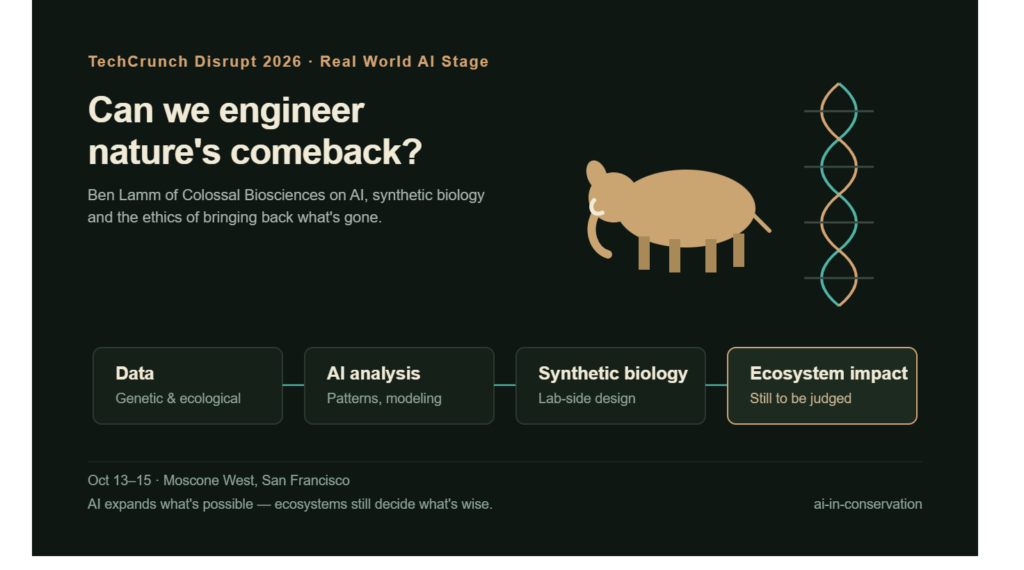
At one level, researchers collect biological information. At another, computational systems help analyze that information. Synthetic biology then provides laboratory techniques for designing or modifying biological systems.
The combination can create new possibilities that would be much harder to explore using any one technology alone.
Question → Direct Answer: Is AI the same as synthetic biology?
No. AI is a computational technology, while synthetic biology is a field of biological engineering. They can work together, with AI helping analyze information or model biological systems while synthetic biology provides methods for working with biological systems.
That distinction will become increasingly important as discussions around AI and biology move from theoretical possibilities toward real-world applications.
How Colossal Biosciences Is Exploring De-Extinction
One company sits prominently at the center of this debate: Colossal Biosciences.
The company is pioneering efforts to bring extinct species back through advances in synthetic biology and AI. Its work has helped turn de-extinction from a purely speculative idea into a topic of serious discussion across science, technology and investment circles.
But what exactly does “de-extinction” mean?
Definition , De-extinction: De-extinction refers to scientific efforts aimed at restoring extinct species or recreating organisms with characteristics of extinct animals using modern biological technologies.
The idea immediately sounds futuristic because extinction has traditionally been treated as permanent.
Once a species disappears, its biological lineage can no longer continue in its original form. De-extinction research asks whether modern biotechnology can overcome some of those limitations by using surviving genetic information and related biological species.
AI can become part of this process by helping researchers work with complex biological datasets.
However, it is important not to reduce the science to a simple formula of “AI plus DNA equals extinct animal.”
The actual scientific challenges are considerably more complicated.
Who Is Ben Lamm?
Ben Lamm, co-founder and CEO of Colossal Biosciences, is the entrepreneur representing this ambitious intersection of technology and biology at TechCrunch Disrupt 2026.
According to the TechCrunch Events article, Lamm has spent more than two decades building companies at the intersection of AI and emerging technologies.
Before Colossal Biosciences, he founded several technology companies, including Hypergiant, Conversable and Chaotic Moon. Those companies were later acquired by Trive Capital, LivePerson and Accenture, respectively.
His career provides an unusual bridge between software entrepreneurship and biological engineering.
Today, his focus is a problem that goes well beyond traditional technology products: exploring whether de-extinction could become a conservation tool.
Question → Direct Answer: Why is Ben Lamm speaking about AI and conservation?
Lamm leads Colossal Biosciences, a company exploring de-extinction through synthetic biology and AI. His experience as a technology entrepreneur gives him a perspective on applying emerging technologies to biological and conservation challenges.
That combination is precisely what makes the Disrupt discussion unusual.
It brings together two worlds that are often discussed separately: AI startups and life sciences.
How AI Could Change Biological Research
The most important contribution of AI to biology may not be a dramatic headline about a revived species.
It could be something more fundamental: helping researchers understand biological information faster and at greater scale.
Analyzing Genetic Data
Genetic information contains enormous amounts of biological detail.
Researchers can use computational tools to examine patterns in genetic sequences and compare information across organisms. AI can assist with this type of analysis by processing complex datasets and identifying relationships that warrant further investigation.
For de-extinction research, genetic information is particularly important because extinct organisms cannot simply be studied like living populations.
Scientists may instead need to work with whatever biological and genetic information remains available, alongside information from related living species.
Modeling Biological Systems
Biology is not simply a collection of independent pieces.
Genes interact with biological systems, organisms interact with environments, and ecosystems contain relationships between many different species.
AI-based models can help researchers study these complicated relationships.
Question → Direct Answer: What does AI contribute to biological modeling?
AI can help researchers process complex biological information and model patterns or relationships within biological systems. Its value comes from supporting scientific analysis rather than replacing laboratory experiments or ecological expertise.
Accelerating Scientific Discovery
Another potential advantage is speed.
Scientific research can require researchers to examine enormous datasets before reaching a useful hypothesis. Computational systems can help narrow the field of possibilities and identify patterns that researchers can investigate further.
This is one reason AI and biology have become such an important technology intersection.
The same basic computational capabilities that make AI powerful in software,pattern recognition, prediction and large-scale data analysis,can potentially be applied to biological questions.
But biology has a major difference from software.
The real world pushes back.
A model can generate a prediction. A laboratory experiment still has to test it. An organism still has to survive. An ecosystem still has to respond.
That makes biological AI applications fundamentally different from many digital applications.
AI in Conservation vs Traditional Conservation
The emergence of AI does not mean conventional conservation suddenly becomes obsolete.
In fact, the two approaches can complement each other.
Traditional conservation focuses heavily on protecting species and habitats that exist today. Emerging approaches involving AI and biotechnology explore whether technology can address problems that were previously considered impossible or extremely difficult.
| Approach | Main Focus | Potential Role | Key Challenge |
| Traditional conservation | Existing species and habitats | Protect biodiversity today | Habitat loss and ecological pressures |
| AI-assisted research | Biological and environmental data | Identify patterns and accelerate analysis | Requires high-quality data and scientific validation |
| Synthetic biology | Biological systems | Design or modify biological processes | Complex biological and ethical considerations |
| De-extinction technology | Extinct species | Explore restoration or recreation | Scientific feasibility and ecological consequences |
| AI + synthetic biology | Computational and biological systems | Combine data analysis with biological engineering | Requires multidisciplinary expertise |
Question → Direct Answer: Does AI replace traditional conservation?
No. AI can support conservation research, but protecting existing species and ecosystems remains a fundamentally different challenge. De-extinction and other advanced technologies should therefore be viewed as potential additions to conservation strategies, not automatic replacements for habitat protection or species preservation.
This is one of the central tensions in the debate.
If technology can help revive an extinct species, that does not necessarily mean it is the most effective way to protect biodiversity.
Can De-Extinction Actually Help Biodiversity?
This is where the conversation becomes much more complicated.
The emotional appeal of bringing an extinct species back is obvious. Extinction represents a permanent loss, and reversing that loss sounds like one of the most powerful applications imaginable for biotechnology.
But conservation is about ecosystems, not just individual animals.
A species exists within a network of relationships involving food, predators, climate, habitat and other organisms. Bringing back an organism without considering that surrounding ecosystem could create entirely different challenges.
The Potential Conservation Benefits
Supporters of de-extinction argue that biotechnology could potentially contribute to conservation in ways that extend beyond individual extinct species.
Research into extinct animals can also generate knowledge about genetics, biological resilience and ecosystems.
Meanwhile, the development of tools for working with endangered species could potentially have applications outside de-extinction itself.
Question → Direct Answer: Could de-extinction contribute to conservation?
Potentially, yes, but the value depends on whether revived or recreated organisms can meaningfully contribute to functioning ecosystems and conservation goals. The technology must therefore be evaluated not only by whether an organism can be produced, but also by what ecological purpose it would serve.
That is a much harder test.
The Risk of Creating a Distraction
There is another side to the argument.
Thousands of species are threatened by pressures affecting ecosystems today. Protecting habitats, reducing human-driven environmental damage and supporting existing populations are immediate conservation challenges.
If enormous amounts of attention and investment flow toward extinct species, critics may ask whether resources would be better spent protecting species that are still alive.
This creates a difficult comparison:
Should humanity spend more effort reversing extinction, or preventing the next extinction?
There is no simple answer.
The debate is ultimately about priorities.
Why TechCrunch Disrupt 2026 Is Bringing AI and Biology Together
The discussion around AI in conservation is especially relevant because technology companies are increasingly moving into scientific domains.
TechCrunch Disrupt 2026 will bring this conversation to the Real World AI Stage through the fireside chat “Can We Engineer Nature’s Comeback?”
Ben Lamm will discuss the technologies behind de-extinction, the role of AI in modern biology and the debate around whether engineering nature represents a conservation breakthrough or a distraction from protecting existing ecosystems.
The event will take place at Moscone West in San Francisco from October 13–15, 2026.
According to the source article, Disrupt is expected to bring together 10,000+ founders, investors and operators across 250+ sessions exploring technologies and market forces shaping the future.
That makes the session relevant beyond biology.
For founders, it provides an example of how AI is expanding into industries that have traditionally required deep domain expertise. For students and young professionals, it demonstrates why future technology careers may increasingly sit at the intersection of disciplines.
Question → Direct Answer: Why does this TechCrunch Disrupt session matter?
It shows how AI is moving beyond software into biology, conservation and other real-world scientific fields. The conversation also highlights the ethical and ecological questions that emerge when technological capabilities become powerful enough to influence living systems.
What Founders and Students Can Learn From AI and Biology
For people entering technology careers, the biggest lesson may not be about de-extinction itself.
It is about interdisciplinary thinking.
The next generation of AI opportunities may not come exclusively from building another chatbot or productivity application. AI is increasingly being connected with medicine, robotics, energy, climate science, biology and other specialized fields.
That means technical skills will increasingly need to be paired with domain knowledge.
Students interested in this space can start by understanding the basics of:
- Artificial intelligence and machine learning
- Genetics and genomics
- Synthetic biology
- Computational biology
- Conservation science
- Ecology and biodiversity
- AI ethics and responsible innovation
You do not need to become an expert in every field.
Instead, developing enough knowledge to understand how these disciplines interact can help you recognize opportunities that are invisible when each field is studied separately.
Why This Matters for Indian Students
For students and young professionals in India, this trend is especially relevant because AI is becoming a general-purpose technology.
The important career question is gradually shifting from “Do you know AI?” to “What problem can you solve with AI?”
A person who understands both AI and a scientific or industrial domain may be able to approach problems differently from someone who knows only one side.
That could create opportunities in research, biotechnology, climate technology, healthcare, environmental monitoring and scientific computing.
Question → Direct Answer: What should students take away from AI in conservation?
Students should view AI as a tool that can be combined with domain expertise rather than as a standalone career field. Learning how AI works alongside biology, environmental science or other disciplines can open pathways into emerging areas of technology.
The Bigger Questions Around Engineering Nature
The most fascinating part of this story may ultimately have nothing to do with whether a particular extinct animal can return.
It is about where humanity draws the line between restoring nature and redesigning it.
For centuries, conservation has largely meant protecting natural systems from human interference.
New biotechnology introduces another possibility: actively changing biological systems to address environmental problems.
That shift carries enormous responsibility.
1. What Should Count as Conservation?
If scientists recreate an organism with characteristics of an extinct species, is that automatically conservation?
Not necessarily.
Conservation usually involves protecting biodiversity and ecological systems. A recreated organism would need to be considered within the context of its habitat, ecological relationships and potential effects.
2. Who Decides What Nature Should Look Like?
Technology can make new interventions possible, but technical feasibility does not automatically establish that an intervention is desirable.
Scientists, conservationists, policymakers, local communities and the public may all have different perspectives on what should happen.
3. How Much Intervention Is Too Much?
This may become one of the defining ethical questions of advanced biotechnology.
Humans already influence ecosystems in countless ways. The emergence of synthetic biology and AI could increase the precision and scale of that influence.
The challenge will be deciding when intervention is justified.
4. Could the Same Technology Help Living Species?
This may be one of the most constructive ways to evaluate AI in conservation.
Rather than focusing exclusively on extinct animals, researchers could also ask whether advances in genetics, computational biology and AI can help protect endangered species or better understand biological resilience.
That shifts the conversation from “Can we bring something back?” toward “Can we prevent more things from disappearing?”
Both questions matter.
What the Future of AI in Conservation Could Look Like
The future is unlikely to be a simple world where AI controls ecosystems.
A more realistic picture is one where AI becomes another layer in a multidisciplinary scientific process.
Researchers could use computational systems to analyze increasingly complex datasets. Biologists could use those insights to formulate experiments. Conservationists could evaluate ecological consequences. Policymakers and communities would still need to decide whether particular interventions are appropriate.
In other words, AI may become more powerful without becoming the decision-maker.
That distinction is crucial.
The technology can help humans see patterns, explore possibilities and accelerate research. But decisions involving living systems carry consequences that cannot be evaluated through computational performance alone.
The most valuable development may therefore be the combination of AI capability with biological expertise, ecological understanding and responsible governance.
That is what makes the discussion around de-extinction so much bigger than one startup or one extinct species.
It is a preview of a future in which artificial intelligence increasingly interacts with the physical and biological world.
Why the AI and Biology Intersection Matters Now
The conversation at TechCrunch Disrupt 2026 arrives at an important moment.
AI has already moved from research laboratories into everyday products. The next phase could involve deeper integration with scientific and physical systems.
Biology presents one of the most challenging frontiers because living systems are complex, interconnected and difficult to predict.
That makes the stakes different.
A software update can be rolled back. An ecological intervention may not be so easily reversed.
Question → Direct Answer: What is the biggest lesson from the AI-biology debate?
The biggest lesson is that technological capability and responsible application are two different things. AI may expand what scientists can analyze and engineer, but decisions about biodiversity and living systems require scientific validation, ecological context and careful ethical judgment.
For that reason, the future of AI in conservation should not be measured only by spectacular technological demonstrations.
It should also be measured by whether these tools help protect biodiversity, improve scientific understanding and solve real environmental problems without creating new ones.
That is the conversation worth having.
And it is precisely why a question such as “Can We Engineer Nature’s Comeback?” is bigger than de-extinction.
It is a question about the future relationship between technology and nature.
FAQ
What is AI in conservation?
AI in conservation is the use of artificial intelligence and computational techniques to analyze biological or environmental information and support conservation research and decision-making. Applications can include analyzing genetic data, identifying patterns and modeling biological systems.
Can AI revive extinct species?
AI alone cannot revive an extinct species. De-extinction research combines multiple technologies, including genetics, synthetic biology and computational methods, with AI potentially helping researchers analyze biological information and model complex systems.
What is Colossal Biosciences?
Colossal Biosciences is a biotechnology company exploring efforts to bring extinct species back through advances in synthetic biology and AI. Its work has made de-extinction a prominent topic in discussions about biotechnology, conservation and biodiversity.
What is de-extinction technology?
De-extinction technology refers to scientific approaches aimed at restoring extinct species or recreating organisms with characteristics of extinct animals using modern biological tools. The field raises questions about scientific feasibility, ecological consequences and conservation priorities.
How can AI and biology work together?
AI can process and analyze complex biological information, while biology and synthetic biology provide methods for studying, designing or modifying biological systems. Combining the fields can help researchers investigate questions that require both computational analysis and laboratory science.
Why is AI in conservation controversial?
AI in conservation becomes controversial when technological intervention raises questions about ecological risk, ethics and conservation priorities. De-extinction, for example, could offer new scientific possibilities while also raising concerns that resources or attention could shift away from protecting species and ecosystems that still exist.
Final Takeaway
AI is not simply changing software anymore; it is beginning to influence how humans study and interact with the living world. The real test will be whether technologies such as AI, genetics and synthetic biology can expand conservation without making humans less careful about the ecosystems they are trying to protect.
For more explainers on emerging AI, science and technology trends, keep exploring Kalinga.ai and follow how these technologies move from ambitious ideas into the real world.