What Is the Superhuman Fathom Acquisition About?
The Superhuman Fathom acquisition brings a popular AI meeting notetaker into a productivity platform that is increasingly built around AI-powered automation.
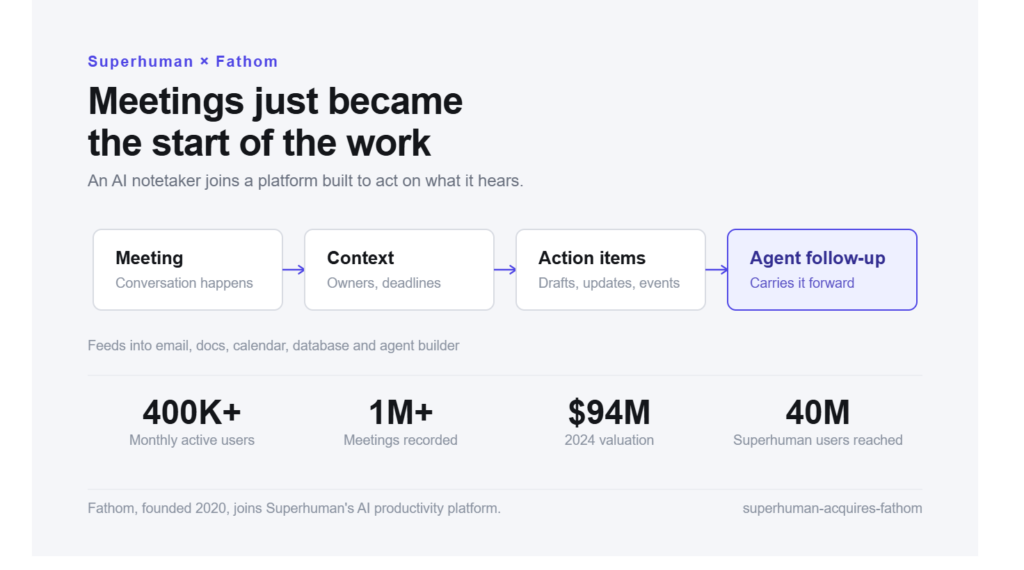
Fathom records meetings and helps users capture useful information from conversations. Superhuman can now potentially use that information as context for actions across email, calendars, documents, databases, and AI agents.
That creates a different vision for meeting software.
Instead of treating a meeting as an event that ends when participants leave the call, an AI-powered productivity platform can treat the meeting as the beginning of a workflow.
Definition + Expansion
AI meeting notetaker is software that uses artificial intelligence to record, transcribe, summarize, and extract useful information from meetings.
Traditional meeting notes require someone to listen, write down important points, organize them, and remember what needs to happen next. AI notetakers automate much of that process, creating summaries and identifying action items that can potentially feed into other productivity tools.
The next step is agentic work: AI systems proactively using information to perform or initiate tasks rather than waiting for a user to manually start each workflow.
Question → Direct Answer: What did Superhuman acquire?
Superhuman acquired Fathom, a YC-backed AI meeting notetaker founded in 2020. The acquisition gives Superhuman access to Fathom’s meeting-recording technology, product experience, and user base as it expands its AI-centered productivity platform.
Why Did Superhuman Acquire Fathom Instead of Building It?
The most revealing part of the deal may be that Superhuman had already tried to build a notetaker itself.
TechCrunch reported that Superhuman tested an internally developed notetaker with select users earlier in 2026. The company ultimately decided that acquiring a finished product was a better path.
Superhuman CEO Shishir Mehrotra told TechCrunch that the internal testing increased the company’s confidence that there was demand for the category. It also demonstrated how difficult it is to build a high-quality meeting-recording product.
That distinction matters.
At first glance, an AI notetaker can appear relatively simple: record audio, transcribe it, summarize the conversation, and identify action items.
In practice, creating a product people trust with important conversations involves many interconnected technical and product challenges.
Question → Direct Answer: Why did Superhuman choose acquisition over building its own notetaker?
Superhuman chose to acquire Fathom after testing an internal product and realizing how much work is required to build a strong meeting notetaker. Fathom already had an established product, technical capabilities, and a substantial user base, allowing Superhuman to accelerate its plans.
The Hidden Complexity of Meeting AI
A meeting can contain multiple speakers, interruptions, background noise, technical terminology, incomplete sentences, jokes, decisions, disagreements, and references to earlier conversations.
Simply converting audio into text is therefore only one part of the problem.
A useful meeting product needs to turn an unstructured conversation into information that people can actually use.
That can include:
- Meeting summaries
- Decisions
- Action items
- Important questions
- Follow-up tasks
- Customer requirements
- Deadlines
- Names and responsibilities
- Relevant business context
The value comes from transforming a conversation into structured information.
And that structured information is precisely what an AI agent can potentially use later.
Why Are AI Meeting Notetakers Becoming More Important?
Meetings contain something productivity software has historically struggled to capture: context.
Email tells you what someone wrote.
A calendar tells you when an event happened.
A task manager tells you what someone entered as a task.
A meeting can explain why the task exists in the first place.
A customer might say that a feature is urgent. A manager might assign a follow-up. A team might agree to change a deadline. A sales prospect might reveal a requirement that never appears in an email.
The meeting therefore contains valuable context that can disappear once the conversation ends.
AI notetakers can preserve that context.
Question → Direct Answer: Why are meetings valuable to AI productivity platforms?
Meetings contain decisions, action items, customer needs, and business context that can inform future work. Capturing this information gives AI productivity platforms a richer source of context for drafting emails, updating records, scheduling follow-ups, and initiating workflows.
How Does Fathom Fit Into Superhuman’s AI Platform?
The acquisition makes more sense when viewed alongside Superhuman’s existing products.
According to the TechCrunch report, Superhuman already has:
- An email client
- A docs application
- A calendar
- A database solution
- An AI agent builder platform
Adding a meeting notetaker creates another important source of information.
Imagine a sales meeting where a customer asks for a proposal and requests a follow-up call.
A conventional notetaker might produce a summary.
A more agentic productivity platform could potentially turn that information into a sequence of actions:
Meeting → context → action items → email draft → database update → calendar event
The meeting is no longer simply something to document.
It becomes an input for automated work.
From Notes to Actions
This is the central strategic reason Superhuman acquires Fathom.
The value of meeting intelligence increases when it connects to other applications.
For example, meeting information could potentially help an AI system:
- Understand what was discussed.
- Identify decisions and action items.
- Determine who is responsible.
- Find relevant information in connected systems.
- Draft appropriate follow-up communication.
- Update records or databases.
- Schedule future meetings.
- Start an AI-powered workflow.
The exact functionality Superhuman will ultimately provide may evolve, but the strategic direction is clear: meeting context can become fuel for agentic productivity.
What Is Agentic Work and Why Does It Matter?
The phrase agentic work describes workflows where AI systems can take multiple steps toward completing a goal rather than simply responding to individual prompts.
A conventional AI assistant waits.
An agent can potentially act.
That difference may sound small, but it changes how productivity software is designed.
Today, a user might read a meeting summary, identify three tasks, open an email application, write a message, open a calendar, schedule a meeting, and update a database.
In an agentic workflow, AI could potentially help coordinate several of those steps.
Question → Direct Answer: What is agentic work?
Agentic work is a model of productivity in which AI systems can proactively perform or initiate multiple tasks toward a goal. Instead of requiring a separate prompt for every action, the AI uses context, instructions, and connected tools to help move work forward.
Why Meeting Context Is Especially Useful
AI agents need context to make useful decisions.
Without context, an agent may know how to send an email but not why the email needs to be sent.
A meeting can provide that missing information.
For example:
“The client wants the revised proposal by Friday, and Priya will send it after finance approves the pricing.”
That sentence contains several pieces of structured information:
- Customer requirement
- Deadline
- Responsible person
- Dependency
- Required document
- Approval process
An AI system that understands that context has a much better starting point for assisting with the next steps.
This is why meeting intelligence could become strategically important for productivity platforms.
How Strong Is Fathom’s Position in the AI Notetaker Market?
Fathom is not entering Superhuman’s ecosystem as an untested experiment.
According to TechCrunch, Fathom has more than 400,000 monthly active users, and more than 1 million people have recorded meetings using the service.
Its free plan helped drive adoption, giving the company a sizable user base before the acquisition.
Fathom has also raised more than $30 million in funding and was valued at $94 million in 2024, according to PitchBook data cited by TechCrunch.
Its investors include Zoom Apps Fund, Telescope Partners, BoxOne Ventures, and Maven Ventures. TechCrunch also reported that individual investors include Reddit CEO Steve Huffman, former Twitch CEO Emmett Shear, and Cruise co-founder Kyle Vogt.
Question → Direct Answer: Why was Fathom attractive to Superhuman?
Fathom offered more than meeting-recording technology. It brought an established product, significant usage, technical expertise, and more than 400,000 monthly active users. Superhuman also sees an opportunity to distribute Fathom’s capabilities through its broader productivity ecosystem.
Why Is Competition in AI Notetaking So Intense?
The meeting-notetaker market has become crowded because meetings are a natural source of structured business context.
Startups such as Granola and Read AI have raised significant funding, while Wispr has also been preparing to enter the meeting-notetaker market, according to TechCrunch’s reporting.
But the competitive pressure is changing.
Simply recording meetings may no longer be enough.
Users increasingly expect AI tools to extract insights, connect information across applications, and help complete follow-up work.
AI Notetaker vs. Agentic Productivity Platform
| Approach | Primary function | Next opportunity |
| Traditional notes | Capture information manually | Better organization |
| AI notetaker | Record and summarize meetings | Extract context |
| AI meeting assistant | Summarize and identify tasks | Connect to workflows |
| Agentic productivity platform | Use context to perform work | Proactive automation |
| Integrated productivity suite | Connect multiple work applications | End-to-end workflows |
The competition is therefore moving from “Who has the best transcript?” to “Who can turn conversation into useful work?”
That is a much bigger product challenge.
What Could Meeting Context Mean for AI Agents?
An AI agent is only as useful as the information it can access and understand.
If an agent knows only what the user types into a prompt, it has limited context.
If it can understand emails, documents, calendar events, databases, and meeting conversations, it can potentially build a much richer picture of what the user is trying to accomplish.
That is why Fathom could become an important piece of Superhuman’s broader strategy.
Question → Direct Answer: Why does meeting context matter for AI agents?
Meeting context captures decisions, responsibilities, deadlines, and customer requirements that may not exist elsewhere in a structured form. Giving AI agents access to that context can help them identify and support the work that needs to happen after a conversation.
The Context Layer of Productivity
Consider a project meeting.
The calendar knows that the meeting happened.
The email system knows some messages were exchanged.
The document platform contains project files.
The database contains customer information.
But the meeting itself may explain the relationships between all those pieces.
For example:
Customer wants X → team agreed to Y → Priya owns the task → deadline is Friday → follow-up meeting next week.
That relationship between information is extremely valuable.
A future productivity platform could use meeting context as a connective layer between otherwise separate applications.
What Could Superhuman Do With Fathom?
Superhuman CEO Shishir Mehrotra teased that a notetaker could help the company surface meeting context in real time.
The broader possibilities follow naturally from Superhuman’s existing product ecosystem.
A meeting could potentially lead to an email draft.
A customer request could potentially update a database.
A commitment could potentially become a calendar event.
An action item could potentially be assigned to an AI agent.
These examples illustrate why Superhuman acquires Fathom at a strategically interesting moment.
The company is not simply expanding its list of productivity applications. It is adding a source of real-world business context that can connect those applications.
Question → Direct Answer: What could Fathom enable inside Superhuman?
Fathom could provide meeting context that helps Superhuman connect conversations with email, documents, calendars, databases, and AI agents. This could allow meeting information to become a trigger for follow-up work rather than remaining only as a summary.
Superhuman vs. Standalone AI Notetakers
The acquisition highlights an important strategic difference between standalone AI tools and integrated productivity platforms.
A standalone notetaker can focus deeply on meeting capture and intelligence.
A platform can potentially use the resulting information across many applications.
Neither model is automatically better.
Standalone Notetaker
The advantage is specialization.
A company focused entirely on meeting intelligence can invest heavily in recording quality, transcription, summaries, search, meeting analytics, and related features.
It may also be able to experiment rapidly with new meeting-specific workflows.
Integrated Productivity Platform
The advantage is connectivity.
If meeting data can flow directly into email, calendars, documents, databases, and agents, users may not need to move information manually between applications.
That can reduce friction.
The strategic battle may therefore come down to depth versus integration.
Why Distribution Matters as Much as Technology
Technology alone was not the only factor behind the deal.
Fathom CEO Richard White told TechCrunch that Superhuman’s 40 million-user base offered an opportunity to reach users at scale.
This is an important lesson for startups.
Building a useful product and distributing that product are different challenges.
A standalone startup must continuously acquire users, develop products, build infrastructure, and expand into adjacent workflows.
Joining a larger platform can potentially accelerate distribution.
Question → Direct Answer: Why is Superhuman’s user base important to the acquisition?
Superhuman’s reported 40 million-user base gives Fathom an opportunity to reach a much larger audience through an established productivity ecosystem. For Superhuman, the acquisition can also add an established meeting product without starting entirely from scratch.
Product Distribution Creates Strategic Value
This is particularly relevant in AI because many AI features are becoming easier to build.
If multiple companies can access similar foundation models, distribution can become a major differentiator.
An established platform already has customers, workflows, data relationships, and brand recognition.
A startup with excellent technology may still struggle if it cannot reach enough users.
The Superhuman-Fathom deal demonstrates how acquisition can solve both a technology problem and a distribution problem.
What Does This Acquisition Mean for the Future of Productivity Software?
The larger trend is clear: productivity software is moving from tools that help people work toward systems that can help perform the work itself.
That does not mean humans disappear from the workflow.
Instead, the software becomes more proactive.
A calendar does not merely display meetings.
An email client does not merely display messages.
A notetaker does not merely record conversations.
An AI agent can potentially connect all of those pieces and help determine what should happen next.
The New Productivity Loop
The emerging model looks something like this:
Conversation → Context → Decision → Action → Follow-up → New context
Traditional software often treats these as separate events.
Agentic productivity platforms aim to connect them.
That could eventually make meetings much more valuable as sources of operational information.
What Are the Risks of Agentic Productivity?
More automation also creates new challenges.
An AI system that only summarizes a meeting can make a bad summary.
An AI system that acts on that summary can potentially make a bad decision.
That means moving from notetaking to agentic work increases the importance of accuracy, permissions, privacy, and human review.
Meeting data can also contain sensitive business information, personal information, strategic plans, customer details, and confidential discussions.
As productivity platforms gain access to more context, they must also become increasingly careful about how that information is stored, processed, shared, and used.
Question → Direct Answer: Why does agentic productivity require stronger safeguards?
Agentic systems can move beyond generating information to taking actions based on that information. Errors in summaries or interpretation can therefore have larger consequences when AI is allowed to update records, send communications, schedule events, or initiate workflows.
What Can Students and Young Professionals Learn From This Shift?
For students and early-career professionals, the Superhuman-Fathom deal offers a useful preview of how AI may change everyday work.
The important skill may not simply be knowing how to prompt an AI.
It may be understanding how work flows through an organization.
Someone who understands meetings, email, project management, databases, and AI agents can identify opportunities for automation that someone focused only on one tool might miss.
This makes workflow thinking increasingly valuable.
Skills Worth Developing
- AI productivity tools
- Workflow automation
- Prompt and context design
- Data organization
- AI agent fundamentals
- Business process analysis
- Privacy and responsible AI
- Human-in-the-loop system design
For aspiring AI professionals in India, these skills can be useful across startups, IT services, SaaS companies, consulting, operations, and enterprise technology.
The future workplace may not be defined by whether you use AI.
It may be defined by how effectively you connect AI to the work that actually needs to get done.
Is the AI Notetaker Becoming the New Productivity Hub?
The Superhuman-Fathom acquisition suggests that the answer could increasingly be yes.
Meetings are full of information, but their value has traditionally depended on people remembering what happened and manually converting decisions into tasks.
AI can potentially shorten that gap.
The meeting becomes a source of structured context. That context can feed an email, a document, a database, a calendar, or an agent.
The important shift is therefore not simply better meeting notes.
It is turning conversation into action.
That is why the Superhuman acquires Fathom story matters beyond the two companies involved. It reflects a broader competition among productivity platforms to become the place where AI understands what users are doing and helps determine what happens next.
FAQ: Superhuman and Fathom Acquisition
Why did Superhuman acquire Fathom?
Superhuman acquired Fathom after testing an internal meeting notetaker and determining that building a high-quality product in the category was more complex than it initially appeared. Fathom provided an established product, technical expertise, and a substantial user base.
What is Fathom AI?
Fathom is an AI-powered meeting notetaker founded in 2020. It records meetings and helps users capture information from conversations, and TechCrunch reported that it had more than 400,000 monthly active users at the time of the acquisition.
How does Fathom fit into Superhuman?
Fathom can provide meeting context to Superhuman’s broader productivity ecosystem, which includes email, docs, calendar, database capabilities, and an AI agent builder. The goal is to connect meeting information with downstream work.
What is agentic work?
Agentic work refers to AI-assisted workflows in which systems can proactively perform or initiate multiple steps toward a goal instead of waiting for users to issue separate prompts for every action.
Why are AI meeting notetakers becoming popular?
AI meeting notetakers reduce the effort required to record, summarize, and extract action items from conversations. Their strategic value is increasing because meeting context can potentially be used by other AI productivity tools and agents.
How many people have used Fathom?
TechCrunch reported that more than 1 million people had recorded meetings using Fathom and that the company had more than 400,000 monthly active users.
Take the Next Step With Kalinga.ai
Want to understand how AI agents are changing everyday work? Explore Kalinga.ai for practical AI explainers, productivity insights, and the latest developments shaping the future of work.