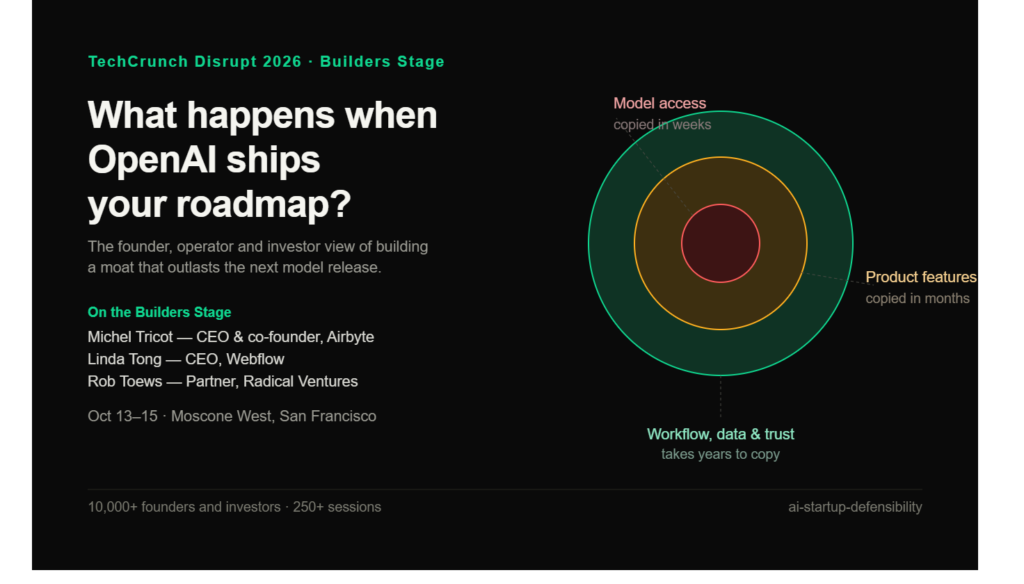
What Does AI Startup Defensibility Mean?
AI startup defensibility is a company’s ability to maintain a competitive advantage even when larger competitors, including foundation model providers, introduce similar technologies or features.
In traditional software, a company might build an advantage through proprietary technology, patents, distribution, brand recognition, or a large customer base. AI changes that equation because the underlying capabilities can improve rapidly and become widely accessible through APIs and models.
A startup may build an impressive AI feature today, only to discover that the same capability becomes available directly from a major model provider months later.
Definition + Expansion
AI startup moat is a durable advantage that makes it difficult for competitors to reproduce a company’s product, customer relationships, data, workflows, or overall value proposition.
A strong moat does not necessarily mean owning the most advanced AI model. It can come from proprietary data, deep integration into customer workflows, specialized expertise, strong distribution, trusted relationships, or years of accumulated product knowledge.
For AI founders, that distinction is becoming increasingly important because model capability alone may not remain unique for long.
Question → Direct Answer: Why is AI startup defensibility becoming more important?
AI startup defensibility matters because foundation model companies can rapidly absorb capabilities that once differentiated smaller startups. A startup therefore needs advantages beyond a feature that can be reproduced by a new model or platform update.
Why Are Foundation Model Companies Becoming Startup Competitors?
The competitive landscape for AI startups has changed dramatically.
A few years ago, a startup could identify a promising AI application, build a product around it, and compete primarily against other startups. Today, the company may also be competing against the very platform it uses to power its product.
OpenAI, Anthropic, Google, and other major AI companies continuously expand their models and product ecosystems. Every major release creates the possibility that an existing startup capability could become a standard platform feature.
Consider a hypothetical startup that builds an AI assistant for a specific business task. If a foundation model provider later adds that same workflow directly to its platform, the startup suddenly has to explain why customers should continue paying for a separate product.
That creates a strategic shift from “Can we build this?” to “Can we own the value around it?”
Question → Direct Answer: What is the biggest competitive threat for some AI startups?
For some AI startups, the biggest threat may be the platform underneath their product rather than another startup. A foundation model company can potentially turn a startup’s differentiated feature into a built-in capability through a future model or product release.
From Technology Advantage to Business Advantage
This does not mean every startup feature will eventually be copied.
Foundation model companies have enormous markets to serve, and specialized startups can move faster in particular industries or workflows. But the possibility of platform competition changes how founders should think about product strategy.
A feature may be technically impressive without being strategically defensible.
For example, a startup might offer:
- AI-powered document summarization
- Automated coding assistance
- Generic customer support
- Image generation
- Basic research assistance
- Natural-language search
- AI writing tools
These capabilities can still be useful. The problem is that usefulness and defensibility are not the same thing.
The more easily a capability can be reproduced by a general-purpose model, the more pressure a startup may face to develop additional sources of value.
When Does an AI Product Become Just a Feature?
One of the most important questions for AI founders is whether they are building a standalone business or creating something that could eventually become a feature inside a larger platform.
This is the strategic problem highlighted by the TechCrunch Disrupt session.
Imagine a startup builds an AI tool that solves a problem extremely well. Customers love it, revenue grows, and investors become interested. Then a major AI company introduces a similar capability as part of an existing subscription.
The startup hasn’t necessarily failed.
But its competitive environment has changed overnight.
Question → Direct Answer: What does it mean when an AI startup becomes a feature?
An AI startup becomes vulnerable as a “feature” when its core functionality can be incorporated into a larger platform without requiring customers to maintain a separate product. The startup then needs additional advantages that make its complete solution more valuable than the feature alone.
The Feature-versus-Business Test
Founders can ask a simple strategic question:
If OpenAI, Google, or another major platform released my core feature tomorrow, why would customers still choose my company?
The answer should not simply be “because our AI is slightly better.”
Model performance can change.
A stronger answer might involve a proprietary workflow, years of customer data, deep enterprise integration, specialized compliance requirements, trusted relationships, or a distribution network that is difficult to reproduce.
This is where AI startup strategy begins to move beyond model performance.
What Makes an AI Startup Difficult to Replace?
The TechCrunch article identifies several areas where AI startups can potentially create durable value.
These advantages are important because they exist outside the raw intelligence of a foundation model.
1. Proprietary Data
Data can become a major source of differentiation when a startup has access to information competitors cannot easily reproduce.
The advantage is not simply having “lots of data.” The data needs to be relevant, useful, legally usable, and connected to a product that turns it into customer value.
For example, a specialized enterprise platform may accumulate years of customer-specific information and workflow patterns. Replacing that system could become difficult even if a competitor has access to an equally capable AI model.
2. Deeply Embedded Workflows
A product becomes harder to replace when it is deeply integrated into how customers actually work.
Think about a business tool that connects to databases, approval processes, reporting systems, internal applications, and employee workflows.
A competitor might reproduce the AI feature but still struggle to reproduce the entire operational environment around it.
3. Customer Relationships
Trust can become a competitive advantage.
Businesses may be reluctant to switch from a platform that understands their requirements, integrates with their systems, provides support, and has a proven record of reliability.
In enterprise AI, the relationship around the technology can sometimes be as important as the technology itself.
4. Domain Expertise
General-purpose AI is powerful, but specialized industries often have complicated requirements.
Healthcare, finance, manufacturing, legal services, cybersecurity, education, and other sectors may require knowledge of specific processes, terminology, regulations, and customer expectations.
A startup that deeply understands one of these domains can build value around the model rather than simply selling access to the model.
5. Trust
When AI systems influence important business decisions, customers may care about more than speed and intelligence.
They may also care about:
- Reliability
- Security
- Transparency
- Accountability
- Data handling
- Support
- Compliance
- Consistent performance
These factors can make a specialized AI product more difficult to replace with a generic model feature.
Three Perspectives on AI Startup Defensibility at TechCrunch Disrupt 2026
The Builders Stage session at TechCrunch Disrupt 2026 brings together a founder, an operator, and an investor.
That combination matters because AI startup defensibility looks different depending on where you sit in the ecosystem.
Michel Tricot: The Founder Perspective
Michel Tricot is CEO and co-founder of Airbyte, an open-source data integration platform.
According to TechCrunch, Airbyte has grown to more than 7,000 customers, including 18% of the Fortune 500.
His experience provides a practical perspective on building infrastructure that remains valuable even as AI capabilities evolve.
Data integration is particularly relevant because AI systems depend on access to information. The infrastructure connecting data sources, analytics systems, operations, and AI applications can remain valuable even when the underlying models change.
Question → Direct Answer: Why is Airbyte relevant to the AI defensibility discussion?
Airbyte illustrates how infrastructure and data workflows can create value beyond a specific AI model. A startup can potentially remain important by solving a deeper operational problem rather than depending entirely on one model capability.
Linda Tong: The Operator Perspective
Linda Tong is CEO of Webflow, a visual development platform, and has also held leadership roles at companies including Google, Cisco, and the NFL, according to TechCrunch.
Her perspective focuses on how software companies can remain differentiated while AI changes customer expectations.
For established software businesses, AI can create both opportunities and threats. New capabilities can make products more powerful, but they can also lower the barrier for competitors to reproduce features.
The strategic challenge is therefore not simply adding AI.
It is figuring out where AI strengthens the product’s existing value rather than replacing the reason customers use it.
Rob Toews: The Investor Perspective
Rob Toews, a partner at Radical Ventures, evaluates AI companies from an investment perspective.
Investors have to think beyond today’s growth.
A startup may have impressive revenue, strong user adoption, or exciting technology. But if a foundation model company can reproduce its central value proposition, investors may question how durable that advantage will be.
That makes defensibility a critical part of evaluating the long-term potential of an AI business.
How Can Founders Build Beyond the Next Model Release?
The safest strategy is not to predict exactly what OpenAI, Anthropic, or Google will launch next.
It is to build something that remains valuable even if the underlying models improve dramatically.
Question → Direct Answer: How can AI startups stay competitive as foundation models improve?
AI startups can stay competitive by building advantages around proprietary data, customer workflows, domain expertise, distribution, trust, and integrations rather than relying solely on model capability. The goal is to make the complete customer solution difficult to replace, even when the underlying AI becomes commoditized.
Build Around the Customer’s Workflow
A useful AI feature is easy to understand.
A deeply integrated workflow is harder to replace.
Suppose an AI startup helps a company automate a complex internal process. The startup could simply provide an AI-generated answer, or it could integrate with the company’s data, approvals, records, applications, compliance requirements, and reporting systems.
The second approach creates more switching costs.
The AI model becomes one component of a larger business system.
Own the Context
Generic AI systems operate across millions of use cases.
A specialized startup can focus intensely on one.
That focus can create valuable context around customer requirements, industry terminology, workflows, edge cases, and outcomes.
The startup’s advantage then comes from knowing how to apply AI to a problem, not merely from having access to AI.
Make Switching Painful for the Right Reasons
Switching costs are not necessarily about locking customers in unfairly.
They can come naturally from useful integrations and accumulated value.
If a product has become part of a customer’s daily workflow, stores valuable organizational context, and connects multiple systems, moving away from it may require time and effort.
That can create a legitimate competitive advantage.
AI Startup Strategy: What Should Founders Ask Before Building?
A founder considering a new AI product should think about the competitive landscape before writing the first line of code.
The question is not only whether customers want the product today.
It is whether they will still need the company after foundation models become significantly more capable.
A practical framework is to ask:
- What happens if the underlying model becomes 10 times better?
- What happens if the model provider adds our core feature?
- What part of our product is uniquely ours?
- Do we own valuable proprietary data or context?
- How deeply are we integrated into customer workflows?
- Why would customers switch to us instead of using a built-in platform feature?
- Can our distribution advantage survive a major model release?
- Does our product solve a specialized problem better than a general-purpose AI system?
These questions can expose weaknesses early.
A Simple Defensibility Framework
| Advantage | Why it matters | Vulnerability |
| Better model access | Improves product capability | Model providers can upgrade |
| Proprietary data | Creates unique context | Data quality and access matter |
| Customer workflows | Creates integration value | Can require long implementation |
| Domain expertise | Solves specialized problems | Competitors can hire experts |
| Distribution | Accelerates customer acquisition | Platforms may have larger reach |
| Customer trust | Supports retention | Must be continuously earned |
| Deep integrations | Makes replacement harder | Integration costs can be high |
The strongest businesses may combine several of these advantages rather than depending on just one.
Why Proprietary Data Alone Isn’t Enough
It is tempting to say that data is the answer to AI startup competition.
But that is too simplistic.
A dataset does not automatically become a moat. Data must generate meaningful value, and the company needs the right systems, expertise, and customer relationships to turn that data into better outcomes.
A competitor with a better product may sometimes outperform a company that simply has more information.
That is why AI startup defensibility should be viewed as a system of advantages rather than a single asset.
The real question is:
What combination of data, workflow, expertise, distribution, and trust becomes difficult to reproduce?
That combination is much harder to copy than an isolated AI feature.
How Should Investors Evaluate Defensible AI Companies?
For investors, AI startups create a difficult valuation problem.
Traditional software metrics still matter, but the durability of the technology advantage becomes harder to predict when foundation models are improving rapidly.
A startup might have excellent growth today because its AI capability is impressive.
But investors also need to ask what happens if that capability becomes widely available.
The Three-Year Question
One useful thought experiment is:
Will this company still matter three years from now if foundation models become dramatically more capable?
A strong answer might involve:
- Unique customer relationships
- Proprietary operational data
- Specialized distribution
- Deep workflow integration
- Strong brand or trust
- Industry-specific expertise
- A network or ecosystem effect
- Infrastructure that remains valuable across models
The more independent these advantages are from one specific model, the more resilient the business may be.
Why Model Independence Matters
Building entirely around one model provider can create another strategic risk.
If a startup depends heavily on one API, pricing structure, technical capability, or platform policy, changes by that provider can affect the startup’s economics.
Model flexibility can therefore become valuable.
A startup may want an architecture that allows it to use different models where appropriate rather than treating one provider as an irreplaceable component.
That does not eliminate platform risk, but it can reduce dependence.
What Does the TechCrunch Disrupt Session Reveal About AI’s Next Competitive Phase?
The “What Happens When OpenAI Ships Your Roadmap” session is ultimately about a broader shift in how AI companies compete.
The first phase of the AI boom emphasized access to powerful models.
The next phase is increasingly about what businesses build around those models.
Foundation models will continue improving. As they do, some capabilities will become cheaper, faster, and more widely available.
That can be good news for startups.
Lower technology costs can allow smaller companies to build products that previously required enormous resources. But it also means founders have to think carefully about where the lasting value sits.
Question → Direct Answer: Does better foundation AI automatically hurt startups?
No. Better foundation models can reduce development costs and make new products possible. The risk is greatest for startups whose main differentiator is a capability that a larger platform can easily reproduce without needing the startup’s additional data, workflow, expertise, or customer relationships.
What Does This Mean for Students and Future AI Professionals?
The debate around AI startup defensibility is also useful for students and young professionals because it changes how AI skills should be viewed.
Learning how to use an AI API is valuable.
But understanding the business problem around that API may be even more valuable.
A future AI professional should increasingly understand both technology and product strategy.
That means learning:
- How foundation models work at a practical level
- How AI products are integrated into workflows
- How to evaluate model performance
- How proprietary data creates product value
- Why customers adopt or abandon software
- How AI affects business models
- How to identify sustainable competitive advantages
- Why security, privacy, and trust matter
For someone planning an AI career in India, this broader perspective can be especially useful.
The strongest opportunities may not come from simply building another chatbot. They may come from applying AI to difficult industry problems where domain knowledge, data, workflows, and implementation expertise matter.
What Happens If OpenAI Ships Your Roadmap?
This question is becoming a useful stress test for every AI startup.
If the answer is “we would lose our customers,” the company may have a feature rather than a durable business.
If the answer is “the model would make our product better, but customers would still need us,” that is a much stronger position.
The difference comes down to where the value lives.
A startup that depends entirely on a temporary technical advantage is vulnerable to rapid model progress. A startup that owns the workflow, customer relationship, specialized context, data, and trust around an AI-powered solution has more ways to remain valuable.
That is the strategic heart of the TechCrunch Disrupt discussion.
AI Startup Defensibility vs. AI Feature Competition
| Business position | Core advantage | Risk from foundation models |
| AI feature startup | One powerful capability | High |
| Specialized AI application | Industry-specific workflow | Medium |
| AI infrastructure company | Data or technical infrastructure | Lower in some use cases |
| Workflow platform | Deep customer integration | Lower |
| Domain-focused AI company | Expertise + context + workflow | Potentially lower |
| Distribution-led AI business | Strong customer access | Depends on channel strength |
No category is automatically safe.
But the table highlights an important principle: the farther a company’s value extends beyond a single AI capability, the more opportunities it has to defend its position.
The Future of AI Startup Strategy
The next generation of AI companies may not win simply by having the best model.
They may win by building the best business around models.
That could mean creating software that becomes deeply embedded in a customer’s operations, accumulating specialized knowledge, developing trusted relationships, or building infrastructure that works across multiple generations of AI technology.
The model may change every few months.
The customer’s underlying problem may not.
That is why founders should start with the problem they can own rather than the AI capability they can demonstrate.
Question → Direct Answer: What is the long-term goal of a defensible AI startup?
The goal is to create customer value that survives rapid changes in AI capability. A defensible AI startup should become difficult to replace because of its workflows, data, expertise, integrations, distribution, trust, or combination of these advantages,not merely because it uses a powerful model.
The central lesson from TechCrunch Disrupt 2026 is therefore simple: don’t build a product that depends on being better than the next model release; build a business that becomes more valuable as AI improves.
FAQ: AI Startup Defensibility
What is AI startup defensibility?
AI startup defensibility is a company’s ability to maintain a competitive advantage even when foundation model companies introduce similar capabilities. It can come from proprietary data, customer workflows, domain expertise, distribution, integrations, and trust.
Why can OpenAI become a competitor to AI startups?
OpenAI can become a competitor when it introduces capabilities that overlap with features developed by startups using its models or competing foundation models. A startup can become vulnerable when its primary value can be reproduced as a platform feature.
How can AI startups build a moat?
AI startups can build a moat through proprietary data, deep workflow integration, specialized domain expertise, strong customer relationships, distribution advantages, trust, and infrastructure that remains valuable across model generations.
Is proprietary AI technology enough to protect a startup?
Proprietary technology can help, but it may not be enough if a foundation model provider can reproduce the same capability quickly. Durable businesses typically combine technology with customer relationships, data, workflows, expertise, or other advantages.
Why are customer workflows important for AI startups?
Customer workflows can make a product difficult to replace because the software becomes integrated with daily operations, data sources, business processes, and other systems. A competing AI feature may reproduce functionality without reproducing the entire workflow.
What should AI founders ask before building a new product?
AI founders should ask what happens if a major foundation model company launches the same feature. They should also identify which parts of their product are difficult to reproduce and whether customers would still need the company after the next major model release.
Take the Next Step With Kalinga.ai
Want to understand how AI is changing startups, careers, and the technology industry? Explore Kalinga.ai for practical AI explainers, startup insights, and the latest developments shaping the future of AI.