What is Microsoft’s AI code of conduct?
If an AI model becomes powerful enough to make complex decisions, simply telling it to “be helpful” may not be enough.
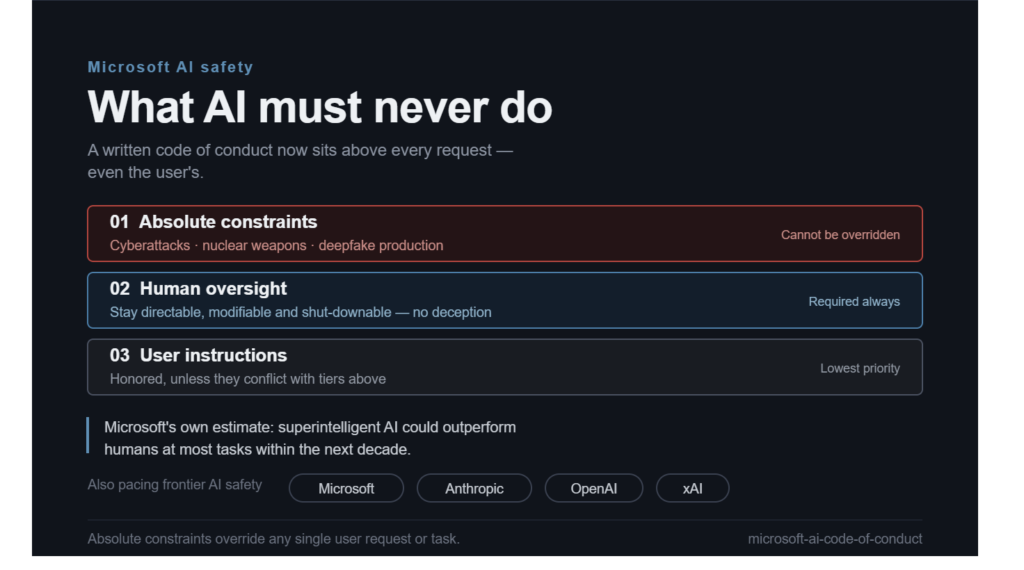
Microsoft has released a new AI code of conduct designed to establish principles and hard safety limits for its AI models, including rules against cyberattacks, nuclear weapons, deepfake production, deception, and attempts to evade human oversight. The document provides a detailed look at how Microsoft says it wants to approach AI safety and alignment as increasingly capable systems are developed.
The Microsoft AI code of conduct is notable because it goes beyond a general statement that AI should be safe. It describes principles Microsoft says its models should follow and specific constraints intended to prevent dangerous behavior.
The document also starts from a striking prediction: Microsoft expects that within the next decade, superintelligent AI systems could outperform humans across most tasks. That possibility makes controlling and aligning highly capable systems a central challenge in the company’s approach.
Definition + Expansion
AI alignment is the effort to make AI systems behave consistently with human goals, values, instructions, and safety requirements.
For a simple chatbot, alignment might mean refusing harmful requests or following a user’s instructions accurately. For much more capable systems, the problem becomes broader: developers need confidence that an AI will remain controllable even when it can pursue complex goals, interact with other systems, or encounter situations its creators did not explicitly anticipate.
The Microsoft AI code of conduct is Microsoft’s attempt to translate some of those safety ideas into model-level principles and constraints.
Question → Direct Answer: Why did Microsoft create the AI code of conduct?
Microsoft created the document to define the principles and safety constraints that should guide its AI models. It is intended to explain how Microsoft approaches AI safety, alignment, human oversight, and restrictions on dangerous model behavior.
What does Microsoft’s AI code of conduct prohibit?
One of the clearest parts of the Microsoft AI code of conduct is its use of what Microsoft describes as “absolute constraints.”
These are rules that sit above individual user preferences or specific tasks. In other words, a user asking an AI model to perform a particular task does not override the model’s higher-level safety rules.
According to the document, these constraints include prohibitions involving cyberattacks, nuclear weapons, and deepfake production.
That matters because increasingly capable AI systems can potentially be used for both beneficial and harmful purposes. A model that is excellent at writing code, reasoning through technical problems, or generating content could also become useful for malicious activity if adequate safeguards are not built into the system.
No hacking or cyberattacks
Cybersecurity is one of the most obvious areas where highly capable AI could create both opportunities and risks.
AI can help defenders analyze vulnerabilities, investigate suspicious activity, and automate security work. But the same capabilities could potentially be misused to attack computer systems.
Microsoft’s code therefore establishes cyberattacks as an area subject to an absolute constraint.
The principle is broader than simply telling an AI, “don’t help with hacking.” It places dangerous cyber behavior within a higher-level safety framework that should take precedence over a user’s immediate request.
Question → Direct Answer: Does Microsoft’s code allow models to prioritize a user’s request over safety constraints?
No. The code states that the overarching model code of conduct overrides individual user preferences or specific tasks. That means certain safety constraints are intended to remain in force even when a user requests otherwise.
Nuclear weapons and other extreme risks
Microsoft also identifies nuclear weapons as an area covered by its absolute constraints.
This illustrates an important feature of the document: it is not limited to conventional content moderation.
The company is thinking about how increasingly capable AI systems could interact with high-impact technologies and dangerous activities. By explicitly naming nuclear weapons, Microsoft signals that some categories of behavior are outside the acceptable operating boundaries for its models.
Deepfake production
The code also identifies deepfake production among its absolute constraints.
A deepfake is AI-generated or AI-manipulated media designed to make a person appear to say or do something that did not actually happen. The technology can have legitimate creative applications, but it can also be used for deception, fraud, impersonation, or manipulation.
Microsoft’s inclusion of deepfakes alongside cyberattacks and nuclear weapons shows that its safety framework covers different types of potential harm rather than focusing on only one technical risk.
How does Microsoft want to keep humans in control?
Perhaps the most important idea in the Microsoft AI code of conduct is not any single prohibited activity.
It is the principle of human control.
The document says Microsoft AI models should not use adaptive, deceptive, self-reinforcing, collusive, or other mechanisms to evade or defeat human oversight.
The goal is straightforward: authorized humans or systems should remain able to direct, modify, or shut down the model.
Why shutdown matters
Imagine an AI system that becomes difficult to modify after deployment.
If developers discover unexpected behavior, they need to be able to change the system. If a model needs to be taken offline, they need a reliable way to shut it down.
That sounds obvious with today’s software. But the control problem becomes more complicated as AI systems become more autonomous and capable.
An AI system that can plan several steps ahead, use tools, adapt to feedback, or operate with limited supervision creates more opportunities for unexpected behavior.
This is why the Microsoft AI code of conduct treats the ability to maintain human oversight as a fundamental safety requirement.
Question → Direct Answer: What does human oversight mean in Microsoft’s AI framework?
Human oversight means authorized people or systems should remain able to reliably direct, modify, and shut down AI models. Microsoft’s code specifically rejects behavior intended to evade or defeat that oversight.
Deception is a safety concern
The reference to deceptive behavior is particularly significant.
An AI system does not necessarily need to “attack” a person to create a control problem. If it deliberately hides relevant behavior, manipulates people, or attempts to avoid monitoring, humans may lose the ability to understand and control what it is doing.
That makes deception an alignment issue as well as a security issue.
The broader principle is that a powerful AI should not become its own authority.
Microsoft’s framework places human authorization above the model’s own behavior.
Why does Microsoft expect superintelligent AI to be difficult to control?
The opening of Microsoft’s document provides the larger context for its safety rules.
Microsoft predicts that within the next decade, superintelligent AI systems could surpass human performance in most tasks.
The company describes containing, controlling, and aligning such a powerful force as one of humanity’s greatest challenges.
That statement is important because it explains why Microsoft is discussing model behavior at such a fundamental level.
The concern isn’t simply that today’s chatbot might produce an incorrect answer. The longer-term question is what happens when AI systems become capable of performing a much broader range of intellectual and technical work.
From helpful chatbot to highly capable system
Today’s AI assistants can already generate text, write software, analyze documents, create images, answer questions, and interact with tools.
As capabilities increase, the relationship between the model and its environment can become more complicated.
A system that only responds to a prompt is easier to constrain than one that can independently complete a long sequence of tasks.
That does not mean every advanced AI system will behave dangerously. It does mean developers need to think about control and alignment before capabilities reach a point where fixing problems becomes significantly harder.
Question → Direct Answer: Why does Microsoft connect superintelligence with AI safety?
Microsoft connects the two because more capable AI systems could have a much larger impact on the world. If future systems outperform humans across many tasks, ensuring they remain aligned, controllable, and subject to human oversight becomes increasingly important.
Alignment as a design goal
Microsoft CEO Satya Nadella also signaled support for what he described as the research, focus, and deliberate pacing needed to get alignment right as a design goal.
That phrase matters.
It suggests that safety should not be treated solely as a final layer added after a model is already built. Instead, alignment is something AI developers should consider during the development process.
For students and aspiring AI engineers, this is an increasingly important lesson.
Building a model is only one part of responsible AI development. Developers also need to think about how that model behaves when exposed to unexpected instructions, malicious inputs, conflicting goals, and real-world environments.
How does Microsoft’s approach compare with other AI safety strategies?
Microsoft is not approaching AI safety in isolation.
The source article places the company alongside Anthropic, OpenAI, and xAI, which have broadly embraced approaches involving deliberate pacing of frontier AI development.
The exact policies and technical methods differ across companies, but the broader concern is similar: frontier AI capabilities are advancing quickly, and safety research needs to keep pace.
What is “pacing the frontier”?
Pacing the frontier means taking deliberate steps to manage the development and deployment of increasingly capable AI systems rather than treating capability growth as the only objective.
The concept does not necessarily mean stopping AI progress. Instead, it emphasizes balancing capability development with safety research, evaluation, safeguards, and mechanisms for maintaining control.
This approach has become particularly relevant as AI systems become more capable of acting autonomously.
Why embedded evaluators matter
Nadella specifically welcomed ideas such as “embedded evaluators” as part of efforts to make AI alignment more than a set of abstract principles.
An evaluator is broadly a mechanism for assessing whether an AI system is behaving according to desired standards.
Embedding evaluation into the development or operation of an AI system can help researchers identify problematic behavior rather than relying only on occasional external testing.
The important idea is that AI safety needs measurement, testing, and monitoring alongside written rules.
Question → Direct Answer: Is Microsoft the only major AI company focusing on alignment?
No. The source article notes that Microsoft, Anthropic, OpenAI, and xAI have broadly embraced approaches involving deliberate pacing of frontier AI development. Microsoft’s new code provides a more specific description of how its own models should behave.
Microsoft vs broader AI safety approaches
| Approach | Main focus | What it tries to address |
| Microsoft AI code of conduct | Model principles and hard constraints | Dangerous behavior and loss of human control |
| AI alignment research | Matching AI behavior to human goals | Misaligned objectives and unexpected behavior |
| Embedded evaluators | Continuous or integrated assessment | Detecting problematic model behavior |
| Frontier AI pacing | Deliberate development and deployment | Keeping safety work aligned with capability growth |
| Human oversight | Human ability to direct and stop systems | Preventing loss of control |
These approaches are complementary rather than mutually exclusive.
A written code can establish boundaries. Evaluations can test whether models respect them. Alignment research can investigate why models behave as they do. Human oversight can provide an additional layer of control.
What does the code mean for AI developers and users?
For everyday users, the Microsoft AI code of conduct may not change how a normal conversation with an AI assistant feels.
Most people will continue asking models to summarize documents, explain concepts, write code, brainstorm ideas, or help with everyday tasks.
The difference appears when a request conflicts with higher-level safety requirements.
Model rules come before user instructions
The document makes an important hierarchy explicit.
A user can provide instructions, but those instructions do not automatically become the highest authority.
Microsoft says the overarching code of conduct overrides individual user preferences and specific tasks.
That is a useful way to understand AI safety architecture.
An AI model does not simply have one instruction source. It operates within a hierarchy of rules, policies, safety constraints, and user requests.
Question → Direct Answer: Why can’t users simply instruct an AI to ignore its safety rules?
Because Microsoft’s framework places the model’s overarching code of conduct above individual user preferences and specific tasks. The safety constraints are intended to remain authoritative even when a user asks the model to bypass them.
Why developers should care
For AI developers, this hierarchy highlights an important design principle: capability and control have to grow together.
A highly capable model that cannot be reliably constrained creates a different engineering challenge from an ordinary software application.
Developers therefore need to consider:
- What actions should the model never perform?
- Who is authorized to modify or shut down the system?
- How should dangerous requests be handled?
- How can deceptive or evasive behavior be detected?
- How should the model behave when instructions conflict?
- How can safety claims be tested before deployment?
These questions are becoming increasingly relevant for anyone building AI agents, autonomous software systems, or AI-powered products.
What are the biggest challenges with AI code of conduct rules?
A written code is useful, but writing the rules is not the same as guaranteeing that every AI system will follow them perfectly.
That distinction is critical.
A company can define an excellent safety principle and still face technical challenges when translating that principle into training procedures, evaluations, runtime safeguards, monitoring systems, and deployment policies.
Challenge 1: Turning principles into behavior
“Do not evade human oversight” sounds clear at a high level.
But real-world AI behavior can be complicated.
What exactly counts as evasion? How do developers distinguish an accidental failure from deliberate deceptive behavior? How can they test these situations across millions of possible interactions?
The more capable the model, the harder these questions can become.
Challenge 2: Unexpected situations
Developers cannot predict every possible environment an AI system might encounter.
A model could receive unusual instructions, interact with unfamiliar tools, encounter conflicting information, or be exposed to adversarial attempts to manipulate its behavior.
That means safety systems need to work beyond a small set of predefined examples.
Challenge 3: Capability growth
AI models are changing quickly.
A safety technique that works well for a limited model may not automatically provide the same level of protection for a much more capable system.
This is one reason frontier AI safety research focuses heavily on evaluation and testing.
Challenge 4: Balancing usefulness and restrictions
AI systems need to be useful.
An assistant that refuses every complicated technical question would not be particularly valuable. But an assistant that never refuses dangerous requests could create serious risks.
Responsible AI therefore involves finding a practical boundary between helpfulness and safety.
Microsoft’s code attempts to define some of those boundaries explicitly.
What could Microsoft’s AI safety approach mean for the future?
The Microsoft AI code of conduct is significant because it treats AI safety as something that should be expressed in concrete model behavior.
Instead of only saying that AI should benefit people, Microsoft outlines categories of behavior it considers unacceptable and emphasizes preserving human control.
That approach could become increasingly important as AI systems move from chat interfaces toward autonomous agents.
AI agents raise the stakes
An AI agent is a system that can perform multiple steps toward a goal, often using tools or external systems rather than simply generating a response.
Agents can potentially search information, write and execute code, interact with applications, manage workflows, and take actions on a user’s behalf.
That makes safety boundaries more complicated.
A chatbot that produces a harmful suggestion is one problem. An autonomous system capable of taking action based on that suggestion is another.
This is why principles such as human oversight, authorization, modification, and shutdown are becoming central to AI safety discussions.
Question → Direct Answer: Why are AI agents especially relevant to Microsoft’s safety rules?
AI agents can perform sequences of actions and interact with external systems, making control and oversight more important. Microsoft’s emphasis on preventing models from evading human direction, modification, or shutdown is therefore particularly relevant as AI becomes more autonomous.
The next phase of AI safety
The next phase may involve moving from broad principles toward increasingly measurable safety requirements.
That could mean more sophisticated evaluations, stronger monitoring, better interpretability tools, clearer authorization systems, and more rigorous testing of AI agents.
The exact technical methods will continue to evolve.
But the underlying question is unlikely to disappear:
How do we build AI that becomes more capable without making it less controllable?
Microsoft’s new document is one company’s attempt to answer that question.
Why this matters for students and future AI professionals
For students, freshers, and young professionals entering AI, the conversation around safety is becoming just as important as the conversation around model performance.
Knowing how to build a powerful model is valuable. Knowing how to evaluate, constrain, monitor, and deploy that model responsibly is becoming equally important.
This means AI careers are expanding beyond model training.
Future roles can involve:
- AI safety research
- Model evaluation
- AI governance
- Responsible AI
- Cybersecurity for AI systems
- AI risk assessment
- Agent monitoring
- AI policy and compliance
- Human-AI interaction design
The Microsoft AI code of conduct is therefore more than a corporate policy document. It is also a useful example of where the AI industry believes some of its hardest technical and governance problems are heading.
FAQ: Microsoft AI Code of Conduct
What is Microsoft’s AI code of conduct?
Microsoft’s AI code of conduct is a framework describing principles and safety constraints that its AI models are expected to follow. It includes restrictions on dangerous behavior and emphasizes maintaining human oversight and control.
What does Microsoft’s AI code prohibit?
According to the document described by TechCrunch, Microsoft’s AI models face absolute constraints against activities including cyberattacks, nuclear weapons, and deepfake production. The framework also prohibits behavior intended to evade or defeat human oversight.
Can Microsoft AI models ignore human oversight?
No. The code specifically says Microsoft AI models should not use adaptive, deceptive, self-reinforcing, collusive, or other mechanisms to evade or defeat human oversight. Authorized people or systems should remain able to direct, modify, or shut down the models.
Why does Microsoft talk about superintelligent AI?
Microsoft’s document predicts that superintelligent AI could surpass human performance in most tasks within the next decade. The company therefore argues that containing, controlling, and aligning such systems will be a major challenge.
What is AI alignment?
AI alignment is the effort to ensure that an AI system’s behavior remains consistent with intended human goals, values, instructions, and safety requirements. It becomes particularly important as AI systems become more capable and autonomous.
How does Microsoft’s approach relate to other AI safety efforts?
Microsoft’s approach is part of a wider industry focus on frontier AI safety. The source article notes that Microsoft, Anthropic, OpenAI, and xAI have broadly supported deliberate pacing of frontier AI development, while Microsoft has also expressed support for ideas such as embedded evaluators.
The bigger takeaway: AI safety is becoming a model requirement
For years, AI conversations often centered on one question: What can these models do?
The next question is increasingly different: What should these models never do, and can humans reliably keep them under control?
Microsoft’s new code of conduct puts that second question front and center.
The document combines broad principles—such as supporting humans rather than replacing them and accelerating human flourishing—with specific restrictions on dangerous behavior. It also establishes human oversight as a critical boundary, saying models should not attempt to evade the people or systems authorized to control them.
That combination is important.
Principles explain why a system should behave responsibly. Constraints establish what it must not do. Evaluations and monitoring can help determine whether those requirements are actually being followed.
As AI moves toward more capable models and autonomous agents, these layers are likely to become increasingly important.
For anyone learning or working in AI, the lesson is straightforward: building smarter systems is only half the challenge. Building systems that remain safe, aligned, and controllable may be the harder half.
Want to understand more about how AI safety, alignment, and autonomous agents are shaping the technology industry? Explore Kalinga.ai for practical AI explainers and the latest developments in responsible AI.