What is Daydream’s new AI fashion shopping feature?
Ever saved an outfit from Instagram or Pinterest and then spent far too long trying to find the clothes yourself?
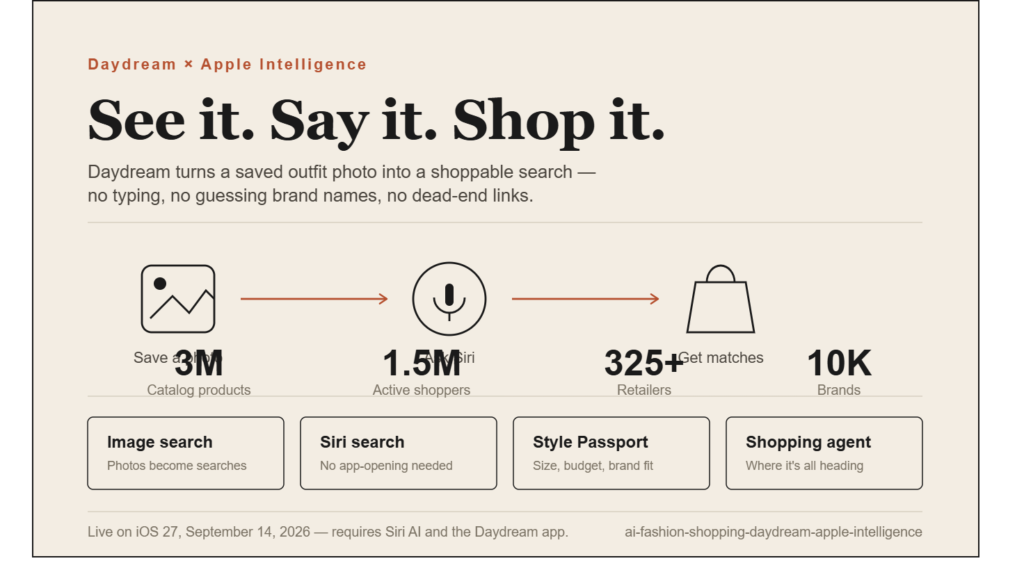
Daydream is making that process much simpler by using Apple Intelligence and iOS 27 to turn saved outfit photos into shoppable fashion searches. The AI-powered fashion discovery app has introduced two features: one can analyze outfits saved in an iPhone’s Photos app and find matching or similar products, while the other lets users search Daydream through Siri without opening the app.
The features launched alongside the official rollout of iOS 27 on September 14, 2026, according to TechCrunch. They require an iPhone running iOS 27 with Siri AI enabled and the Daydream app installed.
This is an important development because AI fashion shopping is moving beyond typed keywords. Instead of describing a jacket, remembering a brand name, or manually browsing retailer websites, shoppers can start with something they have already seen.
That “something” could be a screenshot, an Instagram post, a Pinterest image, a photo of an outfit, or even a picture taken while out shopping.
Definition + Expansion
AI fashion shopping is the use of artificial intelligence to help people discover, search for, compare, and purchase clothing and accessories based on natural-language requests, images, personal preferences, or context.
Traditional online shopping usually starts with a keyword such as “black blazer” or “white sneakers.” AI changes the starting point: the shopper can provide an image, describe an occasion, ask for a particular style, or request a variation of something they already like.
Daydream’s new features combine these ideas with Apple’s newer intelligence capabilities, making fashion discovery more contextual and less dependent on conventional search terms.
Question → Direct Answer: What are Daydream’s two new features?
Daydream has introduced image-based shopping from the iPhone Photos app and Siri-powered natural-language fashion search. The first identifies clothing and accessories in saved images and finds products; the second lets users search Daydream by voice or text through Siri.
How does Daydream shop from your camera roll?
The first major feature addresses a familiar problem: you have the perfect outfit saved on your phone, but you don’t know where to buy it.
Daydream’s approach is to make that image itself searchable.
Using Apple’s image-context capabilities, the app can analyze an outfit saved in Photos and identify individual pieces. For example, an image might contain a sweater, trousers, shoes, and accessories. Rather than treating the picture as one object, Daydream can break it down into separate fashion items.
It then searches its catalog for relevant products.
According to the TechCrunch report, Daydream’s catalog contains roughly 3 million products. If the exact product shown in the image is available, Daydream can connect the image to the retailer selling it. If the original item is unavailable, it can surface similar alternatives instead.
That makes AI fashion shopping particularly useful for inspiration-driven purchases.
From screenshot to shopping search
Imagine you see a celebrity-inspired outfit on Instagram.
Normally, you might screenshot it, open Google, search for something like “brown oversized sweater black trousers outfit,” browse dozens of results, and try to work out which products are actually available.
Daydream is attempting to compress that entire process.
You save the image. Daydream analyzes it. The app identifies the individual pieces and presents potentially shoppable matches.
The difference is subtle but important: the image becomes the search query.
Question → Direct Answer: Can Daydream find the exact clothes in a saved image?
Sometimes. If the exact item is still available through Daydream’s retail catalog, the app can match the image to the retailer selling it. If the exact product is no longer available, Daydream can instead show similar styles.
This distinction matters because fashion images often outlive the products they feature. A social-media post may show an outfit from months or years ago, while the original garment could already be sold out.
Asking for a different version
Daydream’s visual search is not limited to finding something that looks exactly like the image.
Users can also ask for variations.
TechCrunch reported an example from Daydream CEO and co-founder Julie Bornstein: someone could say, “I like this sweater but want it in red.”
That turns image search into something closer to a conversation.
Instead of asking, “What is this?”, the shopper can ask, “What would I like instead?”
This is where AI fashion shopping starts to resemble a personal stylist. The system isn’t merely identifying a product; it is interpreting an intention and trying to translate that intention into available products.
Of course, the quality of the result depends on the products available in the catalog and how accurately the AI understands the image and request. But the interaction itself represents a shift from static visual search toward conversational discovery.
How does Siri power Daydream’s fashion search?
Daydream’s second feature brings fashion discovery directly into Siri.
Users can make a fashion request through Siri using either voice or text without opening the Daydream application.
For example, a shopper could say:
“Hey, Siri, search Daydream for a cool blazer for my board meeting on Monday.”
Daydream can then provide personalized results based on the request.
This is significant because the shopper doesn’t have to remember which app to open. The request begins with an everyday conversation rather than a traditional search interface.
Natural language becomes the shopping interface
Traditional fashion search might require several separate filters:
- Category: blazer
- Color: black
- Occasion: work
- Style: modern
- Budget: a specific range
- Brand: optional
With conversational AI fashion shopping, the user can potentially express these preferences in one sentence.
A request such as “Find me a smart blazer for a board meeting” contains contextual information that a basic product search may not capture.
The system has to interpret what “smart” means in this context, understand that a board meeting implies a professional setting, and then identify suitable products.
That is the broader promise of natural-language interfaces: people can communicate what they want without learning how a search system expects them to phrase it.
Question → Direct Answer: Does Siri need the Daydream app to be open?
No. Daydream’s new Siri-powered search is designed to let users make fashion requests without opening the Daydream app first.
That makes Siri a potential entry point into the shopping experience rather than simply a voice assistant that launches another application.
Style Passport makes recommendations more personal
Daydream also has a feature called Style Passport, which asks users for information such as their size, preferred brands, personal style, and budget.
This information can make AI-powered recommendations more relevant.
Consider two people searching for “a dress for dinner.” One may prefer luxury brands and have a high budget, while another may want affordable options. Their sizes and preferred styles may also be completely different.
A recommendation engine that knows these preferences has more context than one that only sees the phrase “dress for dinner.”
This is an important ingredient in the future of AI fashion shopping: personalization.
The more accurately an AI understands what a person likes, the less time that person may need to spend filtering irrelevant products.
Why is Daydream different from generic visual search?
Visual shopping is not new.
Google, Amazon and several smaller companies already use AI to help consumers discover products through images, recommendations, and natural-language queries. TechCrunch specifically noted competitors and adjacent players including Google, Amazon, Onton and Alta.
So why does Daydream believe its approach can stand out?
The company’s argument is that fashion requires more specialized understanding than simply recognizing objects in an image.
Fashion is more complicated than object recognition
An image-recognition system might correctly identify a “jacket.”
But shoppers usually want more than that.
They may care about:
- The jacket’s cut and silhouette
- Whether the style is formal or casual
- The brand’s reputation
- Material and quality
- Color variations
- Whether it fits their existing wardrobe
- Whether a similar item is actually available to purchase
- Whether the product fits their budget
Daydream CEO Julie Bornstein told TechCrunch that many visual search tools lack fashion-category expertise and can return inaccurate results, less credible brands, or links to images that aren’t actually shoppable.
Daydream is positioning its fashion-specific catalog and discovery experience as the answer to that problem.
Question → Direct Answer: Why does fashion expertise matter in visual search?
Fashion expertise matters because recognizing an item is only the first step. A useful shopping system also needs to understand style, product relevance, brand credibility, availability, and whether the result can actually be purchased.
Daydream vs other AI shopping approaches
| Approach | Starting point | Main strength | Potential challenge |
| Daydream visual search | Saved outfit image | Fashion-focused product matching | Dependent on catalog and image understanding |
| Daydream + Siri | Voice or text request | Contextual, hands-free discovery | Requires iOS 27 and Siri support |
| Traditional fashion search | Keywords and filters | Familiar and controllable | Requires users to describe what they want |
| General visual search | Product or lifestyle image | Broad product recognition | May lack fashion-specific context |
| Retailer search | Store catalog | Direct path to purchase | Often limited to one retailer’s inventory |
The important distinction is that Daydream isn’t simply trying to make fashion search faster. It is trying to make the way people express shopping intent more natural.
What does this mean for AI-powered fashion shopping?
Daydream’s launch is part of a broader shift in AI fashion shopping: shopping tools are increasingly trying to understand context rather than just keywords.
A shopper does not necessarily think in product categories.
They might think:
“I need something for a wedding.”
“I want an outfit like this.”
“I like this sweater, but in another color.”
“Find something that works with the clothes I already own.”
These are human requests, not conventional search queries.
AI systems can potentially translate those requests into structured product searches.
The shopping journey is becoming conversational
The traditional online shopping journey often looks like this:
Search → Filter → Browse → Compare → Purchase
AI-assisted shopping can introduce another pattern:
Show → Ask → Refine → Discover → Purchase
That is a major reason AI fashion shopping is attracting attention.
The shopper doesn’t always need to know the product name. They can begin with a visual reference or a vague idea and refine the request through conversation.
Daydream’s “red sweater” example demonstrates this clearly. The shopper starts with an existing visual reference and adds a preference. The AI is expected to bridge the gap between those two pieces of information.
From shopping app to shopping agent
Daydream says its latest features are only one step toward a bigger ambition: building a shopping agent.
A shopping agent is an AI system that can understand a person’s preferences and assist with shopping across different situations rather than simply answering one product-search query.
Bornstein described Daydream’s longer-term vision as a shopping agent that understands someone’s style well enough to work across different surfaces in their life.
That could eventually mean an AI that recognizes when a person is looking for a specific type of clothing, remembers preferences, and helps turn inspiration into purchases.
Question → Direct Answer: Is Daydream already a fully autonomous shopping agent?
No. The current features are better understood as steps toward that goal. Daydream’s present capabilities focus on image-based product discovery and Siri-powered searches, while the company describes a broader shopping-agent vision for the future.
Why is Apple’s role important?
Daydream’s launch is also an example of how Apple’s AI ecosystem could change third-party apps.
Instead of every application building a completely separate AI assistant, Apple’s intelligence capabilities can provide new ways for apps to understand images, context, and natural-language requests.
For Daydream, that creates two useful entry points:
Photos can become a shopping surface. Siri can become a shopping interface.
That is potentially more powerful than simply adding an AI chatbot inside the Daydream app.
On-device intelligence could make AI more contextual
Daydream says it expects to keep going deeper into on-device intelligence.
On-device AI means some AI processing can happen directly on a user’s device instead of relying entirely on remote servers. Depending on the feature, this can potentially make experiences more integrated with the information already available on the device.
For a fashion app, context is especially valuable.
Your camera roll contains the things you have saved. Siri understands the request you are making. Your Style Passport contains preferences you have chosen to share.
Combining those pieces could create a more personalized shopping experience.
However, this also makes privacy and permission design important. When AI systems interact with personal photos, messages, preferences, or other device context, users need clear controls over what information an application can access and how it is used.
What can Indian shoppers learn from Daydream’s approach?
The most interesting lesson isn’t necessarily whether Daydream becomes the dominant fashion app.
It is what its product demonstrates about the future of digital commerce.
Indian consumers are already comfortable discovering products through social media, creator recommendations, marketplaces, short-form video, and messaging. That creates an environment where visual and conversational commerce can become increasingly important.
Imagine saving an outfit from a creator’s video and asking an AI system to find something similar within a particular budget.
Or taking a picture of an outfit at a college event and asking for affordable alternatives.
Or asking for a formal look for an interview while specifying a budget and preferred brands.
These are exactly the kinds of natural requests that AI systems are increasingly designed to handle.
Question → Direct Answer: Why is visual AI useful for younger shoppers?
Visual AI can reduce the gap between seeing something you like and finding a product that resembles it. Instead of translating an image into multiple keywords, shoppers can potentially use the image itself as the starting point.
For students and young professionals, this could be particularly useful when budgets, occasions, and personal style all influence what counts as a good recommendation.
What are the benefits and limitations of AI fashion shopping?
The appeal of AI fashion shopping is straightforward: less searching and more relevant discovery.
But AI does not automatically make shopping perfect.
Potential benefits
- Faster discovery: A saved image can become the starting point for a product search.
- Natural interaction: Users can describe what they want conversationally.
- Personalization: Style, size, brand preferences, and budget can influence recommendations.
- Visual inspiration: Shoppers don’t need to know the exact name of an item.
- Alternative suggestions: Unavailable products can potentially be replaced with similar options.
- Context-aware searches: Requests can include occasions such as meetings, events, or dinners.
- Hands-free access: Siri allows users to search without opening Daydream.
Potential limitations
The first limitation is product availability. Even excellent image recognition cannot find an exact product if that item isn’t represented in the catalog.
The second is interpretation. Fashion is subjective, and an AI might understand that an image contains a blazer without perfectly understanding why the shopper likes that particular blazer.
The third is personalization quality. Style preferences are complicated. A questionnaire can capture size, budget, and favorite brands, but personal taste can still change depending on mood, occasion, season, and context.
Finally, shoppers should remember that AI recommendations are recommendations, not guarantees. Users still need to check product details, sizing, pricing, shipping, returns, and retailer information before purchasing.
What could Daydream’s shopping agent become?
Daydream’s current features point toward a larger change in how commerce could work.
Today, people often move between several disconnected surfaces:
Social media → Screenshot → Search engine → Retailer → Product page → Checkout
A shopping agent could eventually connect more of these steps.
You see something you like. The AI understands it. You say what you would change. The system finds options based on your preferences and budget. You compare the results and decide what to buy.
The important word here is eventually.
Daydream has not announced that all of these steps are already automated. Its current launch is a foundation for the broader shopping-agent concept.
The bigger competition may be about context
The future of AI commerce may not simply be about which company has the biggest product catalog.
It could also be about which service understands the shopper best.
A system that knows a user’s style, budget, size, preferred brands, current context, and visual references could potentially produce more useful recommendations than a generic search engine.
That is why Daydream’s integration with Apple’s ecosystem is strategically interesting.
The company isn’t only placing AI inside a fashion app. It is attempting to make fashion discovery available at moments when users are already interacting with their phones.
Question → Direct Answer: What is Daydream ultimately trying to build?
Daydream says it wants to build a shopping agent that understands an individual’s style and can help them discover products across everyday situations and surfaces, rather than limiting the experience to one shopping app.
Why this matters beyond fashion
The same pattern could eventually spread to other forms of shopping.
Think about furniture.
You photograph a living room and ask an AI to find a similar chair.
Think about electronics.
You take a picture of a device and ask which current models offer similar features.
Think about travel.
You save a hotel photo and ask for comparable stays within your budget.
Fashion is simply a particularly visual category, making it a natural testing ground for this kind of interaction.
The broader trend is toward intent-based commerce.
Instead of asking consumers to translate their desires into search-engine language, AI systems increasingly attempt to translate human intent into products.
That is arguably the most important idea behind Daydream’s latest launch.
FAQ: AI Fashion Shopping and Daydream
What is Daydream?
Daydream is an AI-powered fashion discovery app that helps users discover clothing and accessories from a catalog of products. According to TechCrunch, the platform launched in 2025 and now has more than 1.5 million shoppers, with products from more than 325 retailers and 10,000 brands.
How does Daydream use Apple Intelligence?
Daydream uses Apple’s iOS 27 developer tools to introduce image-based shopping and Siri-powered natural-language search. Users can analyze saved outfit images and search for products through Siri without opening the Daydream app.
Can Daydream shop from photos saved on an iPhone?
Yes. Daydream’s new image-context feature can analyze outfit photos saved in the Photos app, identify individual pieces, and surface matching or similar products from its catalog of roughly 3 million products.
Can Daydream find alternatives if an outfit is unavailable?
Yes. If Daydream can identify an exact item and it is still available, it can match the image to the retailer selling it. If the original item is unavailable, Daydream can instead surface similar products.
What is Siri fashion search?
Siri fashion search allows users to make natural-language clothing and accessory requests through Siri without opening Daydream. A request can include information such as the type of clothing, intended occasion, and desired style.
What is Daydream’s Style Passport?
Style Passport is a Daydream feature that collects preferences such as a user’s size, preferred brands, personal style, and budget. Those details can help Daydream provide more personalized fashion recommendations.
The bigger picture: AI is changing how we discover products
The most interesting part of Daydream’s update isn’t simply that an AI can recognize a sweater.
It is that the boundary between inspiration and shopping is getting smaller.
A screenshot can become a search. A voice request can become a product recommendation. A personal preference can shape the results. And an everyday conversation with Siri can become an entry point to a shopping experience.
That is the direction AI fashion shopping is taking: away from rigid product searches and toward systems that understand images, language, preferences, and context together.
Daydream is still building toward its larger shopping-agent vision, but its iOS 27 integration shows what that future could look like. For shoppers, the promise is simple: see something you like, describe what you want, and let AI help connect the two. keep exploring kalinga.ai for more.