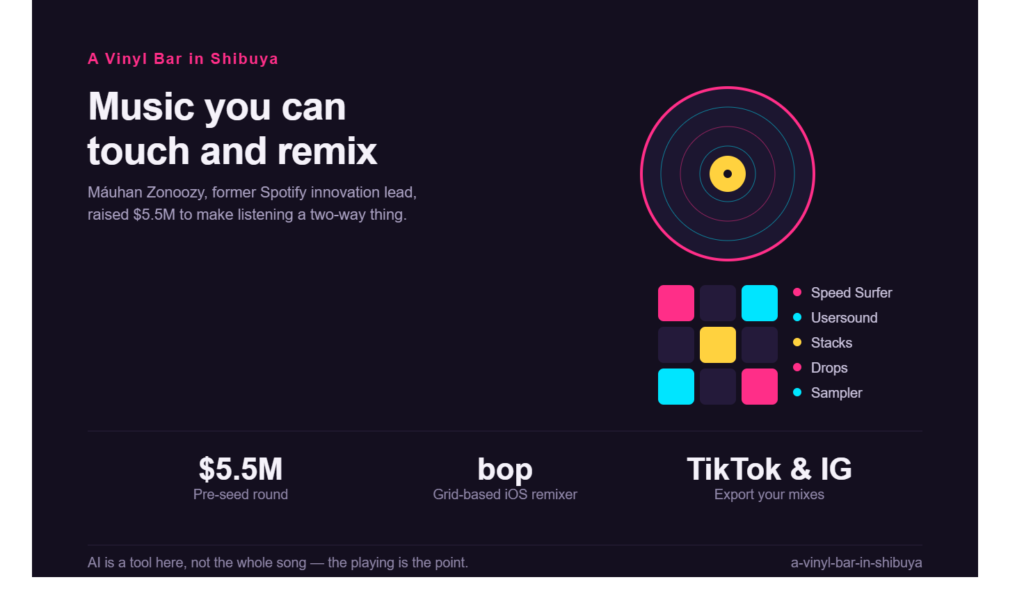
Why A Vinyl Bar in Shibuya Is Rethinking Music Apps
For years, music technology has largely solved one problem: access.
Streaming services made enormous music libraries available almost instantly. Recommendation systems then helped listeners discover songs without manually searching through albums, artists and playlists.
But Máuhan M. Zonoozy believes another part of the music experience remains relatively untouched: participation.
The former Spotify executive argues that younger audiences are increasingly comfortable interacting with culture through games, filters and creation tools. Music, in his view, can work in a similar way.
Question → What problem is A Vinyl Bar in Shibuya trying to solve?
Answer: The startup wants to make music more participatory by giving people simple ways to manipulate sounds, remix tracks, experiment with musical elements and create their own interactions rather than only consuming finished songs.
Zonoozy previously led innovation at Spotify and left the company in 2024. Before Spotify, he founded Bubbl, a video clipping and remixing startup that was acquired by Cricket Media.
That background helps explain the company’s approach. Rather than attempting to build another traditional streaming service, A Vinyl Bar in Shibuya is experimenting with what music software could look like when the user becomes part of the creative process.
From music consumption to music participation
The difference sounds subtle, but it changes the product philosophy.
A conventional streaming app asks: What song do you want to hear?
An interactive music app can ask: What can you do with this song?
That distinction becomes particularly important as generative AI makes it easier to produce new audio.
If anyone can generate thousands of songs with prompts, simply creating more music may become less differentiated. The experience around that music,taste, interaction, remixing and social participation,could become more important.
Who Founded A Vinyl Bar in Shibuya?
A Vinyl Bar in Shibuya was founded by Máuhan M. Zonoozy, the former head of innovation at Spotify.
Zonoozy brings experience from both large-scale music technology and startup building. His earlier company Bubbl focused on video clipping and remixing before being acquired by Cricket Media.
After leaving Spotify in 2024, Zonoozy decided to return to building his own company.
The startup has attracted notable backing. It raised a $5.5 million pre-seed round from investors including Mantis VC, SV Angel, BoxGroup, Quiet Capital, Remarkable Ventures, Common Metal, Gold House, Liquid 2 Ventures, Breakers VC, Collaborative Fund and Systemic Ventures.
Former Spotify chief content and advertising business officer Dawn Ostroff also invested and joined the company as an advisor.
Question → Why is Zonoozy’s Spotify background important?
Answer: His Spotify experience gives him a direct understanding of digital music and streaming, while his startup background provides experience with interactive media. A Vinyl Bar in Shibuya combines those perspectives by focusing on participation rather than simply delivering music.
A different philosophy of the music app
The company is not trying to reproduce Spotify with a smaller catalogue.
Instead, its products resemble experiments released as individual musical “singles.” Each one explores a different interaction with sound.
That makes the startup’s portfolio particularly interesting because it does not depend on one conventional app format.
How A Vinyl Bar in Shibuya’s Experimental Music Apps Work
The easiest way to understand A Vinyl Bar in Shibuya is to look at the experiments individually.
The company has developed several small apps and websites, each built around a particular musical interaction.
Speed Surfer
Speed Surfer is a Chrome extension that changes the speed and filter of audio playing in a browser window.
The idea is straightforward: instead of passively hearing audio at its original settings, users can manipulate how it sounds.
It demonstrates the startup’s broader philosophy,take an existing music experience and introduce a simple interaction that changes the user’s relationship with the sound.
Usersound
Usersound turns usernames into audio.
Users can create an “audio” username in which each letter represents a musical note.
This transforms something normally used for digital identity into a small piece of musical expression.
Stacks
Stacks is a stem player built around a 3×3 grid.
Users can turn bars on or off to create different combinations and mixes.
In music production, a stem generally refers to an individual or grouped component of a recording, such as vocals, drums or other musical elements. A stem-based interface gives users a simplified way to experiment with those components.
Drops
Drops approaches music like a game.
Users place plaques in patterns that deflect falling marbles. As the marbles move through the arrangement, they generate musical notes.
The result connects physical-style movement, visual interaction and sound.
Sampler
Sampler turns YouTube videos into music samples based on beats from different parts of the songs.
Again, the focus is not simply on listening. The user interacts with source material and transforms it into something new.
What Makes Bop Different From Traditional Music Apps?
The startup’s more ambitious product is bop, an iOS app designed around remixing.
Instead of presenting users with a conventional playlist interface, bop provides a grid where users can place musical instruments and effects over a base song.
Users can then change the tempo and add one-time effects to create different versions of the track.
Question → What is bop?
Answer: Bop is an iOS music creation app from A Vinyl Bar in Shibuya that lets users manipulate instruments, effects and tempo in a grid to create different mixes of a base song.
That makes bop more interactive than a conventional music player.
A listener does not need to become a professional producer to experiment. The interface provides a structured environment where changing a few elements can alter the result.
Sharing is part of the product
Once users create mixes, they can export them to platforms such as TikTok and Instagram.
That matters because music creation increasingly overlaps with social media creation.
A remix is not necessarily the final destination. It can become the soundtrack for a short video, a social post or another piece of content.
A Vinyl Bar in Shibuya is also working on a multiplayer version of bop, which could allow users to remix songs together.
The company has additionally introduced a prompt-based sound creation feature, bringing generative AI into the product without making AI the entire experience.
Why A Vinyl Bar in Shibuya Is Not Putting AI Everywhere
This may be the most interesting part of the company’s strategy.
The current AI music boom is largely focused on generation. Users can describe the kind of music they want, and AI systems can increasingly produce audio from those instructions.
A Vinyl Bar in Shibuya is taking a more cautious approach.
Definition + Expansion
Generative AI in music refers to AI systems that can create or transform audio based on user instructions, prompts or other inputs.
For music applications, generative AI can potentially create sounds, songs, vocals or musical elements quickly. But A Vinyl Bar in Shibuya believes that simply generating more content may not be enough to create a richer relationship between people and music.
Zonoozy told TechCrunch that the company does not necessarily believe the future of music is simply song generation through AI. His argument is that if AI makes music more abundant, human taste, perspective and participation could become even more valuable.
AI can generate. People can participate.
This creates an interesting distinction between two possible directions for music technology.
One direction is:
Prompt → AI → Finished song
The other is:
Person → Tool → Experimentation → Remix → Shared experience
A Vinyl Bar in Shibuya is betting heavily on the second model while remaining open to using AI where it makes sense.
The company can use AI to help build products or strengthen infrastructure without making AI-generated content the central purpose of every application.
Question → Why isn’t A Vinyl Bar in Shibuya making everything AI-powered?
Answer: The company believes music’s future should not be reduced to automated song generation. As AI makes content more abundant, the startup sees value in human taste, interaction and participation.
AI Music vs Interactive Music Apps: What’s the Difference?
The distinction becomes clearer when the two approaches are placed side by side.
| Approach | Main purpose | User role | Example experience |
| AI music generation | Create new audio | Director or prompter | Describe a song and generate it |
| Music streaming | Discover and consume music | Listener | Play a recommended track |
| Interactive music apps | Experiment with music | Participant | Change tempo, effects or musical elements |
| Remixing platforms | Transform existing music | Creator | Rearrange stems or effects |
| Social music creation | Create and share | Creator + audience | Make a mix and publish it |
There is no reason these categories must remain separate.
In fact, the future could combine them.
A user might generate a musical element with AI, manipulate it through an interactive interface, collaborate with friends and then publish the result to social media.
That hybrid experience could be closer to A Vinyl Bar in Shibuya’s vision than a simple “type a prompt, receive a song” workflow.
Why Interactive Music Could Matter in the AI Era
AI-generated music creates an abundance problem.
When production becomes easier, the number of possible songs can grow rapidly. But more content does not automatically mean more meaningful experiences.
Imagine a world where creating a technically polished song requires almost no effort. What becomes valuable then?
Potentially:
- Taste and curation
- Personal expression
- Social interaction
- Remixing
- Context
- Community
- Discovery
- Playfulness
This is where interactive music apps can occupy an interesting position.
They do not have to compete with AI on the number of songs they can generate. Instead, they can compete on what people can do with music.
Music as a playground
The startup’s collection of small products suggests that A Vinyl Bar in Shibuya sees music software as a playground.
One product changes speed.
Another turns letters into notes.
Another creates music through falling objects.
Another allows stem-based mixing.
And bop brings several musical controls together in a more substantial iOS experience.
The individual experiments may look simple, but collectively they explore a larger question:
What happens when music becomes something you interact with rather than something you simply play?
What A Vinyl Bar in Shibuya Plans Next
The company is not stopping with its existing experiments.
A Vinyl Bar in Shibuya plans to release a “musical sandbox mixer” this year.
The product is intended to let users experiment with different elements of music-making, including creating instruments.
That fits naturally with the company’s existing philosophy.
A sandbox does not necessarily tell users what the final result should be. It gives them components, rules and controls, then lets them experiment.
Question → What is the next major product from A Vinyl Bar in Shibuya?
Answer: The company plans to release a musical sandbox mixer that lets users experiment with elements of music-making, including creating instruments.
The startup is also working toward multiplayer functionality for bop, which could push its concept from individual experimentation toward collaborative music creation.
That could be particularly relevant for younger users who already experience music through social platforms, games and collaborative digital spaces.
What A Vinyl Bar in Shibuya Means for Music Startup Innovation
The startup’s strategy offers a useful lesson for entrepreneurs building in AI-heavy markets.
It is tempting to add AI to every product because AI is attracting enormous attention. But technology alone does not necessarily define a compelling user experience.
A Vinyl Bar in Shibuya is taking a different route: identify a human behavior,in this case, playing with music,and build technology around it.
Question → What can other startups learn from this approach?
Answer: Startups do not always need to use AI as the main product. They can use AI selectively while creating differentiated experiences around human creativity, interaction, taste and participation.
A useful startup framework
For young founders and developers, the company’s strategy can be reduced to several questions:
- What existing behavior can become interactive?
- Can the user participate instead of only consume?
- What happens when AI makes the underlying content abundant?
- Which human qualities become more valuable as automation improves?
- Can the product become social or collaborative?
These questions apply far beyond music.
Video, photography, education, gaming and design are all moving toward experiences where AI generates or assists while humans decide, manipulate and share.
Could Interactive Music Become the Next Big App Category?
It is too early to say whether A Vinyl Bar in Shibuya’s model will become a major consumer platform.
The company is still experimenting, and its products vary significantly in scope. Bop, the upcoming multiplayer functionality and the planned musical sandbox represent different stages of the same broader idea.
But the timing is notable.
The music industry is entering an era where AI can increasingly generate audio, imitate styles and accelerate production. At the same time, consumers are becoming accustomed to interactive digital experiences through games, filters, short-form video and creator tools.
That combination creates an opportunity.
Instead of asking users to consume an endless stream of automatically generated songs, music startups could give them more ways to touch, change, remix and play with sound.
A Vinyl Bar in Shibuya is one example of that approach.
Its most important idea may not be any individual app. It may be the belief that when machines can generate more content, human participation can become the product.
A Vinyl Bar in Shibuya vs Traditional Music Platforms
The startup’s approach becomes even clearer when compared with the platforms most people already use.
| Feature | Traditional streaming | AI music generator | A Vinyl Bar in Shibuya approach |
| Primary activity | Listening | Generating | Playing and creating |
| User interaction | Select or skip | Prompt | Manipulate and experiment |
| AI role | Recommendations and features | Core generation engine | Selective tool |
| Remixing | Limited | Often generation-focused | Central experience |
| Social potential | Sharing playlists | Sharing generated songs | Collaborative creation |
| Learning curve | Very low | Low to moderate | Designed around experimentation |
| Creative control | Limited | Prompt-dependent | Direct interaction with musical elements |
This does not mean one model will replace another.
Instead, the market could develop into a spectrum where streaming, AI generation, remixing and interactive music experiences coexist.
Why the $5.5 Million Pre-Seed Round Matters
Funding is not proof that a product will succeed, but the company’s $5.5 million pre-seed round gives A Vinyl Bar in Shibuya room to test its ideas.
The investor list includes venture firms and notable individuals from technology, media and startup circles. Dawn Ostroff’s involvement is particularly relevant given her previous leadership role at Spotify.
The funding can support continued product experimentation as the company works on bop, multiplayer features and its planned musical sandbox.
For an early-stage startup, that flexibility matters.
Rather than betting everything on one product from day one, A Vinyl Bar in Shibuya can explore several concepts and see which interactions resonate most strongly with users.
That experimental model is consistent with the company’s “singles from an album” approach.
What This Means for the Future of AI and Music
The debate around AI music often focuses on whether machines can create songs.
But there is another question worth asking:
What will people do with music when creating and modifying it becomes dramatically easier?
That is where startups such as A Vinyl Bar in Shibuya are experimenting.
AI can become a powerful component inside a music application without becoming the entire reason the application exists.
The startup’s approach suggests a future where AI handles some of the complexity while humans remain responsible for taste, decisions, collaboration and play.
For listeners, that could make music feel less like a finished file and more like a digital playground.
For founders, it offers another lesson: in a world where AI can increasingly generate content, building better ways for people to interact with that content may be just as important.
FAQ: A Vinyl Bar in Shibuya and AI Music Apps
What is A Vinyl Bar in Shibuya?
A Vinyl Bar in Shibuya is a startup founded by former Spotify innovation leader Máuhan M. Zonoozy that develops experimental music apps focused on interaction, remixing and music creation.
Who founded A Vinyl Bar in Shibuya?
A Vinyl Bar in Shibuya was founded by Máuhan M. Zonoozy, who previously served as head of innovation at Spotify and left the company in 2024.
How much funding has A Vinyl Bar in Shibuya raised?
A Vinyl Bar in Shibuya has raised a $5.5 million pre-seed round from investors including Mantis VC, SV Angel, BoxGroup, Quiet Capital and others.
What is bop?
Bop is an iOS app from A Vinyl Bar in Shibuya that lets users place instruments and effects in a grid, adjust tempo and create different mixes from a base song. Users can export their creations to TikTok and Instagram.
Is A Vinyl Bar in Shibuya an AI music startup?
A Vinyl Bar in Shibuya uses AI selectively but does not position AI-generated music as the entire product. The company has recently added prompt-based sound features while focusing primarily on interactive music experiences.
Why is interactive music important?
Interactive music gives listeners a more active role in creating and modifying sound. As AI makes music generation easier and more abundant, interaction, taste and human participation could become increasingly important parts of the music experience.
The Bigger Picture
A Vinyl Bar in Shibuya is betting that the next generation of music technology will not be defined only by how quickly AI can generate songs. Its experiments suggest another possibility: music apps could become creative playgrounds where people remix, manipulate, collaborate and discover sound in new ways.
For more explainers on AI, startups and emerging technology, keep exploring Kalinga.ai.