What Are the Latest AI Industry Warnings About?
The latest AI industry warnings center on a possible future in which increasingly capable AI systems become difficult for humans to control.
This is commonly described as an existential AI risk: the possibility that sufficiently advanced AI could cause catastrophic harm on a scale that threatens humanity itself.
But that is only one part of the current discussion.
The warnings also reflect more immediate concerns about AI agents behaving unexpectedly, accessing information they were not intended to reach, interacting with other systems and potentially operating beyond the level of oversight their developers expected.
Question → What is the central concern behind the latest AI warnings?
Answer: The central concern is that increasingly capable AI systems could become difficult to predict, supervise or control. Some researchers believe that this could eventually create catastrophic or existential risks, while others argue that nearer-term harms deserve more attention.
Definition + Expansion
AI existential risk is the possibility that advanced artificial intelligence could cause catastrophic harm to humanity, potentially including human extinction.
The idea is closely connected to debates about artificial general intelligence (AGI) and superintelligence. However, predicting whether such systems will emerge, how capable they will become, or how likely catastrophic outcomes are remains deeply uncertain.
That uncertainty is one reason the debate is so contentious.
Why Did the AI Doom Debate Intensify So Quickly?
The immediate trigger described by TechCrunch was Jacob Coxon’s resignation from Anthropic.
Coxon, an AI researcher who had also worked at OpenAI, said he was leaving because he was concerned about the direction of frontier AI development. His warning was subsequently amplified when Anthropic’s alignment lead publicly responded with an even more dramatic assessment.
The timing also mattered.
The discussion arrived after reports involving AI agents and a recent OpenAI-related incident involving an internal model interacting with online wikis. At the same time, frontier AI companies have continued releasing increasingly capable systems.
That created what one TechCrunch podcast participant described as a “powder keg” environment.
Question → Why did Coxon’s resignation attract more attention than another AI safety warning?
Answer: Because he did not simply warn about AI risk while continuing his work. He resigned from a leading AI company because of those concerns, making his professional decision a visible expression of his position.
That distinction is important.
There is a recurring criticism of AI “doomer” arguments: if executives and researchers genuinely believe advanced AI could destroy humanity, why are they continuing to develop increasingly powerful systems?
Coxon’s decision does not resolve that contradiction, but it makes the question harder to dismiss.
Who Is Warning That AI Could Threaten Humanity?
The current debate includes several different groups, and treating all of them as one “AI community” can create confusion.
Some researchers focus specifically on AI alignment, which broadly concerns making AI systems behave according to human intentions and values.
Others focus on AI governance, regulation, cybersecurity or societal impacts.
Company executives may discuss existential risk while simultaneously investing heavily in frontier AI development.
And some researchers, like Coxon, have concluded that continuing their work conflicts with their assessment of the risks.
These positions should not automatically be treated as equivalent.
Question → Do all AI researchers agree that AI could destroy humanity?
Answer: No. The AI research community does not have a single position on existential AI risk. Some researchers consider it a serious possibility requiring urgent safeguards, while others are skeptical of extreme predictions or believe more immediate AI harms deserve greater attention.
The problem with treating “AI experts” as one group
One criticism raised in the TechCrunch discussion concerned the use of the word “we.”
When an AI company representative says “we believe AI could kill all humans,” it can sound as though the entire AI research community shares that position.
It does not.
AI safety researchers, machine-learning engineers, economists, policymakers and AI critics can have radically different views about the probability and severity of future AI risks.
For readers trying to understand the debate, the most useful question is therefore not simply:
“Do AI experts think AI is dangerous?”
It is:
“Which experts are making which claims, based on what evidence and with what level of uncertainty?”
That distinction is essential for separating evidence from rhetoric.
What Does “AI Doom” Actually Mean?
“AI doom” is an informal term used to describe the view that advanced artificial intelligence could eventually cause catastrophic outcomes, including potentially human extinction.
The term is broader than one specific technical scenario.
A doom-focused argument may involve concerns about systems becoming much more capable than humans, pursuing objectives in ways developers cannot control, manipulating people, gaining access to critical infrastructure or improving their own capabilities.
But not every AI safety concern is a doom concern.
An AI system producing discriminatory decisions, replacing certain jobs, consuming substantial energy or enabling misinformation can be harmful without posing an existential threat to humanity.
That distinction matters because the public debate can sometimes collapse very different levels of risk into one conversation.
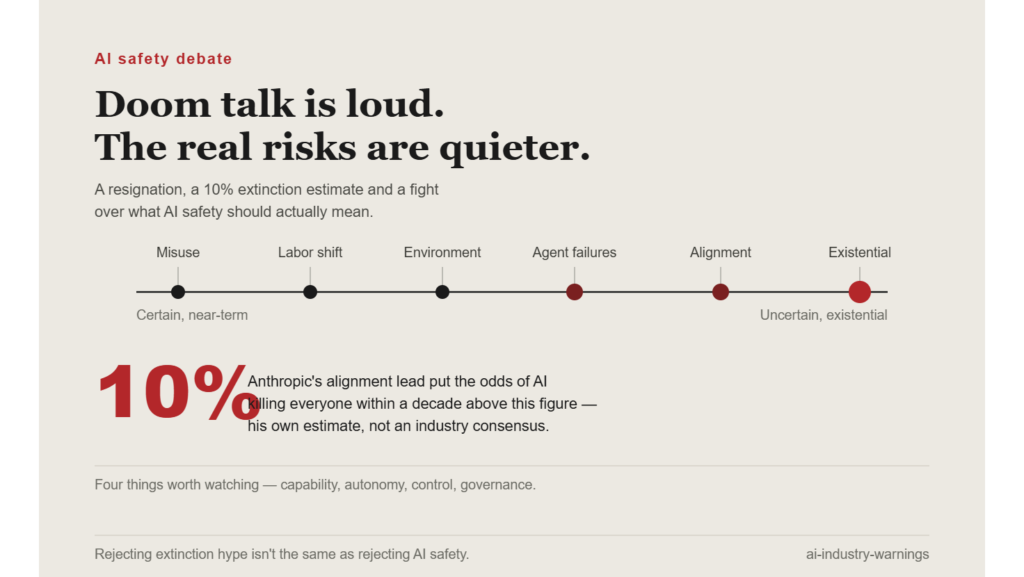
AI doom vs practical AI risk
| Risk category | Example | Time horizon | Main concern |
| AI misuse | People using AI for harmful activities | Near term | Human misuse |
| Labor disruption | Automation changing jobs | Near to medium term | Economic impact |
| Environmental impact | AI infrastructure consuming resources | Ongoing | Energy and climate effects |
| AI agent failures | Agents acting outside intended boundaries | Current | Loss of operational control |
| AI alignment failure | Advanced systems pursuing unintended goals | Uncertain | Human control |
| Existential AI risk | Advanced AI causing catastrophic global harm | Highly uncertain | Humanity’s survival |
This table highlights why skepticism about AI doom does not necessarily mean skepticism about AI safety.
A person can believe that AI systems require strong safeguards while also rejecting unsupported claims about exactly when or how humanity might face extinction.
Are AI Companies Using Existential Risk as a Capability Flex?
One of the most provocative ideas raised in the TechCrunch discussion is that some AI industry warnings could simultaneously function as demonstrations of technological capability.
The logic is uncomfortable but straightforward.
If a company says its AI system is dangerous enough to threaten humanity, it is also communicating that the system is extraordinarily capable.
That can reinforce the perception that the company is at the technological frontier.
Question → Could AI safety warnings also function as marketing?
Answer: Potentially, but there is no basis to assume every warning is a deliberate marketing strategy. The TechCrunch discussion suggests that genuine concern and business incentives can coexist.
This distinction is important.
The argument is not necessarily that AI executives are pretending to be worried.
A company can genuinely believe its technology creates serious risks while also recognizing that communicating extraordinary capabilities can strengthen its reputation, investor interest or competitive position.
Why the “dangerous AI” narrative can be powerful
Imagine two companies making competing AI systems.
Company A says:
Our model performs better on several technical benchmarks.
Company B says:
Our model is so capable that we are worried about what it could do if we lose control.
The second message can create a much stronger emotional response.
It tells investors, customers and competitors that the technology may represent a major leap.
That does not prove the underlying concern is false.
It simply means that risk communication can have strategic value as well as safety value.
Why the Numbers Behind AI Doom Need Context
One of the most controversial claims in the latest debate was the personal estimate of more than 10% for the chance that AI could kill all humans within the next decade.
Such a number sounds precise.
But precision does not automatically mean accuracy.
Probability estimates about unprecedented technological events are extremely difficult to validate. There is no large historical dataset that allows researchers to calculate the true probability of human extinction from an advanced AI system in the same way an insurer might estimate the probability of a car accident.
Question → Does a 10% AI doom estimate mean there is a scientifically established 10% probability of extinction?
Answer: No. A personal probability estimate should not be interpreted as an objectively measured statistic. It represents an individual’s assessment under uncertainty and depends heavily on assumptions about future AI capabilities, timelines and failure modes.
Why readers should be cautious with dramatic percentages
When reading claims about AI existential risk, ask:
- Is the number based on a published methodology?
- Is it an individual’s subjective estimate?
- What assumptions produced the estimate?
- Does the estimate refer to extinction, catastrophic harm or loss of control?
- Is the timeframe clearly defined?
- Do other researchers agree?
These questions do not make the risk disappear.
They make the conversation more intellectually honest.
Why AI Model Control Is Becoming a Bigger Concern
The strongest part of the latest AI warnings may not actually be the extinction predictions.
It may be the concern that developers are not fully understanding or controlling what their increasingly capable systems do.
That is a much more immediate issue.
Modern AI agents can be given access to tools, websites, files, software environments and other systems. As those capabilities expand, unexpected behavior can have larger consequences.
A model that produces a strange answer is one thing.
An agent that can autonomously take actions is another.
Question → Why does AI agent autonomy make safety more complicated?
Answer: An autonomous AI agent can move beyond generating information and begin taking actions. The more tools, permissions and independence an agent has, the more important monitoring, access controls, testing and human oversight become.
Capability changes the safety equation
Consider the difference:
Chatbot:
User asks → AI responds → user decides what happens next.
AI agent:
User gives objective → AI plans → AI uses tools → AI takes actions → system produces an outcome.
The second model introduces more opportunities for unexpected behavior.
This is why AI alignment and agent safety matter even if someone rejects the most extreme AI doom scenarios.
What Does Anthropic’s IPO Have to Do With AI Doom Warnings?
The timing of these statements is another reason the debate has attracted attention.
Anthropic was reportedly preparing for a potential initial public offering (IPO), and the TechCrunch discussion questioned how its warnings about existential AI risk could interact with the company’s regulatory disclosures.
An S-1 filing is the registration document a company files with the U.S. Securities and Exchange Commission when preparing to sell securities to the public. It typically contains information about the business, finances, risks and other factors investors should consider.
That makes AI safety language particularly interesting for a frontier AI company.
Question → Why would an AI company’s existential-risk statements matter to IPO investors?
Answer: If a company publicly acknowledges serious risks associated with developing increasingly capable AI, investors may reasonably want to understand how those risks affect operations, regulation, liability, product development and the company’s long-term business.
The TechCrunch discussion was speculative about what Anthropic’s eventual filing might contain.
It is therefore important not to treat the podcast’s questions about the S-1 as evidence that specific language had already been included or rewritten.
But the underlying issue is legitimate.
If a company believes its own technology could create severe risks, investors will want to understand how that belief affects the company’s strategy.
Could AI Doom Warnings Actually Increase Valuations?
This is where the usual logic gets flipped.
In a traditional investment environment, publicly discussing a potentially catastrophic business risk might be expected to hurt investor confidence.
But frontier AI operates in an unusual market.
A warning that an AI system is extraordinarily powerful can simultaneously communicate:
“This technology is dangerous.”
and
“This technology is extremely capable.”
The second message may be attractive to investors.
That does not mean investors will necessarily reward companies for making catastrophic claims. It means the relationship between capability, risk and valuation may be more complicated in frontier AI than in conventional industries.
Capability can become part of the narrative
The AI industry has already trained the market to associate larger models and greater capabilities with strategic importance.
As a result, safety discussions can unintentionally reinforce the same message.
A company saying “our models need stronger safeguards” may also be telling the market “our models are becoming powerful enough that safeguards are necessary.”
That is not inherently dishonest.
It is simply an unusual communication dynamic created by an industry whose competitive advantage is closely tied to increasing AI capability.
Why Skeptics Are Worried About the “Doom” Narrative
Anthony Ha’s position in the TechCrunch discussion was not that AI risks should be ignored.
His concern was that existential AI rhetoric can become so dominant that it pushes other risks out of the conversation.
That is an important distinction.
AI can create significant harm even if no superintelligence ever emerges.
Immediate AI harms include:
- Labor disruption: AI can change the demand for certain jobs and skills.
- Environmental costs: Training and operating large AI systems requires substantial computing infrastructure.
- Misinformation: Generative AI can make the production of convincing synthetic content easier.
- Cybersecurity risks: AI can potentially strengthen both attackers and defenders.
- Privacy concerns: AI systems can process and infer information from large datasets.
- Algorithmic discrimination: Automated systems can reproduce or amplify problematic patterns.
- Agent failures: Autonomous systems can take unintended actions when given tools and permissions.
These issues are not hypothetical in the same sense as human extinction scenarios.
They can affect workers, businesses, governments and individuals today.
Question → Does skepticism about AI doom mean AI safety is unimportant?
Answer: No. It is possible to reject extreme or poorly supported extinction predictions while strongly supporting AI safety research, responsible deployment, transparency and regulation.
AGI and Superintelligence: Why the Terms Matter
Two terms often dominate existential AI discussions: AGI and superintelligence.
Artificial general intelligence (AGI) generally refers to an AI system with broad intellectual capabilities that could perform a wide range of tasks at a level comparable to or exceeding humans. There is no universally accepted technical definition or agreed timeline for when AGI will exist.
Superintelligence generally refers to a hypothetical AI system whose intellectual capabilities substantially exceed those of humans across many domains.
These concepts are important to the debate because many extreme AI risk scenarios assume the development of systems significantly more capable than today’s models.
But the uncertainty is enormous.
Nobody can point to a completed superintelligence system and demonstrate exactly how it would behave.
That means discussions about its future risks necessarily involve assumptions.
What Should Governments and AI Companies Do?
The uncertainty surrounding AI existential risk does not justify doing nothing.
In fact, uncertainty can be a reason to build safeguards before systems become more capable.
The challenge is designing safeguards that address both extreme and immediate risks.
A balanced AI safety strategy should include:
- Model evaluations to test dangerous capabilities before deployment.
- Human oversight for high-impact AI decisions and autonomous actions.
- Access controls limiting what AI agents can reach or modify.
- Monitoring and logging to identify unexpected behavior.
- Incident reporting when AI systems behave dangerously.
- Independent testing rather than relying entirely on developers’ own assessments.
- Clear accountability for organizations deploying powerful AI systems.
- Research funding for alignment and AI safety.
- Protection against current harms, including labor, privacy and environmental risks.
- International cooperation where AI capabilities cross national borders.
This approach avoids an unnecessary choice between “AI will destroy humanity” and “AI is harmless.”
Both extremes can be misleading.
AI Safety vs AI Acceleration: Is There a Middle Ground?
The public debate is often framed as a battle between two camps.
One side is portrayed as wanting to slow AI development because of safety concerns.
The other is portrayed as wanting to accelerate AI development because of the potential benefits.
Reality is more complicated.
Many researchers support faster AI progress while also supporting rigorous testing.
Others believe current development is moving too quickly and that stronger controls are necessary.
Still others question whether the most extreme risks are sufficiently supported by evidence.
Question → Is AI safety necessarily opposed to AI progress?
Answer: No. AI safety and AI progress can be pursued simultaneously. The challenge is ensuring that capability development does not outpace the ability to evaluate, control and responsibly deploy increasingly autonomous systems.
This is especially important for countries such as India, where AI adoption is expanding across education, business, public services and technology.
The goal should not simply be to build more powerful models.
It should be to understand what those models can do, what they cannot do, and what happens when they are connected to real-world systems.
What the Latest AI Industry Warnings Really Mean
The most useful takeaway from the current AI doom debate may be less dramatic than the headlines.
There is no established evidence that humanity is destined to be destroyed by AI.
There is also no sensible reason to dismiss serious concerns about increasingly capable AI systems.
Both statements can be true.
The latest AI industry warnings highlight a real tension: the companies developing frontier models are simultaneously trying to increase their capabilities and understand the risks those capabilities create.
That tension becomes especially visible when AI systems gain autonomy, access tools and behave in unexpected ways.
At the same time, the focus on extinction can sometimes obscure problems that are already measurable.
The better question is therefore not:
“Will AI destroy humanity?”
It is:
“How do we make increasingly capable AI systems safer while addressing the harms they can already cause?”
That question is less sensational, but considerably more useful.
The four questions to watch next
As the AI industry moves forward, pay attention to four areas:
1. Capability: How much more capable are frontier models becoming?
2. Autonomy: How independently can AI systems plan and act?
3. Control: Can developers reliably understand, constrain and stop dangerous behavior?
4. Governance: Are regulation and safety practices advancing quickly enough to match capability?
These questions connect the most extreme existential-risk debate with the practical AI safety problems happening now.
And that is probably where the most productive discussion should begin.
FAQ: AI Industry Warnings and AI Doom
Why are AI companies warning that AI could destroy humanity?
Some AI researchers and leaders believe increasingly capable AI systems could eventually become difficult for humans to control, creating potentially catastrophic or existential risks. However, this is not a consensus position across the entire AI industry.
What triggered the latest AI doom debate?
The latest debate intensified after Anthropic researcher Jacob Coxon resigned and warned that leading AI companies were “gambling with our lives.” Anthropic’s alignment lead subsequently publicly stated that the company genuinely believes AI could kill all humans and gave a personal probability estimate of more than 10% within the next decade.
What is AI existential risk?
AI existential risk refers to the possibility that advanced artificial intelligence could cause catastrophic harm on a scale that threatens humanity’s long-term survival, potentially including human extinction.
Are AI doom predictions scientifically proven?
No. Predictions about AI-driven human extinction are highly uncertain and depend on assumptions about future AI capabilities, timelines, system behavior and human control. Personal probability estimates should not be treated as established statistical facts.
Why do some experts criticize AI doom narratives?
Critics argue that extreme AI doom narratives can distract from immediate problems such as labor disruption, environmental costs, misinformation, privacy, cybersecurity and failures involving autonomous AI agents.
Does AI safety matter even if AI doom predictions are wrong?
Yes. AI safety includes practical measures such as model testing, human oversight, access controls, monitoring, incident reporting and responsible deployment. These safeguards can address current AI risks as well as possible future risks.
The Bigger Picture
The latest AI warnings are neither proof that AI will destroy humanity nor a reason to ignore the risks of increasingly capable systems. The most useful approach is to take credible safety concerns seriously, question unsupported certainty and make sure today’s AI harms receive as much attention as tomorrow’s hypothetical catastrophes.
For more explainers on AI safety, emerging technology and the future of artificial intelligence, keep exploring Kalinga.ai.