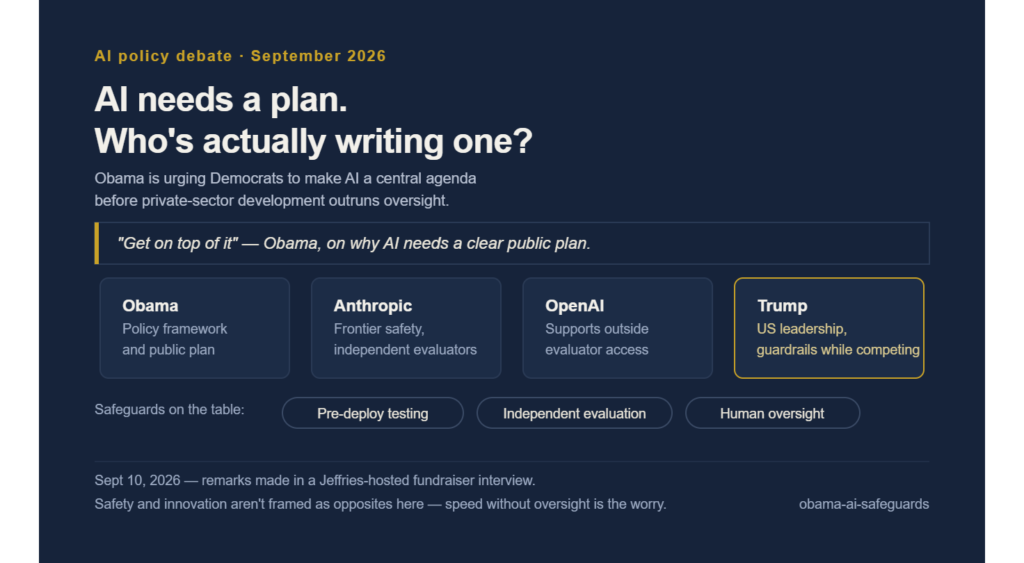
Why is Obama calling for a clear AI safeguards plan?
AI is moving quickly enough that even former presidents are warning policymakers not to treat it as just another technology trend.
Former U.S. President Barack Obama has urged Democrats to make artificial intelligence one of their “central agendas” and develop a clear plan for AI safeguards, according to The New York Times. His message is not simply that AI should be restricted: Obama argued that the technology could be dangerous if governments fail to keep up, but potentially highly beneficial if it is responsibly managed.
Obama made the comments on September 10, 2026, during a Democratic fundraising event where he was interviewed by House Minority Leader Hakeem Jeffries. The discussion reflects a larger U.S. debate over how governments should respond to increasingly capable AI systems while still allowing innovation.
The timing is significant. AI companies themselves are now discussing independent safety evaluations and common standards, while researchers are raising concerns about the possibility of increasingly autonomous and self-improving systems.
For policymakers, the challenge is therefore becoming more specific: How can governments create meaningful AI safeguards without blocking the benefits that advanced AI could deliver?
What did Obama say about AI safeguards?
Question → Direct Answer: What exactly is Obama asking Democrats to do on AI?
Obama wants Democrats to develop a framework for a public conversation about AI’s economic and safety implications if they regain control of the U.S. House. He argued that AI is developing rapidly in private hands and that policymakers need to “get on top of it.”
According to the New York Times, Obama made his comments after Jeffries asked how congressional Democrats should approach AI.
Obama’s argument contains two ideas that are easy to separate but important to consider together:
- AI could create significant economic and scientific benefits.
- AI could become dangerous if its development outpaces effective oversight.
That distinction is central to the current AI policy debate.
Obama did not frame the issue as simply “AI is bad.” Instead, he suggested that responsible oversight could allow society to capture AI’s benefits while reducing its risks.
AI could accelerate scientific progress
One of Obama’s clearest examples was drug development.
He said he genuinely believes AI could accelerate drug development in ways that could help cure diseases. This is important because it demonstrates why policymakers face a difficult balancing act: the same technology that creates new safety concerns could also produce major advances in medicine and research.
For students and young professionals, this is a useful way to understand the policy argument.
AI regulation is not only about preventing harmful uses. It is also about determining how society can safely deploy powerful systems in areas such as healthcare, education, research, cybersecurity and productivity.
Why does Obama want Democrats to make AI a central agenda?
The political significance of Obama’s comments goes beyond one speech.
AI is increasingly affecting jobs, business models, scientific research, national security and information ecosystems. That means AI policy can no longer be treated as a narrow technology issue handled only by specialist committees.
Question → Direct Answer: Why is AI becoming a political priority?
AI is becoming a political priority because its impact extends into the economy, public safety, employment, national competitiveness and scientific research. Policymakers increasingly need rules that address both the opportunities and risks created by advanced AI.
Obama’s argument also reflects a concern about the speed of private-sector AI development.
Unlike traditional government programs, frontier AI systems are primarily being developed by private companies with enormous computing resources, specialized researchers and rapidly evolving commercial incentives.
That creates a governance problem.
Government agencies may need to establish safety expectations while the underlying technology continues changing faster than conventional legislation can be written.
The policy challenge is speed
Imagine lawmakers pass a rule designed around today’s AI models.
By the time the rule takes effect, companies may already be deploying substantially more capable systems.
That is one reason policymakers increasingly discuss frameworks, standards and evaluations rather than relying exclusively on highly specific rules for individual AI products.
A flexible framework could establish principles that remain relevant as models evolve.
At the same time, flexibility creates another problem: rules that are too vague may be difficult to enforce.
This is why Obama’s call for a “clear plan” matters. A policy framework needs enough flexibility to survive technological change while remaining specific enough to create meaningful accountability.
What are AI safeguards and guardrails?
Definition – AI safeguards: AI safeguards are technical, organizational or regulatory measures designed to reduce the likelihood that AI systems cause unacceptable harm.
Safeguards can exist at several levels. A company might test a model before release, limit what an AI agent can access, monitor its behavior after deployment, or give independent evaluators access to examine potential failures.
Governments can also establish requirements for testing, reporting, transparency, security or accountability.
Question → Direct Answer: Are AI safeguards the same as banning AI?
No. AI safeguards are not inherently about stopping AI development. They are intended to create boundaries around how powerful systems are developed and deployed so that useful applications can continue while serious risks are reduced.
This distinction is particularly important in the political debate.
A government could theoretically pursue an approach that heavily restricts advanced AI. Another approach could rely mostly on voluntary industry standards. Between those extremes are regulatory frameworks that establish mandatory safety requirements while allowing companies room to innovate.
Common types of AI safeguards
Potential safeguards can include:
- Pre-deployment testing: evaluating AI models before they reach users.
- Independent evaluation: allowing outside experts to test advanced systems.
- Access controls: limiting what AI agents can do or access.
- Monitoring: tracking systems for unexpected or dangerous behavior.
- Incident reporting: requiring companies to disclose serious AI-related failures.
- Common standards: establishing shared safety expectations across companies.
- Human oversight: keeping people responsible for high-impact decisions.
The exact combination matters because no single safeguard can address every AI risk.
Why are independent AI evaluators becoming important?
One of the most notable developments surrounding Obama’s comments came from Anthropic CEO Dario Amodei.
On September 12, 2026, Amodei outlined a broad approach he called “pacing the frontier.” Among other proposals, the approach would give independent safety evaluators access to leading AI companies and models and encourage companies to develop common safety standards.
OpenAI CEO Sam Altman also said that OpenAI would commit to having independent evaluators with employee-like access.
Question → Direct Answer: Why do independent evaluators matter?
Independent evaluators can provide an external perspective on AI systems rather than leaving companies to assess their own models entirely. Their role could include testing models for dangerous capabilities, unexpected behaviors and weaknesses that internal teams may overlook.
The concept is similar to independent auditing in other industries.
A company has strong incentives to understand its own product, but an outside evaluator can ask different questions and challenge assumptions.
For frontier AI, this could become increasingly important as models gain more sophisticated capabilities.
Company testing vs independent testing
| Approach | Main Advantage | Main Limitation |
| Internal safety testing | Deep access to the model and development process | Potential conflict between safety and commercial incentives |
| Independent evaluation | External scrutiny and greater separation from product teams | Requires meaningful access and technical expertise |
| Government evaluation | Public accountability and regulatory authority | Can be slower and may lack frontier-model expertise |
| Shared industry standards | Consistent expectations across companies | Standards may be difficult to agree on or enforce |
The emerging debate is not necessarily about choosing only one approach.
A stronger system could combine internal testing, independent evaluation and government oversight.
How does the Obama position fit into the wider AI safety debate?
Obama’s comments come during a period of unusually intense discussion about AI safety.
An AI researcher recently resigned from Anthropic and warned that leading companies were moving rapidly toward potentially self-improving systems. The incident intensified discussion about whether AI development is progressing faster than society’s ability to manage it.
Anthropic has also publicly discussed stronger safety coordination.
This creates an unusual situation: AI companies, researchers and politicians are increasingly discussing safeguards at the same time.
Question → Direct Answer: Why has AI safety become such a major issue now?
AI safety has become more prominent because frontier models are becoming more capable, while companies are exploring systems that can perform increasingly complex tasks with less direct human intervention. That raises questions about reliability, misuse, autonomy and whether existing oversight mechanisms are sufficient.
The debate is broader than hypothetical scenarios about machines taking over.
It includes practical concerns such as cybersecurity, misinformation, labor-market disruption, privacy, unsafe automated decisions and the ability of AI agents to interact with external systems.
Obama’s comments therefore fit into a much larger conversation.
Obama, Anthropic, OpenAI and Trump: How do their AI approaches compare?
Different political and industry figures are emphasizing different parts of the AI debate.
Obama is calling for a clearer political framework. Anthropic is discussing industry-wide safety coordination and independent evaluation. OpenAI has signaled support for independent evaluators. President Donald Trump has emphasized U.S. technological leadership while also acknowledging the possibility of guardrails.
Question → Direct Answer: Are these positions completely opposed?
Not necessarily. All of these positions acknowledge that AI requires some form of safety consideration, but they differ over how much oversight is needed, who should provide it and how regulation should interact with technological competition.
| Figure/Organization | Main Emphasis | AI Policy Direction |
| Barack Obama | Public policy and safeguards | Clear government framework and public discussion |
| Dario Amodei / Anthropic | Frontier safety | Independent evaluators and common standards |
| Sam Altman / OpenAI | AI development plus evaluation | Support for independent evaluators |
| Donald Trump | U.S. AI leadership | Maintain technological advantage while allowing guardrails |
Trump’s comments add another dimension to the debate: national competitiveness.
According to Bloomberg, Trump said the U.S. needs to maintain its technological lead because “whoever wins AI wins.” At the same time, he said guardrails could be put in place.
That tension-innovation versus regulation-is likely to remain one of the defining questions in U.S. AI policy.
Why does AI policy have to balance safety and innovation?
It can be tempting to divide the debate into two camps: people who want unrestricted AI development and people who want strict regulation.
The reality is more complicated.
Question → Direct Answer: What is the biggest challenge for AI policymakers?
The biggest challenge is designing rules that reduce serious risks without unnecessarily preventing beneficial AI development. Policymakers must account for rapidly changing technology, economic competition and applications that could provide major social benefits.
Obama’s example of drug development illustrates the point.
If AI can meaningfully accelerate scientific research, overly broad restrictions could delay beneficial discoveries. But if powerful systems can also create significant security or safety risks, doing nothing could leave society exposed.
A sensible policy conversation therefore needs to distinguish between different levels of risk.
Not every AI system needs the same rules
A simple chatbot answering general questions does not present exactly the same risks as an AI system controlling industrial equipment, conducting advanced cyber operations or operating as an autonomous agent.
That suggests AI governance could become increasingly risk-based.
Lower-risk applications could face lighter requirements, while systems with greater capabilities or access to sensitive infrastructure could face stronger testing and oversight.
Such an approach would also reduce the chance that regulation becomes unnecessarily burdensome for startups and smaller developers.
What could a future U.S. AI safeguards framework include?
Obama did not present a complete legislative proposal in the comments reported by the New York Times. His message was that Democrats should develop a framework for public discussion.
That leaves plenty of room for policymakers to debate what such a framework should contain.
Question → Direct Answer: What might a practical AI safeguards framework focus on?
A practical framework could combine model evaluations, transparency, independent testing, security requirements, incident reporting, human oversight and standards for particularly capable AI systems. The precise requirements would depend on the capabilities and risks of each system.
Potential components could include:
- Frontier-model evaluations before deployment.
- Independent safety testing for highly capable systems.
- Clear responsibility for companies deploying high-risk AI.
- Incident reporting when serious failures occur.
- Security requirements for models and their infrastructure.
- Human oversight for consequential decisions.
- Common technical standards across major AI developers.
- Regular reassessment as models become more capable.
The most important feature may be adaptability.
AI policy written today cannot assume that today’s capabilities will remain the technological ceiling.
What does this mean for AI companies?
For AI companies, the growing emphasis on safeguards could change how frontier systems are developed and launched.
Companies may increasingly need to demonstrate not just that their models are capable, but that they understand and can manage those capabilities.
Question → Direct Answer: Will AI safeguards affect AI companies?
Yes. Stronger safeguards could affect model testing, deployment timelines, documentation, security practices, external evaluations and the way companies communicate about advanced capabilities.
This does not necessarily mean every AI startup will face the same regulatory burden.
A risk-based framework could distinguish between a small company building an AI productivity tool and a company developing a frontier model with substantially greater capabilities.
For startups, the challenge could be proving that their systems are safe enough without having the enormous resources available to the largest AI labs.
That could make standardized testing especially valuable.
If independent evaluation becomes a common industry practice, startups could potentially use credible assessments to demonstrate trustworthiness to customers, investors and regulators.
Why should Indian students and professionals care about U.S. AI safeguards?
The U.S. debate matters far beyond Washington.
The largest AI companies operate globally, and AI products developed in the U.S. are widely used by businesses, developers and students around the world.
Question → Direct Answer: Why does the U.S. AI policy debate matter in India?
U.S. AI policies can influence how major AI companies develop, evaluate and deploy products that are also used globally. They can also shape international conversations around AI safety, standards, workforce changes and responsible deployment.
For Indian students and professionals, this creates several practical areas to watch:
- AI skills: Understanding how AI systems are evaluated will become increasingly valuable.
- AI governance: Companies will need people who understand technology and policy.
- Cybersecurity: More capable AI systems create new security opportunities and risks.
- Product development: Safety requirements could become part of AI product design.
- Research: Independent AI evaluation could become a growing technical field.
- Regulation: Professionals may increasingly work at the intersection of technology and public policy.
The broader lesson is straightforward: AI careers will not be limited to coding models.
As AI becomes embedded in more industries, demand can grow for people who understand risk, compliance, security, evaluation, product design and responsible deployment.
Could AI safeguards become a global issue?
Almost certainly, the policy conversation will extend beyond one country.
AI models and products cross borders, while the companies developing them often serve international markets. A model trained or deployed in one country can affect users, businesses and institutions elsewhere.
That makes international coordination difficult but potentially important.
Question → Direct Answer: Why would countries need common AI safety standards?
Common standards could reduce inconsistencies between countries and give companies clearer expectations when developing AI systems for global markets. They could also make independent evaluation easier if evaluators and companies use comparable technical criteria.
However, countries will not necessarily agree on every aspect of AI regulation.
Governments have different priorities around national security, economic competitiveness, privacy, innovation and civil liberties.
The result could be a patchwork of national rules combined with voluntary or industry-led international standards.
That is another reason the current U.S. conversation matters: policies adopted by major AI markets can influence global technology practices.
Is the AI safeguards debate really about controlling AI?
At its core, the debate is about control, accountability and acceptable risk.
Obama’s warning is not that AI’s benefits should be rejected. His position, as reported by the New York Times, is that policymakers need to catch up with a technology developing rapidly in private hands.
Anthropic’s proposals similarly focus on creating mechanisms that can evaluate increasingly capable systems.
Trump’s comments demonstrate the other side of the equation: governments also see AI leadership as a strategic and economic competition.
Question → Direct Answer: Does AI safety conflict with AI innovation?
Not necessarily. Effective AI safety can support innovation by increasing trust, reducing catastrophic failures and creating clearer expectations for developers and users.
The challenge is avoiding two extremes.
One extreme is assuming AI will automatically solve major problems and therefore requires minimal oversight. The other is assuming advanced AI is inherently dangerous and should be broadly restricted.
A more useful approach is to ask:
What capability does the system have? What could go wrong? How severe would the harm be? What safeguards can reduce that risk? Who is accountable if those safeguards fail?
Those questions can apply whether the AI system is a chatbot, an autonomous agent or a scientific research platform.
What happens next in the U.S. AI policy debate?
Obama’s remarks are unlikely to settle the issue.
Instead, they add another prominent voice to an already expanding debate involving politicians, AI executives, researchers and safety advocates.
The next stage will likely focus on turning broad statements about safeguards into concrete mechanisms.
That means questions about who evaluates AI models, what standards they use, how much access they receive, when evaluations become mandatory and what happens when a company fails a safety assessment.
Question → Direct Answer: What should people watch next?
Watch for concrete proposals around independent AI evaluation, common safety standards, frontier-model oversight and the division of responsibility between governments and AI companies.
The political debate will also have to address economic questions.
AI could transform productivity and scientific research, but it may also change the labor market and alter how businesses operate. A comprehensive AI policy therefore cannot focus exclusively on existential or frontier-model risks.
It needs to address the everyday consequences of AI as well.
FAQ: Obama AI Safeguards and AI Policy
What did Obama say about AI safeguards?
Barack Obama said Democrats should make artificial intelligence a central agenda and develop a clear plan addressing AI’s economic impact and safety. He argued that AI could be dangerous if policymakers fail to keep up, but beneficial if it is responsibly managed.
Why does Obama want Democrats to create an AI framework?
Obama wants Democrats to establish a framework for a public conversation about AI if they regain the House majority. His concern is that AI is developing rapidly in private hands and requires policymakers to address its risks and opportunities.
What are AI safeguards?
AI safeguards are technical, organizational or regulatory measures designed to reduce harmful outcomes from AI systems. They can include testing, independent evaluation, monitoring, access controls, incident reporting and human oversight.
Why are independent AI evaluators important?
Independent AI evaluators can provide external testing of powerful AI systems and identify risks that internal development teams may miss. Anthropic CEO Dario Amodei has proposed giving independent safety evaluators access to leading AI companies and models.
Does Obama want AI development to stop?
No. Obama’s comments recognize potential benefits from AI, including accelerating drug development. His argument is that policymakers should establish safeguards so society can capture those benefits while managing serious risks.
How could AI safeguards affect India?
U.S. AI safeguards could influence globally deployed AI products and contribute to international standards for AI development and evaluation. Indian professionals may also see growing opportunities in AI governance, safety, cybersecurity, evaluation and responsible AI development.
The Bottom Line
The message behind Obama’s comments is simple: AI policy cannot wait until the technology has already transformed society.
The harder question is what a “clear plan” should actually contain. Independent evaluations, common safety standards, responsible deployment and human oversight are emerging as possible pieces of that puzzle, while policymakers must still protect innovation and the economic benefits of AI.
For anyone building a career in technology, understanding this debate is becoming just as important as understanding the technology itself.
Want to follow how AI policy is shaping the future of technology and work? Explore more AI and emerging-tech explainers on Kalinga.ai.