What Is the Noise Creator Platform?
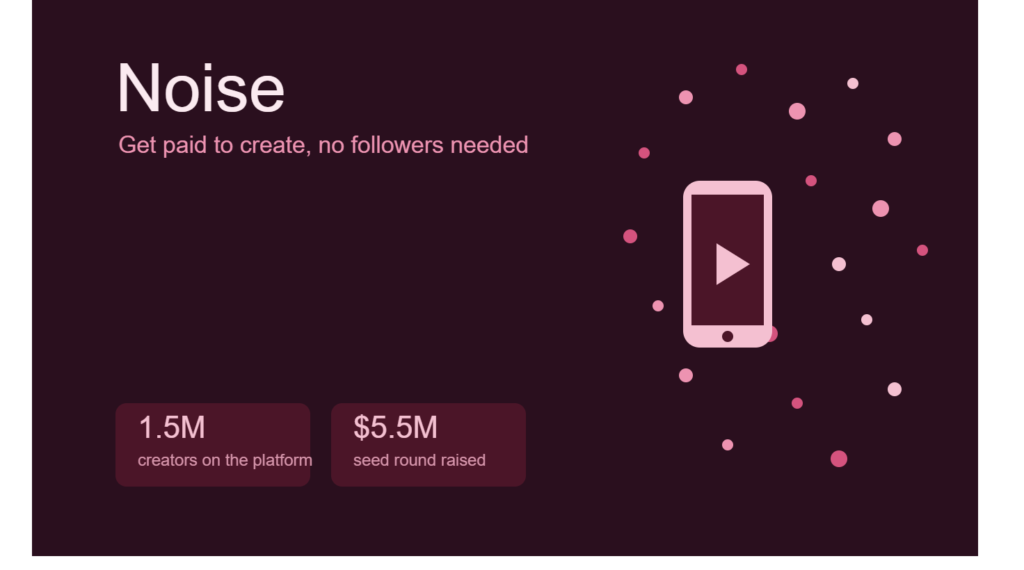
Definition + Expansion , Noise creator platform: Noise is a marketing platform designed to connect brands with everyday content creators and help those creators earn money by producing social media content.
The model is different from traditional influencer marketing. A creator does not necessarily need an established audience or a large follower count to participate. Anyone can download the app, complete creator training, find eligible campaigns, and decide whether to accept opportunities.
Brands provide campaign briefs and budgets through the platform. Noise then helps distribute those campaigns among creators and manages parts of the workflow, including creator recruitment and payments.
The company says creators can publish content on platforms such as TikTok, Instagram, Facebook, and YouTube.
That gives Noise two customers with different problems.
For brands, the challenge is finding enough creators and managing large numbers of individual relationships. For aspiring creators, the challenge is getting their first paid opportunity without already having a huge audience.
Question → Does Noise require creators to have lots of followers?
No. Noise’s model is specifically designed to include everyday people, regardless of follower count.
The company says users can join the platform with a smartphone and gain access to campaigns based on their training and experience. New creators initially receive access to certain campaigns, while additional training and successful work can open up higher-paid opportunities.
That approach turns the usual influencer model upside down.
Instead of asking, “How many followers do you already have?”, the platform is more interested in whether you can create content that brands want to use and audiences want to watch.
Why Is Noise Targeting Everyday Content Creators?
Influencer marketing traditionally puts a premium on audience size.
A creator with hundreds of thousands or millions of followers can offer brands immediate access to an established audience. But that access can also make large influencers expensive, particularly for startups operating with limited marketing budgets.
Noise emerged from the founders’ own experience with this problem.
CEO Diego Kafie, Stu Feldt, and Nic Weber previously built a mobile game company called Playbite. According to Kafie, the team experimented with recruiting gamers and teaching them to create social content promoting the app.
The experiment grew from a handful of people to a much larger group.
The founders reportedly started with five, then 10, 25, and eventually 100 people, according to Kafie’s account in the TechCrunch report. As those creators posted regularly on platforms such as TikTok, Playbite’s installs increased.
The important lesson for the founders was the cost.
Rather than paying established influencers with large followings, Playbite was teaching ordinary users how to make promotional content from scratch.
Kafie said this happened at a fraction of the cost of traditional marketing approaches.
Question → Why can everyday creators be attractive to startups?
Everyday creators can potentially give brands access to a wider range of voices and content styles without requiring the cost of hiring established influencers individually.
For a startup, the ability to work with hundreds or thousands of creators at once can also make experimentation easier. A brand can potentially test many creative approaches rather than placing most of its budget behind a small number of influencer partnerships.
That is the business opportunity Noise is trying to turn into a scalable platform.
How Does Noise Work for Creators?
The Noise creator platform is structured around campaigns.
A creator joins the platform and completes training modules designed to teach them how to create content for brands. New creators may initially have access to only a limited set of campaigns.
As they complete training and gain experience, Noise says they can become eligible for additional opportunities, including higher-paying campaigns.
The process can be summarized like this:
- Download the Noise app.
- Complete creator training modules.
- Review available campaigns.
- Choose campaigns that fit your interests or capabilities.
- Create and publish the required content.
- Generate views through your social platforms.
- Earn according to the campaign’s payment structure.
- Build experience and potentially qualify for additional campaigns.
The exact income for an individual creator can vary based on campaign terms, performance, and other factors.
Noise says its top creators earn more than six figures annually, although that figure represents the platform’s top performers rather than what an average creator should expect.
That distinction is important for anyone considering content creation as an income source.
A platform saying its top creators earn a particular amount does not mean every participant will achieve the same result.
Question → How does Noise pay creators?
According to TechCrunch’s report, Noise pays creators based on views delivered rather than using only a traditional flat-fee influencer model.
Brands set their campaign budgets and rates, while creators can decide whether to accept available opportunities. Kafie said creators can say yes or no to the rates offered.
This gives creators some control over which campaigns they participate in while allowing brands to structure campaigns around their marketing budgets.
Why Is the Creator Economy Growing?
The timing of Noise’s expansion reflects a broader interest in the creator economy.
The TechCrunch report cited research showing that 57% of young people and slightly more than 40% of U.S. adults overall want to participate in influencer activity.
That interest helps explain why creator infrastructure has become an increasingly important technology category.
The creator economy is no longer just about celebrities posting sponsored content. It includes editing tools, monetization platforms, creator marketplaces, analytics products, brand partnerships, affiliate commerce, and services designed to help ordinary people produce professional-looking content.
Noise is positioning itself within this infrastructure layer.
Rather than being another social network where creators compete for attention, it is attempting to become a marketplace connecting brands that need content with people willing to produce it.
From influencer to creator
There is an important distinction between the two concepts.
An influencer typically brings an existing audience and uses that audience to influence purchasing or brand perception.
A content creator can instead be valuable because of the content itself.
For example, a brand may want a 30-second video demonstrating its app. The creator does not necessarily need one million followers if the video can be used by the brand as advertising.
That distinction is becoming increasingly important as platforms make it easier for brands to distribute creator-made content through paid advertising.
Noise’s Organic-to-Ads Model Explained
One of Noise’s newer initiatives is its Organic-to-Ads program.
The idea is straightforward: creators publish videos organically on their social platforms, while brands can also take those creator-made videos and use them as paid advertising on platforms such as Meta and TikTok.
This creates two distribution channels for the same creative asset.
The first is the creator’s organic post. The second is the brand’s paid advertising campaign.
For brands, that can potentially increase the useful life of creator content. Instead of paying for a creator post and leaving it there, the brand can identify content it wants to promote and put additional advertising budget behind it.
Question → What does Organic-to-Ads mean for brands?
It means a brand can use creator-generated videos not only as organic social posts but also as paid advertising creatives.
That gives brands another way to scale content that performs well, while creators continue publishing on their own social platforms.
The model also reflects a larger shift in digital advertising: brands increasingly want authentic-looking creative that can work across multiple distribution channels.
Noise vs Traditional Influencer Marketing
The Noise creator platform is not necessarily trying to eliminate traditional influencer marketing.
Instead, it offers a different approach to sourcing and paying creators.
Traditional influencer campaigns often begin with identifying creators who already have a large audience. The brand negotiates with those creators, agrees on deliverables, and pays an agreed fee.
Noise emphasizes scale and accessibility.
A campaign can potentially involve thousands of creators rather than a handful of established influencers.
| Feature | Traditional Influencer Marketing | Noise Model |
| Creator selection | Often based on audience size and niche | Everyday creators can participate |
| Follower requirement | Often important | Not required to join |
| Campaign scale | Small to large | Designed for large-scale campaigns |
| Payment model | Often negotiated flat fee | Noise says payment is tied to views |
| Creator onboarding | Existing experience often preferred | Training provided |
| Brand workflow | Can involve individual creator management | Platform-based campaign management |
| Content distribution | Creator’s audience | Creator posts plus potential paid ads |
| Best suited to | Established influencers and targeted campaigns | Scaled creator recruitment and diverse content |
This difference explains why Noise is attracting attention from startups.
A company with a small marketing budget may struggle to negotiate individual deals with dozens or hundreds of creators. A centralized platform can theoretically reduce that operational burden.
Why Brands Might Want Thousands of Creators
Imagine a mobile app launching in several markets.
Instead of hiring five influencers, the company could want hundreds of different videos demonstrating the product in different styles.
One creator might make a humorous video. Another could create a tutorial. Another might demonstrate a specific feature. Another could produce a testimonial-style video.
That diversity can be valuable because audiences respond differently to different formats.
Noise says its top brands work with several thousand creators on autopilot, according to Kafie.
The platform’s proposition to brands is therefore not simply “find an influencer.”
It is closer to: give us your campaign brief and budget, and we will help you coordinate a large creator network.
Question → What problem is Noise solving for brands?
Noise is trying to reduce the operational work involved in recruiting, coordinating, paying, and managing large numbers of creators.
Instead of a brand managing every creator relationship separately, the platform provides a centralized campaign workflow.
That could become particularly useful when a company wants a large volume of creative content rather than one highly recognizable influencer endorsement.
Why Startups Are an Important Target Market
Noise currently counts mobile apps and startup-oriented companies among its customers.
That makes sense because early-stage companies often face a difficult marketing equation.
They need attention, but they may not have the budgets of established brands. Traditional advertising can become expensive, while hiring major influencers may require fees that do not fit a startup’s finances.
A creator platform can offer another route.
Instead of spending a large amount on a single influencer, a startup could distribute campaigns across many creators and potentially learn which types of content resonate with audiences.
This is particularly relevant for consumer apps, where short-form video can directly influence downloads and product discovery.
Noise’s founders experienced that dynamic themselves through Playbite.
Their previous experiment with recruiting everyday users to create content became the foundation for the company’s current business model.
Can Everyday People Really Become Paid Creators?
The biggest promise behind the Noise creator platform is accessibility.
The traditional path to becoming an influencer can be intimidating. Someone may believe they need professional equipment, thousands of followers, years of audience growth, and a recognizable personal brand before a company will pay them.
Noise is proposing a different starting point.
A smartphone can be enough to begin.
The platform provides training and campaign opportunities, allowing users to learn by producing branded content rather than waiting until they become famous enough to attract advertisers.
That does not eliminate the difficulty of creating successful content.
Creators still need to understand storytelling, hooks, editing, platform behavior, audience attention, and brand requirements.
But the entry barrier can be lower.
Skills that can help new creators
People interested in this model can benefit from learning:
- Short-form video storytelling
- Smartphone video production
- Basic editing
- Social media trends
- Copywriting and captions
- Brand communication
- Audience retention
- Content analytics
- Creative experimentation
- Advertising fundamentals
The opportunity is therefore not simply about owning a smartphone.
It is about turning that smartphone into a tool for developing commercially useful creative skills.
What Does Noise’s $5.5 Million Funding Mean?
Noise announced a $5.5 million seed round on September 16, 2026, bringing its total funding to $7.2 million.
The round was led by Capital Midwest, M25, and Grishin Robotics, with participation from Capitalize VC and operators from companies including DoorDash.
Noise says the new funding will be used to expand product capabilities and hire employees.
That is significant because the company’s business model depends on building infrastructure that can support large numbers of creators and brands.
As the creator network grows, the platform needs to make campaign matching, training, payments, content workflows, and advertising integrations work at greater scale.
Funding can therefore help Noise build the technology and team required to move from an interesting creator experiment into a larger marketing infrastructure business.
Question → What will Noise use the new funding for?
Noise says it will use the new capital to expand its product capabilities and hire.
The company has also recently launched its Organic-to-Ads program, which expands how brands can use content created through its platform.
Noise’s Biggest Challenge: Scaling Quality
The biggest opportunity for creator platforms can also become their biggest challenge.
Thousands of creators can produce an enormous amount of content. But more content does not automatically mean better content.
Brands still need videos that are accurate, engaging, on-brand, and appropriate for their audiences.
Noise therefore has to balance two competing goals:
Scale: Recruit as many creators as possible.
Quality: Ensure those creators can produce useful content for brands.
Its training system is one attempt to address that challenge.
By teaching new users how to create brand content before giving them access to broader campaigns, the company can potentially establish a baseline of skills.
Performance-based campaigns can also create a feedback loop.
Creators whose work performs well may receive more opportunities, while brands can continue spending on content that meets their objectives.
What Noise’s Model Could Mean for the Creator Economy
The broader significance of the Noise creator platform is its attempt to move content creation from an exclusive profession toward a more accessible form of digital work.
The internet already made it possible for individuals to publish globally.
Platforms such as TikTok, Instagram, YouTube, and Facebook made distribution easier.
The next stage is monetization.
Noise is trying to create infrastructure that connects ordinary creators directly to commercial demand.
That could mean more people earning their first dollar online through creative work rather than waiting to build a massive personal brand.
However, the economics of creator work will still vary significantly.
Not every participant will become a top earner. Campaign availability, content quality, views, platform performance, and advertiser demand can all influence earnings.
The opportunity should therefore be viewed as a new route into creator work,not a guarantee of income.
Why This Matters for Students and Young Professionals
For students and young professionals, the creator economy increasingly overlaps with skills that employers already value.
Video editing, social media strategy, communication, marketing analytics, storytelling, and audience research can all be useful beyond influencer marketing.
A person who starts by making short videos for a brand could eventually build skills in digital marketing, advertising creative, community management, or content strategy.
That makes platforms like Noise interesting even for people who do not plan to become full-time influencers.
The experience of creating content for a real business can provide practical exposure to deadlines, briefs, feedback, performance metrics, and customer psychology.
Question → Do you need to become an influencer to benefit from the creator economy?
No.
Creator-economy skills can be useful even if someone never builds a large personal following.
The ability to produce effective short-form video, understand an audience, and translate a brand message into engaging content can be valuable across marketing and communications roles.
Frequently Asked Questions
What is the Noise creator platform?
The Noise creator platform is a marketing marketplace that connects brands with everyday people who create social media content. Users do not need a large follower count to join, and Noise provides training and campaign opportunities.
How does Noise help people become paid creators?
Noise allows people to join its platform, complete creator training, and access eligible brand campaigns. Creators can choose whether to participate in campaigns and are paid based on the campaign’s performance model, with Noise describing its system as paying creators based on views.
How much can creators earn through Noise?
Noise CEO Diego Kafie told TechCrunch that the platform’s top creators earn more than six figures annually. That figure refers to the platform’s top performers and should not be interpreted as a typical or guaranteed income level for every creator.
Does Noise require creators to have followers?
No. Noise’s model is designed to allow everyday people to participate regardless of follower count. The company says users can join with a smartphone and gain access to campaigns based on their training and experience.
What is Noise’s Organic-to-Ads program?
Organic-to-Ads allows brands to take videos created by Noise creators and use them as paid advertisements on platforms such as Meta and TikTok, in addition to the creators’ organic posts.
How much funding has Noise raised?
Noise announced a $5.5 million seed round in September 2026, bringing its total funding to $7.2 million. The round was led by Capital Midwest, M25, and Grishin Robotics, with additional participation from Capitalize VC and operators from companies including DoorDash.
The Bottom Line
The Noise creator platform is betting that you do not need to be an established influencer to create valuable content for brands. By combining creator training, campaign matching, performance-based payments, and large-scale brand distribution, Noise is trying to make paid content creation accessible to a much broader group of people.
Its $5.5 million seed round gives the startup fresh capital to expand its technology and team, while its Organic-to-Ads program pushes the model further into mainstream digital advertising.
For students, freshers, and aspiring creators, the bigger takeaway is simple: the creator economy is increasingly becoming about skills and useful content, not just follower counts.
Explore Kalinga.ai for more explainers on emerging creator-economy platforms, AI-powered work, and the technologies reshaping how people earn online.