Why Is Meta Developing Camera-Free Luna Smart Glasses?
The central idea behind Meta Luna smart glasses is simple: keep the conversational AI experience while removing the camera that creates some of the strongest privacy concerns.
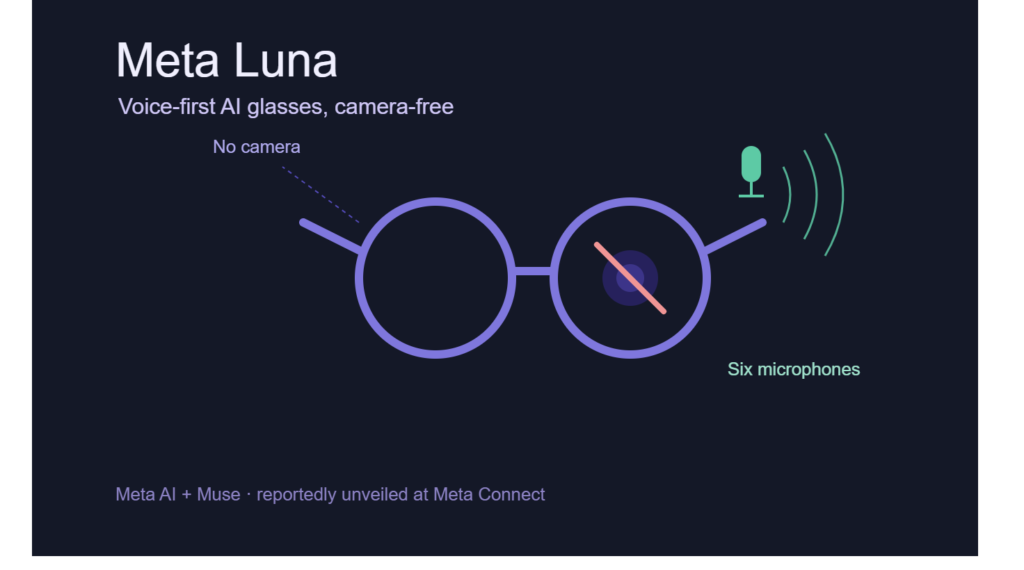
The Information reports that Luna is being developed without cameras and will instead use six built-in microphones, speakers and a physical button to let users interact with Meta AI and Muse, Meta’s newly launched consumer AI agent.
Reuters separately reported that Meta plans to release the camera-free glasses this fall, citing The Information’s reporting and people familiar with the company’s plans. Reuters said Meta did not immediately respond to a request for comment.
Definition + Expansion
Camera-free smart glasses are wearable glasses that provide connected or AI-powered functions without using an integrated camera to capture photos or video.
That distinction matters because a camera changes the social meaning of a wearable. A person talking to glasses with microphones may still raise privacy questions, but a camera-equipped device can potentially record the people, screens and surroundings in front of the wearer.
Luna reportedly removes that visual recording capability while preserving voice interaction with Meta’s AI systems. In other words, the glasses could remain an AI interface without doubling as a first-person camera.
Question: Is Meta Luna officially confirmed?
Answer: Not yet. Reports from The Information and Reuters describe Luna as a planned camera-free model, but Meta has not publicly confirmed the product’s specifications or launch.
That distinction is important when discussing Meta Luna smart glasses. Reported specifications should not be treated as final product specifications until Meta announces the device.
What Features Will Meta Luna Smart Glasses Have?
Based on current reporting, Luna is designed around voice-first AI interaction rather than visual capture.
The Information reports that the glasses will contain six built-in microphones, speakers similar to those used in existing Meta smart glasses and a button on the side that can quickly activate Meta AI. The report also says the frames will have slimmer temple arms than previous Meta smart glasses.
The reported feature set can be summarized like this:
- No integrated camera
- Six built-in microphones
- Speakers for audio output
- Physical side button for AI activation
- Access to Meta AI
- Integration with Meta’s Muse AI agent
- Reportedly slimmer arms than earlier Meta smart glasses
- Potentially two styles, called Clubmaster and Burbank
- Potential October 2026 shipments, according to The Information’s reporting
The last two details remain reported rather than officially confirmed.
Why Six Microphones Matter
Six microphones may sound excessive for a pair of glasses, but voice interaction is central to the reported Luna concept.
For an AI assistant to work naturally while someone is walking, commuting or working, it needs to reliably capture the user’s speech. Multiple microphones can help a wearable distinguish the user’s voice from surrounding noise and improve voice interaction.
The broader design therefore appears to shift the glasses from “camera on your face” toward “AI assistant you can talk to.”
That is a meaningful difference in positioning.
Why Does Removing the Camera Matter for Privacy?
Privacy is one of the biggest challenges facing camera-equipped smart glasses.
A smartphone already has cameras, but people generally understand when someone is holding a phone and pointing it toward them. Glasses are different because the camera sits directly on the user’s face and can potentially record without the obvious visual behavior associated with holding a phone.
The Information reported that existing Meta smart glasses have faced scrutiny because some users have allegedly modified or covered the recording indicator LED. Meta subsequently rolled out a software update designed to prevent recording when the LED has been covered.
That illustrates the underlying problem: technical safeguards can exist, but social trust still matters.
Definition + Expansion
Wearable privacy refers to the privacy considerations created when computing, sensors and connectivity are integrated into devices people wear in everyday environments.
Unlike a laptop used at home, a wearable accompanies its user into classrooms, offices, restaurants, public transport and social gatherings. People nearby may not know what the device is sensing or how its data is being processed.
Removing the camera does not eliminate every privacy question, but it removes one major capability: visual recording.
Question: Does camera-free automatically mean private?
Answer: No. Camera-free glasses can reduce concerns about image and video capture, but microphones, AI services, connectivity and data processing can still create privacy questions.
Meta itself describes Muse as a personal AI agent designed with privacy and security controls, including a dedicated virtual machine, permission controls and audit trails. Meta says users can choose connected apps and can opt out of their interactions being used to train its AI models.
Those policies concern Muse rather than proving how a future Luna product will handle every type of wearable data.
Camera-Free vs Camera-Equipped Smart Glasses
The most useful way to understand the reported Meta Luna smart glasses is to compare them with camera-equipped AI glasses.
| Feature | Camera-equipped AI glasses | Reported Luna approach |
| Camera | Yes | No |
| Photo capture | Possible | Not available through a camera |
| Video recording | Possible | Not available through a camera |
| Voice interaction | Yes | Yes |
| AI assistant | Yes | Yes |
| Microphones | Yes | Six reported microphones |
| Speakers | Yes | Yes |
| Visual AI based on onboard camera | Possible | Not possible through an onboard camera |
| Main privacy concern | Visual recording | Voice/data processing |
| Physical AI activation | Varies | Reported side button |
The biggest trade-off is straightforward: removing the camera can reduce visual privacy concerns, but it also removes camera-dependent features.
That means Luna would not simply be a cheaper or safer version of camera-equipped glasses. It would be a somewhat different category of wearable.
What Will Luna Lose Without a Camera?
A camera-free design solves one problem by giving up several capabilities.
Camera-equipped smart glasses can potentially identify visual information, capture photos and videos, interpret surroundings and support other computer-vision features. Without a camera, Meta Luna smart glasses would need to rely primarily on audio, cloud services and other sensors.
That means users could potentially talk to an AI assistant, listen to responses and interact with connected services, but they could not ask the glasses to visually analyze something in front of them using an onboard camera.
For example, a camera-equipped device might eventually help identify a plant, read a sign or describe an object. A camera-free device cannot perform those tasks through visual input from the glasses themselves.
The Trade-Off
The design therefore presents a clear choice:
More sensing can create more functionality, but fewer sensors can make a wearable easier to accept in shared spaces.
This is especially relevant for workplaces, colleges, public venues and other environments where recording other people can create concerns.
For users who mainly want hands-free AI, audio and notifications, a camera may not be necessary.
For users who specifically want visual AI, removing the camera could make the product less useful.
How Could Meta AI and Muse Work With Luna?
The reported Meta Luna smart glasses are expected to rely heavily on Meta’s AI ecosystem.
The glasses would reportedly let users communicate with Meta AI through microphones and a side button. They are also expected to connect with Muse, Meta’s consumer AI agent.
Meta introduced Muse on September 8, 2026, describing it as a personal AI agent that can take actions rather than simply answer questions. Meta says Muse can handle tasks such as sending emails, booking travel and turning goals into action plans, while users control which apps and permissions it can access.
That makes the glasses potentially more interesting than a simple voice assistant.
From Voice Assistant to AI Interface
Traditional voice assistants largely answer questions or perform predefined commands.
Agentic AI, by contrast, is designed to complete multi-step tasks on a user’s behalf.
If Luna eventually connects deeply with Muse, the glasses could become a hands-free access point for that agent.
Imagine asking an assistant while walking:
- “What meetings do I have this afternoon?”
- “Remind me to message my project partner.”
- “Add this idea to my task list.”
- “What is the weather going to be like tonight?”
- “Help me plan tomorrow’s schedule.”
These examples describe the broader potential of voice AI, not confirmed Luna capabilities.
The important strategic point is that Meta does not necessarily need a camera to make AI glasses useful.
Could Camera-Free Glasses Make Smart Wearables More Acceptable?
Possibly, but the product still faces a larger trust challenge.
The reported Luna design directly addresses one criticism: people may be uncomfortable around a device capable of discreetly recording video.
However, removing a camera does not automatically make people comfortable with microphones or AI-powered data processing.
A pair of glasses that can listen for voice commands is still a connected computing device.
Definition + Expansion
Privacy-by-design means building privacy protections into a product’s architecture rather than treating privacy as something added after launch.
For smart glasses, that could include clear indicators, physical controls, permission systems, limited data collection, transparent retention policies and easy ways to disable features.
Camera removal is one hardware-level privacy decision. It does not replace the need for responsible software and data practices.
Question: Can removing the camera solve all smart-glasses privacy concerns?
Answer: No. It can eliminate camera-based recording through the glasses, but microphone use, cloud processing, account data and AI interactions remain relevant privacy considerations.
This is why Luna’s reported design should be viewed as one response to the privacy problem, rather than a complete solution.
Why Meta May Want Two Types of AI Glasses
There is another business reason the reported Luna strategy is interesting.
Not every consumer wants the same balance between functionality and privacy.
One person might want camera-based visual AI, photography and hands-free video. Another might want speakers, voice AI and notifications but feel uncomfortable wearing a camera.
Offering different products could allow Meta to target both groups.
| User priority | Camera-equipped glasses | Camera-free Luna concept |
| Hands-free AI | Strong fit | Strong fit |
| Photos and video | Strong fit | Not available |
| Visual AI | Possible | Not through onboard camera |
| Audio assistant | Available | Core reported feature |
| Recording concerns | Higher | Lower for visual capture |
| Voice/data privacy | Relevant | Still relevant |
| Conventional eyewear appearance | Varies | Reportedly slimmer arms |
| Best suited to | Users wanting broader sensing | Users prioritizing voice AI without a camera |
This is not necessarily about replacing camera-equipped smart glasses.
Instead, Luna could become an alternative for people who want AI eyewear without visual recording.
What Does Luna Mean for the Smart Glasses Market?
The reported Meta Luna smart glasses arrive as the smart-glasses industry is still trying to establish what consumers actually want.
The category has expanded rapidly, but it faces familiar consumer-tech problems: price, usefulness, battery life, comfort, privacy and the question of whether the device solves a problem people actually have.
Meta is already positioned near the front of the market, according to the source material behind the report. At the same time, Reality Labs, the division responsible for Meta’s AR and VR hardware ambitions, has continued to incur substantial losses. TechCrunch previously reported significant financial pressure from the company’s long-running Reality Labs investment.
That makes product differentiation important.
If camera-equipped glasses are increasingly associated with privacy controversy, a camera-free model gives Meta another proposition to test.
The Bigger Hardware Shift
The interesting trend is not simply “Meta removes a camera.”
It is the possibility that AI glasses could become useful without trying to replicate every function of a smartphone camera.
That could lead to several categories:
- Camera-first glasses for photography, video and visual AI.
- Audio-first glasses for assistants, music and notifications.
- Display glasses for information and augmented-reality interfaces.
- Agentic glasses designed primarily as interfaces to AI agents.
- Hybrid products combining some or all of these capabilities.
Meta’s reported Luna concept sits much closer to the audio-first and agentic categories.
When Could Meta Luna Smart Glasses Launch?
According to Reuters, The Information reported that Meta could unveil Luna at its annual Connect developer conference on September 23 or 24, 2026, with shipments targeted for October.
The Information also reported that the glasses could come in two styles, called Clubmaster and Burbank.
However, these remain reported plans rather than confirmed launch specifications.
Question: When will Meta Luna smart glasses be available?
Answer: Current reporting points to a possible October 2026 shipment window, following a potential announcement at Meta Connect on September 23–24. Meta has not officially confirmed those dates.
For Indian consumers, availability, pricing and launch timing should therefore be treated as unknown until Meta makes an official announcement.
What Should Students and Young Professionals Learn From Luna?
For students, developers and young professionals, the Luna story is bigger than one pair of glasses.
It demonstrates an important principle in product design: more technology does not always mean a better product.
A camera can make an AI wearable dramatically more capable, but it can also make people around the wearer uncomfortable. A microphone can enable useful voice interaction, but it introduces its own privacy questions.
The product challenge is finding the right balance.
For people entering AI, hardware or product careers, several lessons stand out:
- User trust is a product feature.
- Privacy concerns can influence hardware design.
- AI interfaces do not always need screens.
- AI agents could make ordinary devices more useful.
- Removing a capability can sometimes expand a product’s potential audience.
- Hardware decisions affect regulation, public acceptance and product positioning.
- The most technically capable device is not automatically the most socially acceptable one.
This is particularly relevant as AI moves beyond smartphones and laptops into wearables, vehicles, homes and workplaces.
Is Meta Luna a Sign That AI Glasses Are Changing?
The reported Luna project suggests that the smart-glasses market may be moving toward specialized AI experiences rather than one universal device.
Instead of assuming everyone wants cameras, displays and sensors packed into their eyewear, companies may increasingly offer different hardware configurations.
Meta’s own AI strategy also points toward a broader ecosystem. Muse is designed as a personal AI agent, and Meta says it is coming to AI glasses.
That makes the glasses less important as a standalone gadget and more important as an interface for AI.
The long-term question is therefore not simply whether people want smart glasses.
It is whether people want an AI assistant that is always available through something they already wear.
FAQ: Meta Luna Smart Glasses
What are Meta Luna smart glasses?
Meta Luna smart glasses are reportedly a new camera-free smart-glasses model being developed by Meta. The reported design includes six microphones, speakers and a physical button for accessing Meta AI and Muse.
Do Meta Luna smart glasses have a camera?
No, the reported Luna design does not include an integrated camera. The Information and Reuters reports describe Luna as a camera-free alternative to Meta’s existing camera-equipped smart glasses.
Why is Meta removing the camera?
The reported move comes amid growing scrutiny and privacy concerns surrounding camera-equipped smart glasses. Removing the camera could reduce concerns about visual recording while preserving voice-based AI functions.
What AI features will Luna have?
According to reporting, Luna will allow users to communicate with Meta AI and Meta’s Muse consumer AI agent through built-in microphones, speakers and a side button. The exact final feature set has not been officially confirmed by Meta.
When could Luna launch?
Current reports suggest that Meta could announce Luna at Meta Connect on September 23–24, 2026, with shipments targeted for October. These dates remain unconfirmed by Meta.
Are camera-free smart glasses completely private?
No. Removing a camera can reduce concerns about photo and video recording, but microphones, AI interactions, connectivity and data processing can still raise privacy questions. Camera-free design should therefore be considered one privacy measure rather than a complete privacy solution.
Meta’s reported Luna project shows how quickly AI hardware is evolving: sometimes the next step is not adding another sensor, but removing one that users do not trust. If you’re following the future of AI wearables, keep an eye on Meta Connect and the next generation of voice-first AI devices. keep exploring kalinga.ai for more.