What Is X Cashtag Trading?
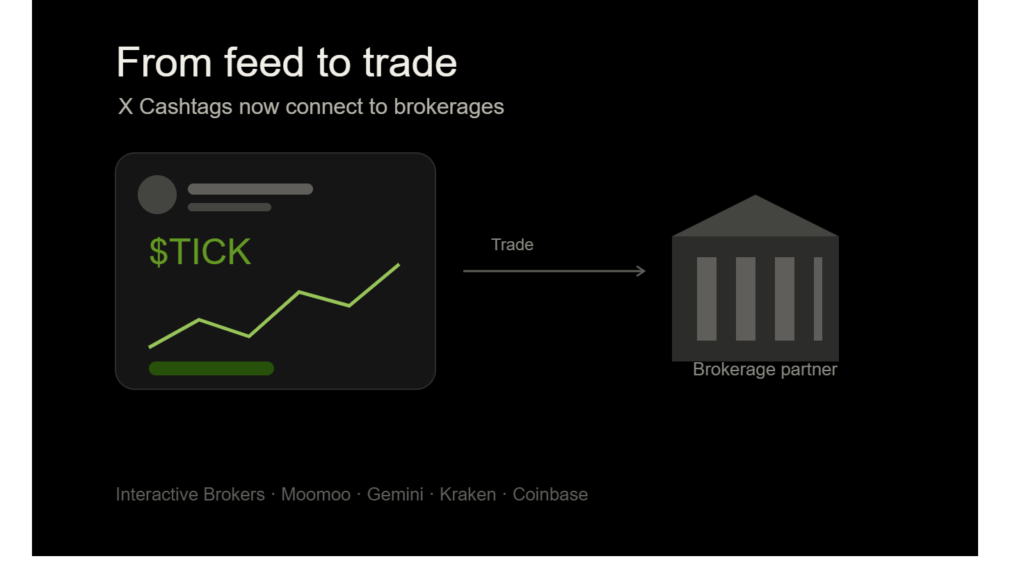
X Cashtag trading is a feature that connects interactive ticker symbols on X with participating brokerage platforms, allowing eligible U.S. users to move from market discussions to a brokerage and complete a trade.
A Cashtag is the dollar-sign format used for financial tickers on X,for example, a ticker can be written with a $ before the symbol. Historically, Cashtags helped users find conversations about particular stocks or other assets.
The new feature adds a financial-action layer to that conversation.
Definition + Expansion
Cashtags are interactive financial ticker references on X that connect an asset symbol with market information and related posts.
Previously, their primary role was discovery and discussion. X’s new trading integration adds a Trade option for supported assets, allowing users to continue from the Cashtag page to a participating brokerage.
The result is a shorter path between financial content and financial action.
Question: Does X execute the stock trade itself?
Answer: No. Under the reported Cashtag system, X sends users to participating brokerages, where users log in and complete their trades. The actual transaction happens through the brokerage platform.
That means X is functioning more like a financial discovery and referral layer than a conventional brokerage in this feature.
How Does X Cashtag Trading Work?
The process is designed to happen directly from the financial conversation users are already following.
Suppose a user sees a post discussing a supported stock. The ticker appears as an interactive Cashtag. After tapping it, the user can see the asset’s price information and related posts on X.
If the asset is supported for trading, a Trade option can take the user to a participating brokerage.
The basic flow is:
- Find a supported Cashtag in an X post or financial discussion.
- Tap the Cashtag to open the asset’s dedicated view.
- Review the price chart and related posts.
- Tap Trade if the option is available.
- Choose or continue to a participating brokerage.
- Sign in or create an account with that brokerage.
- Complete the transaction on the brokerage platform.
X’s reported design therefore keeps the social conversation and market information inside X while handing the actual trading process to its financial partners.
Question: What happens after a user taps “Trade”?
Answer: The user is directed to a participating brokerage’s app or website, where they authenticate and complete the trade. X does not complete the order on the user’s behalf.
This distinction also means that account requirements, available assets and transaction rules can depend on the selected brokerage.
Which Companies Are X’s Cashtag Trading Partners?
X launched the feature with five participating financial platforms:
| Partner | Broad role in the launch |
| Interactive Brokers | Brokerage services |
| Moomoo | Brokerage and investing services |
| Gemini | Cryptocurrency trading |
| Kraken | Cryptocurrency trading |
| Coinbase | Cryptocurrency trading |
The launch lineup gives X access to both traditional financial markets and crypto markets through different partners. TechCrunch identified all five as initial partners when the feature launched for U.S. users.
Not every asset will necessarily be available through every partner. Brokerage eligibility, supported products and account requirements can vary.
This is important because seeing a Cashtag on X does not automatically mean every user can immediately trade that asset.
Question: Can every X user trade through Cashtags?
Answer: No. The feature is being launched for U.S. users, and actual trading access depends on participating brokerages, supported assets and user eligibility.
For users outside the U.S., including India, the availability described in this launch should not be interpreted as an announcement of local access.
How Are X Cashtags Different From Traditional Stock Tickers?
A stock ticker traditionally helps identify a security. A Cashtag adds a social layer around that identifier.
Consider the difference:
| Traditional ticker | X Cashtag |
| Identifies an asset | Identifies an asset within a social conversation |
| Primarily used for market data | Combines market data with posts |
| Usually accessed through financial platforms | Appears directly inside X |
| Separate discussion and trading environments | Discussion can lead directly to brokerage access |
| Market discovery is often financial-platform first | Discovery can begin with social content |
This distinction explains why X Cashtag trading is strategically interesting.
The ticker itself is not new. What changes is what happens after the user taps it.
The platform is trying to make the Cashtag a bridge connecting three things:
Conversation → Discovery → Financial action
That creates a much tighter connection between social media activity and financial services.
Why Is X Connecting Financial Conversations to Trading?
X has spent years positioning itself as a place where people discuss markets in real time.
Investors, analysts, companies, journalists, traders and crypto communities already use the platform to react to price movements and financial news.
The original Cashtag concept was created for this type of discussion. TechCrunch notes that Stocktwits came up with the idea for Twitter’s Cashtags in 2008, when the dollar-sign format helped users track conversations around stocks.
The new system takes that existing behavior one step further.
Instead of:
See ticker → leave X → search for asset → open brokerage → trade
the intended experience becomes closer to:
See ticker → open Cashtag → view market information → tap Trade → brokerage
That reduction in friction is the core product change.
From Social Network to Financial Interface
X has been building toward a broader financial-services strategy under its vision for an “everything app.”
Cashtag trading fits that direction because it does not require users to stop using the social network before beginning a financial journey.
A person can encounter a market discussion, investigate the asset and then move toward a brokerage without manually searching for the ticker elsewhere.
Question: Why does reducing friction matter?
Answer: Fewer steps can make it easier for users to move from discovering financial information to taking an action through a connected service. That is precisely the behavior X’s Cashtag system is designed to connect.
But lower friction can also make financial decisions feel faster and more impulsive.
That brings us to the biggest issue surrounding the feature.
Could X Cashtag Trading Increase Market-Manipulation Risks?
Potentially, the closer connection between social conversation and trading creates another layer of risk.
X is already a platform where users can rapidly amplify claims about companies, stocks and cryptocurrencies. Adding a direct route to brokerages could make the consequences of those conversations more immediate.
TechCrunch specifically raised concerns that AI-controlled bots, spammers and other bad actors could attempt to influence market conversations, potentially pushing users toward a particular direction.
The concern is not that every financial conversation on X is manipulative.
Rather, the platform combines three powerful ingredients:
- Extremely fast information sharing
- Public conversations around financial assets
- A new pathway from those conversations to trading platforms
That combination deserves careful attention.
Definition + Expansion
Market manipulation generally refers to deceptive or artificial activity intended to influence the price or perceived demand for a financial asset.
On a social platform, manipulation could involve coordinated posts, misleading claims, spam or automated accounts attempting to create the appearance of widespread enthusiasm or concern.
AI can make content generation and account automation easier to scale, which is why the role of bots is particularly relevant to this discussion.
Question: Does X Cashtag trading itself cause market manipulation?
Answer: The feature does not by itself prove that manipulation will occur. The concern is that connecting social discussion directly with trading could make coordinated misinformation or artificial engagement more consequential if bad actors exploit the system.
That is an important distinction.
The technology creates a new pathway; it does not establish that every transaction resulting from that pathway is manipulated.
How Could AI Bots Change Social Trading?
AI makes the discussion particularly timely.
A human account can publish a post, reply to another user and participate in a financial discussion. Automated systems can potentially generate and distribute much larger volumes of content.
If those systems are used responsibly, automation can help with legitimate tasks such as summarizing financial information or organizing public discussions.
If they are used deceptively, the same technology can make it harder for ordinary users to distinguish genuine market sentiment from artificially generated activity.
The combination of AI + social media + financial markets therefore creates a new monitoring challenge.
For platforms, useful safeguards could involve areas such as:
- Detecting coordinated automated behavior
- Identifying spam networks
- Improving transparency around automated accounts
- Monitoring suspicious activity
- Giving users better context around financial claims
- Maintaining clear rules against deceptive market activity
These are broader platform and market-integrity considerations, not claims about specific incidents caused by the new Cashtag feature.
Does X Cashtag Trading Mean X Is Becoming a Brokerage?
Not in the same sense as the participating brokerages.
The new system allows X users to move from a Cashtag to a brokerage partner, but the partner handles the actual transaction.
This structure matters because it separates financial discovery from trade execution.
X controls the user experience around the Cashtag, while the brokerage handles the account and transaction.
X’s Role
X provides:
- Cashtag pages
- Market information
- Related social posts
- The Trade pathway
- Connections to participating partners
Brokerage’s Role
The brokerage provides:
- User account access
- Authentication
- Trading infrastructure
- Order execution
- Its own eligibility and product rules
That division is one of the most important facts to understand about X Cashtag trading.
Question: Does tapping a Cashtag automatically place a trade?
Answer: No. Tapping the Cashtag opens market information, while selecting Trade sends the user toward a participating brokerage. The user still has to authenticate and complete the transaction there.
There is therefore still a deliberate step between reading a post and executing a transaction.
What Does X Cashtag Trading Mean for Investors?
For investors and traders, the biggest change is where financial discovery happens.
Previously, someone might see a stock discussed on X and then switch to a dedicated investing application.
Now, the platform is attempting to connect those two experiences.
That can be convenient, but convenience should not be confused with better financial decision-making.
Social posts can be useful for discovering topics, identifying trends in public discussion or finding links to additional information. They can also contain incomplete, inaccurate or deliberately misleading information.
A Cashtag provides a technical bridge to the market. It does not automatically provide better investment research.
Question: Should users treat X posts as investment research?
Answer: Users should distinguish social-media discussion from independently verified financial information. The new Cashtag feature makes access to brokerages easier, but it does not make posts on X more reliable simply because a Trade button is available.
For students and young professionals learning about investing, this distinction is especially important.
What Does X Cashtag Trading Mean for X?
The feature gives X another way to connect its enormous stream of conversations with financial activity.
The platform already has an audience interested in stocks, ETFs and cryptocurrency. By adding brokerage pathways, X can potentially make those conversations more valuable to financial partners while strengthening its own role as a financial information destination.
The strategic shift can be summarized as:
Before:
X = financial conversation
Now:
X = financial conversation + market information + brokerage pathway
That does not mean X has replaced established financial platforms.
Instead, it means X is trying to become part of the journey users take from discovering an asset to acting on that interest.
Why the Cashtag Format Matters
The clever part of the system is that X does not need to create a completely new financial interface.
The Cashtag already exists.
Users already understand that $ followed by a ticker points toward a financial asset. X is adding functionality to an existing behavior rather than asking users to learn an entirely new system.
That can make the transition from social discussion to financial tools feel more natural.
What Should Indian Users Know About X Cashtag Trading?
For Indian users, the most important point is that the reported launch is specifically for U.S. users.
The five launch partners named by TechCrunch are connected to the U.S. rollout, and the feature should not be assumed to be available to users in India simply because they can see Cashtags on X.
India has its own regulatory framework, financial intermediaries and requirements for securities and cryptocurrency-related services.
So if you’re using X from India, think of the new feature primarily as an indicator of where social-media platforms are heading globally,not as an announcement that Indian users can immediately access the same trading flow.
A Useful Lesson for Students
For students studying computer science, business, finance or digital marketing, the development illustrates how different industries are converging.
A single product can now combine:
- Social networking
- AI-generated content
- Financial data
- Digital identity
- Brokerage infrastructure
- Automated moderation
- User-generated market sentiment
That convergence creates opportunities for product managers, developers, cybersecurity professionals, financial-technology specialists and trust-and-safety teams.
What Could Come Next for X’s Financial Features?
The Cashtag launch could become one component of a broader financial strategy.
The feature already creates a connection between X’s social graph and external financial platforms. Future developments could potentially involve more brokerage partners, additional markets or other financial services, but X has not announced those expansions in the source reporting.
The important development today is narrower: supported Cashtags can now connect U.S. users with participating brokerages.
That alone represents a meaningful change from Cashtags being primarily a way to discuss assets.
Question: Is X turning Cashtags into a full investing platform?
Answer: Not based on the current launch. X is connecting Cashtags with external brokerages rather than executing trades itself. The feature is better understood as a social-financial discovery and brokerage-routing system.
FAQ: X Cashtag Trading
What is X Cashtag trading?
X Cashtag trading is a feature that allows eligible U.S. users to move from supported Cashtags on X to participating brokerages and complete stock, ETF or cryptocurrency trades through those financial partners.
How do you trade stocks through X Cashtags?
Users can tap a supported Cashtag, view the asset’s price chart and related X posts, select the Trade option and continue to a participating brokerage. The trade itself is completed through the brokerage rather than directly on X.
Which brokerages work with X Cashtag trading?
The initial launch partners are Interactive Brokers, Moomoo, Gemini, Kraken and Coinbase, according to TechCrunch’s September 16, 2026 report.
Can users outside the U.S. use X Cashtag trading?
The new trading rollout is described as being for U.S. users. Availability for users in other countries should not be assumed unless X announces a local rollout and applicable partners.
Does X execute the trades?
No. X provides the Cashtag interface and connects users to participating financial platforms, while the brokerage handles the account and transaction.
Could AI bots affect social-media trading?
AI-controlled bots could potentially make it easier to generate or amplify large volumes of financial content. TechCrunch specifically highlighted the possibility that bots, spammers and other bad actors could attempt to influence conversations around assets, although the existence of the feature does not itself establish that manipulation will occur.
The Bottom Line
X Cashtag trading turns financial discussion on X into a direct pathway toward participating brokerages for U.S. users. The feature does not make X the brokerage itself, but it significantly shortens the distance between seeing an asset discussed and reaching a platform where it can be traded.
For the broader tech industry, the more interesting story may be the convergence of social media, AI, financial data and transaction infrastructure. The convenience is clear, but so is the need to distinguish market research from social-media hype and to consider how automated accounts could influence financial conversations.
Want to understand where AI, social media and fintech are heading next? Explore more technology explainers and industry insights on Kalinga.ai to stay ahead of the trends shaping the digital world.