Why Automattic’s Severance Agreements Matter
What happens when a CEO is temporarily removed, two executives take control, and those same executives sign agreements protecting their own departures?
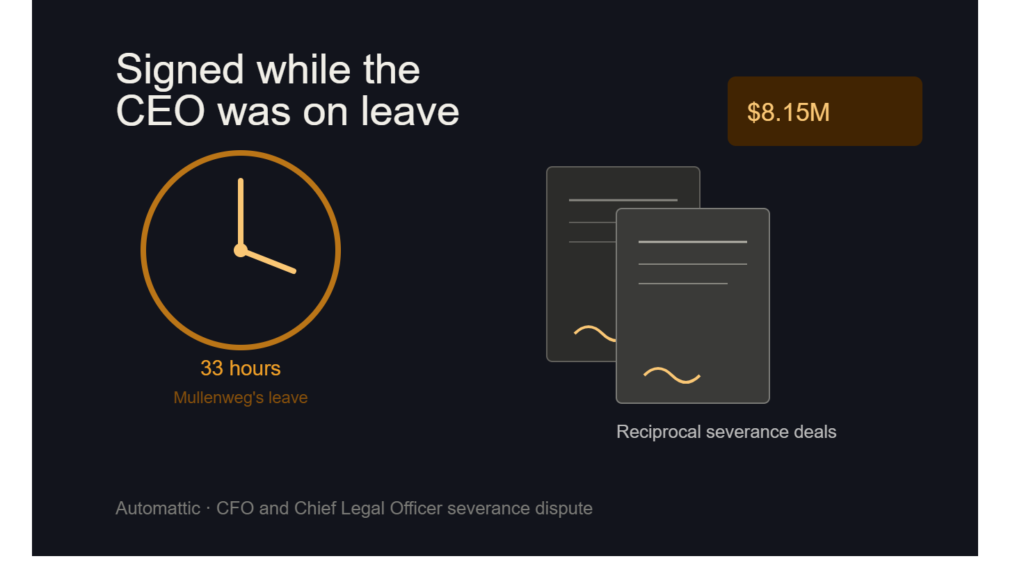
The answer at Automattic is now tied to two reciprocal severance agreements signed during a 33-hour leadership upheaval involving CEO Matt Mullenweg. According to documents reviewed by TechCrunch, CFO Mark Davies and Chief Legal Officer Andy Missan signed each other’s severance agreements while Mullenweg was on paid leave.
The agreements could require Automattic to provide the two executives with 12 months of base salary, accelerated equity vesting, access to vested stock options and another year of health coverage if the agreements’ conditions are met.
The combined value of the salary and accelerated equity package is approximately $8.15 million, according to TechCrunch.
But the financial figure is only one part of the story. The bigger questions involve corporate governance, executive protections, board authority and what happens when an extraordinary leadership intervention lasts less than two days.
What Happened During Mullenweg’s 33-Hour Ouster?
How the Interim Leadership Change Unfolded
On September 9, 2026, Automattic’s board voted to place Mullenweg on paid leave. The board has not publicly explained the reason for that decision, according to TechCrunch.
Mullenweg subsequently accused CFO Mark Davies and three board members of conspiring to force the vote. He said in a company-wide Slack message that he received only about 50 minutes’ notice and did not have time to have the resolution reviewed by outside legal counsel.
Mullenweg returned to his CEO position approximately 33 hours later.
The board members who had voted for his removal subsequently left the company. During that short period, however, Davies became interim CEO and the company went through a significant temporary leadership transition.
It was during this window that Davies and Missan signed reciprocal severance agreements.
Question: Why is the 33-hour period important?
Direct answer: Because the agreements were executed while Mullenweg was away from the CEO role and Davies was serving as interim CEO. That timing puts the contracts at the center of questions about how Automattic’s leadership structure operated during the attempted transition.
What the Agreements Provided
The documents reviewed by TechCrunch establish a series of protections for Davies and Missan if their departures qualify under the agreements.
Those protections include:
- 12 months of base salary, paid as a lump sum.
- Accelerated vesting of equity under the specified conditions.
- The ability to exercise vested stock options.
- An additional year of health coverage.
- Benefits conditioned on signing a broad release of claims.
- Continuing obligations involving confidentiality, nonsolicitation and other post-employment restrictions.
The arrangements therefore go beyond a simple final paycheck. They establish a framework for compensation and other benefits if the executives leave under circumstances covered by their agreements.
What Are Reciprocal Severance Agreements?
Definition: A reciprocal severance agreement is an arrangement in which two executives enter into agreements that provide each executive with defined benefits if specified conditions surrounding their departure are met.
In Automattic’s case, the unusual element is that Davies signed Missan’s agreement while Missan signed Davies’ agreement. That does not automatically establish that the agreements are invalid or improper.
However, the arrangement becomes particularly notable because it occurred during an unusually short and consequential leadership transition.
Why the Signing Arrangement Is Notable
Normally, executive employment and severance agreements are negotiated as part of a broader employment relationship and corporate approval process.
Here, the agreements were signed during the same brief period in which the company’s CEO had been placed on leave and the CFO had temporarily assumed the CEO role.
That context is why the agreements have attracted attention.
TechCrunch reported that Automattic’s legal team is now considering whether to honor the agreements or challenge their legal validity.
Question: Does reciprocal signing automatically make the agreements improper?
Direct answer: No. The fact that executives signed each other’s agreements does not by itself establish wrongdoing. The significance comes from the combination of the reciprocal signing, the timing, the leadership dispute and the potential financial obligations attached to the agreements.
That distinction matters. A corporate governance question is not automatically evidence of misconduct.
What the $8.15 Million Package Includes
The most eye-catching figure in the Automattic dispute is the potential $8.15 million combined value of salary and accelerated equity benefits for Davies and Missan.
But this figure should not be interpreted as a simple cash payment that has already been made.
The agreements establish benefits that depend on the executives meeting the relevant conditions. Automattic is now considering whether those conditions apply and whether the agreements themselves should be challenged.
Salary and Equity Benefits
Each agreement provides for 12 months of base salary paid as a lump sum when the relevant severance conditions are satisfied.
The agreements also accelerate equity vesting, which can substantially change the value of an executive’s compensation when employment ends.
For Davies and Missan, TechCrunch reported that the total package, including accelerated equity and one year of salary, comes to approximately $8.15 million.
Health Coverage and Stock Options
The agreements also provide another year of health coverage and allow executives to exercise vested stock options.
That means the financial value of an executive severance arrangement can extend beyond salary.
A useful way to understand the package is to separate its components:
| Benefit | What it means |
| 12 months of salary | Base compensation paid as a lump sum under qualifying conditions |
| Accelerated equity | Certain equity awards vest faster than they otherwise would |
| Vested stock options | Executives retain the ability to exercise vested options |
| Health coverage | Another year of health benefits |
| Claims release | Executive agrees to release specified claims |
| Post-employment restrictions | Confidentiality, nonsolicitation and other obligations continue |
Question: Is the $8.15 million already owed to the executives?
Direct answer: Not necessarily. The figure represents the value Automattic could owe under the agreements if the relevant severance conditions are satisfied. The company is reportedly evaluating whether to pay the benefits or challenge the agreements’ validity.
How “Cause” and “Good Reason” Work in the Agreements
Executive severance contracts often depend on carefully defined legal terms.
Two of the most important are “cause” and “good reason.”
Definition + Expansion – “Cause”: In an executive employment agreement, “cause” generally defines circumstances that allow a company to terminate an executive without owing certain severance benefits.
In these Automattic agreements, “cause” is narrowly defined around specified conduct, including gross negligence that materially harms the company, knowing dishonesty or fraud that causes material harm, certain material legal violations, material confidentiality or intellectual-property breaches, and certain serious criminal conduct.
The agreements also establish a process before cause can be invoked.
According to TechCrunch, the company must notify the executive in writing within 60 days of learning about the relevant conduct. The executive then receives 30 days to cure the conduct if it is curable, followed by a requirement for a majority of the board to agree that cause exists.
What “Good Reason” Means
Definition: “Good reason” is a contractual concept that can allow an executive to resign while still qualifying for severance when specified negative changes are made to the executive’s job.
The agreements address this concept in different ways.
For Davies, the agreement specifically states that removal from the interim CEO position does not constitute “Good Reason” as long as he remains CFO.
That provision is particularly relevant because Davies became interim CEO during the brief period when Mullenweg was away.
Question: Why does the “Good Reason” clause matter for Davies?
Direct answer: It appears designed around his specific temporary CEO role. The agreement prevents the end of that interim assignment, by itself, from becoming a contractual reason for Davies to resign and claim severance while he remains CFO.
That does not establish why the provision was included. It simply shows how precisely the agreement addresses the circumstances surrounding the temporary leadership arrangement.
Why Automattic May Challenge the Severance Deals
Automattic now faces a choice between honoring the agreements or contesting them.
The company’s legal team is reportedly evaluating the agreements’ validity, meaning the dispute could move from an internal governance issue into a legal disagreement over contractual obligations.
Several factors make that question significant.
The Governance Question
Corporate governance refers to the systems through which a company is directed, controlled and held accountable.
In a leadership crisis, those systems become especially important because decisions may need to be made quickly while authority is being contested.
At Automattic, the board temporarily removed Mullenweg, Davies became interim CEO, and agreements were signed protecting the departures of two senior executives.
That sequence raises a straightforward governance question:
Who had the authority to approve major executive compensation arrangements during the temporary leadership transition?
The answer depends on Automattic’s corporate documents, board authority, employment agreements and applicable law. The article’s available reporting does not establish that the agreements were invalid.
The Stock Ownership Question
Another detail reported by TechCrunch concerns Davies’ Automattic stock ownership.
An HR document reviewed by TechCrunch indicated that Davies held no Automattic stock at the time of his departure, although he still held a large number of outstanding vested options.
One source told TechCrunch that Davies had sold his stock a few months earlier, but the publication said it could not independently confirm the timing.
That distinction is important because stock ownership and vested options are not the same thing.
Someone can hold no shares while still possessing vested options that may have economic value.
The WP Engine Legal Context
Automattic’s internal leadership dispute is occurring against the backdrop of its continuing legal conflict with hosting provider WP Engine.
According to the article, WP Engine accused Mullenweg in July of destroying evidence in legal filings, including messages from applications such as Signal, WhatsApp and Telegram.
The allegation is contested context rather than an established finding in the material provided here.
TechCrunch described one possible interpretation of the board’s intervention as an attempt to demonstrate that Automattic was taking concerns about Mullenweg seriously.
Under that scenario, a temporary change in leadership could potentially have relevance to the company’s position in ongoing litigation.
Question: Does the WP Engine dispute explain why the board removed Mullenweg?
Direct answer: The available reporting does not establish that as the reason. TechCrunch reported that the board had not publicly explained its reason for placing Mullenweg on leave, so connections between the leadership intervention and the litigation remain interpretations rather than confirmed explanations.
That distinction is especially important when discussing corporate disputes: a possible motive is not the same as a documented motive.
Two Competing Interpretations of the Leadership Crisis
TechCrunch reported two broad ways the events could be interpreted.
The first is that the board was responding to an internal leadership crisis and sought to protect executives who might face consequences if the intervention failed.
Under this interpretation, the severance agreements could be viewed as protections created during a high-risk transition.
The second possibility is that the board was attempting to establish a temporary period of control for another strategic reason.
TechCrunch reported that Mullenweg suspects this possibility, although the article also noted that the board had not publicly provided him with a stated reason for its vote.
Neither interpretation has been established as the definitive explanation.
Why Attribution Matters
This is a useful lesson in analyzing breaking corporate news.
A report can contain:
- Documented facts – such as when a board vote happened.
- Contractual provisions – such as the terms of a severance agreement.
- Statements by participants – such as Mullenweg’s accusations or explanations.
- Reported interpretations – such as theories about why the board acted.
- Unresolved questions – such as whether the agreements are legally enforceable.
Keeping those categories separate makes corporate reporting easier to understand.
Automattic Severance Agreements vs. Typical Executive Protections
Not every executive severance arrangement is unusual. Senior executives frequently have contracts covering compensation, equity and benefits if their employment ends under specified circumstances.
The important issue here is the combination of timing, reciprocal signing and leadership upheaval.
| Issue | Typical executive arrangement | Automattic situation |
| Salary protection | May provide severance after qualifying departure | 12 months of base salary |
| Equity | May specify vesting treatment | Accelerated vesting under the agreement |
| Stock options | Often governed by equity plan terms | Vested options can be exercised under the agreement |
| Health benefits | May continue for a defined period | Another year of health coverage |
| Cause | Contract defines qualifying misconduct | Narrowly specified categories and procedures |
| Good Reason | May protect executives from material role changes | Davies’ agreement addresses his interim CEO role |
| Signing process | Usually part of corporate employment governance | Davies and Missan signed each other’s agreements |
| Context | Normal employment relationship | Signed during a 33-hour leadership crisis |
The comparison does not establish whether Automattic’s agreements are legally valid or invalid.
Instead, it highlights why the documents are receiving attention.
What Happened to Automattic’s Legal Leadership?
Another development reported alongside the severance dispute involves Automattic’s legal team.
The company replaced its previous counsel, Gibson Dunn, with Stephen Shackelford and Shawn J. Rabin of Susman Godfrey LLP, according to the reporting provided.
Automattic’s general counsel, Jordan Hinkes, also had his company account deactivated, according to sources cited by TechCrunch.
Mullenweg subsequently said on X that Hinkes was joining an AI startup as general counsel and that the move had been planned for weeks.
That statement provides an important piece of context: the account deactivation and Hinkes’ departure should not automatically be interpreted as evidence that his exit was caused by the leadership confrontation.
What the Automattic Dispute Means for Corporate Governance
The Automattic episode demonstrates why executive contracts matter during periods of organizational instability.
For employees and executives, a severance agreement can provide financial certainty when leadership changes unexpectedly.
For boards, however, the process surrounding those agreements can become just as important as their financial value.
A few governance principles stand out:
- Authority matters: Companies need clearly defined rules about who can approve executive contracts.
- Timing matters: Agreements signed during a leadership transition may receive greater scrutiny.
- Documentation matters: Written contracts can become critical evidence when parties disagree.
- Conflict management matters: Reciprocal arrangements can raise questions about potential conflicts even when they are not automatically improper.
- Legal review matters: Employment contracts can contain detailed definitions that determine whether benefits are actually payable.
- Transparency matters: When companies provide limited explanations during leadership disputes, outside observers may have difficulty separating fact from speculation.
Question: What can other companies learn from this episode?
Direct answer: Leadership transitions should have clear approval procedures for executive compensation, severance and authority changes. Written governance rules can reduce uncertainty when a temporary management structure suddenly becomes necessary.
Why the Case Matters Beyond Automattic
Automattic is best known for products and platforms connected to WordPress, but this story is ultimately about a broader business issue: how companies manage authority when leadership breaks down.
For startups and technology companies, founders can hold substantial influence over corporate strategy and culture. At the same time, boards have governance responsibilities that can become more visible during a crisis.
The Automattic dispute shows how quickly those responsibilities can collide.
It also illustrates why employment contracts should not be viewed merely as HR paperwork. Clauses covering severance, cause, good reason, equity and board approval can have millions of dollars in consequences when leadership changes unexpectedly.
For young professionals entering the technology industry, understanding these concepts can be useful even if they never become executives.
Knowing the difference between salary, equity, vested options, accelerated vesting and severance can make employment contracts easier to understand.
What Happens Next at Automattic?
The immediate question is whether Automattic will honor the severance agreements or challenge them.
The company is reportedly reviewing the documents and determining its next legal steps.
There are also broader unanswered questions about the company’s governance following the failed attempt to remove Mullenweg.
Among the key issues to watch are:
- Whether Automattic pays the severance benefits.
- Whether the company challenges the validity of the agreements.
- How the company handles its board and executive leadership structure.
- Whether further information emerges about the September 9 board vote.
- How the dispute interacts with Automattic’s ongoing litigation involving WP Engine.
- What happens to other executives affected by the leadership transition.
At this stage, the most reliable conclusions come from the documents and reported events rather than speculation about undisclosed motives.
The Automattic severance agreements are significant because they put a concrete financial and contractual dimension on an otherwise extraordinary leadership dispute.
FAQ
What are the Automattic severance agreements?
The Automattic severance agreements are executive contracts signed by CFO Mark Davies and Chief Legal Officer Andy Missan during the period when CEO Matt Mullenweg was on paid leave. According to TechCrunch, each executive signed the other’s agreement, which provides specified salary, equity, stock-option and health-coverage benefits if qualifying severance conditions are met.
How much could Automattic owe under the severance agreements?
According to TechCrunch, the combined value of the two executives’ packages, including one year of salary and accelerated equity, is approximately $8.15 million. That does not mean the money has already been paid; Automattic is reportedly considering whether to honor or challenge the agreements.
Why did Mark Davies become interim CEO?
Davies became interim CEO after Automattic’s board voted to place Matt Mullenweg on paid leave on September 9, 2026. Mullenweg returned to the CEO role approximately 33 hours later.
Did the board explain why Mullenweg was placed on leave?
According to the reporting provided by TechCrunch, Automattic’s board had not publicly explained the reason for its decision to put Mullenweg on paid leave. Mullenweg disputed the process and accused Davies and board members of conspiring against him.
Does signing reciprocal severance agreements prove misconduct?
No. The fact that Davies and Missan signed each other’s agreements does not by itself establish misconduct or invalidate the contracts. The significance comes from the timing, leadership dispute, contractual terms and questions about corporate authority during the transition.
What could happen to the severance agreements next?
Automattic’s legal team is reportedly evaluating whether to pay the benefits or challenge the agreements’ legal validity. The eventual outcome will depend on the contracts, applicable corporate and employment law, and the facts surrounding their approval and execution.
Final Takeaway
The Automattic severance agreements turn a brief leadership crisis into a much larger corporate-governance story, with $8.15 million in potential compensation and important questions about executive contracts, board authority and accountability.
For anyone following technology companies, the episode is a useful reminder that leadership decisions can have consequences far beyond who occupies the CEO chair.
Want to understand more technology-business stories like this? Explore Kalinga.ai for clear explainers on the companies, leadership decisions and trends shaping the technology industry.