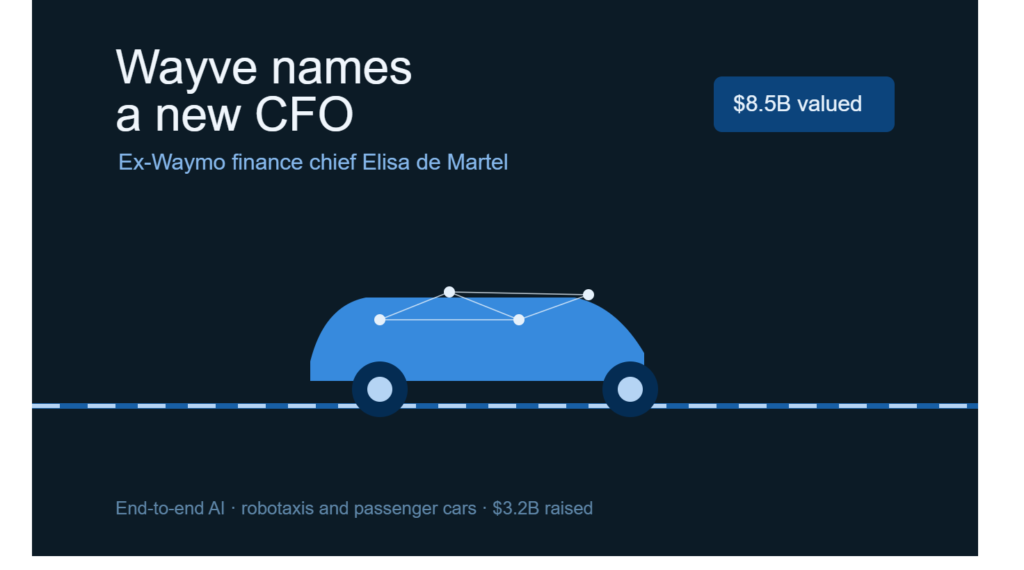
Why Wayve Hired Former Waymo CFO Elisa de Martel
A self-driving startup can spend years proving its technology works, but the harder challenge begins when that technology has to become a real business.
That is the stage Wayve is approaching, and the company has brought in former Waymo CFO Elisa de Martel as its new chief financial officer. De Martel is taking over from Max Warburton, who will move into a strategic advisory role, as Wayve prepares to expand its automated-driving technology toward robotaxis and passenger vehicles.
The appointment is significant because de Martel is arriving with experience from some of the world’s biggest technology and manufacturing companies, including Waymo and Apple.
Her previous role at Waymo also covered a particularly important period for the autonomous-driving company. She served as Waymo’s CFO from 2022 through January 2026, when the company expanded commercial operations and raised $5.6 billion in a Series C funding round that valued it at more than $45 billion, according to TechCrunch.
Wayve is now facing a different but similarly important transition: moving from technology development and limited deployment toward becoming a higher-volume automotive technology supplier.
What Elisa de Martel Brings to Wayve
Elisa de Martel’s career combines financial leadership with experience in deep technology and manufacturing.
Before joining Wayve, she held senior financial positions at companies including Waymo and Carbon, the industrial 3D-printing company. She also spent 11 years as manufacturing finance director at Apple, giving her experience inside a company where technology development ultimately has to connect with large-scale production.
That combination is relevant to Wayve because autonomous driving is not simply a software problem.
A self-driving company has to manage research and development, computing requirements, automotive partnerships, regulatory considerations, manufacturing relationships, capital allocation and commercial expansion.
Definition + Expansion — Deep tech:
Deep tech refers to technology built around substantial scientific or engineering innovation rather than simply a software feature or consumer application. Autonomous driving is a deep-tech field because companies must combine artificial intelligence, sensors, vehicles, computing and real-world testing to create systems that can operate safely.
For Wayve, de Martel’s experience sits at the intersection of technology and finance.
TechCrunch reported that her connection to deep technology was particularly attractive to Wayve’s leadership, including founder and CEO Alex Kendall.
Question: Why is a former Waymo CFO valuable to Wayve?
Direct answer: De Martel has experience managing finances at an autonomous-driving company that moved from development toward commercial operations. That experience could be relevant as Wayve attempts a similar transition from developing its technology to deploying it more broadly.
Why Wayve Is Entering a Critical Commercial Phase
Wayve was founded in 2017 and has developed an approach to automated driving based on an end-to-end neural network.
The company is now valued at approximately $8.5 billion and has raised $3.2 billion to date, according to the information reported by TechCrunch.
Those numbers demonstrate significant investor interest, but valuation and funding are not the same as commercial scale.
The next challenge is turning a technically promising system into a product that automakers and mobility companies can deploy at meaningful volume.
This is where the role of the Wayve CFO becomes particularly relevant.
A startup preparing for commercial deployment has to answer questions such as:
- How much capital should be allocated to research and development?
- Which automotive partnerships deserve additional investment?
- How should the company manage cash as deployments expand?
- What commercial agreements can support long-term growth?
- How should the business structure its relationships with automakers and mobility providers?
- What financial and operational systems are needed for larger deployments?
These questions sit directly within a CFO’s responsibilities.
Question: What stage is Wayve at now?
Direct answer: Wayve is moving beyond pure development and testing toward limited real-world deployment and broader commercialization. Its technology is being developed for both robotaxis and passenger vehicles, while partnerships with automakers and mobility companies create potential routes to larger-scale deployment.
How Wayve’s Self-Driving Technology Works
Wayve’s technology is built around a different philosophy from systems that depend heavily on high-definition maps, custom hardware or large collections of hand-coded driving rules.
The company uses an end-to-end neural network, a type of artificial intelligence system designed to learn the relationship between driving data and vehicle behavior.
Rather than depending on a fixed collection of manually programmed instructions for every driving scenario, Wayve’s system uses data to learn how to drive.
According to the information reported by TechCrunch, the company’s approach does not rely on high-definition maps, custom hardware or hand-coded rules.
That is an important part of Wayve’s pitch to automakers.
What Is an End-to-End Neural Network?
Definition + Expansion — End-to-end neural network:
An end-to-end neural network is an AI model designed to learn a complex task by connecting inputs to outputs through the model rather than requiring developers to manually specify every intermediate decision.
In autonomous driving, the basic idea is that driving data can be used to train a model to produce driving behavior.
This approach can potentially make the technology more adaptable across different vehicles and environments, although real-world autonomous driving still requires extensive testing and safety validation.
Wayve has built its software around this data-driven approach.
The company describes two product directions: an “eyes on” assisted-driving system and an “eyes off” fully automated-driving system.
The distinction matters.
An “eyes on” system still requires the human driver to remain responsible for monitoring the road. An “eyes off” system is intended to handle all driving within environments where the system is designed to operate.
Question: Does Wayve make the car fully autonomous everywhere?
Direct answer: No. Wayve’s technology includes both assisted-driving and fully automated-driving products, but the “eyes off” system is intended to operate in specific environments rather than automatically meaning a vehicle can drive itself everywhere.
Wayve vs. Waymo: Different Paths to Autonomous Driving
Because de Martel previously served as CFO of Waymo, it is natural to compare the two companies.
However, their technologies and commercial strategies should not be treated as identical.
| Category | Waymo | Wayve |
| Company focus | Autonomous driving and robotaxi services | Automated-driving software for robotaxis and passenger vehicles |
| Parent/company context | Alphabet autonomous vehicle company | Independent self-driving startup |
| De Martel role | CFO from 2022 to January 2026 | CFO from September 2026 |
| Technology approach | Waymo’s autonomous-driving technology | End-to-end neural network approach |
| Maps/hardware philosophy | Uses a dedicated autonomous-driving technology stack | Designed without reliance on high-definition maps or custom hardware |
| Commercial direction | Commercial robotaxi operations | Robotaxis and passenger vehicles |
| Funding reported in source | $5.6B Series C in 2024 | $3.2B raised to date |
| Reported valuation | More than $45B after Series C | About $8.5B |
The comparison illustrates why de Martel’s experience could be relevant without suggesting that Wayve is simply following Waymo’s strategy.
Wayve’s technology is designed to be hardware-agnostic, meaning the company aims to make its software work with vehicles and hardware platforms that automakers already use.
That approach is central to its pitch.
Why Automakers Are Interested in Wayve
Automakers already have substantial investments in vehicle platforms, sensors and computing architectures.
A self-driving technology provider that requires an automaker to completely redesign its vehicle could therefore create a significant barrier to adoption.
Wayve’s approach attempts to reduce that barrier.
The company has developed partnerships with automotive manufacturers including Nissan and Stellantis, according to TechCrunch.
The company’s software-focused strategy is also attractive to mobility companies.
Uber, for example, is interested in using more capable automated-driving technology for robotaxi deployments.
This creates two potential routes for Wayve.
The first is supplying technology to automakers that want automated-driving capabilities in consumer vehicles.
The second is supporting autonomous mobility services such as robotaxis.
Question: Why does hardware-agnostic technology matter to automakers?
Direct answer: It can potentially allow automakers to integrate automated-driving software without committing to an entirely different vehicle hardware strategy. Wayve’s pitch is that its technology can work with existing automotive hardware choices rather than requiring a proprietary hardware stack.
That does not guarantee commercial adoption, but it explains why the company’s model has attracted automotive partners.
What the Wayve CFO Will Do
The CFO position at Wayve goes well beyond tracking expenses.
According to the company, de Martel will oversee:
- Financial strategy and planning.
- Capital allocation.
- Financial reporting.
- Corporate governance.
- Treasury.
- Tax.
- Commercial deals.
- Investor relationships.
- Strategic partnerships.
This makes the appointment especially relevant as Wayve approaches larger-scale deployment.
A CFO in a technology startup moving toward commercialization must connect financial planning with the company’s operational ambitions.
For example, a company developing autonomous-driving software may need significant capital for computing, testing, engineering, partnerships and deployment.
At the same time, revenue may not grow at the same pace as development costs during the early stages of commercialization.
That makes capital allocation particularly important.
Question: What is the most important financial challenge for Wayve at this stage?
Direct answer: The company needs to manage the transition from heavily funded technology development to a business capable of generating sustainable commercial value. De Martel’s responsibilities place her at the center of financial planning, capital allocation and strategic transactions during that transition.
Wayve’s Robotaxi Opportunity
Robotaxis are one of the most visible applications for autonomous-driving technology.
Instead of selling a vehicle equipped with self-driving technology directly to consumers, a company can work with a mobility platform to provide automated transportation services.
Wayve has already made progress in this area.
The company recently launched public rides in London, with a human safety operator on board.
That qualification is important.
A public robotaxi ride with a safety operator is not the same thing as a fully autonomous commercial service without human supervision.
Still, public deployment provides a real-world environment for testing and demonstrating the technology.
Wayve is also working toward a potential deployment in Tokyo, with Uber, Wayve and Nissan planning a robotaxi service there, according to the source material.
This gives the company another potential market in which its technology could be tested and deployed.
Why Passenger Vehicles Matter Too
Robotaxis are only one part of Wayve’s strategy.
The company’s “eyes on” and “eyes off” systems can also be applied to consumer vehicles.
That opens a different commercial model.
Instead of earning revenue from operating a transportation service, Wayve can potentially provide technology to automakers that incorporate automated-driving capabilities into their vehicles.
The distinction is important because the economics, customer relationships and deployment requirements can be very different.
| Deployment model | Potential customer | Main role of Wayve technology |
| Robotaxi | Mobility company/operator | Automated driving for passenger transportation |
| Consumer vehicle | Automaker | Driver-assistance or automated-driving software |
| “Eyes on” system | Vehicle owner/driver | Assisted driving requiring human attention |
| “Eyes off” system | Vehicle/robotaxi operator | Fully automated driving in supported environments |
Question: Why pursue both robotaxis and passenger vehicles?
Direct answer: The two markets offer different routes to commercial adoption. Robotaxis can provide controlled deployment environments, while passenger vehicles can potentially create a much larger addressable market if automakers integrate Wayve’s software into consumer cars.
Why the CFO Role Matters at This Stage
Technology companies often receive the most attention for their engineers and founders.
But when a company moves toward commercialization, financial leadership becomes increasingly important.
Wayve’s next phase could involve larger partnerships, more deployments and greater operational complexity.
That means the company needs systems capable of managing financial reporting, capital, taxes, governance and strategic transactions at a larger scale.
De Martel’s background is relevant because she has already worked through a comparable transition at Waymo.
During her time there, Waymo expanded commercial operations and raised billions of dollars.
Her earlier experience at Apple also adds exposure to manufacturing finance.
For a company trying to become an automotive technology supplier, that background is potentially useful because automotive commercialization involves much more than software development.
Question: Is de Martel’s appointment evidence that Wayve is ready for mass deployment?
Direct answer: No. The appointment signals that Wayve is preparing for a more commercially focused phase, but it does not by itself prove that the company has achieved high-volume deployment or that its technology will scale successfully.
That distinction is crucial.
A senior executive appointment can indicate a company’s priorities without guaranteeing its future performance.
The Bigger Shift: From Self-Driving Startup to Automotive Supplier
Wayve’s most important challenge may not be demonstrating that its AI can drive a vehicle.
It may be proving that the technology can become a dependable component of the automotive industry.
Those are different problems.
A research project can succeed with a limited number of vehicles and controlled testing environments.
An automotive supplier needs repeatable technology, strong partnerships, financial discipline, regulatory compliance and the ability to support deployment across potentially large fleets.
This is the transition Wayve is now approaching.
Its $8.5 billion valuation and $3.2 billion in funding provide significant financial backing, but scale will ultimately depend on commercial execution.
The company has already attracted automakers and mobility companies.
The next stage is converting those relationships into sustained deployments.
What Comes Next for Wayve?
Wayve now has several major milestones to manage.
First, it needs to continue advancing its automated-driving technology through real-world deployment.
Second, it needs to deepen relationships with automakers such as Nissan and Stellantis.
Third, it needs to continue developing its robotaxi opportunity through partnerships with companies such as Uber.
Fourth, it needs to build the financial and operational infrastructure required for higher-volume automotive programs.
De Martel’s arrival fits directly into that fourth challenge.
Her role will include financial planning, capital allocation, governance, treasury and strategic commercial support.
The appointment also creates an interesting connection between two major autonomous-driving companies.
De Martel spent several years helping manage the financial side of Waymo during its transition toward commercial operations.
She is now joining Wayve at a moment when that company is approaching its own transition from development to deployment.
Question: What should observers watch next?
Direct answer: The most relevant indicators are Wayve’s deployment progress, automotive partnerships, robotaxi expansion, commercial agreements and ability to move from limited real-world operations toward higher-volume automotive applications.
What Wayve’s Move Means for the Self-Driving Industry
The appointment of a former Waymo CFO at Wayve is more than an executive hiring story.
It reflects a broader shift in the autonomous-driving industry.
For years, companies competed primarily on technical demonstrations, AI models, sensors and test fleets.
Now the conversation increasingly includes commercial deployment.
Who will supply automakers?
Who will operate robotaxis?
Which technology can work across different vehicles?
How much capital is required to reach scale?
And which companies can turn autonomous-driving research into repeatable commercial businesses?
Wayve is positioning itself around those questions.
Its end-to-end AI approach, automotive partnerships and robotaxi ambitions all point toward a company trying to become more than a self-driving research startup.
The arrival of de Martel reinforces that direction, particularly because her responsibilities extend across finance, governance and strategic commercial activity.
FAQ
Who is the new Wayve CFO?
Elisa de Martel is the new Wayve CFO. She previously served as CFO of Waymo from 2022 to January 2026 and has also held senior financial roles at Carbon and Apple.
Why did Elisa de Martel join Wayve?
De Martel joins Wayve as the company moves from development and testing toward broader deployment of its automated-driving technology. TechCrunch reported that her deep-tech background was particularly attractive to Wayve’s leadership.
What does the Wayve CFO do?
The Wayve CFO oversees financial strategy and planning, capital allocation, reporting, governance, treasury and tax. De Martel will also work with Wayve’s leadership on commercial deals, investor relationships and strategic partnerships.
How much money has Wayve raised?
Wayve has raised $3.2 billion to date, according to the source article, and is valued at approximately $8.5 billion.
What technology does Wayve use?
Wayve uses an end-to-end neural network for its automated-driving software. Its approach is designed without relying on high-definition maps, custom hardware or hand-coded driving rules and instead uses data to teach the vehicle how to drive.
Is Wayve developing robotaxis?
Yes. Wayve is developing technology for robotaxis as well as passenger vehicles. The company has launched public rides in London with a human safety operator and is expected to pursue a Tokyo robotaxi deployment involving Uber, Wayve and Nissan.
Final Takeaway
The arrival of Wayve CFO Elisa de Martel comes at a strategically important moment for the self-driving startup: the company is moving from building and testing autonomous-driving technology toward deploying it through robotaxis and passenger vehicles.
Her experience at Waymo and Apple gives Wayve financial and technology-industry experience as it works to turn its $3.2 billion-funded, approximately $8.5 billion-valued business into a larger automotive technology supplier.
The bigger story is therefore not simply who became CFO. It is whether Wayve can successfully make the difficult jump from promising autonomous-driving technology to repeatable commercial deployment at automotive scale.
Want to understand where AI, autonomous vehicles and deep-tech businesses are heading next? Explore Kalinga.ai for more clear technology explainers and industry insights that connect emerging innovation with the businesses building it.