What Is the Science Corp Brain-Computer Interface?
Definition + Expansion
Science Corp brain-computer interface: A technology approach that connects neural activity with computing systems so information can be communicated between the human nervous system and machines.
A brain-computer interface, commonly called a BCI, attempts to create a communication pathway between the brain and an external device. Instead of relying entirely on a keyboard, touchscreen or voice command, a BCI can potentially interpret signals from the nervous system and translate them into useful computer actions.
The Science Corp approach sits within a broader field called neural engineering, which combines neuroscience, engineering and computing to develop technologies that interact with the nervous system.
Science Corp has focused particularly on applications involving vision, cognition and mobility. According to the TechCrunch report supplied for this article, the company is also preparing for human trials involving its biohybrid brain-computer interface technology.
Question → Direct Answer: Is Science Corp trying to replace smartphones and computers immediately?
No. The company’s work is better understood as an attempt to develop new human-machine interfaces and medical technologies. The idea of a completely screen-free computing future is a longer-term vision rather than an immediate replacement for today’s devices.
That distinction matters. A neural interface can begin with a specific medical purpose while eventually opening possibilities for broader human-computer interaction.
Why Does Max Hodak Think the Screen Era Could End?
Most computing interfaces require humans to translate their intentions into physical actions.
You move a mouse. You tap a screen. You type a sentence. You speak a command. Each method creates a layer between what you want to do and the machine that performs the task.
Hodak’s argument is that future interfaces could reduce some of those layers.
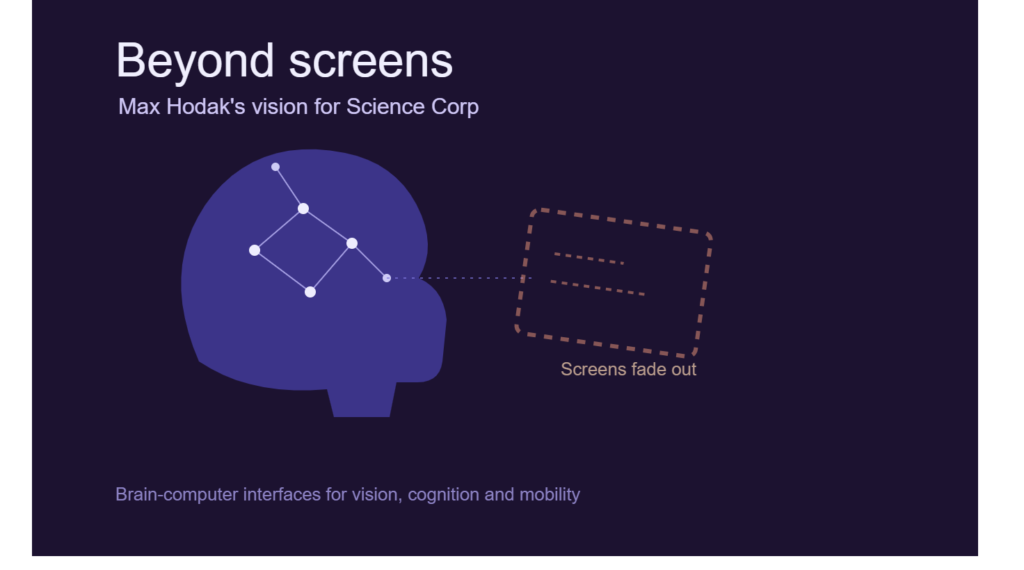
At his “Beyond Screens” session at TechCrunch Disrupt 2026, Hodak is expected to discuss how brain-computer interactions could create new ways for people to engage with machines.
The phrase “screen era” should therefore be understood as a description of his vision, not a prediction that screens are about to disappear from everyday life.
A post-screen interface could mean that some tasks currently performed through displays eventually move to other forms of interaction.
Question → Direct Answer: Why are screens such a big target for interface innovation?
Screens are powerful because they let humans see enormous amounts of digital information, but they also require visual attention and physical interaction. A new interface could potentially make certain interactions more direct by using neural signals, wearable devices or other forms of human-machine communication.
Imagine wanting to interact with a computer while your hands are occupied. Today, you might need voice control or another physical interface. In a future system, neural signals could potentially become another pathway.
That does not mean every interaction would become better through a brain interface. Reading a long article, editing a spreadsheet or watching a movie may still make more sense on a display.
The more realistic possibility is interface diversification: screens remain useful, while neural, wearable, audio and other interfaces take over specific tasks.
Max Hodak’s Journey to Science Corporation
Hodak’s interest in unconventional interfaces did not begin with Science Corp.
According to the TechCrunch article, he started programming at six years old and later studied biomedical engineering at Duke’s Pratt School of Engineering. He also worked in Miguel Nicolelis’ brain-computer interface laboratory, an experience that helped shape his interest in connecting neuroscience and technology.
He later co-founded Transcriptic, a robotic cloud laboratory focused on life sciences.
Hodak became particularly well known after co-founding Neuralink in 2016, where he served as its initial president. Neuralink helped bring brain-implant technology into mainstream public discussion.
In 2021, Hodak founded Science Corporation.
The company took a broader approach to neural engineering, with an emphasis on applications that could potentially help people with disabilities or neurological conditions.
This history helps explain why Hodak’s screen-free computing argument is connected to medical technology rather than simply being another consumer-gadget prediction.
Question → Direct Answer: What experience does Max Hodak bring to Science Corp?
Hodak combines experience in biomedical engineering, brain-computer-interface research, robotics and startup leadership. His earlier work at Neuralink and his research background provide context for Science Corp’s focus on neural engineering.
That combination is important because building a brain-computer interface is not simply a software problem.
It involves biology, hardware, signal processing, neuroscience, clinical research and long-term safety considerations.
How Science Corp’s Technology Could Change Human-Computer Interaction
Traditional computing follows a relatively straightforward model:
Human → physical interface → computer → digital response
A touchscreen, keyboard or mouse acts as the interface between the person and the machine.
Neural interfaces attempt to introduce a different pathway:
Human nervous system → neural interface → computer or device
That change could have significant implications if the technology becomes sufficiently reliable and safe.
For example, someone with severe mobility limitations could potentially use neural signals to control a device. Someone with significant vision loss could potentially receive visual information through a technology designed to interact with the visual system.
The key word is potentially.
Research results and clinical applications must be evaluated individually. A successful medical application does not automatically mean the same technology is ready for general-purpose consumer computing.
The possible shift from “input devices” to “intent”
A keyboard does not understand what you want directly. It receives keystrokes.
A touchscreen does not understand your goal directly. It detects touches and gestures.
A neural interface could potentially attempt to identify patterns associated with a person’s intended action.
That would represent a major conceptual shift in interface design.
Instead of asking, “What physical action should the user perform?”, engineers could increasingly ask, “What information can the system safely and reliably infer from the user’s neural activity?”
This is one reason the Science Corp brain-computer interface concept extends beyond another type of computer accessory. It involves changing the communication layer between humans and machines.
Science Corp’s Medical Work Goes Beyond Computing
The most important near-term applications of Science Corp’s technology may not involve replacing laptop screens.
They may involve medicine.
The company has already worked on technology aimed at restoring sight for people with severe vision loss. According to Science Corp’s published information cited by TechCrunch, its PRIMA implant has received CE marking and uses glasses containing a small camera that sends captured visual information to an implanted retinal chip.
That illustrates an important point about neural technology.
A brain-computer interface does not necessarily have to begin as a device for healthy consumers who want a faster way to use a computer. It can first address a medical problem where conventional technology cannot provide an adequate solution.
Science Corp has also described broader ambitions involving vision, cognition and mobility.
The TechCrunch report says Hodak sees possible future applications for implanted sensors that could help monitor seizures, support damaged brain cells and potentially contribute to treatments for neurological conditions such as Parkinson’s disease.
These applications remain areas of research and development. They should not be interpreted as established treatments simply because the underlying technology is being investigated.
Question → Direct Answer: What is Science Corp’s main opportunity in healthcare?
Its opportunity is to use neural-engineering technologies to address problems involving vision, cognition and mobility. Its work on retinal technology provides an example of how an interface between biological systems and technology can have a medical purpose.
From Restoring Sight to Building New Interfaces
The most interesting part of Science Corp’s vision is the potential connection between medical neural engineering and general computing.
Medical technology often begins by restoring a capability that a person has lost.
A system that helps restore vision, for example, addresses a specific biological limitation. But the same underlying knowledge about how neural signals represent information could eventually influence how humans interact with computers.
This creates a spectrum of possibilities.
At one end are assistive technologies, designed to help people regain or improve a function.
In the middle are adaptive interfaces, where machines respond more naturally to human signals.
At the other end are augmentation technologies, where interfaces could potentially provide capabilities beyond conventional human-computer interaction.
The farther technology moves along that spectrum, however, the more complicated the technical, ethical and regulatory questions become.
Screen-Based Computing vs Neural Interfaces
The difference between traditional interfaces and neural interfaces can be summarized simply:
| Interface approach | Main interaction | Potential strength | Key limitation |
| Keyboard | Typing | Precise text input | Requires physical movement |
| Touchscreen | Touch and gestures | Intuitive visual interaction | Requires attention and physical contact |
| Voice interface | Speech | Hands-free control | Can struggle with context, privacy and noisy environments |
| Wearable interface | Body or gesture signals | More natural interaction | Hardware and sensing limitations |
| Brain-computer interface | Neural activity | Potentially direct neural interaction | Complex biology, safety and reliability challenges |
This comparison shows why the Science Corp brain-computer interface idea is fundamentally different from simply building a better smartphone.
The goal is not necessarily to make the screen faster.
It is to explore whether some interactions can eventually happen without requiring the same physical interface.
What Makes Brain-Computer Interfaces So Difficult?
The human brain is not a simple computer input port.
Neural activity contains enormous amounts of information, but interpreting that information reliably is difficult. Signals can vary between people and can change over time.
There are also major engineering challenges.
A practical neural interface may need to solve problems involving:
- Signal quality: Neural signals can be difficult to detect and interpret accurately.
- Biocompatibility: Implanted devices must interact safely with biological tissue.
- Durability: Technology may need to function reliably for years.
- Data processing: Neural signals can generate complex datasets requiring sophisticated algorithms.
- Calibration: Systems may need to learn how an individual person’s signals correspond to intended actions.
- Clinical safety: Medical applications require rigorous testing and oversight.
- Privacy: Neural data could potentially reveal sensitive information about a person.
- User experience: Even technically successful systems need to be practical for real people.
These challenges explain why a headline about the “end of the screen era” should not be interpreted as a near-term product announcement.
The difficult work is happening underneath the headline.
Why the Biohybrid Approach Matters
Science Corp’s work includes a biohybrid brain-computer interface, a term that points toward combining biological systems with engineered technology.
Biohybrid technologies can be understood as systems that combine biological components or processes with artificial hardware or engineered systems.
That approach is particularly relevant to neural engineering because the nervous system itself is biological.
Instead of treating the brain simply as another electronic device, researchers need to understand how engineered components can interact with biological signals and tissue.
Question → Direct Answer: What does “biohybrid” mean in this context?
It refers to an approach that combines biological systems with engineered technology. For a brain-computer interface, that can mean designing hardware and biological interfaces that communicate with neural systems.
This is one reason neural engineering sits at the intersection of several disciplines rather than belonging neatly to one technology category.
A successful project can require expertise from neuroscience, medicine, electronics, materials science, artificial intelligence and software engineering.
Science Corp’s Funding Shows Investor Interest
Science Corp has also attracted substantial private investment.
The TechCrunch article says the company has raised $230 million in a Series C round at a $1.5 billion valuation.
Those figures provide context for the level of commercial interest surrounding neural engineering.
However, funding should not be confused with proof that a technology is ready for widespread deployment. Venture investment typically reflects expectations about future opportunities, while medical and engineering validation requires separate evidence.
For the technology industry, though, substantial funding can provide resources for expensive research, clinical trials, hardware development and regulatory work.
That matters because neural interfaces are unlikely to progress through software-style iteration alone.
Building and testing implanted technology can take significantly longer than releasing a new app or cloud service.
What Could a Post-Screen Future Actually Look Like?
A post-screen future does not necessarily mean a world without phones, laptops or televisions.
Instead, it could mean a world where screens are only one part of a much larger interface ecosystem.
Consider a few possible scenarios:
1. Accessibility
People with severe mobility limitations could potentially interact with digital systems through neural signals rather than conventional physical controls.
2. Medical restoration
Neural technologies could potentially help restore capabilities involving vision or movement when conventional treatment options are limited.
3. Hands-free computing
Certain tasks could eventually be controlled without touching a device.
4. Wearable and neural combinations
Glasses, sensors, implants and AI systems could work together to interpret information and deliver responses through different channels.
5. New forms of computing
If computers can better understand human intent, developers could design applications around completely different interaction models.
None of these scenarios should be treated as guaranteed outcomes.
They are possible directions suggested by current research and by Hodak’s vision for the future.
What Does TechCrunch Disrupt 2026 Add to the Conversation?
Hodak’s appearance at TechCrunch Disrupt 2026 places the Science Corp discussion in front of a large technology audience.
The event is scheduled for October 13–15, 2026, at Moscone West in San Francisco, according to the supplied TechCrunch Events article. The event is expected to bring together more than 10,000 founders, investors and startup community members across more than 250 sessions.
For the broader startup ecosystem, the importance of the session is less about one prediction and more about the direction of interface innovation.
For years, the dominant computing pattern has been screen-based.
Smartphones made touchscreens mainstream. Voice assistants added speech. Wearables introduced new sensors. AI systems are now increasingly capable of understanding language, images and other forms of information.
Neural interfaces could represent another step in that evolution.
Question → Direct Answer: Why should startups and developers pay attention to this discussion?
Because interface changes can create entirely new product categories. If computers become capable of interpreting human signals in new ways, developers may eventually need to rethink how software is designed, controlled and experienced.
That does not mean every startup needs to build a brain interface.
It means developers should understand how changing interfaces can reshape software opportunities.
The Biggest Questions Are Not Just Technical
The future of neural interfaces raises questions that go beyond engineering.
Who owns neural data?
If a device can collect information about neural activity, users need meaningful control over how that information is stored, processed and shared.
How should consent work?
Medical implants and neural technologies involve highly sensitive interactions with the human body. Users need to understand what a system can do and what information it collects.
How secure are neural systems?
As more technology becomes connected to biological signals, cybersecurity becomes another major consideration.
Who gets access?
Advanced medical and neural technologies could initially be expensive. That raises questions about affordability and access.
Where should augmentation stop?
Medical restoration and consumer enhancement are not necessarily the same thing. Society will need to debate how different applications should be developed and regulated.
These questions are not reasons to dismiss neural technology. They are part of what responsible development needs to address.
What Does This Mean for India’s Future Tech Workforce?
For Indian students and young technology professionals, the emergence of neural engineering creates an interesting interdisciplinary opportunity.
The field is not limited to neuroscientists.
Future teams working on human-machine interfaces could need expertise in:
- Artificial intelligence and machine learning
- Biomedical engineering
- Electronics and embedded systems
- Computer vision
- Signal processing
- Robotics
- Neuroscience
- Cybersecurity
- Healthcare technology
- Data privacy and ethics
- Product design
This is particularly relevant as AI increasingly moves beyond software-only environments.
The next generation of technology may be built across AI + hardware + biology, rather than AI alone.
Students who understand more than one of these areas could find opportunities at the intersection.
For example, a machine-learning engineer who understands biomedical signals could contribute differently from someone who only knows conventional software development.
Likewise, a biomedical engineer with strong programming skills could work on neural data pipelines, device intelligence or assistive technologies.
Is the Screen Era Really Ending?
Not yet.
There is currently no basis in the supplied source to conclude that smartphones, laptops and other screens are about to disappear.
What Hodak is presenting is a vision of computing in which screens are no longer the only important interface.
That distinction is crucial.
Technology rarely replaces one interface overnight. Instead, new interfaces usually coexist with older ones until they become useful enough for particular tasks.
Keyboards did not disappear when touchscreens arrived. Voice assistants did not eliminate typing. Wearables did not eliminate smartphones.
A similar pattern could emerge with neural interfaces.
The Science Corp brain-computer interface could eventually become part of a broader collection of ways humans interact with technology rather than serving as a universal replacement for screens.
And that may actually be a more interesting future.
Instead of asking whether screens will survive, we can ask a better question:
What should the interface be when a computer can understand more about what a person wants?
That is the problem Max Hodak and Science Corp are attempting to explore.
What to Watch Next From Science Corp
Several developments will help determine how quickly the vision progresses.
First, human trials will be important because laboratory demonstrations and real-world human applications are very different stages of development.
Second, medical outcomes will matter. Science Corp’s work involving vision provides an example of how neural engineering can move from research toward practical applications.
Third, the company’s ability to translate neural technology into reliable products will be critical.
Finally, privacy, safety and regulatory frameworks will shape how these systems can be used.
For now, the most useful way to understand the Science Corp brain-computer interface is as an emerging technology platform with both medical applications and a much broader interface vision.
The screen may not be disappearing tomorrow.
But the way humans interact with computers is clearly expanding.
FAQ: Science Corp Brain-Computer Interface
What is the Science Corp brain-computer interface?
The Science Corp brain-computer interface is part of the company’s neural-engineering work aimed at creating communication pathways between biological neural systems and technology. Science Corp is exploring applications involving vision, cognition, mobility and human-computer interaction.
Who is Max Hodak?
Max Hodak is the CEO and founder of Science Corporation. He previously co-founded Neuralink and Transcriptic and has a background in biomedical engineering and brain-computer-interface research.
Why does Max Hodak talk about a screen-free future?
Hodak believes future technology could use new forms of brain-computer interaction to reduce dependence on conventional interfaces such as screens, keyboards and other physical controls. His “Beyond Screens” discussion at TechCrunch Disrupt 2026 is focused on this vision.
Has Science Corp already restored eyesight?
Science Corp’s PRIMA retinal technology has been developed for people with severe vision loss, and the company has reported CE marking for the technology. The system uses glasses with a small camera that sends visual information to an implanted retinal chip.
Is Science Corp replacing smartphones with brain implants?
No. The company’s current work includes medical neural-engineering applications, while the broader idea of moving beyond screens represents a longer-term vision for human-computer interaction. There is no indication that conventional smartphones are about to be replaced.
Why are brain-computer interfaces important for the future of technology?
Brain-computer interfaces could introduce new ways for humans and computers to communicate. Their potential applications range from assistive medical technology to new computing interfaces, although significant technical, clinical, privacy and regulatory challenges remain.
The Bigger Picture
The most interesting part of Max Hodak’s argument may not be the claim that screens are ending. It is the idea that the interface between humans and machines is still unfinished.
For decades, computers have asked humans to learn their language: clicks, taps, commands and keystrokes. Neural engineering explores the possibility of making machines better at understanding human signals instead.
Whether that becomes the next major computing platform remains to be seen. But Science Corp’s work shows why the future of computing may involve not only better AI and faster hardware, but also a fundamentally different relationship between technology and the human body.
If you want to follow how AI, robotics and emerging interfaces are changing technology, keep exploring Kalinga.ai for more explainers on the next generation of computing.