Can This Mesothelioma Drug Turn Cancer’s Defenses Against It?
What if one of cancer’s survival systems could become the very weakness doctors use to attack it?
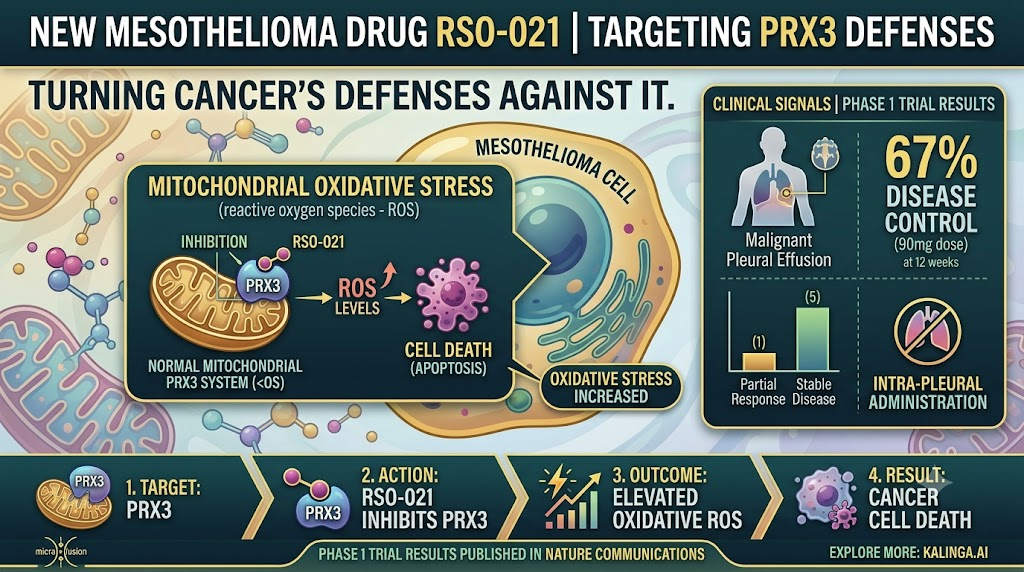
A new mesothelioma drug called RSO-021 is being studied with a counterintuitive strategy: instead of protecting cancer cells from oxidative stress, researchers disable one of their key antioxidant defenses. In a phase 1 trial involving patients with relapsed pleural mesothelioma and malignant pleural effusion, 67% of evaluable patients at the 90 mg dose had disease control at 12 weeks, according to research published in Nature Communications.
The result is promising, but it is important to understand what the number actually means. This was an early-stage, small, non-randomized clinical study designed primarily around safety, tolerability and dose finding,not a definitive test proving that RSO-021 is better than existing treatments.
The science behind it, however, is particularly interesting because it targets a basic vulnerability in cancer biology: tumor cells can generate unusually high levels of damaging molecules called reactive oxygen species, or ROS, and then become dependent on antioxidant systems to keep that stress under control.
What Is the New Mesothelioma Drug?
Question → Direct Answer: What is RSO-021?
RSO-021 is an experimental cancer treatment formulated from thiostrepton, a naturally occurring antibiotic that can covalently inactivate the mitochondrial antioxidant protein peroxiredoxin 3, or PRX3. It is being investigated as a targeted treatment for pleural mesothelioma and other cancers associated with malignant pleural effusion.
Unlike conventional chemotherapy, the central idea behind this mesothelioma drug is not simply to attack rapidly dividing cells. Researchers are trying to exploit a metabolic dependency that can make tumor cells unusually vulnerable to oxidative damage.
The approach originated from research at the University of Vermont Cancer Center and was subsequently developed toward clinical testing with RS Oncology. The phase 1 study was conducted in the United Kingdom between 2022 and 2023, under oversight of the UK’s Medicines and Healthcare products Regulatory Agency, or MHRA.
The peer-reviewed study was published in Nature Communications on July 14, 2026.
Definition + Expansion: What Is PRX3?
PRX3 is a mitochondrial antioxidant enzyme that helps control hydrogen peroxide and oxidative stress inside cells.
Mitochondria are the structures that generate much of a cell’s usable energy. They also produce reactive oxygen molecules as a consequence of cellular metabolism. PRX3 forms part of a mitochondrial antioxidant system that helps prevent those molecules from accumulating to damaging levels.
Cancer cells can have an especially difficult balancing act. Their rapid growth and altered metabolism can increase oxidative stress, meaning they may become unusually dependent on antioxidant defenses to remain viable.
That creates the opportunity researchers are exploring: remove a critical antioxidant defense and the tumor’s own oxidative stress may become destructive.
Why Is Mesothelioma So Difficult to Treat?
Mesothelioma is a rare and aggressive cancer most commonly associated with asbestos exposure. The disease can develop decades after exposure because inhaled asbestos fibers can become lodged in the lungs and contribute to chronic inflammation and cellular damage.
The University of Vermont reports that approximately 30,000 people worldwide are diagnosed with mesothelioma each year. It also describes the disease as having a major unmet medical need, particularly because treatment options remain limited for patients whose disease returns or progresses.
The most common form, pleural mesothelioma, affects the lining surrounding the lungs. Many patients also develop malignant pleural effusion, in which cancer-associated fluid accumulates in the space between the lung and chest wall.
That fluid accumulation is important to the RSO-021 story because researchers can use an existing pleural catheter to deliver the experimental treatment directly into the chest.
Question → Direct Answer: Why does mesothelioma need new treatment strategies?
Because patients with relapsed or refractory disease have limited therapeutic options, researchers are looking for treatments that exploit specific biological dependencies rather than relying only on broadly toxic approaches.
The new mesothelioma drug therefore represents a different research direction: target the tumor’s ability to survive its own oxidative environment.
How Does RSO-021 Turn Oxidative Stress Against Cancer?
To understand the treatment, imagine a cell constantly producing sparks.
Reactive oxygen species are not automatically bad. Cells naturally generate them during metabolism and use them in several biological processes. The problem arises when oxidative molecules accumulate beyond the cell’s ability to control them.
Cancer cells can live with higher levels of oxidative stress than healthy cells, but they still need mechanisms to prevent that stress from becoming overwhelming.
One of those mechanisms involves PRX3.
When RSO-021 inhibits PRX3, the tumor’s mitochondrial antioxidant defenses are weakened. According to the Nature Communications study, pharmacological inhibition of PRX3 increases mitochondrial oxidative stress and can induce apoptosis, a regulated form of cell death.
The Basic Chain of Events
The proposed mechanism can be simplified like this:
- Cancer cells generate reactive oxygen species.
- PRX3 helps control oxidative stress inside mitochondria.
- RSO-021 disables PRX3.
- Hydrogen peroxide and other oxidative stress increase.
- Mitochondrial function becomes impaired.
- Excessive damage can trigger cancer-cell death.
This is why the strategy is sometimes described as turning cancer’s own defenses against it.
The researchers are not adding more oxidative stress from scratch. Instead, they are interfering with a system that tumor cells already rely on to survive the oxidative pressure associated with cancer metabolism.
Why Did Scientists Target PRX3 Instead of Adding Antioxidants?
At first glance, attacking an antioxidant system may sound backwards.
If oxidative molecules can damage cells, why not give patients more antioxidants and reduce the damage?
That question has been explored in cancer research for years. But reducing oxidative stress is not necessarily beneficial when the target is a tumor. Cancer cells can use antioxidant defenses to tolerate the stress associated with rapid growth and abnormal metabolism.
The UVM research takes the opposite approach.
Instead of attempting to protect tumor cells from reactive oxygen species, researchers are asking whether cancer can be pushed beyond its oxidative tolerance by disabling a key defense mechanism.
Question → Direct Answer: Why could blocking an antioxidant help kill cancer cells?
Cancer cells can depend heavily on antioxidant systems because their metabolism creates substantial oxidative stress. Blocking an important antioxidant pathway can therefore allow damaging molecules to accumulate until the tumor cell can no longer maintain its normal function.
This does not mean antioxidants are inherently harmful or that people should change their diet or supplements based on this research. The finding concerns a specific molecular pathway and an experimental cancer treatment, not general advice about antioxidant consumption.
How Did an Antibiotic Become a Cancer Drug?
The story behind this mesothelioma drug is another unusual part of the research.
RSO-021 is based on thiostrepton, a naturally occurring antibiotic belonging to the thiopeptide class. Researchers discovered that thiostrepton can covalently inactivate PRX3, disrupting the enzyme’s ability to participate in the mitochondrial antioxidant system.
A covalent inhibitor is a drug that forms a chemical bond with its target protein, helping disable that protein’s function.
In this case, the target is PRX3.
The University of Vermont says research into the approach began around 2015, eventually leading to collaboration with RS Oncology and development of a clinical formulation known as RSO-021.
The journey illustrates an important feature of drug development: discovering that a molecule affects a biological target is only the beginning. Researchers then have to establish how the mechanism works, develop a usable formulation, test safety, determine dosing and finally evaluate the treatment in people.
What Happened in the Phase 1 Trial?
The clinical evidence behind RSO-021 is one of the most closely watched parts of the research.
The phase 1 study enrolled patients with malignant pleural effusion caused by advanced solid tumors, including mesothelioma. The Nature Communications paper reports that 15 patients were treated overall, including 12 with pleural mesothelioma, one with colorectal cancer and two with non-small-cell lung cancer.
For the recommended 90 mg treatment cohort, the researchers evaluated disease control at the 12-week point.
The result was notable: 6 of 9 evaluable patients, or 67%, had disease control at 12 weeks. That group included one patient with a partial response and five whose disease remained stable according to the study’s response criteria.
A partial response means a measurable reduction in tumor burden, while stable disease means the cancer did not meet the study criteria for either sufficient shrinkage to count as a response or sufficient growth to count as progression.
What the 67% Figure Does,and Does Not,Mean
The headline number needs careful interpretation.
| Finding | What it tells us |
| 67% disease control | 6 of 9 evaluable patients at 90 mg had controlled disease at 12 weeks |
| Partial response | 1 of 10 evaluable patients in the 90 mg cohort had a partial response |
| Stable disease | 5 patients contributed to the 67% disease-control figure |
| Trial stage | Phase 1 |
| Study design | Open-label and non-randomized |
| Primary purpose | Safety, tolerability and dose finding |
| Treatment route | Local intrapleural administration |
| Overall phase 1 population | 15 patients across mesothelioma and other solid tumors |
The distinction between disease control and tumor shrinkage is especially important. A 67% disease-control rate does not mean that 67% of patients experienced substantial tumor shrinkage.
In fact, the peer-reviewed study reports one partial response among 10 evaluable patients at the 90 mg dose, while five additional patients had stable disease at 12 weeks.
That is encouraging early evidence of biological activity, but it is not equivalent to proof of clinical superiority.
What Did Researchers Learn About Survival?
The investigators also reported survival data from the mesothelioma group.
The published paper reports progression-free and overall survival analyses, but these results need to be interpreted within the limitations of a very small, single-arm early-phase study.
The University of Vermont described the survival findings as encouraging, while emphasizing that the research team expected additional clinical data to provide a clearer picture. UVM also reported that phase 2 results were expected to be presented later in 2026.
Question → Direct Answer: Does the early trial prove that RSO-021 extends survival?
No. The study provides encouraging early signals, but a small, non-randomized phase 1 trial without a concurrent control group cannot establish that the treatment causes a survival advantage compared with standard therapy.
This distinction matters whenever an experimental cancer treatment makes headlines. Early clinical results can show that a treatment is reaching its target and producing signs of activity, but larger and more rigorous trials are needed to determine how much benefit patients actually receive.
How Is This Mesothelioma Drug Delivered?
RSO-021 has another unusual feature: it is delivered directly into the pleural space rather than being administered as a conventional systemic treatment.
The pleural space is the narrow area between the lungs and the chest wall. In pleural mesothelioma, cancer can affect the tissues in and around this region.
Many patients develop malignant pleural effusion, creating a buildup of fluid around the lung. The clinical study used an indwelling pleural catheter that could already be present for managing that fluid.
According to UVM, approximately 90% of mesothelioma patients develop pleural effusions. The researchers used the existing access route to place RSO-021 near the disease site.
Why Local Delivery Matters
Local administration could potentially produce a higher concentration of the drug around the tumor while limiting exposure elsewhere in the body.
The approach also illustrates an important principle in modern cancer research: drug delivery can be as important as the drug’s molecular target.
In this case, the treatment is designed around a specific anatomical problem,the pleural space,and a specific molecular vulnerability,PRX3 dependence.
The phase 1 study found the 90 mg dose to be well tolerated and reported that no patient deaths were attributed to the drug. Researchers also demonstrated evidence of target engagement in patient samples, supporting the conclusion that RSO-021 was affecting PRX3 in human tumors.
What Did Laboratory Experiments Show?
The clinical trial was built on years of laboratory research.
Researchers used genetic techniques to remove PRX3 from mesothelioma cells. The resulting cells showed reduced proliferation and changes in mitochondrial metabolism.
In mouse experiments, PRX3-deficient mesothelioma cells failed to form measurable or histologically detectable tumors, while control cells produced substantial tumor burden.
The researchers also tested thiostrepton against patient-derived mesothelioma explants,tumor tissue obtained from patients and studied outside the body.
Across those experiments, thiostrepton induced markers associated with cancer-cell death, although responses varied between individual tumor samples.
That variation is important.
Cancer is not one uniform disease. Two tumors that look similar under a microscope can have different molecular characteristics and respond differently to the same treatment.
The study also identified SLC7A11 as a potential mediator of resistance to PRX3 inhibition. That finding could help researchers investigate why some tumors respond better than others and whether combination treatments might overcome resistance.
Could the PRX3 Strategy Work Against Other Cancers?
Potentially,but this remains an area of investigation rather than an established treatment strategy.
The researchers found evidence that the PRX3 pathway may be relevant beyond mesothelioma. The study’s laboratory experiments examined a broad panel of human tumor cell lines, and the authors identified PRX3 inhibition as a potential therapeutic strategy for other cancers with similar oxidative-stress dependencies.
UVM researchers are also investigating thiostrepton in peritoneal malignancies, gastric cancer and other gastrointestinal cancers.
The broader idea is straightforward:
If a cancer relies heavily on a particular antioxidant defense, disabling that defense could potentially create a therapeutic vulnerability.
But that hypothesis has to be tested cancer by cancer.
A treatment that works in pleural mesothelioma may not automatically work in pancreatic cancer, stomach cancer or another malignancy. Differences in metabolism, genetics, drug delivery and tumor environment can substantially change treatment response.
How Could Future PRX3 Inhibitors Improve the Treatment?
The current formulation is only one version of the underlying strategy.
Researchers from UVM, RS Oncology, the University of Leicester and other collaborators are investigating second-generation PRX3 inhibitors with improved solubility, according to the supplied University of Vermont report.
One long-term objective is to develop versions that could potentially be administered orally rather than requiring local delivery into the pleural space.
That could make the approach easier to administer and potentially expand which patients can receive it.
However, an oral formulation would still need its own development and testing. Better convenience does not automatically mean better efficacy or safety.
What Are the Biggest Questions Researchers Still Need to Answer?
The early findings raise several important questions.
1. Does RSO-021 improve outcomes in larger trials?
The first phase of development established safety and generated preliminary evidence of activity. Larger studies are necessary to determine whether those signals persist.
2. Which patients are most likely to respond?
The identification of SLC7A11 as a potential resistance mechanism could eventually help researchers investigate biomarkers of response. But those findings remain exploratory and need validation.
3. Can resistance be overcome?
Cancer cells are highly adaptable. If tumors compensate for PRX3 inhibition by strengthening another antioxidant pathway, combining treatments could become an important research direction.
4. Can the treatment work outside pleural disease?
The existing phase 1 evidence is centered on patients with malignant pleural effusion and local intrapleural delivery. Other cancers and other forms of mesothelioma require separate clinical evidence.
5. Can the immune system become part of the treatment effect?
Researchers are investigating whether RSO-021 has effects beyond direct tumor-cell killing. UVM and RS Oncology research has reported immune-related changes following PRX3 inhibition, suggesting that the treatment could potentially influence the tumor’s immune environment.
Why Is This Approach Different From Conventional Cancer Treatment?
Many cancer therapies focus on recognizable targets such as DNA replication, cell division, specific signaling proteins or immune checkpoints.
The PRX3 strategy takes a metabolic approach.
It asks a different question: What does the cancer cell need to survive the stress created by being a cancer cell?
That distinction could become increasingly important as researchers learn more about tumor metabolism.
Cancer cells often grow rapidly and rewire their energy production. Those adaptations can create vulnerabilities. A biological system that helps a tumor survive under stressful conditions can simultaneously become something the tumor cannot easily live without.
The mesothelioma drug RSO-021 is being developed around precisely that concept.
A Simple Comparison
| Approach | Main idea | Role in RSO-021 research |
| Chemotherapy | Damage or kill rapidly dividing cells | Existing treatment category |
| Immunotherapy | Help the immune system recognize or attack cancer | Existing treatment category |
| Targeted therapy | Block a specific molecular target | RSO-021 fits this broader concept |
| PRX3 inhibition | Disable a mitochondrial antioxidant defense | Central mechanism of RSO-021 |
| Local intrapleural delivery | Concentrate treatment in the pleural space | Route used in the phase 1 study |
The categories can overlap. RSO-021 is targeted at a molecular vulnerability while also being delivered locally, and researchers are studying whether its effects include immune modulation.
What Does This Discovery Mean for the Future of Cancer Research?
The most interesting lesson may not be the specific drug.
It is the strategy.
Cancer cells are often described as abnormal versions of normal cells. But those abnormalities can create dependencies. A tumor that produces excessive oxidative stress may need unusually strong antioxidant defenses. If researchers can identify and safely disrupt one of those defenses, the tumor’s adaptation can become its weakness.
That is the logic behind PRX3 inhibition.
The early RSO-021 results show why translating laboratory discoveries into clinical research matters. The work moved from molecular experiments and animal models to a first-in-human trial, where researchers could determine whether the mechanism could actually be engaged in human tumors.
At the same time, the study shows why scientific headlines need context.
A 67% disease-control rate at 12 weeks is an early clinical signal, not proof that the drug is an established cure. The study was small, open-label and non-randomized, and the 67% figure came from nine evaluable patients in the 90 mg cohort.
That combination of excitement and caution is exactly what makes early-stage cancer research worth following.
FAQ: Mesothelioma Drug and PRX3 Treatment
What is the new mesothelioma drug RSO-021?
RSO-021 is an experimental cancer treatment based on thiostrepton. It inhibits the mitochondrial antioxidant enzyme PRX3, with the goal of increasing oxidative stress inside tumor cells and triggering cancer-cell death.
How does RSO-021 work against mesothelioma?
RSO-021 targets PRX3, an antioxidant enzyme that helps cancer cells manage oxidative stress. Blocking PRX3 can increase mitochondrial oxidative stress, impair tumor-cell metabolism and promote apoptosis in mesothelioma models.
Did the RSO-021 trial control mesothelioma in 67% of patients?
At the 90 mg dose, 6 of 9 evaluable patients had disease control at 12 weeks, producing a 67% disease-control rate. This included one partial response and five cases of stable disease; it does not mean that 67% of patients experienced tumor shrinkage.
Is RSO-021 an approved mesothelioma treatment?
The evidence discussed here comes from an early clinical development program, and RSO-021 remains an investigational treatment rather than an established standard therapy. The phase 1 study was designed primarily to evaluate safety, tolerability and dosing while exploring preliminary signs of antitumor activity.
Why does RSO-021 use thiostrepton?
Thiostrepton is a naturally occurring antibiotic that can covalently inactivate PRX3. Researchers developed it into the clinical formulation RSO-021 so that its PRX3-targeting activity could be investigated as an anticancer treatment.
Could PRX3 inhibitors treat other cancers?
Researchers are investigating that possibility because oxidative-stress and antioxidant dependencies occur across multiple cancers. UVM researchers are exploring thiostrepton in additional malignancies, but evidence from mesothelioma cannot by itself establish that PRX3 inhibitors will work in other cancer types.
Key Takeaways
- RSO-021 is an experimental mesothelioma drug based on the antibiotic thiostrepton.
- Its target is PRX3, a mitochondrial antioxidant enzyme that helps cells control oxidative stress.
- Blocking PRX3 can allow oxidative stress to build inside tumor cells and contribute to cancer-cell death.
- In a phase 1 study, 67% of nine evaluable patients at the 90 mg dose had disease control at 12 weeks.
- The 67% figure included one partial response and five cases of stable disease.
- The treatment was delivered locally into the pleural space through an indwelling catheter.
- Laboratory experiments found that eliminating PRX3 impaired mesothelioma growth and mitochondrial function.
- Researchers are investigating SLC7A11 and other factors that may influence resistance to PRX3 inhibition.
- Future research is exploring whether the same mechanism could apply to other cancers.
- RSO-021 remains an investigational treatment, so larger and controlled clinical studies are needed to determine its eventual role in cancer care.
The bigger idea is compelling: sometimes the best way to attack a cancer cell is not to find something unique to destroy, but to identify the survival system it cannot afford to lose. For more explainers on emerging biotechnology and medical innovation, keep exploring Kalinga.ai.