What Did New Horizons Discover on Pluto?
Question → Direct Answer: What is the new evidence for liquid nitrogen on Pluto?
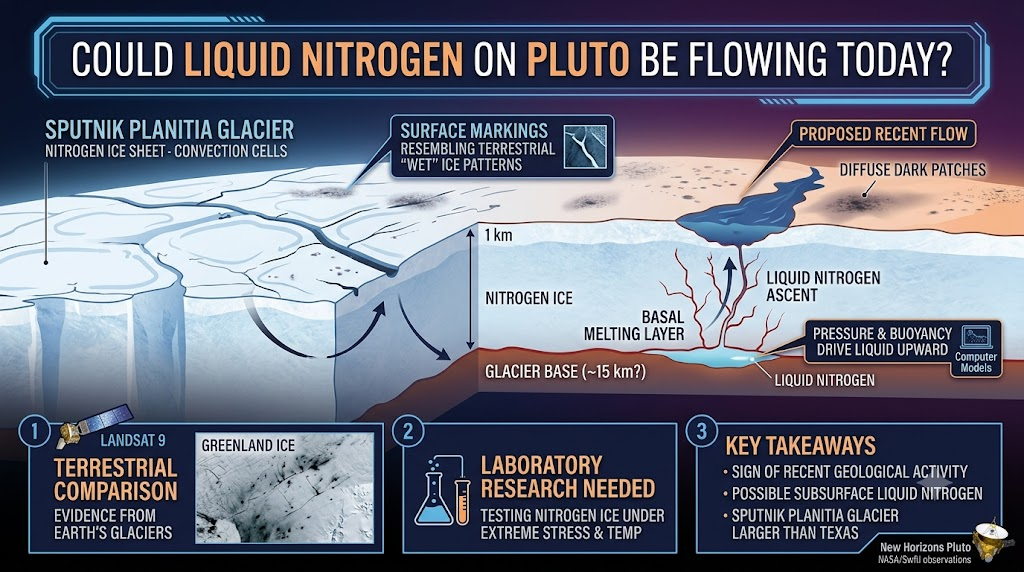
Scientists found dark lines and diffuse dark patches in the northern part of Sputnik Planitia that could be produced when liquid nitrogen emerges from below the glacier and temporarily wets the frozen surface.
The discovery comes from a new analysis led by Southwest Research Institute (SwRI) scientists using observations collected by New Horizons during its historic Pluto encounter. The spacecraft observed Pluto in detail during its 2015 flyby, providing scientists with the high-resolution images needed to study the dwarf planet’s unusual surface.
Sputnik Planitia is already one of Pluto’s most remarkable geological regions. It forms the large left-hand portion of Pluto’s famous heart-shaped surface feature and consists largely of nitrogen ice.
The new study, published in the peer-reviewed Planetary Science Journal, focuses on unusual dark features in the northern section of this vast glacier.
Researchers propose that these features could sometimes become wet when liquid nitrogen reaches the surface from beneath the ice.
Definition + Expansion: What Is Liquid Nitrogen?
Liquid nitrogen is nitrogen in a liquid state that exists at temperatures far below those experienced naturally on Earth’s surface.
On Pluto, nitrogen is a major surface material, but the dwarf planet’s extreme environment means nitrogen behaves very differently from how water behaves on Earth. Instead of thinking about familiar rivers and rain, scientists studying Pluto have to consider how nitrogen can freeze, melt and potentially move under extraordinarily cold conditions.
That is what makes the new finding so intriguing. Liquid nitrogen on Pluto would not require Earth-like rainfall or surface lakes; it could potentially originate beneath the glacier itself.
What Is Sputnik Planitia?
Sputnik Planitia is an enormous glacier made primarily of frozen nitrogen. According to the SwRI research, it is larger than Texas and Oklahoma combined, making it one of the most prominent geological features on Pluto.
The region is also unusual because its surface appears relatively young. Scientists studying the glacier’s surface overturning have estimated that parts of it may be less than one million years old based on modelling.
That relatively young surface provides an important clue.
If the dark features being studied formed after the surface was created or renewed, they could represent comparatively recent geological activity rather than remnants from Pluto’s distant past.
Question → Direct Answer: Why is Sputnik Planitia important to the discovery?
Sputnik Planitia contains a huge reservoir of nitrogen ice, and its geological structure may allow nitrogen deep beneath the surface to melt and potentially move upward. Its young, actively changing surface also provides an opportunity to identify relatively recent processes.
The region is not simply a frozen field of static ice. New Horizons revealed evidence of convection cells, or areas where nitrogen ice can slowly circulate, across parts of Sputnik Planitia.
These cells are roughly city-sized and are separated by narrow dark lines and broader, less sharply defined dark regions.
Those patterns became the focus of the new investigation.
Why Are Pluto’s Dark Surface Features Important?
At first glance, dark markings on an icy surface might not seem like evidence for liquid.
But planetary scientists often learn about hidden processes by studying patterns on a surface.
The researchers noticed that some dark features in northern Sputnik Planitia resemble patterns observed on terrestrial glaciers. On Earth, liquid water can move across or beneath ice and leave behind darkened or wet-looking areas.
The researchers therefore asked whether something similar could happen on Pluto,except with nitrogen instead of water.
Liquid nitrogen cannot simply fall as ordinary rain on Pluto under the conditions described by the researchers. The dwarf planet’s extremely cold environment and atmospheric conditions make a rainfall explanation unsuitable.
That means another source would be needed if liquid is responsible for the dark patterns.
One possibility is subsurface liquid rising through cracks.
The Clues Scientists Are Following
The proposed interpretation depends on several observations:
- Dark lines occur between convection cells in northern Sputnik Planitia.
- Some broader dark patches appear in patterns comparable to features associated with liquid on terrestrial ice.
- The surface is relatively young according to modelling.
- Computer simulations show that nitrogen ice at the base of the glacier could potentially melt.
- Models indicate that liquid nitrogen could move upward through narrow conduits.
- The liquid could then travel downhill after reaching the surface.
None of these observations alone proves that liquid nitrogen is currently flowing across Pluto.
Together, however, they provide the basis for the researchers’ hypothesis.
How Could Liquid Nitrogen Exist Beneath Pluto’s Ice?
The idea of liquid beneath a frozen glacier sounds strange, but Pluto’s nitrogen ice may behave differently from ordinary ice on Earth.
Sputnik Planitia’s nitrogen glacier is several kilometres deep. At its base, conditions may allow nitrogen ice to melt under certain circumstances represented in the researchers’ computer models.
That creates a possible underground source of liquid nitrogen.
The key point is that the liquid would not necessarily need to form at the surface. It could form much deeper inside the glacier and then move through fractures or narrow pathways.
Question → Direct Answer: Could nitrogen melt beneath Pluto’s surface even though Pluto is extremely cold?
According to the researchers’ computer simulations, nitrogen ice at the bottom of Sputnik Planitia could melt under the relevant pressure and physical conditions, creating liquid nitrogen that could potentially move upward.
This is one of the most important parts of the study because it changes the question from “How could liquid exist on Pluto?” to “How could liquid generated deep beneath the ice reach the surface?”
The researchers believe the answer may involve narrow conduits, buoyancy and pressure from below.
How Could Liquid Nitrogen Reach Pluto’s Surface?
Imagine a frozen landscape containing a network of tiny underground pathways.
If liquid forms deep enough beneath the ice, pressure or buoyancy could help push it upward. Instead of spreading through the entire glacier, the liquid could travel through relatively narrow channels.
The computer simulations led by Dr. Orkan Umurhan, a senior research scientist at the SETI Institute, provide a possible physical explanation for this process.
The proposed sequence looks something like this:
Nitrogen ice melts at depth → liquid nitrogen enters a narrow pathway → pressure or buoyancy moves it upward → liquid reaches the surface → it travels downhill → surrounding nitrogen ice becomes temporarily wet or darkened.
That would provide a potential explanation for the dark features seen by New Horizons.
Definition + Expansion: What Is Basal Melting?
Basal melting is melting that occurs at the bottom of an ice layer or glacier rather than at its exposed surface.
On Pluto, the concept is particularly interesting because Sputnik Planitia contains a deep layer of nitrogen ice. If conditions at its base allow some nitrogen to become liquid, that material could potentially move through the overlying ice.
The process would therefore be fundamentally different from sunlight melting ice at the top of a glacier.
What Do Earth’s Glaciers Reveal About Pluto?
One of the most interesting aspects of the research is that scientists did not study Pluto in isolation.
The SwRI-led team compared New Horizons observations with images from NASA’s Landsat 9 satellite showing icy regions on Earth, including Greenland.
The comparison revealed visual similarities.
On Greenland, narrow dark markings can appear where liquid water is present on or around ice and snow. Researchers noticed patterns on Sputnik Planitia that looked sufficiently similar to motivate the hypothesis that liquid nitrogen could be interacting with Pluto’s surface.
Of course, Pluto and Earth are dramatically different environments.
On Earth, the relevant liquid is water. On Pluto, the proposed liquid is nitrogen.
The comparison is therefore not saying that Pluto has Earth-like glaciers. Instead, it provides a useful visual analogy: liquid moving through or across an icy landscape can leave recognizable surface patterns.
Question → Direct Answer: Why compare Pluto with Greenland?
Greenland provides a real-world example of how liquid interacting with ice can create dark surface features. Similar patterns on Sputnik Planitia helped researchers develop the hypothesis that a liquid,potentially nitrogen,could be responsible for Pluto’s markings.
The comparison is an investigative clue rather than direct proof.
That distinction matters because the same-looking surface feature can sometimes have different causes on different worlds.
What Do the New Horizons Images Tell Scientists?
New Horizons transformed scientists’ understanding of Pluto when it flew past the dwarf planet in 2015.
Before the encounter, Pluto was largely a distant point of light with limited visible geological detail. New Horizons revealed mountains, plains, glaciers, fractures, atmospheric haze and a surprisingly varied surface.
Sputnik Planitia became one of the most important regions discovered by the mission.
The new research demonstrates why those observations continue to generate discoveries more than a decade after the flyby.
The spacecraft did not directly observe a stream of liquid nitrogen moving across Pluto. Instead, scientists are extracting new information from the geological patterns captured by the mission.
Question → Direct Answer: Did New Horizons directly photograph liquid nitrogen flowing on Pluto?
No. The evidence comes from the appearance and distribution of surface features observed by New Horizons, combined with comparisons to icy environments on Earth and computer simulations showing how subsurface nitrogen could potentially reach the surface.
This is an important scientific distinction.
The discovery is not a photograph of a nitrogen river. It is a model-supported interpretation of geological evidence.
That interpretation will need additional testing as scientists learn more about nitrogen’s behaviour under Pluto-like conditions.
Why Could Pluto Be More Geologically Active Than It Looks?
Pluto is located in the distant Kuiper Belt, far beyond the orbit of Neptune. Its distance from the Sun makes it easy to imagine as a permanently frozen and inactive world.
But New Horizons showed that Pluto has a surprisingly complex geological history.
The possibility of liquid nitrogen adds another layer to that picture.
If nitrogen can melt beneath Sputnik Planitia and travel upward through the glacier, then Pluto could still be undergoing processes that reshape its surface.
Question → Direct Answer: What does this mean for Pluto’s geology?
It suggests that Pluto may not simply preserve an ancient frozen surface. Instead, its nitrogen glaciers could still participate in active processes involving melting, fluid movement and surface modification.
The proposed activity would not resemble Earth’s rivers or volcanic lava flows exactly.
Instead, it would represent a form of cryogenic geology, where substances other than water can act as geological fluids under the extreme conditions of the outer solar system.
That possibility makes Pluto valuable as a natural laboratory.
Scientists can use it to study how materials behave when temperatures, pressures and atmospheric conditions are radically different from those found on Earth.
Could Liquid Nitrogen on Pluto Be Flowing Right Now?
This is where the discovery becomes particularly interesting,and where caution is important.
The study provides evidence that liquid may have flowed on Pluto in relatively recent times, and the researchers propose that liquid nitrogen may exist beneath Sputnik Planitia today or may have been present there very recently.
However, the observations do not establish a continuously flowing underground river.
The exact timing, frequency and duration of the proposed liquid activity remain uncertain.
Question → Direct Answer: Is there proof that a nitrogen river is flowing on Pluto right now?
No. The study proposes that liquid nitrogen may be present beneath Sputnik Planitia or may have flowed there recently, but further observations and laboratory work are needed to determine whether active liquid flow is occurring today.
That distinction is especially important when translating scientific research into headlines.
“Liquid nitrogen may be moving beneath Pluto” accurately reflects the research question and evidence. “Scientists discovered a permanent underground river on Pluto” would go beyond what the study establishes.
Could Similar Processes Exist Elsewhere in the Solar System?
Pluto may not be the only distant world where unusual liquids could shape the surface.
The researchers note that more than half of Pluto has not been mapped at high resolution, meaning scientists do not yet know whether similar basal liquid processes occur elsewhere on the dwarf planet.
There is also a potentially interesting connection to Triton, Neptune’s largest moon.
NASA’s Voyager 2 spacecraft observed geyser-like activity on Triton during its 1989 flyby. Although Triton and Pluto are different worlds, the possibility that material can move from beneath an icy surface provides an intriguing comparison.
Pluto and Triton: A Useful Comparison
| Feature | Pluto | Triton |
| Location | Kuiper Belt | Neptune’s largest moon |
| Important spacecraft observation | New Horizons | Voyager 2 |
| Icy surface | Yes | Yes |
| Relevant nitrogen activity | Proposed liquid movement beneath Sputnik Planitia | Geyser-like activity observed |
| Current evidence | Surface features and computer models | Direct observations of geysers |
| What scientists still need | More observations and laboratory research | Further investigation of surface processes |
The comparison does not mean the two worlds share the same mechanism.
Instead, it highlights a broader planetary-science question: how can volatile materials move through extremely cold environments and reshape icy worlds?
What Laboratory Research Is Still Needed?
The proposed mechanism depends heavily on how nitrogen behaves under unusual conditions.
That is why the researchers emphasize the need for more laboratory work involving solid nitrogen under stress and strain.
Dr. Umurhan noted that the relevant physical processes have not been studied in complete detail under the conditions needed to reproduce Pluto’s environment.
This is a significant challenge.
Scientists cannot simply recreate Pluto inside an ordinary laboratory freezer. They need to reproduce extremely low temperatures and the relevant pressures and mechanical conditions to understand how nitrogen ice might deform, melt or transport liquid.
Question → Direct Answer: Why are laboratory experiments important?
Laboratory experiments can test whether the physical behaviour predicted by computer models actually occurs under Pluto-like conditions. They can help researchers determine whether basal nitrogen melting and upward liquid transport are realistic mechanisms.
The combination of spacecraft observations, computer simulations and laboratory experiments is therefore central to evaluating the discovery.
Each provides a different piece of the puzzle:
- New Horizons: shows what Pluto’s surface actually looks like.
- Computer models: test whether proposed underground processes are physically possible.
- Laboratory experiments: test how nitrogen behaves under relevant conditions.
- Future spacecraft observations: could reveal whether similar features exist elsewhere.
What Scientists Still Need to Find Out
The new evidence opens several questions about Pluto’s interior and surface.
First, scientists need to determine whether the dark features are definitely produced by liquid nitrogen. The resemblance to terrestrial glacier features is suggestive, but surface similarities alone cannot establish the material responsible.
Second, researchers need to understand how often the proposed process occurs.
If nitrogen periodically reaches the surface, scientists may eventually be able to identify patterns that distinguish active or recently active areas from older geological features.
Third, more of Pluto needs to be mapped at high resolution.
The New Horizons encounter provided an extraordinary amount of information, but it covered only part of the dwarf planet in comparable detail.
The Biggest Open Questions
- Is liquid nitrogen actually present beneath Sputnik Planitia today?
- How deep beneath the surface does any liquid occur?
- How frequently could nitrogen move through cracks?
- How long could liquid remain mobile after reaching the surface?
- Are the dark features definitely caused by liquid?
- Do similar processes occur elsewhere on Pluto?
- Could related mechanisms operate on other Kuiper Belt worlds?
- Can laboratory experiments reproduce the predicted nitrogen behaviour?
Answering these questions could reveal much more about how icy bodies evolve far from the Sun.
Why Does This Discovery Matter for Planetary Science?
The significance of liquid nitrogen on Pluto goes beyond one unusual feature.
Planetary science often starts with an assumption based on familiar Earth conditions. Water dominates Earth’s surface geology, so scientists naturally look for water-driven processes when studying other worlds.
But the outer solar system offers a different chemistry.
At temperatures where water would be completely frozen, other substances can become the important geological materials. Nitrogen, methane and other volatile compounds can participate in surface and subsurface processes that have no close equivalent in everyday Earth geology.
Pluto therefore offers scientists a chance to study a kind of planetary physics that cannot easily be observed on our own planet.
A Different Kind of Geological World
The proposed nitrogen cycle could potentially involve several stages:
Deep ice → melting → underground movement → upward transport → surface flow → refreezing or surface darkening
That is a surprisingly active picture for a world located billions of kilometres from the Sun.
It also reinforces one of the most important lessons from New Horizons: distance and cold do not necessarily mean geological inactivity.
Pluto’s surface may look frozen and still, but beneath that appearance could be a system capable of moving material and modifying the landscape.
What Could This Mean for Future Pluto Exploration?
Future missions to Pluto could provide the observations needed to test the new hypothesis more directly.
High-resolution mapping of currently poorly observed regions could reveal whether dark features associated with potential liquid movement occur elsewhere.
A future spacecraft could also potentially study surface composition in greater detail, monitor changes over time or investigate the relationship between Sputnik Planitia’s surface structures and deeper geological processes.
For now, the New Horizons dataset remains the foundation.
The spacecraft was designed, built and operated by the Johns Hopkins Applied Physics Laboratory, with Southwest Research Institute directing the mission through Principal Investigator Alan Stern. NASA’s Marshall Space Flight Center provides mission oversight through the New Frontiers Program.
The continued scientific output from New Horizons shows that a spacecraft does not have to be actively visiting a world for its observations to keep producing new discoveries.
Sometimes, scientists simply need to ask a new question of old data.
Why Liquid Nitrogen on Pluto Changes the Story of the Dwarf Planet
The most exciting part of the discovery is not that Pluto might have a strange form of liquid.
It is that the finding suggests the dwarf planet may still be physically active beneath its frozen exterior.
Scientists already knew Sputnik Planitia was unusual. Its nitrogen ice, convection cells and relatively young surface pointed to geological processes unlike those seen on most familiar planetary bodies.
The new research adds another possibility: nitrogen may melt deep below the glacier and travel through cracks toward the surface.
If future observations confirm the mechanism, Pluto could become an even more important natural laboratory for understanding cryogenic geology.
For now, the evidence should be viewed as a compelling scientific hypothesis supported by spacecraft observations and modelling,not as proof of a continuously flowing liquid river.
That balance between discovery and uncertainty is what makes the result scientifically valuable.
Pluto may look frozen, but its geology may still be moving.
FAQ: Liquid Nitrogen on Pluto
Is there liquid nitrogen on Pluto?
Researchers have proposed that liquid nitrogen may exist beneath Sputnik Planitia, Pluto’s enormous nitrogen-ice glacier. Computer models suggest nitrogen ice at the glacier’s base could melt and that the resulting liquid could move upward through narrow channels.
Did NASA find a liquid nitrogen river on Pluto?
No. New Horizons did not directly photograph a liquid nitrogen river. Scientists identified dark surface features that may be consistent with liquid nitrogen reaching and moving across the surface, and computer models provide a possible explanation for how that could happen.
What is Sputnik Planitia?
Sputnik Planitia is a massive glacier on Pluto made largely of frozen nitrogen. It forms a major part of Pluto’s famous heart-shaped surface region and contains large convection cells separated by dark lines and patches.
How could nitrogen melt on Pluto?
According to the study’s computer models, nitrogen ice several kilometres beneath Sputnik Planitia could melt at the glacier’s base under appropriate physical conditions. Pressure or buoyancy could then potentially drive the liquid upward through narrow conduits.
Why are Pluto’s dark features important?
The dark features in northern Sputnik Planitia resemble markings associated with liquid interacting with ice on terrestrial glaciers. Researchers therefore propose that they could represent areas temporarily wetted by liquid nitrogen rising from beneath Pluto’s frozen surface.
Could liquid nitrogen be flowing on Pluto today?
The research suggests that liquid nitrogen may exist beneath Sputnik Planitia today or may have been present there very recently, but it does not establish that a continuous flow is occurring at the present moment. Further observations, modelling and laboratory experiments are needed.
Key Takeaways
- Liquid nitrogen on Pluto may be moving beneath or across Sputnik Planitia, according to a new SwRI-led analysis.
- The evidence comes from dark lines and patches observed in the northern part of Pluto’s enormous nitrogen glacier.
- Researchers compared the features with liquid-related patterns observed on Greenland’s ice sheet using NASA Landsat 9 imagery.
- Computer models suggest nitrogen ice several kilometres beneath Sputnik Planitia could melt and produce liquid.
- The liquid could potentially rise through narrow channels because of buoyancy or pressure from below.
- Once reaching the surface, liquid nitrogen could travel downhill and temporarily wet the surrounding frozen nitrogen.
- The study provides the first evidence that liquid may have flowed on Pluto in relatively recent times.
- New Horizons did not directly photograph a flowing nitrogen river; the interpretation is based on surface evidence and modelling.
- More than half of Pluto has not been mapped at high resolution, leaving open the possibility of finding similar features elsewhere.
- Scientists want additional laboratory experiments to understand how solid nitrogen behaves under extreme stress, strain and temperature conditions.
- Similar subsurface or surface processes could potentially help scientists understand icy worlds elsewhere in the solar system, including Triton.
- The discovery reinforces the idea that Pluto may be more geologically active than its frozen appearance suggests.
For more explainers on space science, emerging technology and discoveries shaping our understanding of the universe, keep exploring Kalinga.ai.