What Is the Skull Immune Organ?
Definition + Expansion
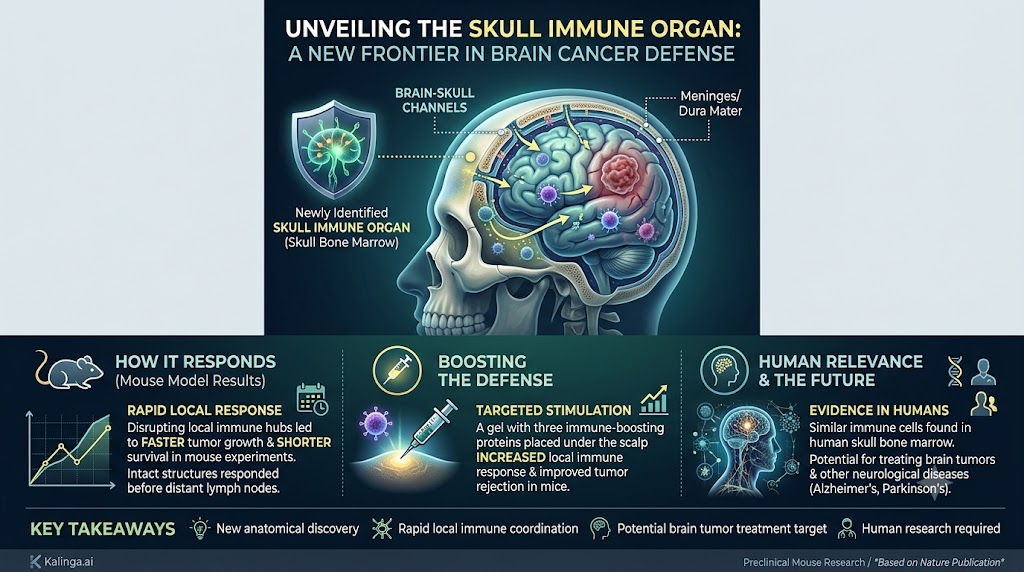
Skull immune organ: A newly identified group of organized, lymph node-like immune structures found within the skull bone marrow that appears capable of coordinating local immune responses near the brain.
These structures are not a conventional organ in the same sense as the heart or liver. Researchers describe them as previously unrecognized immune hubs located in the skull bone marrow, positioned unusually close to the brain.
Their location is particularly important. The brain was once considered largely isolated from the immune system, but research over recent years has revealed multiple physical and biological connections between the brain and surrounding tissues.
The new discovery adds another piece to that picture: immune structures sitting directly inside the bone surrounding the brain.
Question → Direct Answer: Why is this discovery important?
The skull immune organ could provide the brain with a rapid local immune response instead of relying entirely on distant lymph nodes elsewhere in the body. In the mouse experiments, disrupting these structures allowed brain tumors to grow faster and shortened survival.
Researchers also detected evidence of similar immune cells in human skull bone marrow. However, more research is needed to determine whether the structures function in humans in exactly the same way.
How the Skull and Brain Communicate With the Immune System
For decades, scientists had a simplified view of the brain as an organ that was largely separated from the body’s immune defenses.
That picture has changed.
Earlier work from senior researcher Jonathan Kipnis and his laboratory helped demonstrate that the brain has lymphatic vessels within the dura mater, the protective membrane surrounding the brain beneath the skull.
These discoveries showed that the brain can communicate with the immune system through physical pathways that were not fully understood previously.
The latest research builds on that work.
Tiny Channels Connect the Brain and Skull
Researchers previously identified tiny channels connecting the skull, dura and brain tissue. These channels can provide pathways for immune cells and cellular material to move between the brain and the nearby skull bone marrow.
That creates an important biological connection.
Instead of thinking about the brain and skull as completely separate structures, scientists can now examine them as part of a closely connected neuroimmune environment.
The new study followed proteins moving out of the brain through these channels and into skull bone marrow. Once there, researchers observed organized immune structures resembling those normally associated with lymph nodes.
Question → How does the brain communicate with skull bone marrow?
The study indicates that tiny channels between the brain, its surrounding membranes and the skull can provide a physical route for cellular material and immune communication. This connection may help explain why the skull immune organ can respond quickly to changes occurring near the brain.
Why Lymph Node-Like Structures Inside Bone Matter
Lymph nodes are important immune coordination centers.
They help immune cells recognize threats and organize responses. One important function involves interactions between T follicular helper cells and B cells.
B cells can produce antibodies, proteins that recognize specific targets and help the immune system respond to infections and other threats.
Finding structures resembling this type of immune organization inside healthy skull bone marrow was unexpected.
Researchers had not previously observed such structures in healthy bone marrow, according to the study team.
That raises a bigger question: why would the body position specialized immune structures so close to the brain?
One possibility suggested by the findings is that the brain benefits from having immune surveillance nearby.
The brain is a highly specialized organ where inflammation and immune activity must be tightly controlled. A local immune system could potentially respond quickly while reducing the need for an immediate, broad immune reaction throughout the body.
Question → What makes the skull location unusual?
The structures are located in bone marrow immediately adjacent to the brain. Their proximity means immune activity could potentially begin locally before signals travel to more distant lymph nodes.
That timing became particularly important when researchers tested the structures against brain cancer.
How the Skull Immune Organ Responds to Brain Cancer
To investigate whether the newly identified structures actually protect the brain, researchers used a mouse model of glioblastoma.
Glioblastoma is an aggressive type of brain cancer that develops from cells in the brain and is known for being difficult to treat.
The researchers interfered with the immune hubs in the skull and then observed what happened to tumors.
The result was significant in the mouse model: tumors grew faster when the local immune structures were disrupted.
Mice with impaired skull immune defenses also had shorter survival compared with animals whose immune hubs remained intact.
This provides experimental evidence that the skull immune organ is not merely an interesting anatomical feature. It appears to participate actively in the immune response against brain tumors in mice.
Local Defense Before Distant Immune Signals
The timing of the immune response was another important observation.
Researchers found that the immune activity appeared first within the skull bone marrow structures and only later appeared in nearby lymph nodes outside the skull.
That suggests the skull may function as an early-response zone for immune activity associated with the brain.
Think of it like a local emergency response system.
Instead of sending an alert across the entire body before action begins, the immune system may have a nearby checkpoint capable of recognizing signals and organizing an initial response.
Question → Does the skull immune organ stop brain cancer by itself?
The study does not establish that the skull immune organ alone can eliminate brain cancer. Instead, mouse experiments indicate that these local immune structures contribute to the body’s response against brain tumors, and disrupting them makes tumor progression worse.
What Happened When Researchers Disrupted the Local Defense?
The mouse experiments provided an important test.
If these structures were simply passive collections of immune cells, damaging or interfering with them should not necessarily have a major effect on tumor progression.
But that was not what researchers observed.
When the skull immune hubs were disrupted, brain tumors grew more quickly. The affected mice also experienced shorter survival.
This gives researchers a functional connection between the anatomy they discovered and the biological outcome they were studying.
The experiment therefore moves the discovery beyond “there are immune cells in the skull.”
It suggests those cells are organized into specialized structures that can influence the immune response to brain cancer.
What the Mouse Results Tell Us
The findings support several observations:
- Skull bone marrow contains previously unrecognized immune structures.
- The structures resemble lymph node-like immune hubs.
- They can respond rapidly to signals associated with brain cancer.
- Disrupting the structures allowed tumors to grow faster in mice.
- Impaired local immune defenses were associated with shorter survival.
- Human skull bone marrow also showed evidence of similar immune cells.
The last point is especially interesting, but it should not be overstated.
Finding comparable immune cells in humans does not yet prove that the same cancer-fighting mechanism works in people.
Can the Skull’s Immune Response Be Boosted?
After identifying the local immune response, researchers asked a more practical question: could they strengthen it?
The team developed a targeted treatment designed to increase antibody production within skull bone marrow.
They combined three immune-boosting proteins in a gel and placed the treatment directly beneath the scalp.
The approach was designed to stimulate the immune structures close to the brain rather than broadly activating immune defenses throughout the body.
The treatment produced a strong immune response against tumors in the mouse experiments.
Importantly, the response appeared first inside the skull bone marrow immune hubs. Activity later emerged in nearby lymph nodes outside the skull.
That sequence supports the idea that the local immune structures can act as an early staging area for the response.
Question → Did boosting the skull immune organ improve outcomes in mice?
Yes. In the reported mouse experiments, stimulating the local immune response helped animals reject tumors more effectively and survive longer than control animals.
That is promising experimental evidence, but it is not yet evidence that the treatment works in human patients.
Skull-Based Immune Therapy vs. Traditional Systemic Approaches
The study raises an interesting possibility for future brain cancer treatment: instead of always trying to activate the entire immune system, scientists could potentially target immune activity near the brain.
| Approach | Where the immune response is targeted | Potential purpose | Current evidence from this study |
| Systemic immune activation | Throughout the body | Generate a broad immune response | Not the focus of this study |
| Distant lymph-node response | Lymph nodes outside the skull | Coordinate immune activity away from the brain | Response appeared after local skull activity |
| Skull immune targeting | Skull bone marrow near the brain | Activate local immune defenses | Demonstrated in mouse experiments |
| Direct skull-area treatment | Tissue beneath the scalp | Deliver immune-boosting signals near local immune hubs | Improved tumor rejection and survival in mice |
The key difference is location.
A future therapy based on this research could theoretically attempt to activate immune defenses exactly where the brain is already communicating with the immune system.
But whether that approach can be translated safely and effectively into human medicine remains unknown.
Why Local Immune Targeting Could Matter for Brain Tumors
Brain cancer presents a difficult treatment problem because the brain is biologically different from many other organs.
The immune environment around the brain is highly specialized. Researchers therefore continue to investigate ways to activate useful immune responses without creating excessive inflammation or damaging healthy neural tissue.
A local immune strategy could eventually offer a different approach.
Rather than treating the entire immune system as one large network, doctors might someday be able to influence specific immune hubs located near the disease site.
The skull immune organ discovery provides a potential biological target for that research.
Question → Could targeting the skull reduce unwanted immune effects elsewhere?
That is one of the possibilities raised by the researchers, but it has not been established in human clinical trials. The current evidence only shows that local stimulation produced an immune response and improved outcomes in the mouse model.
This distinction matters because many promising cancer treatments work in laboratory animals but require extensive testing before they can become human therapies.
The Discovery May Extend Beyond Brain Cancer
Brain tumors are the most direct application tested in the study, but researchers believe the discovery could have wider implications for diseases involving the nervous system.
The skull sits immediately around the brain, making its immune environment potentially relevant to conditions where immune activity and neurological function intersect.
The researchers specifically pointed to possible future relevance for conditions including:
- Alzheimer’s disease
- Parkinson’s disease
- Schizophrenia
- Long COVID
- Other neurological conditions with an immune component
This does not mean the skull immune organ has been shown to treat these conditions.
Instead, the discovery provides scientists with a new anatomical location to investigate when studying neuroimmunology.
What Is Neuroimmunology?
Neuroimmunology: The field of science that studies interactions between the nervous system and the immune system.
The field has expanded as researchers have discovered that the brain is not completely isolated from immune activity. The newly identified skull structures could provide another important piece of that relationship.
For students and young researchers, this is an especially useful example of how biology can change when scientists look more closely at connections between systems that were traditionally studied separately.
What Makes the Human Finding Important?
The researchers did not limit their work to mice.
They also found evidence of similar immune cells in human skull bone marrow.
That observation is important because it suggests the biological structures identified in mice may have some human counterpart.
However, there is a major difference between finding similar cells and demonstrating the same therapeutic function.
The mouse experiments provide the strongest evidence for the cancer-fighting role described in this study. Human research will be needed to determine how these structures work in people and whether they can safely be targeted.
Question → Does this discovery mean a new brain cancer treatment is available now?
No. The research is an early-stage scientific discovery based primarily on mouse experiments. It identifies a potential immune pathway and therapeutic target, but human clinical testing is needed before any treatment based on it could be considered established.
The Bigger Change in How Scientists See the Brain
Perhaps the most important part of the discovery is not simply the identification of another group of immune cells.
It is the changing picture of the brain itself.
For years, descriptions of the brain emphasized its separation from the immune system. Discoveries involving lymphatic vessels, skull-to-brain channels and now specialized immune structures are creating a much more connected model.
The skull may not simply be a protective shell.
Its bone marrow could participate directly in monitoring what happens around the brain.
That means the skull immune organ could be viewed as part of a larger communication network linking the brain, its surrounding membranes, bone marrow and immune system.
This perspective could influence future research in both cancer biology and neurological disease.
What Researchers Still Need to Find Out
The discovery is exciting, but many questions remain unanswered.
First, researchers need to understand exactly how these immune structures form and how they maintain their organization inside skull bone marrow.
They also need to determine how the structures distinguish different signals coming from the brain.
Another major question is whether the same structures and immune pathways operate in humans with brain tumors.
Future studies will also need to establish whether directly targeting these structures can be done safely.
Key Open Questions
- How common are these immune structures in humans?
- Do they respond differently to different types of brain tumors?
- Can they be safely activated in people?
- Could local immune stimulation complement existing brain cancer treatments?
- Do similar mechanisms contribute to neurological diseases?
- Could researchers target these structures without causing harmful inflammation?
Answering these questions will determine whether the discovery becomes a foundation for new therapies or primarily improves scientists’ understanding of brain-immune communication.
Why This Discovery Matters for the Future of Brain Cancer Research
The study changes the starting point for one important question: where does the immune response to a brain tumor actually begin?
Previously, researchers naturally focused on immune cells and lymph nodes throughout the body. The new findings suggest that the skull itself may contain a specialized local response system that deserves attention.
That could lead to a new research strategy.
Instead of asking only how to make the body’s immune system attack a brain tumor, scientists may also ask how to strengthen the immune network already positioned beside the brain.
The distinction is subtle but potentially important.
A local immune response could offer researchers another way to coordinate cancer-fighting activity while studying how to avoid unnecessary effects elsewhere in the body.
For now, however, the most defensible conclusion is that the skull immune organ represents a new biological target for investigation, not an established human cancer treatment.
Key Takeaways
- Researchers at Washington University School of Medicine identified previously unknown lymph node-like immune structures in mouse skull bone marrow.
- The structures appear to provide a rapid local immune response to brain cancer.
- Disrupting the local immune hubs caused tumors to grow faster and was associated with shorter survival in mice.
- A gel containing three immune-boosting proteins stimulated the local response and improved tumor rejection and survival in the mouse model.
- Researchers also found evidence of similar immune cells in human skull bone marrow.
- The findings were published in Nature.
- The research could influence future studies of brain cancer and other neurological diseases, but human therapeutic applications remain to be tested.
FAQ: Skull Immune Organ and Brain Cancer
What is the skull immune organ?
The skull immune organ refers to newly identified lymph node-like immune structures located within skull bone marrow. In mice, these structures appear to coordinate a local immune response near the brain.
How does the skull immune organ fight brain cancer?
In the mouse study, the skull’s immune structures responded rapidly to brain tumors. Disrupting them allowed tumors to grow faster, while stimulating the local immune response improved tumor rejection and survival.
Are skull immune structures found in humans?
Researchers found evidence of similar immune cells in human skull bone marrow. However, the cancer-fighting function demonstrated in the study was tested in mice, so additional human research is required.
Can this discovery treat glioblastoma today?
No. The findings are preclinical and primarily based on a mouse model of glioblastoma. The research identifies a potential therapeutic target but does not establish a treatment for human patients.
Why could local immune targeting matter for brain cancer?
The skull structures sit directly beside the brain and may respond before more distant lymph nodes. Targeting this local immune environment could eventually provide another strategy for stimulating anti-tumor immunity.
Could the discovery help treat neurological diseases?
Possibly, but this remains an area for future research. Scientists believe the skull’s local immune environment could be relevant to neurological conditions involving immune activity, including Alzheimer’s disease, Parkinson’s disease and other disorders.
Final Takeaway
The discovery of a skull immune organ gives scientists a new way to understand how the brain communicates with the immune system. In mice, these local immune hubs helped respond to brain cancer, and strengthening them improved tumor rejection and survival , but the next challenge is determining whether the same strategy can safely work in humans.
For more explainers on emerging medical science, biotechnology and breakthrough research, keep exploring Kalinga.ai.